The Baseball & Softball category has 196 audiobooks on Listento.it, with an average listener rating of 4.6★ across 329 ratings. The most-rated is Moneyball.

Doc, Donnie, the Kid, and Billy Brawl
Summary
Never before had both the Yankees and the Mets been in contention for the playoffs so late in the same season. For months New York fans dreamed of the first Subway Series in nearly 30 years, and the Mets and the Yankees vied for their hearts. Despite their nearly identical records, the two teams were drastically different in performance and clubhouse atmosphere. The Mets were a team filled with hard-nosed players who won over New York with their dirty uniforms, curtain calls, after-hours activities, and because, well, they weren't the Yankees. Meanwhile the Yankees featured some of the game's greatest talent. But the Yankees' abundance of talent was easily overshadowed by their dominating owner, George Steinbrenner, whose daily intrusiveness made the 1985 Yankees appear more like a soap opera than a baseball team. While the drama inside the Mets' clubhouse only made the team more endearing to fans, the drama inside the Yankees' clubhouse had the opposite effect. The result was the most attention-grabbing and exciting season New York would see in generations.
©2019 the Board of Regents of the University of Nebraska (P)2019 Tantor

Big Sexy
Summary
From picking coffee in the Dominican Republic to reaching icon status as a Major League pitcher in America, here is the story of baseball's most colorful player told in his own words Bartolo Colón - also known as Big Sexy - is a baseball icon and one of the most beloved players to ever play the game. In a career spanning 21 years, Colón has won the Cy Young Award and won more games than any other Latin American-born pitcher. But more importantly, Big Sexy has captured the hearts of fans of the game as well as the stars he has played against. Colón plays the game the way it was meant to be. In Big Sexy: In His Own Words, Bartolo Colón opens up as never before. The result is a touching and deeply personal story of a truly unique baseball life.
©2020 Bartolo Colón (P)2020 Blackstone Publishing

Satchel
Summary
Here is the definitive biography of Satchel Paige, an all-American story of struggle and triumph about the greatest pitcher to ever throw a baseball. In his hometown streets of Mobile, Alabama, Satchel Paige fired rocks with enough power and precision to bring down a bird or a rival gang member. In the Negro Leagues he fine-tuned a pitch so fast that catchers complained it set their mitts on fire. After a young Joe DiMaggio managed a scratch a single off of him, a Yankees scout wired his bosses, "DiMaggio all we hoped he'd be. Hit Satch one for four." But racial discrimination kept the Yankees and every other big-league team from signing Paige until he was 42, when he was voted Rookie of the Year. While many dismissed him as a Stepin Fetchit, if not an Uncle Tom, this book makes clear that Paige was something else entirely, a quiet subversive, defying both Uncle Tom and Jim Crow. He pitched so spectacularly that white writers and fans turned out to watch black baseball. He drew the spotlight first to himself, then to his all-black Kansas City Monarchs, and inevitably to the Monarch's rookie second baseman Jackie Robinson. In the process, Satchel, even more than Jackie, opened the door for African Americans to the national pastime and forever changed his sport and this nation.
©2009 Larry Tye (P)2009 Random House

Alou: My Baseball Journey
Summary
Growing up in a tiny shack in the Dominican Republic, Felipe Alou never dreamed he would be the first man to go from his country to play and manage in Major League Baseball and also the first to play in the World Series. Today, the Dominican Republic produces more Major League players than any country outside the United States.
In this extraordinary autobiography, Alou tells of his real dream: to become a doctor. An uncle was funding his university education when an improbable turn of events intervened at the 1955 Pan American Games. There as a track and field athlete, Alou was pressed into service on the baseball field to replace a player sent home for disciplinary reasons. A scout noticed Alou and offered him two hundred pesos to sign a pro contract. Battling racism in the United States and political turmoil in his home country, Alou persevered, paving the way for younger brothers Matty and Jesús and scores of other Dominicans, including his son Moisés. A fourth Alou brother, Juan, might have joined the historic trio if not for the improbable direction his own life took.
Alou played 17 years in the Major Leagues, accumulating more than 2,000 hits and 200 home runs, and then managed another 14 - four with the San Francisco Giants and 10 with the Montreal Expos - where he became the winningest manager in franchise history.
The book is published by University of Nebraska Press. The audiobook will be published by University Press Audiobooks.
©2018 Felipe Alou and Peter Kerasotis; foreword copyright Board of Regents of the University of Nebraska (P)2018 Redwood Audiobooks

Ballpark
Summary
From the earliest corrals of the mid-1800s (Union Grounds in Brooklyn was a "saloon in the open air"), to the much mourned parks of the early 1900s (Detroit's Tiger Stadium, Cincinnati's Palace of the Fans), to the stadiums we fill today, Paul Goldberger makes clear the inextricable bond between the American city and America's favorite pastime. In the changing locations and architecture of our ballparks, Goldberger reveals the manifestations of a changing society: the earliest ballparks evoked the Victorian age in their accommodations - bleachers for the riffraff, grandstands for the middle-class; the "concrete donuts" of the 1950s and '60s made plain television's grip on the public's attention; and more recent ballparks, like Baltimore's Camden Yards, signal a new way forward for stadium design and for baseball's role in urban development. Throughout, Goldberger shows us the way in which baseball's history is concurrent with our cultural history: the rise of urban parks and public transportation; the development of new building materials and engineering and design skills. And how the site details and the requirements of the game-the diamond, the outfields, the walls, the grandstands-shaped our most beloved ballparks. A fascinating, exuberant ode to the Edens at the heart of our cities - where dreams are as limitless as the outfields.
©2019 Paul Goldberger (P)2019 Tantor

The Science of Hitting
Summary
Now on audio for the first time ever! Ted Williams was arguably the greatest pure hitter who ever lived. A lifelong student of hitting, he sought advice from every great hitter - and pitcher - he met. Drawing on that advice, as well as his own legendary life in baseball, Williams produced the all-time batting classic, The Science of Hitting. Using its detailed and concise coaching, players of all skill levels will learn how to improve their fundamentals and gain keen insights into the finer points of hitting, including: How to think like a pitcher and guess the pitch The three cardinal rules for developing a smooth line-driving swing The secrets of hip and wrist action Pitch selection Bunting Hitting the opposite way The Science of Hitting is a must-have for all baseball players looking to improve their turn at bat and for all coaches and parents teaching the sport. PLEASE NOTE: When you purchase this title, the accompanying PDF will be available in your Audible Library along with the audio.
©1971 Ted Williams and John Underwood (P)2020 Simon & Schuster Audio

The Big Fella
Summary
From Jane Leavy, the award-winning, New York Times best-selling author of The Last Boy and Sandy Koufax, comes the definitive biography of Babe Ruth - the man Roger Angell dubbed "the model for modern celebrity." He lived in the present tense - in the camera’s lens. There was no frame he couldn’t or wouldn’t fill. He swung the heaviest bat, earned the most money, and incurred the biggest fines. Like all the new-fangled gadgets then flooding the marketplace - radios, automatic clothes washers, Brownie cameras, microphones, and loudspeakers - Babe Ruth "made impossible events happen". Aided by his crucial partnership with Christy Walsh - business manager, spin doctor, damage control wizard, and surrogate father, all stuffed into one tightly buttoned double-breasted suit - Ruth drafted the blueprint for modern athletic stardom. His was a life of journeys and itineraries - from uncouth to couth, spartan to spendthrift, abandoned to abandon; from Baltimore to Boston to New York, and back to Boston at the end of his career for a finale with the only team that would have him. There were road trips and hunting trips; grand tours of foreign capitals and post-season promotional tours, not to mention those 714 trips around the bases. After hitting his 60th home run in September 1927 - a total that would not be exceeded until 1961, when Roger Maris did it with the aid of the extended modern season - he embarked on the mother of all barnstorming tours, a three-week victory lap across America, accompanied by Yankee teammate Lou Gehrig. Walsh called the tour a "Symphony of Swat." The Omaha World Herald called it "the biggest show since Ringling Brothers, Barnum and Bailey, and seven other associated circuses offered their entire performance under one tent." In The Big Fella, acclaimed biographer Jane Leavy recreates that 21-day circus and in so doing captures the romp and the pathos that defined Ruth’s life and times. Drawing from more than 250 interviews, a trove of previously untapped documents, and Ruth family records, Leavy breaks through the mythology that has obscured the legend and delivers the man.
©2018 Jane Leavy (P)2018 HarperCollins Publishers

Game Six
Summary
Best-selling author Mark Frost takes listeners back to the 1975 World Series in this thrilling account of the greatest baseball game ever played. The Reds and Red Sox endured three soggy days of inactivity to reach game six. But all that downtime could not prepare them for what happened when the skies finally cleared.
©2009 Good Comma Link, Inc. (P)2009 Recorded Books, LLC

Let's Play Two
Summary
The definitive and revealing biography of Chicago Cubs legend Ernie Banks, one of America's most iconic, beloved, and misunderstood baseball players, by acclaimed journalist Ron Rapoport. Ernie Banks, the first-ballot Hall of Famer and All-Century Team shortstop, played in 14 All-Star Games, won two MVPs, and twice led the Major Leagues in home runs and runs batted in. He outslugged Willie Mays, Hank Aaron, and Mickey Mantle when they were in their prime, but while they made repeated World Series appearances in the 1950s and 60s, Banks spent his entire career with the woebegone Chicago Cubs, who didn't win a pennant in his adult lifetime. Today, Banks is remembered best for his signature phrase, "Let's play two", which has entered the American lexicon and exemplifies the enthusiasm that endeared him to fans everywhere. But Banks' public display of good cheer was a mask that hid a deeply conflicted, melancholy, and often quite lonely man. Despite the poverty and racism he endured as a young man, he was among the star players of baseball's early days of integration who were reluctant to speak out about civil rights. Being known as one of the greatest players never to reach the World Series also took its toll. At one point, Banks even saw a psychiatrist to see if that would help. It didn't. Yet Banks smiled through it all, enduring the scorn of Cubs manager Leo Durocher as an aging superstar and never uttering a single complaint. Let's Play Two is based on numerous conversations with Banks and on interviews with more than 100 of his family members, teammates, friends, and associates as well as oral histories, court records, and thousands of other documents and sources. Together, they explain how Banks was so different from the caricature he created for the public. The audiobook tells of Banks' early life in segregated Dallas, his years in the Negro Leagues, and his difficult life after retirement; and it features compelling portraits of Buck O'Neil, Philip K. Wrigley, the Bleacher Bums, the doomed pennant race of 1969, and much more from a long-lost baseball era.
©2019 Ron Rapoport (P)2019 Hachette Audio

The Pittsburgh Cocaine Seven
Summary
Eerily prescient of times to come, this expos examines drug use in Major League Baseball (MLB)during the mid-1980s and one of the biggest drug trials in baseball history. Through a series of exclusive interviews with FBI agents, U.S. attorneys, defense lawyers, journalists, former baseball executives, physicians, and the dealers themselves, the narrative provides a behind-the-scenes look into how the players managed their habits, the effect of the drugs on their athletic performance, and the ruses the players concocted to keep their drug consumption from becoming public knowledge. Among the all-stars implicated as cocaine users were Joaquin Andujar, Dusty Baker, Dale Berra, Keith Hernandez, Lee Mazzilli, John Milner, Dave Parker, and Lonnie Smith, while Willie Mays and Willie Stargell were fingered as amphetamine users. In addition to identifying the players involved, this account reveals how the hapless group of mostly diehard Pittsburgh Pirates fans got into cocaine and connected with the players as well as the often comic deals” that eventually got them busted. Then MLB Commissioner Peter Ueberroth'sfailure to implement a strict drug policy in the aftermath of the trial is also discussed, along with the role this inaction played in enabling the steroid era.
©2010 Aaron Skirboll (P)2013 Audible, Inc.
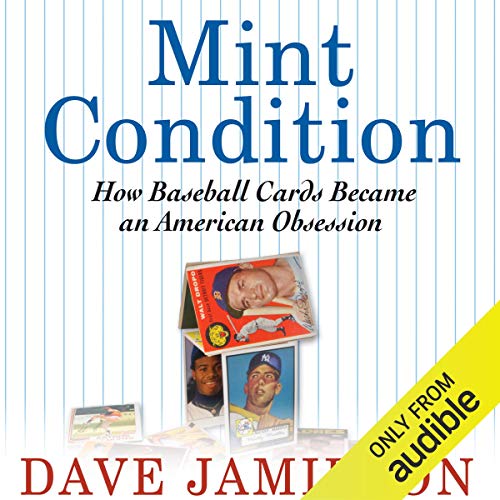
Mint Condition
Summary
When award-winning journalist Dave Jamieson's parents sold his childhood home a few years ago, he rediscovered a prized boyhood possession: his baseball card collection. Now was the time to cash in on the investments of his youth. But all the card shops had closed, and cards were selling for next to nothing online. What had happened? In Mint Condition, his fascinating, eye-opening, endlessly entertaining book, Jamieson finds the answer by tracing the complete story of this beloved piece of American childhood. Picture cards had long been used for advertising, but after the Civil War, tobacco companies started slipping them into cigarette packs as collector's items. Before long the cards were wagging the cigarettes. In the 1930s cards helped gum and candy makers survive the Great Depression. In the 1960s royalties from cards helped transform the baseball players' association into one of the country's most powerful unions, dramatically altering the game. In the '80s and '90s, cards went through a spectacular bubble, becoming a billion-dollar-a-year industry before all but disappearing, surviving today as the rarified preserve of adult collectors. Mint Condition is charming original history brimming with colorful characters, sure to delight baseball fans and collectors.
©2010 Dave Jamieson. The author would like to thank The Topps Company, Inc., and The Upper Deck Company, LLC for permission to reproduce their card images. Recorded by arrangement with Grove Atlantic, Inc. (P)2014 Audible Inc.

The Old Ball Game
Summary
In The Old Ball Game, Frank Deford, NPR sports commentator and Sports Illustrated journalist retells the story of an unusual friendship between two towering figures in baseball history.At the turn of the twentieth century, Christy Mathewson was one of baseball's first superstars. Over six feet tall, clean cut, and college educated, he didn't pitch on the Sabbath and rarely spoke an ill word about anyone. He also had one of the most devastating arms in all of baseball. New York Giants manager John McGraw, by contrast, was ferocious. The pugnacious tough guy was already a star infielder who, with the Baltimore Orioles, helped develop a new, scrappy style of baseball, with plays like the hit-and-run, the Baltimore chop, and the squeeze play. When McGraw joined the Giants in 1902, the Giants were coming off their worst season ever. Yet within three years, Mathewson clinched New York City's first World Series for McGraw's team by throwing three straight shutouts in only six days, an incredible feat that is invariably called the greatest World Series performance ever. Because of their wonderful odd-couple association, baseball had its first superstar, the Giants ascended into legend, and baseball as a national pastime bloomed.
©2005 Frank Deford (P)2013 Audible, Inc.

Tales from the Deadball Era
Summary
The Deadball Era (1901-1920) is a baseball fan's dream. Hope and despair, innocence and cynicism, and levity and hostility blended then to create an air of excitement, anticipation, and concern for all who entered the confines of a major league ballpark. Cheating for the sake of victory earned respect, corrupt ballplayers fixed games with impunity, and violence plagued the sport. At the same time, endearing practices infused baseball with lightheartedness, kindness, and laughter. Fans ran onto the field with baskets of flowers, loving cups, and cash for their favorite players in the middle of games. Ballplayers volunteered for "benefit contests" to aid fellow big leaguers and the country in times of need. "Joke games" reduced sport to pure theater as outfielders intentionally dropped fly balls, infielders happily booted easy grounders, hurlers tossed soft pitches over the middle of the plate, and umpires ignored the rules. Winning meant nothing, amusement meant everything, and league officials looked the other way. Mark Halfon highlights the strategies, underhanded tactics, and bitter battles that defined this storied time in baseball history, while providing detailed insights into the players and teams involved in bringing to a conclusion this remarkable period in baseball history.
©2014 the Board of Regents of the University of Nebraska (P)2019 Tantor

The Phenomenon
Summary
Rick Ankiel had the talent to be one of the best pitchers ever. Then, one day, he lost it. The Phenomenon is the story of how St. Louis Cardinals prodigy Rick Ankiel lost his once-in-a-generation ability to pitch - due not to an injury or a bolt of lightning but to a mysterious anxiety condition widely known as "the Yips". It came without warning in the middle of a playoff game, with millions of people watching. And it has never gone away. Yet the true test of Ankiel's character came not on the mound but in the long days and nights that followed, as he searched for a way to get back in the game. For four and a half years, he fought the Yips with every arrow in his quiver: psychotherapy, medication, deep-breathing exercises, self-help books, and, eventually, vodka. And then, after reconsidering his whole life at the age of 25, Ankiel made an amazing turnaround, returning to the Major Leagues as a hitter and playing seven successful seasons. This book is an incredible story about a universal experience - pressure - and what happened when a person on the brink had to make a choice about who he was going to be.
©2017 Rick Ankiel (P)2017 Hachette Audio

The Last Hero
Summary
In the 34 years since his retirement, Henry Aaron's reputation has only grown in magnitude: he broke existing records (rbis, total bases, extra-base hits) and set new ones (hitting at least 30 home runs per season 15 times, becoming the first player in history to hammer 500 home runs and 3,000 hits). But his influence extends beyond statistics, and at long last here is the first definitive biography of one of baseball's immortal figures. Based on meticulous research and interviews with former teammates, family members, two former presidents, and Aaron himself, The Last Hero chronicles Aaron's childhood in segregated Alabama, his brief stardom in the Negro Leagues, his complicated relationship with celebrity, and his historic rivalry with Willie Mays, all culminating in the defining event of his life: his shattering of Babe Ruths all-time home-run record. Bryant also examines Aaron's more complex second act: his quest to become an important voice beyond the ball field when his playing days had ended, his rediscovery by a public disillusioned with todays tainted heroes, and his disappointment that his career home-run record was finally broken by Barry Bonds during the steroid era, baseball's greatest scandal. Bryant reveals how Aaron navigated the upheavals of his time, fighting against racism while at the same time benefiting from racial progress and how he achieved his goal of continuing Jackie Robinsons mission to obtain full equality for African-Americans, both in baseball and society, while he lived uncomfortably in the public spotlight. Eloquently written, detailed and penetrating, this is a revelatory portrait of a complicated, private man who through sports became an enduring American icon.
©2010 Howard Bryant (P)2010 Random House

Dynastic, Bombastic, Fantastic
Summary
The Oakland A's of the early 1970s were the most transformative team in baseball history. Never before had an entire organization so collectively traumatized baseball's establishment with its outlandish behavior and business decisions - or with its indisputable winning record: five straight division titles and three straight championships. The high drama that played out on the field was exceeded only by the drama in the clubhouse and front office. But those A's, with their garish uniforms and outlandish facial hair, redefined soon virtually every aspect of the game for coming generations. Under the visionary leadership of Charles O. Finley, the team assembled such luminary figures as Reggie Jackson, Catfish Hunter, Rollie Fingers, and Vida Blue. Finley acted as his own general manager and, with an insatiable need for control, dictated everything from the playlist of the ballpark organist to the menu for the media lounge. The advent of free agency spelled the end of Finley's reign; within two years his dynasty was lost. A sprawling, brawling history of one of the game's most unforgettable teams, Dynastic, Bombastic, Fantastic is a paean to a turbulent yet magical time.
©2017 Jason Turbow (P)2017 HighBridge, a division of Recorded Books

Fall from Grace
Summary
Considered by Ty Cobb as the "finest natural hitter in the history of the game," "Shoeless Joe" Jackson is ranked with the greatest players to ever step onto a baseball diamond. With a career .356 batting average - which is still ranked third all-time - the man from Pickens County, South Carolina, was on his way to becoming one of the greatest players in the sport's history. That is until the "Black Sox" scandal of 1919, which shook baseball to its core. While many have sympathized with Jackson's ban from baseball (even though he hit .375 during the 1919 World Series), not much is truly known about this quiet slugger. Whether he participated in the throwing of the World Series or not, he is still considered one of the game's best, and many have fought for his induction into the National Baseball Hall of Fame. From the author of Turning the Black Sox White (on Charles Comiskey) and War on the Basepaths (on Ty Cobb), Shoeless Joe tells the story of the incredible life of Joseph Jefferson Jackson. From a mill boy to a baseball icon, author Tim Hornbaker breaks down the rise and fall of "Shoeless Joe," giving an inside look during baseball's Deadball Era, including Jackson's personal point of view of the "Black Sox" scandal, which has never been covered before.
©2016 Tim Hornbaker (P)2017 Brilliance Publishing, Inc., all rights reserved.

The Hall: A Celebration of Baseball's Greats
Summary
A deluxe baseball treasury unlike any other, complete with essays, photos, and player bios from The National Baseball Hall of Fame and Museum. Everyone dreams of Cooperstown. It's a hallowed name in baseball, for players as well as their fans. It's a house where legends live; it's everything that's great about the game. Never before has the National Baseball Hall of Fame and Museum published a complete registry of inductees with plaques, photographs, and extended biographies. In this unique, 75th anniversary edition, hear the stories of every player inducted into the Hall, organized by position. Each section begins with an original essay by a living Hall of Famer who played that position: Hank Aaron, George Brett, Orlando Cepeda, Carlton Fisk, Tommy Lasorda, Joe Morgan, Jim Rice, Cal Ripken Jr., Nolan Ryan, and Robin Yount.
©2014 The National Baseball Hall of Fame and Museum (P)2014 Hachette Audio

The Greatest Baseball Stories Ever Told
Summary
At a 1931 barnstorming exhibition game in Tennessee, a 17-year-old pitcher for the Chattanooga Lookouts struck out Babe Ruth and Lou Gehrig back to back. Her name was Jackie Mitchell - "organized baseball's first girl pitcher." On September 9, 1965, Sandy Koufax made baseball history by pitching his fourth perfect game. In July 1970, a stripper rushed onto the field at Riverfront Stadium to kiss Johnny Bench, temporarily disrupting a game attended by President Nixon and his family. These are just some of the great, quirky, and comic moments in the annals of baseball recorded in The Greatest Baseball Stories Ever Told. Here also are profiles of such legendary figures as Joe DiMaggio, Pete Rose, and Yogi Berra, essays that explore the complexities and pleasures of the game, even an excerpt from the movie Bull Durham. This is the perfect book for anyone who has ever played so much as a game of catch.
©2001 Jeff Silverman (P)2016 Tantor

The Iowa Baseball Confederacy
Summary
Gideon Clarke is a man on a quest. He is out to prove to the world, as his father tried before him, that the world-champion Chicago Cubs traveled to Onamata, Iowa, in the summer of 1908 for an exhibition game against all-stars from the Iowa Baseball Confederacy, an amateur league. The game, which was to be short, pleasant, and the Cubs thought, one-sided, turned into a titanic battle of over 2,000 innings, played mostly in the pouring rain. This game is not on the record books. No one remembers it or the Confederacy. But Gideon Clarke knows it happened, and he is determined to set the record straight. Like in his previous novel, Shoeless Joe, which was the basis for the movie Field of Dreams, Kinsella creates “a loving mixture of baseball, life and fantasy, in a world where dreams don't have to come true, because they have a validity all their own” (Publishers Weekly).
©1986 W.P. Kinsella (P)2000 Blackstone Audio, Inc.