The Buddhism category has 290 audiobooks on Listento.it, with an average listener rating of 4.7★ across 2,780 ratings. The most-rated is Think Like a Monk.

The Miracle of Mindfulness
Summary
In this beautiful and lucid guide, Zen master Thich Nhat Hanh offers gentle anecdotes and practical exercises as a means of learning the skills of mindfulness - being awake and fully aware. From washing the dishes to answering the phone to peeling an orange, he reminds us that each moment holds within it an opportunity to work toward greater self-understanding and peacefulness.
©1975 Thich Nhat Hanh (P)2012 Tantor

What Makes You Not a Buddhist
Summary
So you think you're a Buddhist? Think again. Tibetan Buddhist master Dzongsar Jamyang Khyentse, one of the most creative and innovative lamas teaching today, throws down the gauntlet to the Buddhist world, challenging common misconceptions, stereotypes, and fantasies. With wit and irony, Khysentse urges listeners to move beyond the superficial trappings of Buddhism - beyond the romance with beads, incense, or exotic robes - straight to the heart of what the Buddha taught.
©2007 Dzongsar Jamyang Khyentse (P)2014 Audible Inc.
Opening the Door of Your Heart
Summary
Here are modern tales of happiness, compassion and love that will both enlighten and entertain. During his wanderings and work over the last 30 years as a Buddhist monk, Ajahn Brahm has gathered many poignant, funny and profound stories. While traditional Buddhist philosophy is at the heart of this collection, these thoughtful stories are written like playful parables, which are used to launch into a deeper exploration of subjects such as mindfulness, suffering, forgiveness, hope, wisdom, and unconditional love. Told with wit and good humor, they reveal moments of compassion in the lives of ordinary people and the timeless wisdom of the Buddha's teachings.
©2004 Ajahn Brahm (P)2009 Bolinda Publishing Pty Ltd

Fail, Fail Again, Fail Better
Summary
When her granddaughter was accepted to Naropa University, the celebrated author Pema Chödrön promised that she'd speak at the commencement ceremony. Fail, Fail Again, Fail Better contains the wisdom shared on that day. "What do we do when life doesn't go the way we hoped?" begins Pema. "We say 'I'm a failure.'" But what if failing wasn't just "okay"... but the most direct way to becoming a more complete, loving, and fulfilled human being? Here, Pema Chödrön offers us her heartfelt advice on facing the unknown - in ourselves and in the world - and how our missteps can open our eyes to see new possibilities and purpose. For listeners of all faiths who are at a life crossroads, this brilliant gem of kindness and clarity is sure to earn its place in our kitchens, offices, and backpacks, ready to help us get back on our feet and into our hearts. Includes an in-depth interview with Pema Chödrön and Tami Simon.
©2015 Pema Chödrön (P)2015 Pema Chödrön

Sex, Sin, and Zen
Summary
With his one-of-a kind blend of autobiography, pop culture, and plainspoken Buddhism, Brad Warner explores an A-to-Z of sexual topics; from masturbation to dating, gender identity to pornography.
In addition to approaching sexuality from a Buddhist perspective, he looks at Buddhism - emptiness, compassion, karma - from a sexual vantage. Throughout, he stares down the tough questions: Can prostitution be "right livelihood"? Can a good spiritual master also be really, really bad? And ultimately, what's love got to do with any of it?
While no puritan when it comes to non-vanilla sexuality, Warner offers a conscious approach to sexual ethics and intimacy; real-world wisdom for our times.
©2010 Brad Warner (P)2017 Brad Warner

How to Be Sick (Second Edition)
Summary
A brand-new edition of the best-selling classic with added and updated practices. In 2001, Toni Bernhard got sick and, to her and her partner’s bewilderment, stayed that way. As they faced the confusion, frustration, and despair of a life with sudden limitations - a life that was vastly different from the one they’d thought they’d have together - Toni had to learn how to be sick. In spite of her many physical and energetic restrictions (and sometimes, because of them), Toni learned how to live a life of equanimity, compassion, and joy. This audiobook reminds us that our own inner freedom is limitless, regardless of our external circumstances. Updated with new insights and practices hard-won from Toni’s own ongoing life experience, this is a must-hear for anyone who is - or who might one day be - sick or in pain.
©2018 Toni Bernhard (P)2018 Wisdom Publications

Unconditional Confidence
Summary
Pema Chodron is one of today's leading meditation teachers. With more than one million books sold to date, she draws sold out crowds across the U.S. and Canada. On Unconditional Confidence, she offers two accessible sessions to help anyone find courage in times of challenge and change.
©2009 Pema Chodron (P)2010 Sounds True

Plaidoyer pour le Bonheur
Summary
Après le succès du Moine et le Philosophe, un vrai traité du bonheur et un guide précieux et convaincant pour nos individualismes en mal de repères... Nous aspirons tous au bonheur. Mais comment le définir, le trouver, le retenir ? À cette question, souvent traitée avec cynisme ou naïveté par la pensée occidentale, Matthieu Ricard offre la réponse du bouddhisme, exigeante, apaisante, optimiste et accessible à tous. En apprenant à chercher le bonheur non à l'extérieur de nous, mais en nous, sans se focaliser sur notre personne, et en pratiquant une approche plus méditative et altruiste du monde, il devient saisissable... Riche de sa double culture et de son expérience de moine, de rencontres avec de grands sages et de sa connaissance des textes sacrés, mais aussi de son expérience de la souffrance des hommes, l'ambassadeur du bouddhisme le plus populaire en France propose ici une réflexion prenante sur le bonheur authentique et les moyens de l'atteindre.
©2003 NiL éditions, Paris (P)2015 Audiolib

Fully Alive
Summary
We live in difficult times. Life sometimes seems like a roiling and turbulent river threatening to drown us. Why, in the face of that, shouldn't we cling for safety to the certainty of the shore - to our comfortably familiar patterns and habits? Because, Pema Chödrön teaches, that kind of fear-based clinging leads only to even greater suffering. In this recorded retreat, based on the program Living Beautifully with Uncertainty and Change held at Omega Institute, Pema Chödrön and her teaching assistant, Meg Wheatley, provide a wealth of wisdom for learning to step right into the river: to be completely, fearlessly present even in the hardest times, the most difficult situations. It's the secret of being fully alive. The teachings and practices they present includes: A teaching based on a Native American prophecy for cultivating the ability to take nothing personally A guided meditation for developing patience in the midst of irritation Tips for accessing your innate strength and confidence - simply by altering your posture
©2017 Pema Chödrön (P)2017 Random House Audio

You Are Here
Summary
This moment is the gateway to enlightenment. It is the only moment we have to be joyful, mindful, and awake. The key is to be there for yourself - to learn to be fully present in your life. This, Thich Nhat Hanh explains, is the heart of Buddhist practice. In this introduction to the practice of presence, the beloved Buddhist teacher provides indispensable insight on the essentials of Buddhist thought and offers a range of simple, everyday practices for cultivating mindfulness. These teachings empower us to witness the wonder of life and transform our suffering, both within us and around us, into compassion, tenderness, and peace - not in some long and hard struggle, but in this very moment. As Thich Nhat Hanh declares, "the energy of mindfulness is the energy of the Buddha, and it can be produced by anybody." It's as simple as breathing in and breathing out.
©2010 Thich Nhat Hanh (P)2018 Random House Audio

The Path Is The Goal
Summary
According to the Buddha, no one can attain basic sanity or enlightenment without practicing meditation. The teachings given here on the outlook and technique of meditation provide the foundation that every practitioner needs to awaken as the Buddha did. Trungpa teaches us to let go of the urge to make meditation serve our ambition; thus we can relax into openness. We are shown how the deliberate practice of mindfulness develops into contrived awareness, and we discover the world of insight that awareness reveals. We learn of a subtle psychological stage set that we carry with us everywhere and unwittingly use to structure all our experience - and we find that meditation gradually carries us beyond this and beyond ego altogether to the experience of unconditioned freedom.
©1995 Diana J. Mukpo (P)2014 Audible Inc.

How to Meditate with Pema Chodron
Summary
When it comes to meditation, Pema Chodron is widely regarded as one of the world's foremost teachers. Yet she's never offered an introductory course on audio - until now. In How to Meditate with Pema Chodron, subtitled "A Practical Guide to Making Friends with Your Mind", the American-born Tibetan Buddhist nun and best-selling author presents her first complete spoken-word course for those new to meditation. Through traditional insights and her personal guidance in 12 sitting sessions, Chodron will help you honestly meet with, and compassionately relate to, your mind as you explore: The basics of mindfulness awareness practice, from proper posture, to learning to settle, to breathing and relaxation Gentleness, patience, and humor - three ingredients for a well-balanced practice Shamatha (or calm abiding), the art of stabilizing the mind to remain present with whatever arises Thoughts and emotions as "sheer delight" - instead of obstacles - in meditation
©Pema Chodron; (P)Sounds True

Three Steps to Courage
Summary
In the midst of fear, anger, or sadness it may seem impossible to find our ground. Yet, the feelings we want to avoid the most can open the way to fearlessness, our basic goodness, and true freedom. Beloved Tibetan Buddhist teacher Pema Chödrön has a unique gift for helping those of all faiths to work with their most difficult inner and outer challenges. In this supportive series of talks, listeners will join her at her best - showing us the way back to our wisest and most heartful selves. Here, Pema shares three simple, time-honored steps to practice when we are in pain or crisis: Finding the stillness and space within our inner storms so that we can act rather than react Using all of our felt experiences - positive and negative - as a direct path not only to immediate relief, but to real courage, nurtured through compassion Transforming our emotions and welcoming them as friends The feelings that we want to run from, Pema tells us, offer us the very fuel we need to grow our strength and self-acceptance. With Three Steps to Courage, you will learn how to do just that - with welcome support and inspiration along the way. Program Highlights Session 1: Refraining from Emotional Reactivity The three steps to courage Guided Practice: Feeling Our Feelings Facing debilitating insecurity and feeling with kindness "Recognition" and the ability to refrain Releasing our storylines and softening into experience Emotions and intimacy Session 2: Emotions as Paths of Awakening Melting the ice cube: becoming intimate with your experience The mindful gap, letting go, and clear seeing Q&A topics: holding space, recognizing wisdom, empathy, and basic goodness Session 3: Transforming Emotions Working with grief and loneliness Courage, ignorance, and the "qualities" game Cultivating spaciousness with tonglen practice Q&A topics: karmic seeds, shenpa, patience, loneliness, optimism, regret, virtue, and the healing power of love PLEASE NOTE: When you purchase this title, the accompanying PDF will be available in your Audible Library along with the audio.
©2020 Pema Chödrön (P)2020 Sounds True

Training the Mind
Summary
Warning: Using this book could be hazardous to your ego! The slogans it contains are designed to awaken the heart and cultivate love and kindness toward others. They are revolutionary in that practicing them fosters abandonment of personal territory in relating to others and in understanding the world as it is. The 59 provocative slogans presented here - each with a commentary by the Tibetan meditation master Chgyam Trungpa - have been used by Tibetan Buddhists for eight centuries to help meditation students remember and focus on important principles and practices of mind training. They emphasize meeting the ordinary situations of life with intelligence and compassion under all circumstances. Slogans include, "Don't be swayed by external circumstances," "Be grateful to everyone," and "Always maintain only a joyful mind. "This edition contains a new foreword by Pema Chodron.
©1993 Diana J. Mukpo (P)2014 Audible Inc.

The Ultimate Happiness Prescription
Summary
Happiness is something everyone desires. Yet how to find happiness - or even if we deserve to - remains a mystery. Still more mysterious is the secret to a lasting happiness that cannot be taken away. In The Ultimate Happiness Prescription, best-selling author Deepak Chopra shows us seven keys to uncover the true secrets of joy in the most difficult times. The goal of life is the expansion of happiness, he contends. But in today's demanding world, that goal seems elusive, if not impossibly out of reach. Society reinforces the belief that fulfillment comes from achieving success, wealth, and good relationships. Yet Chopra tells us that the opposite is true: all success in life is the by-product of happiness, not the cause. So what is the cause? The Ultimate Happiness Prescription shares spiritual principles for a life based on a sense of your "true self" lying beyond the ebb and flow of daily living. Simple daily exercises lead to eliminating the root causes of unhappiness and letting a deeper level of bliss unfold. After all avenues to happiness have been explored and exhausted, only one path is left: the journey to enlightenment. In The Ultimate Happiness Prescription, the daunting and exotic challenge of finding enlightenment becomes accessible step by step. We are taken on an inspiring journey to the true self, the only place untouched by trouble and misfortune. On the way we learn the secrets for living mindfully and with effortless spontaneity. Now happiness is no longer hostage to external events but an experience we carry with us always. As Chopra inspiringly concludes, "Everything we fear in the world and want to change can be transformed through happiness, the simplest desire we have, and also the most profound."
©2009 Deepak Chopra (P)2009 Random House

Liberation Upon Hearing in the Between
Summary
One of the 25 most influential people in America according to Time magazine, and "the leading American expert on Tibetan Buddhism" ( The New York Times), Robert Thurman illuminates the Tibetan Book of the Dead with up-to-date insights for modern audiences. For centuries, this text has been read aloud to the dying, who Buddhist masters say are capable of hearing up to three days after clinical death, as a guide through the tumultuous and often terrifying process of dissolution. Now, in Liberation Upon Hearing in the Between, Professor Robert Thurman demystifies this esoteric teaching and reveals the Tibetan view of dying: it is not an ending to be feared, but a wondrous and liberating culmination of our life's journey, potentially opening into glorious new beginnings. Entering the bardo, the in-between state in which one reality dissolves and the next has not yet formed, we need not become prey to our fears and hopes. Instead, we can relax into our natural clarity and stabilize the journey. And this treasured teaching is for much more than just changing our understanding of death. Whether we have lost a dear relationship, awoken from a dream, or face the loss of our bodied life, simply hearing these teachings steadies our minds and hearts so that the journey from one state to the next changes from a tragic voyage into a clear adventure through the brilliant sky of great liberation.
©2005 Robert Thurman (P)2005 Sounds True
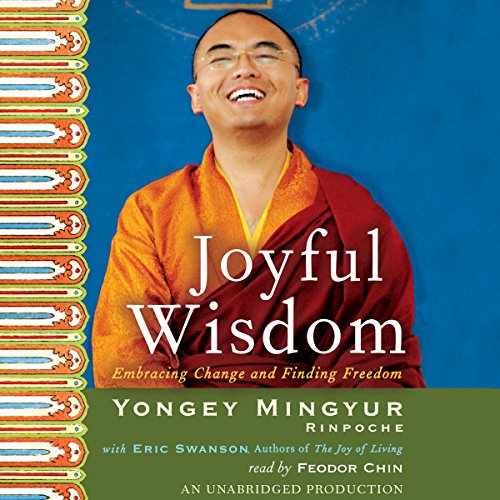
Joyful Wisdom
Summary
Yongey Mingyur is one of the most celebrated among the new generation of Tibetan meditation masters, whose teachings have touched people of all faiths around the world. His first book, The Joy of Living, was a New York Times best seller hailed as "compelling, readable, and informed" ( Buddhadharma) and praised by Richard Gere, Lou Reed, and Julian Schnabel for its clarity, wit, and unique insight into the relationship between science and Buddhism. His new book, Joyful Wisdom, addresses the timely and timeless problem of anxiety in our everyday lives. "From the 2,500-year-old perspective of Buddhism," Yongey Mingyur writes, "every chapter in human history could be described as an 'age of anxiety.' The anxiety we feel now has been part of the human condition for centuries." So what do we do? Escape or succumb? Both routes inevitably lead to more complications and problems in our lives. "Buddhism," he says, "offers a third option. We can look directly at the disturbing emotions and other problems we experience in our lives as stepping-stones to freedom. Instead of rejecting them or surrendering to them, we can befriend them, working through them to reach an enduring authentic experience of our inherent wisdom, confidence, clarity, and joy." Divided into three parts like a traditional Buddhist text, Joyful Wisdom identifies the sources of our unease, describes methods of meditation that enable us to transform our experience into deeper insight, and applies these methods to common emotional, physical, and personal problems. The result is a work at once wise, anecdotal, funny, informed, and graced with the author's irresistible charm.
©2009 Yongey Mingyur (P)2009 Random House

Sit Down and Shut Up
Summary
In Sit Down and Shut Up, Brad Warner tackles one of the great works of Zen literature, the Shobogenzo by 13th century Zen master Dogen. Illuminating Dogen's enigmatic teachings in plain language, Warner intertwines sharp philosophical musings on sex, evil, anger, meditation, enlightenment, death, God, sin, and happiness with an exploration of the power and pain of the punk rock ethos. Riffing on his triumphant return to Ohio for a reunion concert of Akron punk bands, Brad uncovers the real heart of Zen, in teachings and stories with a sharp smack of truth.
©2007 Brad Warner (P)2014 Brad Warner

The Undefeated Mind
Summary
Legions of self-help authors rightly urge personal development as the key to happiness, but they typically fail to focus on its most important objective: hardiness. Though that which doesn't kill us can make us stronger, as Nietzsche tells us, few authors today offer any insight into just how to springboard from adversity to strength. It doesn't just happen automatically, and it takes practice. New scientific research suggests that resilience isn't something with which only a fortunate few of us have been born, but rather something we can all take specific action to develop. To build strength out of adversity, we need a catalyst. What we need, according to Dr. Alex Lickerman, is wisdom - wisdom that adversity has the potential to teach us. Lickerman's underlying premise is that our ability to control what happens to us in life may be limited, but we have the ability to establish a life-state to surmount the suffering life brings us. The Undefeated Mind distills the wisdom we need to create true resilience into nine core principles, including: A new definition of victory and its relevance to happiness The concept of the changing of poison into medicine A way to view prayer as a vow we make to ourselves. A method of setting expectations that enhances our ability to endure disappointment and minimizes the likelihood of quitting An approach to taking personal responsibility and moral action that enhances resilience A process for managing pain - both physical and emotional - that enables us to push through obstacles that might otherwise prevent us from attaining our goals A method of leveraging our relationships with others that helps us manifest our strongest selves Through stories of patients who have used these principles to overcome suffering caused by unemployment, unwanted weight gain, addiction, rejection, chronic pain, retirement, illness, loss, and even death, Dr. Lickerman shows how we too can make these principles function within our own lives, enabling us to develop for ourselves the resilience we need to achieve indestructible happiness. At its core, The Undefeated Mind urges us to stop hoping for easy lives and focus instead on cultivating the inner strength we need to enjoy the difficult lives we all have.
©2012 Alex Lickerman (P)2013 Audible, Inc.

Buddhist Tantra
Summary
"Within my body are all the sacred places of the world," the Buddhist saint Saraha once said, "and the most profound pilgrimage that I can ever make is within my own body." For 15 centuries the realized masters of the tantric path used the crucible of their own lives to develop a powerful and accelerated means to enlightenment. Today these teachings remain alive within the usually hidden inner courtyard of the Vajrayana vehicle of Tibetan Buddhism, a tradition that requires the courage to engage your body, your human desires, and your most challenging life obstacles as the basic fuel for insight. Now, with Buddhist Tantra, esteemed teacher Reggie Ray introduces you to these precious teachings and invites you to explore the path to naked and unprecedented experience. The popular or exoteric teachings of Buddhism are known to many, yet its esoteric teachings remain relatively unknown in the West. If you have been seeking a gateway to this potent tradition, Buddhist Tantra is an unsurpassed opportunity to enter into the temple of its deepest truths. Entering the Vajra World Through the Vehicle of Your Body The word tantra means "to weave through", a metaphor that points to the vibrant fabric of intelligent and living energies that make up the essence of every cell of your body, every fleeting thought you have, and every particle of the universe. Entering this undefiled and ever-renewing vajra world is the promise of the tantric path.
©2007 Reginald A. Ray (P)2007 Reginald A. Ray