The Europe category has 561 audiobooks on Listento.it, with an average listener rating of 4.3★ across 1,762 ratings. The most-rated is Clanlands.

Clanlands
Summary
A road trip book with a difference. Stars of Outlander - Sam Heughan and Graham McTavish - explore Scotland, a land of raw beauty, poetry, feuding, music, history and warfare. Narrated by Sam Heughan and Graham McTavish, with a foreword written and read by Diana Gabaldon. From their faithful camper-van to boats, kayaks, bicycles and motorbikes, join stars of Outlander Sam and Graham on a road trip with a difference. Unlikely friends Sam and Graham begin their journey in the heart of Scotland at Glencoe and travel from there all the way to Inverness and Culloden battlefield, where along the way they experience adventure and a cast of highland characters. In this story of friendship, finding themselves and whisky, they discover the complexity, rich history and culture of their native country. PLEASE NOTE: When you purchase this title, the accompanying PDF will be available in your Audible Library along with the audio.
©2020 Diana Gabaldon, Graham McTavish, Sam Heughan (P)2020 Hodder & Stoughton Limited

The Year of Living Danishly
Summary
When she was suddenly given the opportunity of a new life in rural Jutland, journalist and archetypal Londoner Helen Russell discovered a startling statistic: the happiest place on earth isn't Disneyland but Denmark, a land often thought of by foreigners as consisting entirely of long, dark winters, cured herring, Lego and pastries. What is the secret to their success? Are happy Danes born or made? Helen decides there is only one way to find out: she will give herself a year, trying to uncover the formula for Danish happiness. From child care, education, food and interior design to SAD, taxes, sexism and an unfortunate predilection for burning witches, The Year of Living Danishly is a funny, poignant record of a journey that shows us where the Danes get it right, where they get it wrong, and how we might just benefit from living a little more Danishly ourselves. Helen Russell is a journalist and former editor of MarieClaire.co.uk. She now lives in rural Jutland and works as a Scandinavia correspondent for the Guardian as well as writing a column on Denmark for the Telegraph.
©2015 Helen Russell (P)2015 Audible, Ltd

Witch: A Tale of Terror
Summary
For centuries in Europe, innocent men and women were murdered for the imaginary crime of witchcraft. This was a mass delusion and moral panic, driven by pious superstition and a deadly commitment to religious conformity. In Witch: A Tale of Terror, best-selling author Sam Harris introduces and reads from Charles Mackay's beloved book Extraordinary Popular Delusions and the Madness of Crowds.
Public Domain (P)2016 Sam Harris

The Plantagenets: The Kings Who Made England
Summary
This brilliant new audiobook explores the lives of eight generations of the greatest kings and queens that this country has ever seen, and the worst. The Plantagenets - their story is the story of Britain. England’s greatest royal dynasty, the Plantagenets, ruled over England through eight generations of kings. Their remarkable reign saw England emerge from the Dark Ages to become a highly organised kingdom that spanned a vast expanse of Europe. Plantagenet rule saw the establishment of laws and creation of artworks, monuments and tombs which survive to this day, and continue to speak of their sophistication, brutality and secrets. Dan Jones brings you a new vision of this battle-scarred history. From the Crusades to King John’s humbling over Magna Carta and the tragic reign of the last Plantagenet, Richard II, this is a blow-by-blow account of England’s most thrilling age.
©2019 Dan Jones (P)2019 HarperCollins Publishers Limited

The Celtic World
Summary
Following the surge of interest and pride in Celtic identity since the 19th century, much of what we thought we knew about the Celts has been radically transformed. From the warriors who nearly defeated Julius Caesar to druids who, contrary to popular opinion, definitely did not worship at Stonehenge, get to know the real Celts. In The Celtic World, discover the incredible story of the Celtic-speaking peoples, whose art, language, and culture once spread from Ireland to Austria. This series of 24 enlightening lectures explains the traditional historical view of who the Celts were, then contrasts it with brand-new evidence from DNA analysis and archeology that totally changes our perspective on where the Celts came from. European history and culture have been profoundly affected by the Celts, from the myth of King Arthur to the very map of the United Kingdom, where the English confronted the peoples of the "Celtic Fringe." With a wealth of historical expertise, Professor Jennifer Paxton (PhD Harvard University), Director of the University Honors Program and Clinical Assistant Professor of History at The Catholic University of America, guides you through each topic related to Celtic history with approachability and ease as you unearth what we once thought it meant - and what it may actually mean - to be Celtic. Professor Paxton's engaging, often humorous delivery blends perfectly with the facts about the Celts to uncover surprising historical revelations. The ancient Celts are very much alive in the literary and artistic traditions that their descendants have both preserved and very deliberately revived. All facets of Celtic life, past and present, are addressed by Professor Paxton, who demonstrates a masterful knowledge and carefully separates fact from myth at every turn. Come along for a ride through history to discover your inner Celt. PLEASE NOTE: When you purchase this title, the accompanying reference material will be available in your Library section along with the audio.
©2018 The Great Courses (P)2018 The Teaching Company, LLC

The Six Wives of Henry VIII
Summary
This acclaimed best seller from popular historian Alison Weir is a fascinating look at the Tudor family dynasty and its most infamous ruler. The Six Wives of Henry VIII brings to life England’s oft-married monarch and the six wildly different but equally fascinating women who married him. Gripping from the first sentence to the last and loaded with fascinating details, Weir’s rich history is a perfect blend of scholarship and entertainment.
©1991 Alison Weir (P)2002 Recorded Books
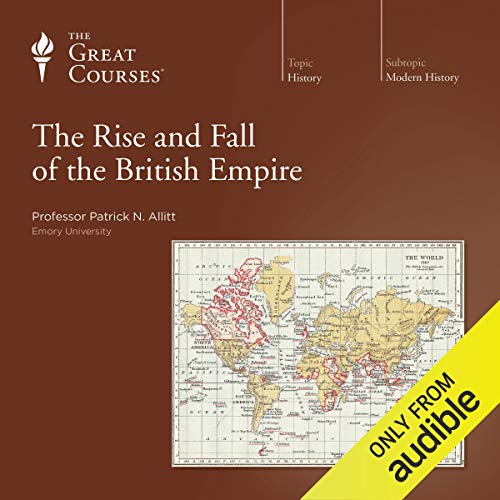
The Rise and Fall of the British Empire
Summary
What were the forces that thrust the British Empire to its extraordinary position of greatness and then just as powerfully drove it into decline? And why is nearly every nation on earth, in one way or another, the consequence of the British Empire? In these 36 lectures, Professor Allitt leads you through four centuries of British power, innovation, influence, and, ultimately, diminishment - four profound centuries that literally remade the world and bequeathed the complex global legacy that continues to shape your everyday life. This is a remarkable lecture series; one that will give you fresh insights into world history in a wide range of areas - political, economic, technological, social, and more. And it will also give you a comprehensive overview you won't find offered anywhere else - a context into which you can integrate new knowledge about this country, as well as understand the background of current events in so many other countries that were once part of Britain's empire, from Ireland to China, and in Africa and the Caribbean. Indeed, it seems fair to say that one cannot truly understand the most important aspects of world history without a firm grasp of the history of the British Empire. In giving you that grasp, these lectures draw on a vast range of critical events, riveting personalities, revealing anecdotes, and eloquent quotations. Compelling, comprehensive, and astonishing in the force of its narrative power, each lecture will give you a refreshing new understanding of what made the British Empire both great in its achievements and vulnerable to its eventual downfall. PLEASE NOTE: When you purchase this title, the accompanying reference material will be available in your Library section along with the audio.
©2009 The Teaching Company, LLC (P)2009 The Great Courses

The Time Traveller's Guide to Medieval England
Summary
Imagine you could travel back to the 14th century. What would you see? What would you smell? More to the point, where are you going to stay? And what are you going to eat? Ian Mortimer shows us that the past is not just something to be studied; it is also something to be lived. He sets out to explain what life was like in the most immediate way, through taking you to the Middle Ages. The result is the most astonishing social history book you are ever likely to read: evolutionary in its concept, informative and entertaining in its detail, and startling for its portrayal of humanity in an age of violence, exuberance and fear.
©2008 Ian Mortimer (P)2009 Isis Publishing Ltd

The Road to Little Dribbling
Summary
A loving and hilarious - if occasionally spiky - valentine to Bill Bryson’s adopted country, Great Britain. Prepare for total joy and multiple episodes of unseemly laughter. Twenty years ago, Bill Bryson went on a trip around Britain to discover and celebrate that green and pleasant land. The result was Notes from a Small Island, a true classic and one of the best-selling travel books ever written. Now, he has traveled about Britain again, by bus and train and rental car and on foot, to see what has changed - and what hasn’t. Following (but not too closely) a route he dubs the Bryson Line, from Bognor Regis in the South to Cape Wrath in the North, by way of places few travelers ever get to at all, Bryson rediscovers the wondrously beautiful, magnificently eccentric, endearingly singular country that he both celebrates and, when called for, twits. With his matchless instinct for the funniest and quirkiest and his unerring eye for the idiotic, the bewildering, the appealing, and the ridiculous, he offers acute and perceptive insights into all that is best and worst about Britain today. Nothing is more entertaining than Bill Bryson on the road - and on a tear. The Road to Little Dribbling reaffirms his stature as a master of the travel narrative - and a really, really funny guy.
©2016 Bill Bryson (P)2016 Random House Audio

The History of the Renaissance World
Summary
A lively and fascinating narrative history about the birth of the modern world. Beginning in the heady days just after the First Crusade, this volume - the third in the series that began with The History of the Ancient World and The History of the Medieval World - chronicles the contradictions of a world in transition. Popes continue to preach crusade, but the hope of a Christian empire comes to a bloody end at the walls of Constantinople. Aristotelian logic and Greek rationality blossom while the Inquisition gathers strength. As kings and emperors continue to insist on their divine rights, ordinary people all over the world seize power: the lingayats of India, the Jacquerie of France, the Red Turbans of China, and the peasants of England. New threats appear, as the Ottomans emerge from a tiny Turkish village and the Mongols ride out of the East to set the world on fire. New currencies are forged, new weapons invented, and world-changing catastrophes alter the landscape: the Little Ice Age and the Great Famine kill millions; the Black Death, millions more. In the chaos of these epoch-making events, our own world begins to take shape. Impressively researched and brilliantly told, The History of the Renaissance World offers not just the names, dates, and facts but the memorable characters who illuminate the years between 1100 and 1453 - years that marked a sea change in mankind's perception of the world. PLEASE NOTE: When you purchase this title, the accompanying reference material will be available in your My Library section along with the audio.
©2013 Susan Wise Bauer (P)2013 Audible, Inc.

A History of Russia: From Peter the Great to Gorbachev
Summary
It's difficult to imagine a nation with a history more compelling for Americans than Russia. Before the collapse of the Soviet Union, this was the nation against which we measured our own nation's values and power and with whom war, if it ever came, could spell unimaginable catastrophe for our planet. Yet many Americans have never had the opportunity to study Russia in depth, and to see how the forces of history came together to shape a future so different from the dreams of most ordinary Russian people, eager to see their nation embrace Western values of progress, human rights, and justice. Now a much-honored teacher has created a series of 36 lectures designed to give you one of the deepest glimpses into Russia you've ever had - a vivid journey through 300 years of Russian history as seen through the eyes of her own people. You'll discover historical themes made clear not by discussing treaties, war declarations, or economic statistics - but by examining the lives and ideas of the men and women who were Russia: tsars, emperors, Communist Party leaders, writers, artists, peasants, and factory workers. You'll grasp what Russian life was like as Professor Steinberg analyzes ideas of power not only from the viewpoint of its rulers, but also from that of the ruled; the theme of happiness and its pursuit that resonates throughout Russian history, and ideas of morality and ethics as wielded by both the Russian state and its critics. And you'll listen as he brings alive the vibrant Russian imagination - so willing to visualize a different kind of life for its people, yet so burdened by its darker sides of doubt and pessimism that those visions were rejected. PLEASE NOTE: When you purchase this title, the accompanying reference material will be available in your Library section along with the audio.
©2003 The Teaching Company, LLC (P)2003 The Great Courses

The Italian Renaissance
Summary
The effects of the Italian Renaissance are still with us today, from the incomparable paintings of Leonardo da Vinci to the immortal writings of Petrarch and Machiavelli. But why was there such an artistic, cultural, and intellectual explosion in Italy at the start of the 14th century? Why did it occur in Italy? And why in certain Italian city-states such as Florence? Professor Bartlett probes these questions and more in 36 dynamic lectures. This is your opportunity to appreciate the results of the Italian Renaissance and gain an understanding of the underlying social, political, and economic forces that made such exceptional art and culture possible. At the heart of Renaissance Italy were the city-states, home to the money, intellect, and talent needed for the growth of Renaissance culture. You'll look at the Republic of Florence, as well as other city-states that, thanks to geographical and historical circumstances, had much different political and social structures. This course contains a wealth of details that will give you a feel and appreciation for the Italian Renaissance - its contributions to history, the ways it was similar and dissimilar to our times, and how the people of the time, both famous and ordinary, experienced it. You'll come away surprised by how much of our modern life was made possible by the Renaissance. Our concept of participatory government, our belief in the value of competition, our philosophy of the content and purpose of education, even our notions of love all have roots in the Renaissance period. Its loftiest ideals - the importance of the individual, the value of human dignity and potential, and the promotion of freedom - are ones we embrace as our own. PLEASE NOTE: When you purchase this title, the accompanying reference material will be available in your Library section along with the audio.
©2005 The Teaching Company, LLC (P)2005 The Great Courses

The Hollow Crown
Summary
The 15th century saw the crown of England change hands seven times as the great families of England fought to the death for power, majesty and the right to rule. The Hollow Crown completes Dan Jones' epic history of medieval England, and describes how the Plantagenets tore themselves apart to be finally replaced by the Tudors. Some of the greatest heroes and villains in British history were thrown together in these turbulent times: Henry V, whose victory at Agincourt and prudent rule at home marked the high point of the medieval monarchy; Edward IV, who was handed his crown by the scheming soldier Warwick the Kingmaker, before their alliance collapsed into a fight to the death; and the last Plantagenet, Richard III, who stole the throne and murdered his own nephews, the Princes in the Tower. Finally, the Tudors arrived - but even their rule was only made certain in the 1520s, when Henry VIII ruthlessly hunted down his family's last remaining enemies. In the midst this tumult, chivalry was reborn, the printing press arrived and the Renaissance began to flourish. With vivid descriptions of the battle of Towton, where 28,000 men died in a single morning, and the Battle of Bosworth Field, at which Richard III was hacked down, this is the real story behind Shakespeare's famous history plays.
©2014 Dan Jones (P)2018 Audible, Ltd

The Late Middle Ages
Summary
The Late Middle Ages - the two centuries from c. 1300 to c. 1500 - might seem like a distant era, but students of history are still trying to reach a consensus about how it should be interpreted. Was it an era of calamity or rebirth? Was it still clearly medieval or the period in which humanity took its first decisive steps into modernity? These 24 provocative lectures introduce you to the age's major events, personalities, and developments, and arms you with the essentials you need to form your own ideas about this age of extremes - an age that, according to Professor Daileader, "experiences disasters and tragedies of such magnitude that those who survive them cannot remember the like, and doubt that subsequent generations will be capable of believing their descriptions. "You'll look at the Black Death, the carnage of frequent wars, and the religious turmoil we associate with the Middle Ages." But you'll also look at the beginning of the intellectual and cultural movement known as Humanism, which planted the seeds of modernity. Humanism's precepts, which hearkened back to the moral inspiration inherent in classical artistic values, humans have an enormous capacity for goodness, for creativity, even for the achievement of happiness. But these were hardly the only forces that tug modern-day historians in multiple directions. The Middle Ages was also a period when the persisting legacy of knights, serfs, and castles coexisted with the cannons and muskets newly made possible by gunpowder. With so many contradictions, it's no wonder that historians have differed widely on how to judge this era-debating even when it ended and modernity began. PLEASE NOTE: When you purchase this title, the accompanying reference material will be available in your Library section along with the audio.
©2007 The Teaching Company, LLC (P)2007 The Great Courses

The Long 19th Century: European History from 1789 to 1917
Summary
Few periods of history offer such captivating complexity as Europe in the long 19th century between 1789 and 1914. From the idealism of the French Revolution to the power of the Industrial Revolution to the chaos of World War I, this fascinating whirl of events, personalities, and forces formed the foundation for the modern world. Over the course of 36 engaging lectures Professor Weiner leads you on a spirited journey across an ever-changing European landscape, examining the forces and personalities that reshaped the continent's physical borders, diplomatic relationships, and balance of power. Assuming no prior knowledge of this era and no professional vocabulary, he explores this turbulent and important era with interest, curiosity, and passion. You'll look at what the transition to modernity meant for peasants, workers, the middle class, aristocrats, women, and minorities. And you'll consider the political and diplomatic moves of the great powers - Great Britain, France, Germany, Austria-Hungary, Russia, and Italy - in the context of the deeper economic, social, and cultural forces at work and how they reflect the impact of some of history's most significant names, including Napoleon Bonaparte, Otto von Bismarck, and Kaiser Wilhelm II. With this ambitious look at the evolution of the environment that ultimately made World War I possible, Professor Weiner explores more than factual history - the dates, battles, and treaties. He repeatedly steps back from on-the-ground events to clarify historical trends or patterns, providing a comprehensive look at this engaging era. PLEASE NOTE: When you purchase this title, the accompanying reference material will be available in your Library section along with the audio.
©2005 The Teaching Company, LLC (P)2005 The Great Courses

King Arthur: History and Legend
Summary
The saga of King Arthur and his court is the most enduringly popular mythic tradition of Western civilization. For over 1,500 years, the Arthurian narrative has enthralled writers, artists, and a limitless audience spanning the Western world and beyond - and its appeal continues unabated in our time. No other heroic figure in literature compares with King Arthur in terms of global popularity and longevity; now, each year sees literally thousands of new versions of the story appear across diverse media, from fiction writing and visual arts to film and popular culture. Delve into the historical mystery behind the figure of Arthur, and discover the magnificent breadth of these epic tales. These 24 spellbinding lectures reveal the full scope of the Arthurian tradition, from its beginnings in post-Roman Britain to its extraordinary trajectory across the centuries and its latest incarnations in modern times. Your pathfinder in this world of mythic adventure and romance, Professor Armstrong, is one of the world's leading Arthurian scholars and the current editor-in-chief of the academic journal Arthuriana. Demonstrating both encyclopedic knowledge and an infectious passion for the subject, she leads you in tracing how the myth developed across time, clarifying many misunderstood aspects of the narrative, such as the origins of the Round Table and the figure of Merlin, the illicit love between Lancelot and Guenevere, and the varied manifestations of the magical Holy Grail. You'll discover how the legend was appropriated and assimilated by differing cultures, and how each writer and artist in the tradition reflected and commented, through the Arthurian narrative, on the concerns of their own time and place. The result is an illuminating look at one of the most engaging, entertaining, and influential legendary traditions the world has ever known. PLEASE NOTE: When you purchase this title, the accompanying reference material will be available in your Library section along with the audio.
©2015 The Great Courses (P)2015 The Teaching Company, LLC

Battle of Brothers
Summary
A New York Times best seller From best-selling author and historical consultant to the award-winning Netflix series The Crown, an unparalleled insider account of tumult, secrecy, and schism in the royal family. The world has watched Prince William and Prince Harry since they were born. Raised by Princess Diana to be the closest of brothers, how have the boy princes grown into very different, now distanced men? From royal insider, biographer, and historian Robert Lacey, this book reveals the untold details of William and Harry’s closeness and estrangement, asking what happens when two sons are raised for vastly different futures - one burdened with the responsibility of one day becoming king, the other with the knowledge that he will always remain spare. How have William and Harry both agreed and diverged in their views of what a modern royal owes to their country? Were the seeds of damage sowed by Prince Charles and Princess Diana as their marriage unraveled for all the world to see? In the previous generation, how have Prince Charles and Prince Andrew’s own relations strained under the crown? What role has Queen Elizabeth II played in marshaling her feuding heirs? What parts have Kate Middleton and Meghan Markle played in helping their husbands to choose their differing paths? And what is the real, unvarnished story behind Harry and Meghan’s dramatic departure? In the most intimate vision yet of life behind closed doors, with its highs, lows, and discretions all laid out, this is a journey into royal life as never offered before.
©2020 Robert Lacey (P)2020 HarperCollins Publishers

A History of England from the Tudors to the Stuarts
Summary
During the 229-year period from 1485 to 1714, England transformed itself from a minor feudal state into what has been called "the first modern society" and emerged as the wealthiest and most powerful nation in the world. Those years hold a huge and captivating story. The English survived repeated epidemics and famines, one failed invasion and two successful ones, two civil wars, a series of violent religious reformations and counter-reformations, and confrontations with two of the most powerful monarchs on Earth, Louis XIV of France and Philip II of Spain. But they did much more than survive. They produced a great culture, giving the world the ideas of John Locke, the plays of Shakespeare, the wit of Swift, the poetry of Milton, the buildings of Christopher Wren, the science of Isaac Newton, and the King James Bible, to name a very few. And, despite the cruelty, bloodshed, and religious suppression they visited upon so many, they ultimately left behind something else: the political principles and ideals for which we-and so many of them - would work and die, and on which we would build our own nation. Now you can watch this remarkable panorama of society, economics, religion, and politics unfold in a series of 48 transfixing lectures by a justifiably honored teacher who takes you into the lives of not only Britain's ruling royal houses, but the English people themselves, describing how they were born, worked, played, worshiped, fell in love, and died. Cinematic in their presentation and detail - whether describing the likely thoughts of Charles I on the way to his execution or the overheard weeping of Queen Anne after she fired her Lord Treasurer - these lectures are as memorable as the history they describe. PLEASE NOTE: When you purchase this title, the accompanying reference material will be available in your Library section along with the audio.
©2003 The Teaching Company, LLC (P)2003 The Great Courses

A History of Eastern Europe
Summary
Eastern Europe has long been thought of as the "Other Europe", a region rife with political upheaval, shifting national borders, an astonishing variety of ethnic diversity, and relative isolation from the centers of power in the West. It has also been, and continues to be, pivotal in the course of world events. A History of Eastern Europe offers a sweeping 1,000-year tour with a particular focus on the region's modern history. In 24 insightful lectures, you'll observe waves of migration and invasion, watch empires rise and fall, witness wars and their deadly consequences - and come away with comprehensive knowledge of one of the world's most fascinating places. In examining this region's remarkable diversity and contested borders, you'll better understand the ever-present tension between the connections between East and West and the areas of marked contrast. These disparities were clear as the world globalized and the US and Soviet superpowers jockeyed for spheres of influence - epitomized by the imposition of the Iron Curtain across Europe and the rise of the Berlin Wall. And yet, throughout the 20th century and into current times, the connectedness of Eastern Europe to the rest of the world continues to be demonstrated beyond question. This region has made itself felt across the globe through: The political and cultural reverberations of peace movements and armed conflicts The crises of huge population migrations and the new expressions of cultural and economic exchange they spark The successes and struggles of NATO and the European Union And more Explore the grand sweep of this epic history, from a series of early invasions to the rise of empires to the collapse of communism and into the new challenges of the 21st century. Meet brilliant poets, writers, artists, and other cultural figures who made an impact on Eastern European history. PLEASE NOTE: When you purchase this title, the accompanying reference material will be available in your Library section along with the audio.
©2015 The Great Courses (P)2015 The Teaching Company, LLC

Europe
Summary
Here is a masterpiece of historical narrative that stretches from the Ice Age to the Atomic Age, as it tells the story of Europe, East and West. Norman Davies captures it all - the rise and fall of Rome, the sweeping invasions of Alaric and Atilla, the Norman Conquests, the Papal struggles for power, the Renaissance and the Reformation, the French Revolution and the Napoleonic Wars, Europe's rise to become the powerhouse of the world, and its eclipse in our own century, following two devastating World Wars. This is the first major history of Europe to give equal weight to both East and West, and it shines light on fascinating minority communities, from heretics and lepers to Gypsies, Jews, and Muslims. It also takes an innovative approach, combining traditional narrative with unique features that help bring history alive: 299 time capsules scattered through the narrative capture telling aspects of an era, and 12 snapshots offer a panoramic look at all of Europe at a particular moment in history. All told, Davies's Europe represents one of the most important and illuminating histories to be published in recent years. PLEASE NOTE: When you purchase this title, the accompanying PDF will be available in your Audible Library along with the audio.
©1996, 1997 Norman Davies (P)2019 Tantor