The Military category has 1,612 audiobooks on Listento.it, with an average listener rating of 4.6★ across 5,283 ratings. The most-rated is The Rise and Fall of the Third Reich.

Andersonville Diary
Summary
Almost 10 times as many men died in the Civil War prison camps of the North and South as were killed at the Battle of Gettysburg. One such camp was Andersonville, where Union soldiers like Brigade Quartermaster John L. Ransom of the Ninth Michigan Cavalry, were subjected to hunger, disease, cruelty, and despair. Captured in November 1863, Ransom kept his spirits and courage up enough to survive and record this compelling true account of his experiences.
Public Domain (P)1999 Recorded Books

The Winter War: A Captivating Guide to the Russo-Finnish War Between Finland and the Soviet Union
Summary
If you want to discover the captivating history of the Winter War, then pay attention.... In December 1940, British Prime Minister Winston Churchill made a speech about a conflict that had some leading figures in Britain and France, including Churchill himself, briefly discussing the idea of going to war with the Soviet Union, even though they were already fighting Adolf Hitler. Of course, war makes strange bedfellows, and one year later, Churchill would find himself allied with the Soviet Union against Germany and Finland. It’s an interesting saga, one with roots in imperial Russian history and the desire of the Finns to be free in their northern forests. In The Winter War: A Captivating Guide to the Russo-Finnish War between Finland and the Soviet Union, you will discover topics such as The Grand Duchy of Finland The Finnish Civil War Between a rock and a hard place The Red Menace Negotiations, “refresher training,” and the balance of forces The Greatest Finn of all time Hell in the snow And much, much more! So if you want to learn more about the Winter War, scroll up and click the "add to cart" button!
©2020 Captivating History (P)2020 Captivating History

Days of Valor
Summary
During the War, Vietnam's coast had to be protected against Viet Cong ambushes and smuggling. The U.S. forces had destroyers, cruisers and gargantuan aircraft carriers, none suited for inshore patrol. This is the story of the Brown Water Navy, the garage-band flotilla assembled to do the job. Douglas Branson has been to Vietnam several times, including trips in 1966, 1995 and 2011. The first time, he was a 22-year-old, Brown Water Navy lieutenant JG. Subsequent visits were as a consultant/tourist. Here, Branson recounts three of his Vietnam adventures with humor, detail and insight into the economic, political and gastronomic forces at work.
©2007 Robert L. Tonsetic (P)2013 Audible, Inc.
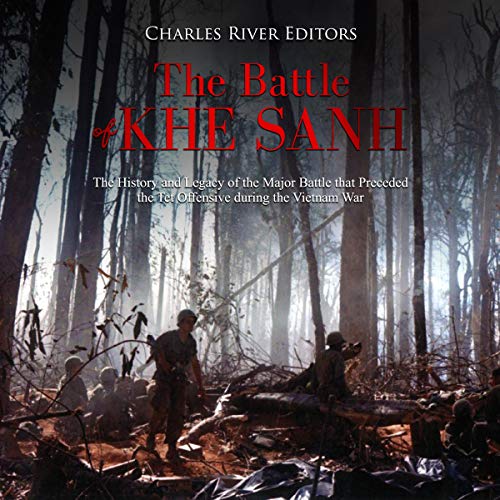
The Battle of Khe Sanh
Summary
By the end of 1967, with nearly half a million troops deployed, more than 19,000 deaths, and a war that cost $2 billion a month and seemed to grow bloodier by the day, President Lyndon Johnson's administration faced skepticism regarding the Vietnam War.
Regardless, by then, both sides were preparing to take the war into a new phase. General William “Westy” Westmoreland, commander of American forces in the theater, planned an aggressive strategy to send forces into Laos and Cambodia to sever the “Ho Chi Minh Trail” and other lines of supply.
However, unbeknownst to the Americans, the North Vietnamese were planning their own major and hopefully decisive campaign for early 1968. This would come in the form of the Tet Offensive, a coordinated surprise assault on many key locations throughout the conflict zone.
Key to both sets of plans was an American base in the extreme northwest region of South Vietnam, close to Laos. It was a part of a chain of US and ARVN (South Vietnamese military) bases designed to screen the South from direct invasion by the North. This base bore the name of a town at its location, Khe Sanh. A long siege punctuated by shorter, bloodier encounters developed in the early days of 1968.
Shortly after the battle, a massive coordinated Viet Cong operation - the Tet Offensive - briefly paralyzed American and South Vietnamese forces across the country, threatening even the American embassy compound in Saigon. Although American soldiers didn’t lose a battle strategically during the campaign, the Tet Offensive made President Johnson untrustworthy and historically unpopular, to the extent that he did not run for reelection in 1968.
By then, Vietnam had already fueled the hippie counterculture, and anti-war protests spread across the country. At the end of the decade, Vietnam had left tens of thousands of Americans dead, spawned a counterculture with millions of protesters, and destroyed a presidency.... More was yet to come.
Nearly 50 years after the fighting, the Battle of Khe Sanh and the Tet Offensive continue to inspire impassioned and occasionally bitter debates among historians, military officers, government officials, veterans, journalists, and the public at large. Perhaps the only proposition to win universal agreement is that the fighting at the start of 1968 represented a significant turning point. The conflict in Vietnam would continue for years, but it would never be the same.
The Battle of Khe Sanh chronicles one of the most controversial battles of the war and the effects it had on both sides.
©2019 Charles River Editors (P)2019 Charles River Editors

Last Post
Summary
From the author of the best-selling Forgotten Voices of the Great War comes a final look at the last 21 living British veterans of the First World War. These interviews, conducted in 2004, will never be repeated, as the youngest was 106 years old, and most are now gone. These first-person accounts follow the young soldiers from their homes throughout Britain to the raging battles while in the service of the Royal Field Artillery, Black Watch, Royal Navy, and others. These combat experiences should never be forgotten.
©2005 Max Arthur; (p)2007 Orion Publishing Group Ltd.

Life in the Third Reich
Summary
Germany was a deeply divided nation when Adolf Hitler and the Nazi Party came to power in 1933. As the shadow of the swastika lengthened, its citizens quickly came to realize that the Nazis' brutal programme was not optional. Everyone was expected to play their part in "national revival", especially those chosen as sacrificial victims. Much has been written about daily life during World War II from the perspective of the Allied nations, but little about life in Germany during the Third Reich. With the benefit of hindsight, questions have been raised as to why a civilized, cultured nation stood by and let the Nazi Party impose their rule in such inhumane fashion, and why so few individuals made any attempt to rebel. Life in the Third Reich draws on the recollections of those who lived through the rise and fall of one of the most vicious and sadistic regimes the world has ever seen. These are the stories of ordinary people in extraordinary times, living in the grip of a regime that did not care if it destroyed the whole country in pursuit of its perverted goals.
©2015 Arcturus Holdings Limited (P)2019 Arcturus Digital Limited

Perilous Missions
Summary
Civil Air Transport (CAT), founded in China after World War II by Claire Chennault and Whiting Willauer, was initially a commercial carrier specializing in air freight. Its role quickly changed as CAT became first a paramilitary adjunct of the Nationalist Chinese Air Force, then the CIA's secret "air force" in Korea, then "the most shot-at airline in the world" in French Indochina, and eventually becoming reorganized as Air America at the height of the Vietnam War. William M. Leary's detailed operational history of CAT sets the story in the perspective of Asian and Cold War geopolitics and shows how CAT allowed the CIA to operate with a level of flexibility and secrecy that it would not have attained through normal military or commercial air transportation.
©1984, 2002 Estate of William Leary (P)2015 Redwood Audiobooks

Escape From the Deep
Summary
Author Alex Kershaw is widely praised for his enthralling nonfiction. In the harrowing war saga Escape from the Deep, he recounts the incredible exploits of the U.S. Navy's deadliest World War II submarine, U.S.S. Tang. From one end of the Pacific theater to the other - dodging mines and depth charges from hundreds of enemy vessels along the way - the 80 men of the Tang became legends. By 1944, they had undertaken more combat actions, including direct surface engagements, and sunk more Japanese ships than any other Allied submarine. Even after the Tang was accidentally sunk by one of her own malfunctioning torpedoes and the nine surviving crewmen were captured by a Japanese patrol boat, their uncommon courage allowed them to persevere through months of inhuman torture before finally being liberated.
©2008 Alex Kershaw (P)2008 Recorded Books,LLC

The Dead and Those About to Die
Summary
A white-knuckle account of the First Infantry Division’s harrowing D-Day assault on the eastern sector of Omaha Beach - acclaimed historian John C. McManus has written a gripping history that will stand as the last word on this titanic battle. Nicknamed the Big Red One, First Division had fought from North Africa to Sicily, earning a reputation as stalwart warriors on the front lines and rabble-rousers in the rear. Yet on D-Day, these jaded combat veterans melded with fresh-faced replacements to accomplish one of the most challenging and deadly missions ever. As the men hit the beach, their equipment destroyed or washed away, soldiers cut down by the dozens, courageous heroes emerged: men such as Sergeant Raymond Strojny, who grabbed a bazooka and engaged in a death duel with a fortified German antitank gun; T/5 Joe Pinder, a former minor-league pitcher who braved enemy fire to save a vital radio; Lieutenant John Spalding, a former sportswriter, and Sergeant Phil Streczyk, a truck driver, who together demolished a German strong point overlooking Easy Red, where hundreds of Americans had landed. Along the way, McManus explores the Gap Assault Team engineers who dealt with the extensive mines and obstacles, suffering nearly a 50 percent casualty rate; highlights officers such as Brigadier General Willard Wyman and Colonel George Taylor, who led the way to victory; and punctures scores of myths surrounding this long-misunderstood battle. The Dead and Those about to Die draws on a rich array of new or recently unearthed sources, including interviews with veterans. The result is history at its finest, the unforgettable story of the Big Red One’s 19 hours of hell - and their ultimate triumph - on June 6, 1944.
©2014 John C. McManus (P)2014 Gildan Media LLC

Brothers in Blue: Matt
Summary
Meet the men of Manning Grove, three small-town cops and brothers, who meet the women who will change the rest of their lives. This is Matt’s story.... As a former Marine, Matt Bryson has dealt with PTSD ever since coming home from the Middle East. He finds himself fortunate to be able to return to his job as a cop at the local police department with his brothers Max and Marc. Dr. Carly Stephens works hard as an obstetrician at the local hospital, struggling to pay off her medical school loans, financially support her elderly parents, and save money to adopt a baby. Unable to have children, she still longs for one of her very own. Instantly attracted to the "dictator doctor," Matt finds Carly easily brings him to his knees both emotionally and physically. What starts out only as a convenient sexual relationship turns into a whole lot more when dealing with their pasts and their future. Especially since Matt doesn’t ever want children. Matt and Carly find themselves on a passionate and emotional journey that can either bring them together or rip them apart. Note: This book can be read as a stand-alone and has an HEA ending. Trigger warning: This audiobook includes a main character dealing with PTSD.
©2017 Jeanne St. James (P)2019 Jeanne St. James

Operation Watchtower
Summary
A powerful account of the tide turning WW2 Pacific Theater campaign. In the height of the Second World War, US forces launched a long and grueling campaign to take the island of Guadalcanal, mounting the first major land attack against Japanese forces. What followed was a six-month string of devastating battles as these two forces wrestled over this key military position. In the wake of near-daily aerial attacks and several determined assaults from the Japanese navy, the Guadalcanal campaign culminated in a victory for America and marked the first of many offensive attacks aimed at neutralizing the Japanese in the Pacific Theater. Now, this thrilling book recounts the story of the Guadalcanal campaign in vivid, gritty detail. Exploring the forces involved, the major battles, and the daily struggle of trying to maintain control of the coveted Henderson airfield, Operation Watchtower examines the pivotal moments which led to the Allies seizing the strategic initiative in a key turning point of the war. Perfect for fans of WW2 history books covering the Pacific, this brilliant book pays tribute to the brave soldiers on both sides of the conflict, recounting their story for both passionate history fans and anyone searching for an in-depth look at of one the greatest battles of World War 2.
©2020 Daniel Wrinn (P)2020 Daniel Wrinn

Bending the Bow of Ulysses
Summary
The purpose of this selection is to document the military career of Wade Hampton III. Six feet tall and sturdily built, Hampton was no armchair warrior. Noted for his patriarchal and caring manner, Hampton would give all of his own personal fortune for the Confederate cause before the Civil War was over. Wounded five times in battle (severely at Gettysburg), at 42 years of age Hampton was described as the idealized statue of a mounted warrior. Despite his lack of military experience and his relatively advanced age, Hampton was a natural cavalryman - brave, audacious, dedicated, and a superb horseman. While Hampton was in command of the Confederate Cavalry Corps through to the end of the war, he never lost a single fight. In fact, it is the thesis of this selection that Hampton was always a significant, but underrated, force in the CSA cavalry. His victories, especially when outnumbered and out-resourced, would be unparalleled. By any measure the choice of Wade Hampton as Stuart's replacement was inspired. As Stuart was very nearly the perfect leader in the days of attack, so Hampton was almost perfectly fitted to command in the days of defense. Hampton was among the most frequent and successful of hand-to-hand combatants among all the general officers in American history. He would lose his brother and his youngest son, both killed in action, and would literally see his eldest son, Wade Hampton IV, critically wounded. After J.E.B. Stuart's death, Hampton became the commander of Southern Cavalry and proved to be a stalwart leader and able tactician. He won the open devotion of his men, the respect of his adversaries, but never the public adulation that his predecessor commanded.
©2013 James M Volo (P)2015 James M Volo

The Women with Silver Wings
Summary
“With the fate of the free world hanging in the balance, women pilots went aloft to serve their nation.... A soaring tale in which, at long last, these daring World War II pilots gain the credit they deserve.” (Liza Mundy, New York Times best-selling author of Code Girls) "A powerful story of reinvention, community and ingenuity born out of global upheaval." (Newsday) When the Japanese attacked Pearl Harbor in December 1941, Cornelia Fort was already in the air. At 22, Fort had escaped Nashville’s debutante scene for a fresh start as a flight instructor in Hawaii. She and her student were in the middle of their lesson when the bombs began to fall, and they barely made it back to ground that morning. Still, when the US Army Air Forces put out a call for women pilots to aid the war effort, Fort was one of the first to respond. She became one of just over 1,100 women from across the nation to make it through the Army’s rigorous selection process and earn her silver wings. The brainchild of trailblazing pilots Nancy Love and Jacqueline Cochran, the Women Airforce Service Pilots (WASP) gave women like Fort a chance to serve their country - and to prove that women aviators were just as skilled as men. While not authorized to serve in combat, the WASP helped train male pilots for service abroad, and ferried bombers and pursuits across the country. Thirty-eight WASP would not survive the war. But even taking into account these tragic losses, Love and Cochran’s social experiment seemed to be a resounding success - until, with the tides of war turning, Congress clipped the women’s wings. The program was disbanded, the women sent home. But the bonds they’d forged never failed, and over the next few decades they came together to fight for recognition as the military veterans they were - and for their place in history.
©2020 Katherine Sharp Landdeck (P)2020 Random House Audio

Rock Force
Summary
From the number-one New York Times best-selling coauthor of No Easy Day comes a thrilling World War II story of the American airborne soldiers who captured a Japanese-held island fortress "Rock Force is a beautifully told story of war: the friendships, the courage and despair, and the terror... One of the most exciting books ever written about the Pacific War.” (Mitch Weiss, New York Times best-selling coauthor of Countdown 1945) In late December 1941, General Douglas MacArthur, caught off guard by the Japanese invasion of the Philippines, is forced to retreat to Corregidor, a jagged, rocky island fortress at the mouth of Manila Bay. Months later, under orders from the president, the general is whisked away in the dark of night, leaving his troops to their fate. It is a bitter pill for a fiercely proud warrior who has always protected his men. He famously declares "I shall return", but the humiliation of Corregidor haunts him, even earning him the derisive nickname "Dugout Doug". In early 1945, MacArthur returns to the Philippines, his eyes firmly fixed on Corregidor. To take back the island, he calls on the 503rd Parachute Infantry Regiment, a highly trained veteran airborne unit. Their mission is to jump onto the island - hemmed in by sheer cliffs, pockmarked by bomb craters, bristling with deadly spiky broken tree trunks - and wrest it from some 6,700 Japanese defenders who await, fully armed and ready to fight to the death. Drawn from firsthand accounts and personal interviews with the battle's surviving veterans, acclaimed war correspondent and best-selling author Kevin Maurer delves into this extraordinary tale, uncovering astonishing accounts of bravery and heroism during an epic, yet largely forgotten, clash of the Pacific War. Here is an intimate story of uncommon soldiers showing uncommon courage and winning, through blood and sacrifice, the redemption of General MacArthur.
©2020 Kevin Maurer (P)2020 Penguin Audio

Scripting the Past
Summary
Declan lives in the shadows helping deliver people out of the worst moments of their lives. After his military career ended, he joined a team in a foreign land putting the most lethal skills in his toolbox to best use, all the while watching over his only family from afar. He wants his sister, Morgan, to enjoy all the best in life, free from the confines of the knowledge of what he does and the evil that threatens their world daily. When his sister’s life is unexpectedly jeopardized though, he will need to break every rule to help find answers of historically altering events that will change his world and cause him to question everything in the pursuit of truth. Alessa has always lived a sheltered life under the overly watchful eye of her parents; even after their untimely deaths, she follows their advice to the letter. Avoiding people, technology, and any social interactions, with the only exception being her best friend and editor, Morgan, she maintains the solace she was born into and knows best. When secrets from her parent’s past start threatening her Morgan, she will embark on a journey toward answers with the most brusque, infuriating man she didn’t know she would never be able to live without.
©2016 Angela Naff (P)2019 Angela Naff

Collision on Tenerife
Summary
The world's worst air disaster happened more than 40 years ago on a remote Atlantic Ocean island, when two fully loaded 747 passenger jets collided after a horrendous series of human errors. One of the jets, KLM Flight 4805, was traveling more than 150 miles an hour and was within seconds of lifting off when it crashed into Pan Am Flight 1736 taxiing in its path. The loss of lives was staggering - 583 dead. The crash happened after a lengthy series of major and minor human errors. In the intervening years, has aviation advanced to the point that such a disaster can't happen again? In this riveting account, written from the perspective of the passengers in the cabin as well as the crew members in the cockpits, Jon Ziomek explains how this largely forgotten accident took place - and what has happened since to reduce the possibility of another such catastrophe.
©2018 Jon Ziomek (P)2020 Tantor

Brothers in Blue: Marc
Summary
Meet the men of Manning Grove, three small-town cops and brothers, who meet the women who will change the rest of their lives. This is Marc’s story.... Officer Marc Bryson doesn’t believe women should be in law enforcement. Ever. When his older brother, Max, is promoted to the small town’s police chief the first thing he does is hire a woman fresh out of the academy. Then makes Marc her Field Training Officer. Determined to follow in her late father’s footsteps, Leah Grant has the moxie to break any glass ceiling that stands in the way from becoming a police officer. Even if that means proving to her coach - who only wants her in his bed and not in the field - she’s worthy of being a permanent member of the force. Working in a man’s world, Leah challenges Marc’s misconceptions about women in the line of duty. But as they struggle to separate their work life from their undeniable chemistry, things continue to steam up and get a little kinky. These two officers of the law must toe the line after being caught red-handed. In the end, can Leah prove to Marc that she is good as backup as well as in bed?
©2018 Jeanne St. James (P)2019 Jeanne St. James

The Darkest Days of the War
Summary
During the late summer of 1862, Confederate forces attempted a three-pronged strategic advance into the North. The outcome of this offensive, the only coordinated Confederate attempt to carry the conflict to the enemy, was disastrous. The results at Antietam and in Kentucky are well known; the third offensive, the northern Mississippi campaign, led to the devastating and little-studied defeats at Iuka and Corinth, defeats that would open the way for Grant's attack on Vicksburg. Peter Cozzens presents here the first book-length study of these two complex and vicious battles. Drawing on extensive primary research, he details the tactical stories of Iuka, where nearly one-third of those engaged fell, and Corinth, which was fought under brutally oppressive conditions, analyzing troop movements down to the regimental level. He also provides compelling portraits of Generals Grant, Rosecrans, Van Dorn, and Price, exposing the ways in which their clashing ambitions and antipathies affected the outcome of the campaign. Finally, he draws out the larger, strategic implications of the battles of Iuka and Corinth, exploring their impact on the fate of the northern Mississippi campaign, and by extension, the fate of the Confederacy. This book is published by University of North Carolina Press.
©1997 The University of North Carolina Press (P)2010 Redwood Audiobooks

Closer
Summary
From New York Times and USA Today best-selling author Kylie Scott comes a new story in her Stage Dive series.... When a stalker gets too close to plus-size model Mae Cooper, it’s time to hire some muscle. Enter former military man turned executive protection officer Ziggy Thayer. Having spent years guarding billionaires, royalty, and rock'n'roll greats, he’s seen it all. From lavish parties through to every kind of excess. There’s no reason some Instagram stylista should throw him off his game. Even if she does have the most dangerous curves he’s ever seen.... *Every 1001 Dark Nights novella is a stand-alone story. For new listeners, it’s an introduction to an author’s world. And for fans, it’s a bonus book in the author’s series. We hope you'll enjoy each one as much as we do.*
©2019 Kylie Scott (P)2019 Audible, Inc.

A Spy at the Heart of the Third Reich
Summary
A work of remarkable scholarship that moves with the swift pace of a John le Carre thriller, A Spy at the Heart of the Third Reich is a chilling addition to the literature of espionage. In 1943, a young official named Fritz Kolbe from the German foreign ministry arranged to meet with Allen Dulles, then an OSS officer in Switzerland and later the director of the Central Intelligence Agency. Kolbe had decided to betray his country. Over the next two years, Kolbe passed on countless valuable documents about German war efforts by tying the pages to his thigh and praying to avoid customs searches. He described the location of munitions factories and relayed diplomatic reports on Germany's intelligence operations and relations with other Axis nations like Romania and nominally neutral countries like Spain. Viewed by many Germans as a traitor, he was erased from the history books and, after Hitler's fall, his diplomatic career came to an end. Drawing on recently declassified materials at the National Archives in Washington and Kolbe's personal archives, Lucas Delattre has written an extraordinary tale of an ordinary man who knew the most valuable service he could provide his country was to betray it.
©2003 Editions Denoel (P)2005 Tantor Media, Inc.