The Philosophy category has 1,858 audiobooks on Listento.it, with an average listener rating of 4.5★ across 25,891 ratings. The most-rated is 12 Rules for Life.

Groundwork of the Metaphysics of Morals
Summary
This is a completely unabridged edition of Groundwork of the Metaphysics of Morals. You may also know this work as Foundations of the Metaphysics of Morals, Grounding of the Metaphysics of Morals, or The Grounding for the Metaphysics of Morals. Our rendition of this classic has crisp, well-edited audio. We handcraft our sound to create the perfect listening experience. We only work with the most talented of narrators. If it's not great, it's not Orange Island Book Shop. Our time-tested audio strategy creates a rich consistency and quality of audio that you're sure to notice. Please enjoy the listen!
Public Domain (P)2019 Orange Island Book Shop
The Art of Doing Nothing
Summary
This is the number one secret to living your best life, and it’s the easiest thing you’ll ever do.... Are you fighting for the "good life", trying to break free from the rat race and push yourself into something more? More relaxation, time on the beach, travel the world, and make more money? You’re not alone. Actually, this is a life that nearly every single one of us is after, and yet in some ironic twist of fate, everybody has themselves convinced that to get there, you must work yourself to the bone. Does your work week often turn into something that is 60+ hours of determined focus? Do you barely have time to eat, let alone sleep, and constantly feel rushed from one task to the next? Creating specific and intentional time for relaxation in your life is hands down the healthiest thing you could do for yourself. In The Art of Doing Nothing, you’ll discover: How to get more done and be more efficient by literally doing nothing The number one secret to effortless action passed down from an ancient Chinese scroll How doing nothing can literally raise your IQ How I turned an 80-hour workweek and $40k debt into having more time, productivity, and happiness Why trying too hard is a fool’s game How to free yourself from guilt around doing nothing Groundbreaking insight into the science of play and why you need to take it seriously How to simplify your life down to the essential using intentionalism Expert-approved hacks to prevent burnout from ever coming back And so much more Be intentional about it, specifically plan time in each day for nothing at all, and watch your productivity and happiness skyrocket. If you’re ready to become more productive, more creative, and outshine all of your peers, then scroll up and click the “Buy Now” button right now. PLEASE NOTE: When you purchase this title, the accompanying PDF will be available in your Audible Library along with the audio.
©2020 Chandler Kitching (P)2021 Chandler Kitching

Irrational Man
Summary
Widely recognized as the finest definition of existentialist philosophy ever written, this book introduced existentialism to America in 1958. Barrett speaks eloquently and directly to concerns of the modern era: a period when the irrational and the absurd are no better integrated than before and when humankind is in even greater danger of destroying its existence without ever understanding the meaning of its existence. Irrational Man begins by discussing the roots of existentialism in the art and thinking of Augustine, Aquinas, Pascal, Baudelaire, Blake, Dostoevski, Tolstoy, Hemingway, Picasso, Joyce, and Beckett. The heart of the book explains the views of the foremost existentialists - Kierkegaard, Nietzsche, Heidegger, and Sartre. The result is a marvelously lucid definition of existentialism and a brilliant interpretation of its impact.
©1958, 1990 William Barrett (P)2019 Tantor
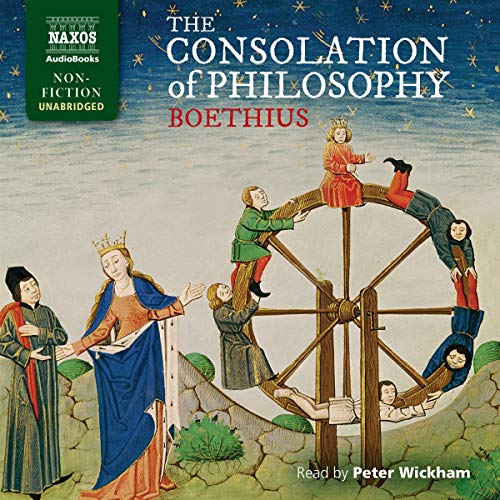
The Consolation of Philosophy
Summary
Charged with treason under Theodoric the Great in sixth-century Rome, Boethius served one year's imprisonment, awaiting trial and eventual execution. During this time, he wrote The Consolation of Philosophy, which would go on to be one of the most popular philosophical works of all time, contributing much to medieval thought and influencing the likes of Dante and Chaucer, as well as Renaissance writers, such as Milton and Shakespeare. Grieving over the injustice of his imprisonment, Boethius meditates on the nature of God, the fickleness of fortune, the idea of free will, why bad things happen to good people, and the nature of happiness. His arguments take the form of a rich and exquisite dialogue between himself and Lady Philosophy and make many allusions to classical Greek and Roman literature in an attempt to create a coherent philosophy that supports his world view. It has been declared a "golden volume not unworthy of the leisure of Plato or Tully" (Edward Gibbon). PLEASE NOTE: When you purchase this title, the accompanying PDF will be available in your Audible Library along with the audio.
Public Domain (P)2019 Naxos Audiobooks

Les trois sagesses chinoises. Confucius, Lao Tseu, Bouddha
Summary
La pensée de Confucius est si forte qu'elle domina la vie intellectuelle de la Chine ancienne pendant des siècles, allant jusqu'à constituer une véritable religion, le confucianisme. Lao-tsu (Laozi, Lao-tzu, ou Lao Tseu) est l'auteur du Tao Te Ching ( Livre de la Voie et de la Vertu), et fut le père fondateur du taoïsme. C'est à lui qu'on doit le sens des équilibres yin et yang, le principe du non-agir, et l'idée du Tao, à l'origine de toutes choses. Siddharta Gautama était né prince ; dégoûté des illusions matérielles, il parcourut un temps le chemin de l'ascétisme, avant de se rendre compte que la négation du corps n'était qu'une autre des illusions de la conscience. C'est alors qu'il atteint l'éveil, ce qui lui valut son surnom de Bouddha, "l'Eveillé" ; il devait ensuite mettre sa sagesse en enseignements. Ensemble, ce sont les trois figures fondamentales de la pensée chinoise, terre de sagesse et d'éveil ; leurs enseignements ont été rassemblés sous forme de citations, cent par auteur, pour se les approprier avec efficacité sur le chemin du développement personnel.
©2017 Compagnie du Savoir (P)2017 Compagnie du Savoir

The Dawn of Day
Summary
Friedrich Nietzsche (1844-1900) is one of the towering intellectual figures of the 19th century, a philologist, philosopher and poet of profound complexity and range whose writings in moral philosophy continue to resonate in the present day. The Dawn of Day (Morgenröte), first published in 1881, marked a clear shift in his thinking and prefigures many of the ideas that would be further developed in his later writings. The clue is in the title, sometimes translated as Dawn or Morning, which suggests the beginning of a different awareness. One of Nietzsche’s least studied works, The Dawn of Day consists of 575 passages ranging from a few lines to numerous pages in length, in which the philosopher considers and dissects the nature of reality and of conventional 19th-century European ethics and morality. The great German thinker and classicist makes considerable use of aphorisms and frequently uses an ironic tone to criticise the nature of the morality suffusing the fabric of the society of his day. In John M Kennedy’s excellent translation, Nietzsche ranges across the influences exerted on the mind of modern man referencing classical sources, the Bible, Christian thinkers and the writer’s own contemporaries. The influence of Schopenhauer and an admiration for Kant are still apparent in his thinking, but Nietzsche clearly begins to develop his own world view, his own philosophy in this work. His burgeoning moral and cultural relativism in his critique of Christian thought is incisive and constant and the roots of the notions later developed into the ideas of ‘the death of God’ and ‘the will to power’ are clearly discernible. The work is organised in four books containing Nietzsche’s reflections on everything including politics, history, art, music, theatre, literature, psychology, religion, culture, crime and punishment, heroism, idealism and a plethora of other issues affecting the individual in society. It is an attempt at creating and describing a modern European perspective on existence while simultaneously exploring the nature of thinking and belief. Nietzsche alternates between pondering, preaching, teasing and provoking the listener. For instance when considering education he remarks, ‘…nobody learns, nobody teaches, nobody wishes, to endure solitude’. Then, shortly afterwards, he states, ‘Master and Pupil. By cautioning his pupils against himself the teacher shows his humanity.’ The Dawn of Day remains an abundant source of food for thought and is expertly presented by reader Michael Lunts for Ukemi Audiobooks.
Public Domain (P)2019 Ukemi Productions Ltd

Queer Phenomenology: Orientations, Objects, Others
Summary
In this groundbreaking work, Sara Ahmed demonstrates how queer studies can put phenomenology to productive use. Focusing on the “orientation” aspect of “sexual orientation” and the “orient” in “orientalism,” Ahmed examines what it means for bodies to be situated in space and time. Bodies take shape as they move through the world directing themselves toward or away from objects and others. Being “orientated” means feeling at home, knowing where one stands, or having certain objects within reach. Orientations affect what is proximate to the body or what can be reached. A queer phenomenology, Ahmed contends, reveals how social relations are arranged spatially, how queerness disrupts and reorders these relations by not following the accepted paths, and how a politics of disorientation puts other objects within reach, those that might, at first glance, seem awry. Ahmed proposes that a queer phenomenology might investigate not only how the concept of orientation is informed by phenomenology but also the orientation of phenomenology itself. Thus she reflects on the significance of the objects that appear - and those that do not - as signs of orientation in classic phenomenological texts such as Husserl’s Ideas. In developing a queer model of orientations, she combines readings of phenomenological texts - by Husserl, Heidegger, Merleau-Ponty, and Fanon - with insights drawn from queer studies, feminist theory, critical race theory, Marxism, and psychoanalysis. Queer Phenomenology points queer theory in bold new directions.
©2006 Sara Ahmed (P)2020 Sara LLC

On the Soul & Parva Naturalia
Summary
Two contrasting reflections by Aristotle which cover very particular ground. In 'On the Soul', Aristotle presents his view of the 'life essence' which, he argues, is possessed by living things whether plants, animals or humans. Not a 'soul' in the generally accepted Western use of the term, this 'soul', he says, is a life force that is indivisible from the organism that possesses it. The essay is divided into three books. Presenting his concept in book I, he further describes the structure of the 'souls' of plants, animals and humans in book II and book III. In 'The Parva Naturalia' ('Little Physical Treatises'), Aristotle continues his investigation into the biology of life and the links between body and 'soul'. It consists of seven essays: 'Sense and Sensibilia', 'On Memory', 'On Sleep', 'On Dreams', 'On Divination in Sleep', 'On Length and Shortness of Life', 'On Youth', 'Old Age', 'Life and Death' and 'Respiration'. Translation by A. J. Smith. Translation by J I Beare and G R T Ross.
Public Domain (P)2018 Ukemi Productions Ltd

Unrugged Individualism
Summary
What is the nature of benevolence toward other people? How does it differ from altruism? Is it a major or minor virtue? How does it relate to the benevolent sense of life? David Kelley answers these questions in a groundbreaking work. Unrugged Individualism is the first philosophical analysis of benevolence from the Objectivist point of view, a major addition to the Objectivist ethics, and a convincing demonstration of the fertility of the system of ideas originated by Ayn Rand.
©2003 The Atlas Society (P)2016 The Atlas Society

Beyond Bad
Summary
Scientific research has achieved what thousands of years of philosophising failed to do: explain why we have morals and how they work. The answers are surprising and frequently disturbing. Morals have held empires together, kept soldiers marching under fire, fed the hungry, passed laws, built walls, welcomed immigrants, destroyed careers and governed our sex lives. But what if morality's all meaningless rubbish, a malfunctioning relic of our evolutionary past? This is the provocative argument that Chris makes. This isn't an attack on one set of moral codes or one way of thinking about ethics: it's a call for abolishing the whole caboodle. He uses evolutionary psychology to show how and why morality emerged: they enabled our forebears to survive and prosper in tribal groups. Today, our morals constrain us, bias us and push us in the wrong direction. The biggest challenges our species faces, whether global warming, nuclear proliferation or the rise of the robots, are pan-human. These challenges are beyond what our moral minds were designed to cope with. You can't build smartphones with Stone-Age axes, and you can't solve modern humanity's problems with tools that are designed to create primitive, competitive groups.
©2021 Chris Paley (P)2021 Hodder & Stoughton Limited

The Inside Fight
Summary
Do you find yourself questioning the things you feel on the inside? A voice that you are trying to fight? But you feel unsure and sweep the matter away? If you ignore things, they keep piling up until you forget, and how do you forget such a big pile? The spirit within is the battle you face each day and night as soon as you stop occupying yourself in worldly matters. Have a listen, and maybe you can understand things better. It is a deep listen, and you can relax - it is simply written. This book is suitable for ages of 13+. It is aimed mostly at adults of all ages, young or old.
©2021 Shamus Zia (P)2021 Shamus Zia

Spiritual Healing: 4 Books in 1
Summary
Unleash your spirituality and achieve enlightenment with the help of this profound and inspiring spiritual collection! Spiritual Healing is the number one ultimate guide that will teach you everything that you need to know about unlocking your hidden powers and living a more meaningful life. For years, this body of ancient and secret knowledge kept a closely guarded secret revealed only to a few chosen individuals. Now is the time to unveil the techniques and practices that can unleash your real power. This collection unveils the wisdom of ancient cultures, exploring deeply held spiritual traditions, and unlocking the secret to achieving enlightenment. Throughout four powerful and eye-opening books, you’ll transform your spiritual growth and learn to flourish by harnessing the limitless potential that the universe holds. Here’s what you’ll find inside: Book One: Chakras for Beginners Blocked, unbalanced, and damaged chakras can wreak havoc on your health. This guide now explores how you can heal your seven chakras to experience lasting physical, mental, and emotional well-being. Covering each chakra and how it can help you, this book is perfect for anyone who wants to understand more about this foundation of Eastern religions. Book Two: Third Eye Awakening Far from being another pop-culture phenomenon, your third eye holds extraordinary potential, which will help you shift your mindset and look at life in a whole new way. This detailed handbook provides you with everything you need to know about awakening your third eye and achieving enlightenment. Book Three: Stoicism Stoicism, one of the oldest Western philosophical schools, has enchanted scholars and the general public for over 2,000 years. Some accounts of human nature and, in particular, human goodness fall short by the reduction of a human being too physical, or by psychical phenomena. Book Four: Law of Attraction A comprehensive user guide that goes beyond theory helps you create a success mindset to manifest your desires, using everyday easy-to-follow action steps. Shift out of the old ways that haven’t worked and implement new strategies to make it work for you finally. This collection is all about awakening your life force energy and using it to change your life for the better. Are you ready? Get your copy today and start now!
©2020 Joseph Sorensen (P)2020 Joseph Sorensen

A Life Beyond Reason
Summary
An unflinching and luminous memoir that explores a father’s philosophical transformation when he must reconsider the questions what makes us human? and whose life is worth living? Before becoming a father, Chris Gabbard was a fast-track academic finishing his doctoral dissertation at Stanford. A disciple of Enlightenment thinkers, he was a devotee of reason, believed in the reliability of science, and lived by the dictum that an unexamined life is not worth living. That is, until his son August was born. Despite his faith that modern medicine would not fail him, August was born with a severe traumatic brain injury as a likely result of medical error and lived as a spastic quadriplegic who was cortically blind, profoundly cognitively impaired, and nonverbal. While Gabbard tried to uncover what went wrong during the birth and adjusted to his new role raising a child with multiple disabilities, he began to rethink his commitment to Enlightenment thinkers - who would have concluded that his son was doomed to a life of suffering. But August was a happy child who brought joy to just about everyone he met in his 14 years of life - and opened up Gabbard’s capacity to love. Ultimately, he comes to understand that his son is undeniably a person deserving of life. A Life Beyond Reason will challenge listeners to reexamine their beliefs about who is deserving of humanity.
©2019 Chris Gabbard (P)2019 Random House Audio

Pocket Guide to Objectivism
Summary
Learn the basic pillars of Ayn Rand’s philosophy in any easy to access format. It’s also a simple, digestible way to brush up on the basics of objectivism and find ways to apply these principles toward building your best life.
©2018 The Atlas Society (P)2019 The Atlas Society

Discourse on the Origin and the Foundations of Inequality Among Men
Summary
Rousseau's Discourse sets out to explore the origin of inequality among people, a journey that sees him trace the evolution of humans from the savage man to the foundations of civil society. With verve and passion, the philosopher argues that the birth of private property was the "beginning of evil". Throughout the book we are led to consider the development of language, reason, self-preservation, benevolence, pity, and law - all through the lens of perhaps the most original thinker of the 18th century.
Public Domain (P)2015 Naxos AudioBooks

Candide
Summary
"Candide is a French satire first published in 1759 by Voltaire, a philosopher of the Age of Enlightenment. It begins with a young man, Candide, who is living a sheltered life in an Edenic paradise and being indoctrinated with Leibnizian optimism by his mentor, Professor Pangloss. The work describes the abrupt cessation of this lifestyle, followed by Candide's slow, painful disillusionment as he witnesses and experiences great hardships in the world. Voltaire concludes with Candide, if not rejecting optimism outright, advocating a deeply practical precept, 'we must cultivate our garden', in lieu of the Leibnizian mantra of Pangloss, 'all is for the best' in the 'best of all possible worlds'. "Candide is characterised by its sarcastic tone as well as by its erratic, fantastical, and fast-moving plot. A picaresque novel with a story similar to that of a more serious coming-of-age narrative (Bildungsroman), it parodies many adventure and romance clichés, the struggles of which are caricatured in a tone that is mordantly matter-of-fact. Still, the events discussed are often based on historical happenings, such as the Seven Years' War and the 1755 Lisbon earthquake. As philosophers of Voltaire's day contended with the problem of evil, so too does Candide in this short novel, albeit more directly and humorously. Voltaire ridicules religion, theologians, governments, armies, philosophies, and philosophers through allegory; most conspicuously, he assaults Leibniz and his optimism. "As expected by Voltaire, Candide has enjoyed both great success and great scandal. Immediately after its secretive publication, the book was widely banned because it contained religious blasphemy, political sedition and intellectual hostility hidden under a thin veil of naïveté. However, with its sharp wit and insightful portrayal of the human condition, the novel has since inspired many later authors and artists to mimic and adapt it. Today, Candide is recognized as Voltaire's magnum opus." [Wikipedia]
Public Domain (P)2017 Lyon Audio

Thomas Troward Collection: The Edinburgh Lectures on Mental Science and the Creative Process in the Individual
Summary
Thomas Troward (1847–1916) was an English author whose works influenced the New Thought Movement and mystic Christianity. Troward's avocation was the study of comparative religion. After his retirement from the judiciary in 1896, Troward set out to apply logic and a judicial weighing of evidence in the study of matters of cause and effect. "In the present volume I have endeavored to set before the listener the conception of a sequence of creative action commencing with the formation of the globe and culminating in a vista of infinite possibilities attainable by every one who follows up the right line for their unfoldment. I have endeavored to show that, starting with certain incontrovertible scientific facts, all these things logically follow, and that therefore, however far these speculations may carry us beyond our past experience, they nowhere break the thread of an intelligible connection of cause and effect."
©2019 Mental Science and The Creative Ideas Publishing (P)2019 Mental Science and The Creative Ideas Publishing

The Kindness of Strangers
Summary
"A fine achievement."--Peter Singer, author of The Life You Can Save and The Most Good You Can Do A sweeping psychological history of human goodness -- from the foundations of evolution to the modern political and social challenges humanity is now facing. How did humans, a species of self-centered apes, come to care about others? Since Darwin, scientists have tried to answer this question using evolutionary theory. In The Kindness of Strangers, psychologist Michael E. McCullough shows why they have failed and offers a new explanation instead. From the moment nomadic humans first settled down until the aftermath of the Second World War, our species has confronted repeated crises that we could only survive by changing our behavior. As McCullough argues, these choices weren't enabled by an evolved moral sense, but with moral invention -- driven not by evolution's dictates but by reason. Today's challenges -- climate change, mass migration, nationalism -- are some of humanity's greatest yet. In revealing how past crises shaped the foundations of human concern, The Kindness of Strangers offers clues for how we can adapt our moral thinking to survive these challenges as well.
©2020 Michael McCullough (P)2020 Brilliance Publishing, Inc., all rights reserved.

Every Time I Find the Meaning of Life, They Change It
Summary
A humorous and philosophical trip through life from the New York Times best-selling coauthor of Plato and a Platypus Walk into a Bar.... Daniel Klein's fans have fallen in love with the warm, humorous, and thoughtful way he shows how philosophy resonates in everyday life. Listeners of his popular books, Plato and a Platypus Walk into a Bar... and Travels with Epicurus, come for enlightenment and stay for the entertainment. As a young college student studying philosophy, Klein filled a notebook with short quotes from the world's greatest thinkers, hoping to find some guidance on how to live the best life he could. Now, from the vantage point of his eighth decade, Klein revisits the wisdom he relished in his youth with this collection of philosophical gems, adding new ones that strike chords with him at the end of his life. From Epicurus to Emerson and Camus to the theologian Reinhold Niebuhr - whose words provided the title of this audiobook - each pithy extract is annotated with Klein's inimitable charm and insights. In this audio, our favorite jokester-philosopher tackles life's biggest questions, leaving us chuckling and enlightened.
©2015 Daniel Klein (P)2015 Recorded Books

Wabi-Sabi
Summary
This book offers a comprehensive look at the Japanese world view known as "wabi-sabi" and how it can be used to change one's perception of life and find happiness in an imperfect life. There's no denying that modern living has afforded us lots of good things with all manner of convenience. Today, we can stay cool, no matter how hot it gets outside, thanks to our air-conditioned rooms. In seconds, we can talk face-to-face with someone halfway across the world, thanks to the internet. So, why are there so many of us who feel disconnected and unhappy? If you've grown tired of keeping up with the mental and emotional demands of modern living, then, perhaps, it's time to turn to age-old pearls of wisdom for advice and gain a new perspective about life. This book is your portal to one such wisdom, as the author invites you to look beyond the cultural tradition and Japanese aesthetics of wabi-sabi and unlock a new dimension for perceiving the world and seeking one's place in it. Travel back in time and explore the Zen roots of wabi-sabi and how it has taught generations of people to find beauty amidst the many imperfections of life. You will learn that wabi-sabi isn't so much about Japanese culture, but life in general. It teaches people to simplify things and recognize what is truly important to them. Defined as the sum of all wisdom gained by generations of Japanese artisans, poets, and philosophers, wabi-sabi calls on you to step on the brakes of your fast-paced lifestyle, smell the flowers, and recognize that you may have been too hard on yourself. While it's easy to dismiss wabi-sabi as a Japanese preference for aesthetics, you will learn that it has so much more to offer. In truth, it's a world view that can be applied to just about every facet of life, from living with nature, to building a family, to accepting failures and dying with dignity. Wabi-Sabi preaches the truth that many people refuse to acknowledge - that our lives don't have to be perfect to be happy. If you’re looking for a life-changing experience, then click the "buy now" button today.
©2020 Robert Miller (P)2020 Robert Miller