The Russia category has 102 audiobooks on Listento.it, with an average listener rating of 4.4★ across 328 ratings. The most-rated is Chernobyl 01:23:40.

The Reckoning
Summary
Bloomsbury presents The Reckoning by Prit Buttar, read by Richard Trinder. By the end of 1944 the Red Army was poised on the very frontiers of the Third Reich. How had the once unstoppable, mighty Wehrmacht faltered so disastrously? Certainly it had suffered defeats before, in particular the vast catastrophe of Stalingrad, but it was in 1944 that the war was ultimately lost. It was no longer a case of if but rather when the Red Army would be at the gates of Berlin. Prit Buttar retraces the ebb and flow of the various battles and campaigns fought throughout the Ukraine and Romania in 1944. January and February saw Army Group South encircled in the Korsun Pocket. Although many of the encircled troops did escape, in part due to Soviet intelligence and command failures, the Red Army would endeavour to not make the same mistakes again. Indeed, in the coming months the Red Army would demonstrate an ability to learn and improve, reinventing itself as a war-winning machine, demonstrated clearly in its success in the Iasi-Kishinev operation. The view of the Red Army as a huge, unskilled horde that rolled over everything in its path is just one myth that The Reckoning reassess. So too does it re-evaluate the apparent infallibility of German military commanders, the denial of any involvement in (or often even knowledge of) the heinous crimes committed in the occupied territories by German forces and the ineffectiveness of Axis allies, such as the Romanians at Iasi, to withstand the Soviet forces. Like all myths, these contain many truths, but also a great many distortions, all of which are skilfully unpicked and analysed in this powerful retelling of 1944 on the Eastern Front.
©2020 Prit Buttar (P)2020 Bloomsbury Publishing Plc

Hitler and Stalin
Summary
An award-winning historian plumbs the depths of Hitler and Stalin's vicious regimes, and shows the extent to which they brutalized the world around them. Two 20th century tyrants stand apart from all the rest in terms of their ruthlessness and the degree to which they changed the world around them. Briefly allies during World War II, Adolph Hitler and Josef Stalin then tried to exterminate each other in sweeping campaigns unlike anything the modern world had ever seen, affecting soldiers and civilians alike. Millions of miles of Eastern Europe were ruined in their fight to the death, millions of lives sacrificed. Laurence Rees has met more people who had direct experience of working for Hitler and Stalin than any other historian. Using their evidence he has pieced together a compelling comparative portrait of evil, in which idealism is polluted by bloody pragmatism, and human suffering is used casually as a political tool. It's a jaw-dropping description of two regimes stripped of moral anchors and doomed to destroy each other, and those caught up in the vicious magnetism of their leadership.
©2020 Laurence Rees (P)2020 PublicAffairs

Retribution
Summary
From critically acclaimed Eastern Front expert Prit Buttar comes this detailed and engrossing account of the war on the Eastern Front as the German forces were driven back following the Battle of Kursk. Making use of the extensive memoirs of German and Russian soldiers to bring their story to life, the narrative follows on from On A Knife's Edge, which described the encirclement and destruction of the German Sixth Army at Stalingrad and the offensives and counter-offensives that followed throughout the winter of 1942-43. Beginning towards the end of the Battle of Kursk, Retribution explores the massive Soviet offensive that followed the end of Operation Zitadelle, which saw depleted and desperate German troops forced out of Western Ukraine. In this title, Buttar describes in detail the little-known series of near-constant battles that saw a weakened German army confronted by a tactically sophisticated force of over six million Soviet troops. As a result, the Wehrmacht was driven back to the Dnepr and German forces remaining in the Kuban Peninsula south of Rostov were forced back into the Crimea, a retreat which would become one of many in the months that followed.
©2019 Prit Buttar (P)2019 Tantor
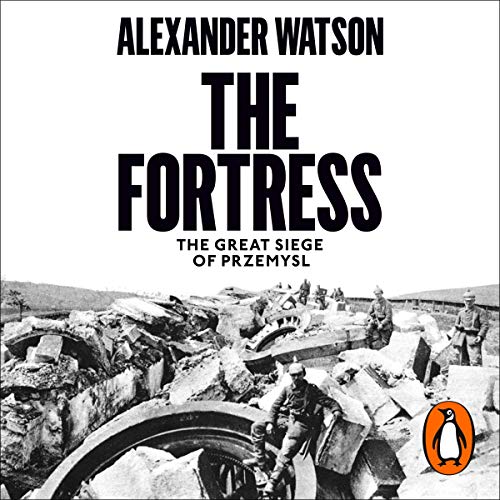
The Fortress
Summary
Brought to you by Penguin. From the prize-winning author of Ring of Steel, a gripping history of the First World War's longest and most terrible siege. In the autumn of 1914 Europe was at war. The battling powers had already suffered casualties on a scale previously unimaginable. On both the Western and Eastern fronts elaborate war plans lay in ruins and had been discarded in favour of desperate improvisation. In the West this resulted in the remorseless world of the trenches; in the East all eyes were focused on the old, beleaguered Austro-Hungarian fortress of Przemysl. The siege that unfolded at Przemysl was the longest of the whole war. In the defence of the fortress and the struggle to relieve it Austria-Hungary suffered some 800,000 casualties. Almost unknown in the West, this was one of the great turning points of the conflict. If the Russians had broken through they could have invaded Central Europe, but by the time the fortress fell their strength was so sapped they could go no further. Alexander Watson, prize-winning author of Ring of Steel, has written one of the great epics of the First World War. Comparable to Stalingrad in 1942-3, Przemysl shaped the course of Europe's future. Neither Russians nor Austro-Hungarians ever recovered from their disasters. Using a huge range of sources, Watson brilliantly re-creates a world of long-gone empires, broken armies and a cut-off community sliding into chaos. The siege was central to the war itself but also a chilling harbinger of what would engulf the entire region in the coming decades, as nationalism, anti-Semitism and an exterminatory fury took hold.
©2019 Alexander Watson (P)2019 Penguin Audio

The Ghost of Freedom
Summary
The Caucasus mountains rise at the intersection of Europe, Russia, and the Middle East. A land of astonishing natural beauty and a dizzying array of ancient cultures, the Caucasus for most of the 20th century lay inside the Soviet Union, before movements of national liberation created newly independent countries and sparked the devastating war in Chechnya. Charles King reveals how tsars, highlanders, revolutionaries, and adventurers have contributed to the fascinating history of this borderland, providing an indispensable guide to the complicated histories, politics, and cultures of this intriguing frontier. Based on new research in multiple languages, the book shows how the struggle for freedom in the mountains, hills, and plains of the Caucasus has been a perennial theme over the last 200 years - a struggle which has led to liberation as well as to new forms of captivity. The book sheds valuable light on the origins of modern disputes, including the ongoing war in Chechnya, conflicts in Georgia and Azerbaijan, and debates over oil from the Caspian Sea and its impact on world markets.
©2008 Oxford University Press, Inc. (P)2017 Tantor

Hitler's Great Gamble
Summary
On June 22, 1941, Hitler invaded the Soviet Union in Operation Barbarossa, one of the turning points of World War II. Within six months, the invasion bogged down on the outskirts of Moscow, and the Eastern Front proved to be the decisive theater in the defeat of the Third Reich. Ever since, most historians have agreed that this was Hitler's gravest mistake. In Hitler's Great Gamble, James Ellman argues that while Barbarossa was a gamble and perverted by genocidal Nazi ideology, it was not doomed from the start. Rather it represented Hitler's best chance to achieve his war aims for Germany, which were remarkably similar to those of the kaiser's government in 1914. Other options, such as an invasion of England or an offensive to seize the oil fields of the Middle East, were considered and discarded as unlikely to lead to Axis victory. In Ellman's recounting, Barbarossa did not fail because of flaws in the Axis invasion strategy, the size of the USSR, or the brutal cold of the Russian winter. Instead, German defeat was due to errors of Nazi diplomacy. Hitler chose not to coordinate his plans with his most militarily powerful allies, Finland and Japan, and ensure the seizure of the ports of Murmansk and Vladivostok. Had he done so, Germany might well have succeeded in defeating the Soviet Union and, perhaps, winning World War II.
©2019 James Ellman (P)2020 Tantor

The History of Russia in 50 Events
Summary
Russia is an assortment of the world’s most beautiful cultures and religions. But how did Russia become home to such a diverse population and tradition that is redolent of so many parts of the world? How much does Russia owe to its spellbinding steppe in respect to its unparalleled history? This audiobook uncovers the mystery behind this and many other little known facts about Russia. Inside you will learn about.... The invasion of the Mongols The three False Dmitrys Napoleons invasion of Russia The Crimean War The formation of the Soviet Union The Cold War And much more! This audiobook discusses 50 thrilling events that were the formative days of the state. It relates both the triumphant and sanguinary years, discussing each epoch in crisp yet sufficient details allowing you to thoroughly discover one of the world’s richest nations. The Kievan Rus', Mongol invasion, Tsars Rule, Cold War, Soviet Union, the epic February Revolution - this audiobook chronicles each epoch, from prehistoric to modern Russia.
©2015 Stephan Weaver (P)2017 Stephan Weaver

Crimean War: A History from Beginning to End
Summary
Discover the remarkable history of the Crimean War... The Crimean War was one of the bloodiest conflicts of the 19th century, but it is also one of the least remembered. More men died in the Crimean War than in the American Civil War which followed soon after, but while the Civil War has been the subject of countless books, articles, and movies, the Crimean War has been virtually ignored. Part of the reason for this is that the causes of the Crimean War are not well understood. Just what made four empires go to war in the Black Sea in 1854? The outcome of the war was also partly responsible; it can be argued that the Crimean War changed nothing and that it is not at all clear why and for what half a million men died. Even the name by which this war is now known was not used at the time; until the 20th century, this war was known in Britain as the Russian War. Yet the Crimean War is important for a number of reasons. Although it did not change the map of Europe and did not directly cause the fall of any of the combatants, it did indirectly shape the second half of the 19th century and the early years of the twentieth century in Europe. This war also introduced newspaper reporters and photographers who provided regular dispatches direct from the battlefield, something that became a feature of virtually every war which followed. The presence of these reporters gave the public some idea, almost for the first time, of what war was really like for the men who fought it. Although the Crimean War did not fundamentally change the world, nothing would be quite the same after its conclusion. This is the story of the Crimean War. Discover a plethora of topics such as: The March to War The Charge of the Light Brigade Death, Disease, and the Lady with the Lamp Inkerman and the Death of the Tsar The Naval War The Fall of Sevastopol And much more! So if you want a concise and informative audiobook on the Crimean War, simply buy this audiobook now for instant access!
©2020 Hourly History (P)2020 Hourly History

Stalin: The Murderous Career of the Red Tsar
Summary
"Death is the solution to all problems. No man – no problem." (Joseph Stalin) Worshipped by the Russians as a great leader, Stalin was one of modern history's greatest tyrants, rivalling Hitler, Mao Zedong and Pol Pot. But he probably had more blood on his hands than any of them. Born Josef Dzhugashvili in Gori, Georgia in 1879, Stalin studied to be a priest while secretly reading the works of Karl Marx. Politics soon became his religion and, under his ruthless rule, up to 60 million people perished. Peasants who resisted Stalin's policy of collectivisation were denounced as Kulaks, arrested and shot, exiled or worked to death in his ever-expanding network of concentration camps, the Gulag. Nobody was safe, not even his friends, his family or his political allies. This is the story of a man who never let up for a second in his pursuit of absolute power.
©2012 Arcturus Publishing Limited (P)2017 Arcturus Digital Limited

The Drive on Moscow, 1941
Summary
At the end of September 1941, more than a million German soldiers lined up along the frontline just 180 miles west of Moscow. They were well trained, confident, and had good reasons to hope that the war in the East would be over with one last offensive. Facing them was an equally large Soviet force, but whose soldiers were neither as well trained nor as confident. When the Germans struck, disaster soon befell the Soviet defenders. German panzer spearheads cut through enemy defenses and thrust deeply to encircle most of the Soviet soldiers on the approaches to Moscow. Within a few weeks, most of them marched into captivity, where a grim fate awaited them. Despite the overwhelming initial German success, however, the Soviet capital did not fall. German combat units as well as supply transport were bogged down in mud caused by autumn rains. General Zhukov was called back to Moscow and given the desperate task to recreate defense lines west of Moscow. The mud allowed him time to accomplish this, and when the Germans again began to attack in November, they met stiffer resistance. Even so, they came perilously close to the capital, and if the vicissitudes of weather had cooperated, would have seized it. Though German units were also fighting desperately by now, the Soviet build-up soon exceeded their own. The Drive on Moscow: Operation Taifun, 1941 is based on numerous archival records, personal diaries, letters, and other sources. It recreates the battle from the perspective of the soldiers as well as the generals. The battle, not fought in isolation, had a crucial role in the overall German strategy in the East, and its outcome reveals why the failure of the German assault on Moscow may well have been true turning point of World War II. Niklas Zetterling is a researcher at the Swedish Defense College. Along with Anders Frankson he has previously written Kursk 1943: A Statistical Analysis and The Korsun Pocket: The Encirclement and Breakout of a German Army in the East, 1944. Both authors currently live in Sweden.
©2012 Niklas Zetterling and Anders Frankson (P)2013 Audible, Inc.

Saving Stalin
Summary
During World War II, the Allied leaders banded together, forged a great victory - and created a new and dangerous post-war world. In the summer of 1941, Harry Hopkins, Franklin Roosevelt's trusted advisor, arrived in Moscow to assess whether the US should send aid to Russia as it had to Britain. Unofficially, he was there to determine whether Josef Stalin - the man who had killed over six million Ukrainians during the 1930s - was worth saving. In this riveting and sweeping narrative, author John Kelly chronicles the turbulent wartime relationship between the great leaders - Roosevelt, Churchill, and Stalin - and military commanders of America, Britain, and the Soviet Union. Faced with the greatest challenge of the century, the Allied leaders and their war managers struggled against a common enemy - and each other. The story behind how victory was forged is an epic story, rich in drama, passion and larger-than-life personalities. The Allies eventually triumphed, but at what cost? Using his trademark character-rich writing style and focusing on unique, unknown, and unexplored aspects of the story, Kelly offers a fresh perspective on the decision-making that changed the course of the war - and the course of history. Saving Stalin brings to vivid life the epic story of the century's greatest human catastrophe. It is an unforgettable master work in historical narrative.
©2020 John Kelly (P)2020 John Kelly

Kiev 1941
Summary
In just four weeks in the summer of 1941 the German Wehrmacht wrought unprecedented destruction on four Soviet armies, conquering central Ukraine and killing or capturing three quarters of a million men. This was the Battle of Kiev - one of the largest and most decisive battles of World War II and, for Hitler and Stalin, a battle of crucial importance. For the first time, David Stahel charts the battle's dramatic course and aftermath, uncovering the irreplaceable losses suffered by Germany's "panzer groups" despite their battlefield gains, and the implications of these losses for the German war effort. He illuminates the inner workings of the German army, as well as the experiences of ordinary soldiers, showing that with the Russian winter looming and Soviet resistance still unbroken, victory came at huge cost and confirmed the turning point in Germany's war in the East.
©2012 David Stahel (P)2019 Tantor

Enduring the Whirlwind
Summary
Despite the best efforts of a number of historians, many aspects of the ferocious struggle between Nazi Germany and the Soviet Union during the Second World War remain obscure or shrouded in myth. One of the most persistent of these is the notion - largely created by many former members of its own officer corps in the immediate postwar period - that the German Army was a paragon of military professionalism and operational proficiency whose defeat on the Eastern Front was solely attributable to the amateurish meddling of a crazed former Corporal and the overwhelming numerical superiority of the Red Army. A key pillar upon which the argument of German numerical-weakness vis-à-vis the Red Army has been constructed is the assertion that Germany was simply incapable of providing its army with the necessary quantities of men and equipment needed to replace its losses. In consequence, as their losses outstripped the availability of replacements, German field formations became progressively weaker until they were incapable of securing their objectives. This work seeks to address the notion of German numerical-weakness in terms of Germany's ability to replace its losses and regenerate its military strength, and assess just how accurate this argument was during the crucial first half of the Russo-German War.
©2016 Gregory Liedtke (P)2017 Tantor

Russian History
Summary
Discover the captivating history of Russia! Russia, or the Russian Federation, as it is officially known, is the world’s largest country and covers almost a sixth of the global landmass. The country is often associated with harsh climates and autocratic government. The shadow of communism and the Cold War continues to influence global attitudes toward Russia. This new Captivating History audiobook serves as an overview of Russian history over the span of more than a millennium, from the foundation of the Russian state by the Viking Prince Rurik in AD 862 until the collapse of the Soviet Union at the end of 1991. In Russian History: A Captivating Guide to the History of Russia, Including Events Such as the Mongol Invasion, the Napoleonic Invasion, Reforms of Peter the Great, the Fall of the Soviet Union, and More, you will discover topics such as: The foundation of Rus The Christianization of Rus The fragmentation and subjugation of Rus The rise of Muscovy Overthrowing the Tatar yoke Gathering the Russian lands The birth of a dynasty The road to reform Imperial majesty Enlightened despotism Reform and reaction War and revolution Terror and upheaval The Great Patriotic War Cold War Reform and collapse And much, much more! So, listen to this audiobook now if you want to discover more about the startling history of Russia!
©2018 Captivating History (P)2018 Captivating History

Reaching for the Moon
Summary
Fifty years after the Moon landing, a new history of the space race explores the lives of both Soviet and American engineers. At the dawn of the space age, technological breakthroughs in Earth orbit flight were both breathtaking feats of ingenuity and disturbances to a delicate global balance of power. In this short book, aerospace historian Roger D. Launius concisely and engagingly explores the driving force of this era: the race to the Moon. Beginning with the launch of Sputnik 1, in October 1957, and closing with the end of the Apollo program in 1972, Launius examines how early space exploration blurred the lines between military and civilian activities, and how key actions led to space firsts as well as crushing failures. Launius places American and Soviet programs on equal footing - following American aerospace engineers Wernher von Braun and Robert Gilruth, their Soviet counterparts Sergei Korolev and Valentin Glushko, and astronaut Buzz Aldrin and cosmonaut Alexei Leonov - to highlight key actions that led to various successes, failures, and ultimately the American Moon landing.
©2019 Roger D. Launius (P)2019 HighBridge, a division of Recorded Books

The Holodomor
Summary
“What are the causes of the famine? The main reason for the catastrophe in Russian agriculture is the Soviet policy of collectivization. The prophecy of Paul Scheffer in 1920-30 that collectivization of agriculture would be the nemesis of Communism has come absolutely true.” (Gareth Jones) Famine - one of the four horsemen of the apocalypse in the Book of Revelation - continues to be one of the most crippling and destructive scourges of humanity. This inexorable affliction, traumatically fatal in the worst-case scenarios, has terrorized every single continent at some point throughout history, some more so than others. Perhaps the most famous was the notorious Irish Potato Famine of 1845, during which a noxious, fungus-like microorganism known as the “Phytophthora infestans” destroyed half of Ireland's potatoes and three-fourths of the crop in the following seven years, resulting in the deaths of 1.5 million and the forced migration of some two million citizens. The catastrophic Bengal Famine of 1943, which was precipitated by a dreadful cyclone and tidal waves the previous year, led to the deaths of an estimated seven million Bengalis. Among some of history’s famines, the Holodomor’s death toll is considerably lower than others, such as the the Chalisa and South India Famines between 1782 to 1784, which killed roughly 11 million people altogether, or the Chinese Famine of 1907, which claimed up to 25 million lives in northern China. The Holodomor, however, which ravaged Ukraine between 1932 and 1933, was not a natural occurrence, but a ghastly man-made famine brought about by Stalinist policies. When Ukraine was incorporated into the Soviet Union, communist ideology was enforced on every part of society, religion was effectively prohibited, and dissenters were sent to the Gulag prison camps. The church was an early target for the communists, as many buildings and religious icons were vandalized and believers were mocked. As awful as that all was, Stalin’s economic plans were especially disastrous for Ukrainians. This Holomodor, calculatedly inflicted to serve the dictator's agenda, as well as to suppress Ukrainian nationalism and stamp out those who dared resist the regime, consequently resulted in the avoidable deaths of anywhere between 3.9 million and 10 million Ukrainian civilians. It was equivalent to roughly 25 percent of the population, a third of them children, and the victims all died in less than two years. One historian of the Soviet Union, Anne Applebaum, charted these events in her book Red Famine, concluding that the “Soviet Union’s disastrous decision to force peasants to give up their land and join collective farms; the eviction of ‘kulaks,’ the wealthier peasants, from their homes; the chaos that followed’ - these policies were ‘all ultimately the responsibility of Joseph Stalin, the General Secretary of the Soviet Communist Party.’” While Ukrainians marked this tragedy as the Holodomor (a composite of the Ukrainian words hunger (holod) and extermination (mor)), and the modern Ukrainian state recognized the period as a genocide in 2006, the Holomodor was deliberately swept under the rug for several decades. As a result, it remains widely unacknowledged to this day, and the nature of the famine - particularly whether it should be considered a genocide - is still debated by scholars. The Holodomor: The History and Legacy of the Ukrainian Famine Engineered by the Soviet Union examines the events that brought about the famine and its terrible toll.
©2020 Charles River Editors (P)2020 Charles River Editors

Tsar Nicholas II and the End of the Romanov Dynasty
Summary
The 17th century was marked by multiple pro-democratic revolutions exploding in both hemispheres. In Europe and its neighbors to the east, border-changing wars were fought incessantly. In the late 19th and early 20th centuries, the underlying premises of political, governmental and social structures within several European and Asian states were shaken to the core after centuries of royalty and one-family rule. By the onset of World War I, royal families began to experience a long, slow decline, with some quietly fading into the status of national symbols and others experiencing political overthrow. Some were horrified by the suddenness of a changing public, while others barely noticed. In the ensuing chaos brought about by the Great War, the last ruling family in Russia suffered the most brutal form of regime change at the hands of the Bolsheviks following a revolution in 1917, as the public outcry for individual equality mirrored the violence of the French Revolution from a prior century. The Romanov dynasty, which had enjoyed unbroken control over the throne since the early 1600s, represented a dilemma for a dissatisfied and restless workforce that nevertheless viewed the royal family through the lens of an ancient mystique. The modern Romanov saga was rife with intrigue, including the exploits of and mystique surrounding Grigory Rasputin, suspicion directed toward the German roots of Tsarina Alexandra, and fascination with the almost beatified children of the Tsar, their image buoyed by the powerful new medium of photography. When this mystical and fictitious portrait of the beloved ruler and happy peasant collided with Lenin’s Bolshevik uprising, a movement largely devoid of mercy or sentiment, the pathos of the Romanov executions was felt all the more deeply around the world, and it has remained a topic of intense inquiry well into the following century. At the same time, gossip surrounding their fates, particularly that of the lost Grand Duchess Anastasia Nikolaevna, have ensured that the Romanovs remain relevant nearly a century after their downfall.
©2016 Charles River Editors (P)2016 Charles River Editors

Romanov
Summary
The Romanov family ruled as tsars and emperors of all Russia for just over 300 years - 19 men and women in total, some of them brilliant, some of them mad, most of them somewhere in between. The story of the Romanovs begins in Moscow in 1613, and ends in Ekaterinburg in 1918, at the beginning of a revolution, where Nicholas II, his wife Alexandra, and their five children were slaughtered by a Soviet death squad. In this book, you will learn about the lives and reigns of each Romanov emperor and empress. Hear about Peter the Great, who kept company with peasants and pie sellers but had his own son tortured to death; Catherine the Great, who finally convinced Europe that there was more to be found in the far north than just snow and barbarians; Alexander I, the gallant emperor who famously defeated Napoleon in 1812; Alexander II, who freed the serfs and survived five assassination attempts before perishing in the sixth; and Nicholas II, who ended the Romanov dynasty in 1917 when he abdicated the throne on behalf of himself and his son, the hemophiliac Alexei, who would never be emperor but is now considered a saint.
©2016 Michael W. Simmons (P)2016 Michael W. Simmons

Le paradis infernal
Summary
Une étude complète et sérieuse de ce qu'était l'URSS de 1933 sous la coupe de Josef Staline. En se rendant sur place Victor Boret analyse le bochevisme et tous les aspects de l'URSS de cette époque.
©1933 QUILLET (P)2020 Ecouter pour comprendre

Communist Daze
Summary
Welcome to Gradieshti, a Soviet village awash in gray buildings and ramshackle fences, a home to a large, collective farm and to the most oddball and endearing cast of characters possible. For three years in the 1960s, Vladimir Tsesis - inestimable Soviet doctor and irrepressible jester - was stationed in a village where racing tractor drivers tossed vodka bottles to each other for sport; where farmers and townspeople secretly mocked and tried to endure the Communist way of life; where milk for children, running water, and adequate electricity were rare; where the world's smallest motley parade became the country's longest; and where one compulsively amorous Communist Party leader met a memorable, chilling fate. From a frantic pursuit of calcium-deprived, lunatic Socialist chickens to a father begging Soviet officials on his knees to obtain antibiotics for his dying child, Vladimir's tales of Gradieshti are unforgettable. Sometimes hysterical, often moving, always a remarkable and highly entertaining insider's look at rural life under the old Soviet regime, they are a sobering exposé of the terrible inadequacies of its much-lauded socialist medical system.
©2017 Vladimir A. Tsesis (P)2017 Blackstone Audio, Inc.