The Russia category has 102 audiobooks on Listento.it, with an average listener rating of 4.4★ across 328 ratings. The most-rated is Chernobyl 01:23:40.

Chernobyl 01:23:40
Summary
At 01:23:40 on April 26th 1986, Alexander Akimov pressed the emergency shutdown button at Chernobyl's fourth nuclear reactor. It was an act that forced the permanent evacuation of a city, killed thousands, and crippled the Soviet Union. The event spawned decades of conflicting, exaggerated, and inaccurate stories. This book, the result of five years of research, presents an accessible but comprehensive account of what really happened - from the desperate fight to prevent a burning reactor core from irradiating eastern Europe, to the self-sacrifice of the heroic men who entered fields of radiation so strong that machines wouldn't work, to the surprising truth about the legendary "Chernobyl diver", all the way through to the USSR's final show-trial. The historical narrative is interwoven with a story of the author's own spontaneous journey to Ukraine's still-abandoned city of Pripyat and the wider Chernobyl Zone.
©2016 Andrew Leatherbarrow (P)2016 Tantor
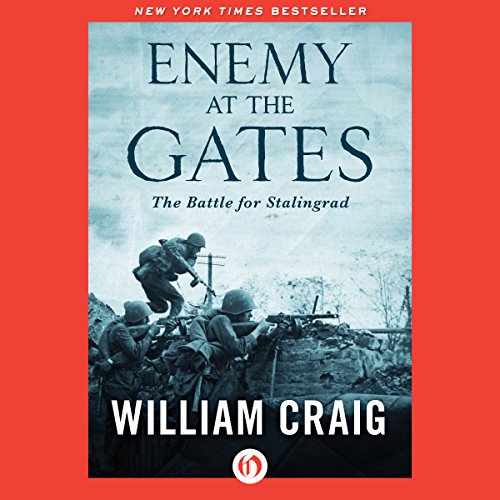
Enemy at the Gates
Summary
A classic work of World War II history that brings to vivid, dramatic life one of the bloodiest battles ever fought - and the beginning of the end for the Third Reich. On August 5, 1942, giant pillars of dust rose over the Russian steppe, marking the advance of the 6th Army, an elite German combat unit dispatched by Hitler to capture the industrial city of Stalingrad and press on to the oil fields of Azerbaijan. The Germans were supremely confident; in three years, they had not suffered a single defeat. The Luftwaffe had already bombed the city into ruins. German soldiers hoped to complete their mission and be home in time for Christmas. The siege of Stalingrad lasted five months, one week, and three days. Nearly two million men and women died, and the 6th Army was completely destroyed. Considered by many historians to be the turning point of World War II in Europe, the Soviet Army's victory foreshadowed Hitler's downfall and the rise of a communist superpower. Best-selling author William Craig spent five years researching this epic clash of military titans, traveling to three continents in order to review documents and interview hundreds of survivors. Enemy at the Gates is the enthralling result: the definitive account of one of the most important battles in world history. The book was the inspiration for the 2001 film of the same name, starring Joseph Fiennes and Jude Law.
©1973 William Craig; This edition published in 2015 by Open Road Integrated Media, Inc. (P)2015 Audible, Inc.

Red Famine
Summary
From the author of the Pulitzer Prize-winning Gulag and the National Book Award finalist Iron Curtain, a revelatory history of one of Stalin's greatest crimes - the consequences of which still resonate today. In 1929 Stalin launched his policy of agricultural collectivization - in effect a second Russian Revolution - which forced millions of peasants off their land and onto collective farms. The result was a catastrophic famine, the most lethal in European history. At least five million people died between 1931 and 1933 in the USSR. But instead of sending relief, the Soviet state made use of the catastrophe to rid itself of a political problem. In Red Famine, Anne Applebaum argues that more than three million of those dead were Ukrainians who perished not because they were accidental victims of a bad policy but because the state deliberately set out to kill them. Applebaum proves what has long been suspected: After a series of rebellions unsettled the province, Stalin set out to destroy the Ukrainian peasantry. The state sealed the republic's borders and seized all available food. Starvation set in rapidly, and people ate anything: grass, tree bark, dogs, corpses. In some cases they killed one another for food. Devastating and definitive, Red Famine captures the horror of ordinary people struggling to survive extraordinary evil. Today, Russia, the successor to the Soviet Union, has placed Ukrainian independence in its sights once more. Applebaum's compulsive narrative recalls one of the worst crimes of the 20th century and shows how it may foreshadow a new threat to the political order in the 21st.
©2017 Anne Applebaum (P)2017 Random House Audio

Stalin, Volume I
Summary
A magnificent new biography that revolutionizes our understanding of Stalin and his world. It has the quality of myth: A poor cobbler's son, a seminarian from an oppressed outer province of the Russian Empire, reinvents himself as a revolutionary and finds a leadership role within a small group of marginal zealots. When the old world is unexpectedly brought down in a total war, the band seizes control of the country, and the new regime it founds as the vanguard of a new world order is ruthlessly dominated from within by the former seminarian until he stands as the absolute ruler of a vast and terrible state apparatus, with dominion over Eurasia. We think we know the story well. Remarkably, Stephen Kotkin's epic new biography shows us how much we still have to learn. Volume One of Stalin begins and ends in January 1928 as Stalin boards a train bound for Siberia, about to embark upon the greatest gamble of his political life. He is now the ruler of the largest country in the world, but a poor and backward one, far behind the great capitalist countries in industrial and military power, encircled on all sides. In Siberia, Stalin conceives of the largest program of social reengineering ever attempted: the root-and-branch uprooting and collectivization of agriculture and industry across the entire Soviet Union. To stand up to the capitalists he will force into being an industrialized, militarized, collectivized great power is an act of will. Millions will die, and many more will suffer, but Stalin will push through to the end against all resistance and doubts. Where did such power come from? The product of a decade of scrupulous and intrepid research, Stalin contains a host of astonishing revelations. Kotkin gives an intimate first-ever view of the Bolshevik regime’s inner geography, bringing to the fore materials from Soviet military intelligence and the secret police.
©2014 Stephen Kotkin (P)2014 Recorded Books

The New Tsar
Summary
The epic tale of the rise to power of Russia's current president - the only complete biography in English - that fully captures his emergence from shrouded obscurity and deprivation to become one of the most consequential and complicated leaders in modern history, by the former New York Times Moscow bureau chief. In a gripping narrative of Putin's rise to power as Russia's president, Steven Lee Myers recounts Putin's origins - from his childhood of abject poverty in Leningrad to his ascension through the ranks of the KGB and his eventual consolidation of rule. Along the way world events familiar to listeners, such as September 11th and Russia's war in Georgia in 2008, as well as the 2014 annexation of Crimea and the ongoing conflict in Ukraine, are presented from never-before-seen perspectives. This audiobook is a grand, staggering achievement and a breathtaking look at one man's rule. On one hand, Putin's many reforms - from tax cuts to an expansion of property rights - have helped reshape the potential of millions of Russians whose only experience of democracy had been crime, poverty, and instability after the fall of the Soviet Union. On the other hand, Putin has ushered in a new authoritarianism, unyielding in his brutal repression of revolts and squashing of dissent. Still, he retains widespread support from the Russian public. The New Tsar is a narrative tour de force, deeply researched and utterly necessary for anyone fascinated by the formidable and ambitious Vladimir Putin but also for those interested in the world and what a newly assertive Russia might mean for the future.
©2015 Steven Lee Myers (P)2015 Random House Audio

Stalingrad
Summary
Tantor Audio presents the complete audio version of the long-awaited one-volume campaign history from the leading experts of the decisive clash of Nazi and Soviet forces at Stalingrad. Stalingrad is an abridged edition of the five-volume Stalingrad Trilogy.
©2017 The University Press of Kansas (P)2017 Tantor

Armor and Blood
Summary
While the Battle of Kursk has long captivated World War II aficionados, it has been unjustly overlooked by historians. Drawing on the masses of new information made available by the opening of the Russian military archives, Dennis E. Showalter at last corrects that error. This battle was the critical turning point on World War II's Eastern Front. In the aftermath of the Red Army's brutal repulse of the Germans at Stalingrad, the stakes could not have been higher. More than 3,000,000 men and 8,000 tanks met in the heart of the Soviet Union, some 400 miles south of Moscow, in an encounter that both sides knew would reshape the war. The adversaries were at the peak of their respective powers. On both sides, the generals and the dictators they served were in agreement on where, why, and how to fight. The result was a furious death grapple between two of history's most formidable fighting forces - a battle that might possibly have been the greatest of all time. In Armor and Blood, Showalter recreates every aspect of this dramatic struggle. He offers expert perspective on strategy and tactics at the highest levels, from the halls of power in Moscow and Berlin to the battlefield command posts on both sides. But it is the author's exploration of the human dimension of armored combat that truly distinguishes this book. In the classic tradition of John Keegan's The Face of Battle, Showalter's narrative crackles with insight into the unique dynamics of tank warfare - its effect on men's minds as well as their bodies. Scrupulously researched, exhaustively documented, and vividly illustrated, this book is a chilling testament to man's ability to build and to destroy. When the dust settled, the field at Kursk was nothing more than a wasteland of steel carcasses, dead soldiers, and smoking debris. The Soviet victory ended German hopes of restoring their position on the Eastern Front, and put the Red Army on the road to Berlin. Armor and Blood presents listeners with what will likely be the authoritative study of Kursk for decades to come.
©2013 Dennis Showalter (P)2013 Tantor

The Unwomanly Face of War
Summary
A long-awaited English translation of the groundbreaking oral history of women in World War II across Europe and Russia - from the winner of the Nobel Prize in Literature “A landmark.” (Timothy Snyder, author of On Tyranny: Twenty Lessons from the Twentieth Century) For more than three decades, Svetlana Alexievich has been the memory and conscience of the twentieth century. When the Swedish Academy awarded her the Nobel Prize, it cited her invention of “a new kind of literary genre,” describing her work as “a history of emotions...a history of the soul.” In The Unwomanly Face of War, Alexievich chronicles the experiences of the Soviet women who fought on the front lines, on the home front, and in the occupied territories. These women - more than a million in total - were nurses and doctors, pilots, tank drivers, machine-gunners, and snipers. They battled alongside men, and yet, after the victory, their efforts and sacrifices were forgotten. Alexievich traveled thousands of miles and visited more than a hundred towns to record these women’s stories. Together, this symphony of voices reveals a different aspect of the war - the everyday details of life in combat left out of the official histories. Translated by the renowned Richard Pevear and Larissa Volokhonsky, The Unwomanly Face of War is a powerful and poignant account of the central conflict of the 20th century, a kaleidoscopic portrait of the human side of war. “But why? I asked myself more than once. Why, having stood up for and held their own place in a once absolutely male world, have women not stood up for their history? Their words and feelings? They did not believe themselves. A whole world is hidden from us. Their war remains unknown...I want to write the history of that war. A women’s history.” (Svetlana Alexievich) Read by Julia Emelin, Yelena Shmulenson, Allen Lewis Rickman, and Alan Winter THE WINNER OF THE NOBEL PRIZE IN LITERATURE “[F]or her polyphonic writings, a monument to suffering and courage in our time.” “A mighty documentarian and a mighty artist... Her books are woven from hundreds of interviews, in a hybrid form of reportage and oral history that has the quality of a documentary film on paper. But Alexievich is anything but a simple recorder and transcriber of found voices; she has a writerly voice of her own which emerges from the chorus she assembles, with great style and authority, and she shapes her investigations of Soviet and post-Soviet life and death into epic dramatic chronicles as universally essential as Greek tragedies.” (The New Yorker)
©2017 Svetlana Alexievich (P)2017 Random House Audio

A Frozen Hell
Summary
In 1939, tiny Finland waged war - the kind of war that spawns legends - against the mighty Soviet Union, and yet, their epic struggle has been largely ignored. Guerrillas on skis, heroic single-handed attacks on tanks, unfathomable endurance, and the charismatic leadership of one of this century's true military geniuses - these are the elements of both the Finnish victory and a gripping tale of war.
©1991 William R. Trotter (P)2018 Tantor

Crimea
Summary
The terrible conflict that dominated the mid-19th century, the Crimean War, killed at least 800,000 men and pitted Russia against a formidable coalition of Britain, France and the Ottoman Empire. It was a war for territory, provoked by fear that if the Ottoman Empire were to collapse then Russia could control a huge swathe of land from the Balkans to the Persian Gulf. But it was also a war of religion, driven by a fervent, populist and ever more ferocious belief by the Tsar and his ministers that it was Russia's task to rule all Orthodox Christians and control the Holy Land. Orlando Figes' major new book reimagines this extraordinary war, in which the stakes could not have been higher and which was fought with a terrible mixture of ferocity and incompetence. It was both a recognisably modern conflict - the first to be extensively photographed, the first to employ the telegraph, the first 'newspaper war' - and a traditional one, with illiterate soldiers, amateur officers and huge casualties caused by disease. Drawing on a huge range of fascinating sources, Figes also gives the lived experience of the war, from that of the ordinary British soldier in his snow-filled trench to the haunted, gloomy, narrow figure of Tsar Nicholas himself as he vows to take on the whole world in his hunt for religious salvation.
©2010 Orlando Figes (P)2018 Audible, Ltd
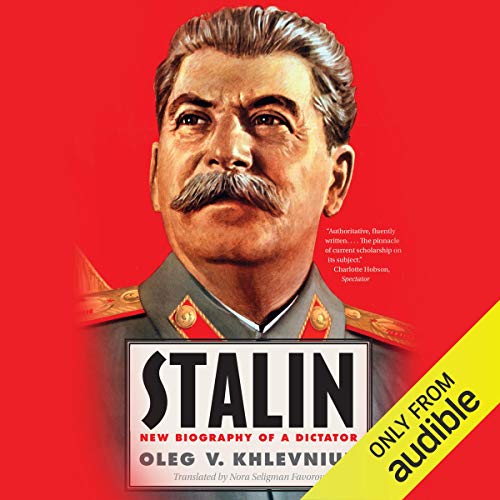
Stalin
Summary
Josef Stalin exercised supreme power in the Soviet Union from 1929 until his death in 1953. During that quarter century, by Oleg Khlevniuk's estimate, he caused the imprisonment and execution of no fewer than a million Soviet citizens per year. Millions more were victims of famine directly resulting from Stalin's policies. What drove him toward such ruthlessness? This essential biography, by the author most deeply familiar with the vast archives of the Soviet era, offers an unprecedented, fine-grained portrait of Stalin, the man and dictator. Without mythologizing Stalin as either benevolent or an evil genius, Khlevniuk resolves numerous controversies about specific events in the dictator's life while assembling many hundreds of previously unknown letters, memos, reports, and diaries into a comprehensive, compelling narrative of a life that altered the course of world history. In brief, revealing prologues to each chapter, Khlevniuk takes his reader into Stalin's favorite dacha, where the innermost circle of Soviet leadership gathered as their vozhd lay dying. Chronological chapters then illuminate major themes: Stalin's childhood, his involvement in the Revolution and the early Bolshevik government under Lenin, his assumption of undivided power and mandate for industrialization and collectivization, the Terror, World War II, and the postwar period. At the book's conclusion, the author presents a cogent warning against nostalgia for the Stalinist era. Cover image: "Stalin is our banner!" poster, 1948. Collection of the Russian State Library, Moscow. © Heritage Image Partnership Ltd/Alamy, Reportage/Archival image.
©2015 Oleg Khlevniuk; Yale University (Translation) (P)2018 Audible, Inc.

The Great Gamble
Summary
The Soviet war in Afghanistan was a grueling debacle that has striking lessons for American foreign policy today. In The Great Gamble, Gregory Feifer examines the war from the perspective of the soldiers on the ground. During the last years of the Cold War, the Soviet Union sent some of its most elite troops to unfamiliar lands in Central Asia to fight a vaguely defined enemy, which eventually defeated their superior number with unconventional tactics. Although the Soviet leadership initially saw the invasion as a victory, many Russian soldiers came to view the war as a demoralizing and devastating defeat, the consequences of which had a substantial impact on the Soviet Union and its collapse. Feifer's extensive research includes fascinating interviews with participants from both sides of the conflict. In gripping detail, he vividly depicts the invasion of a volatile country that no power has ever successfully conquered. Parallels between the Soviet invasion of Afghanistan and the U.S. invasions of Afghanistan and Iraq are impossible to ignore: Both conflicts were waged amid vague ideological rhetoric about freedom. Both were roundly condemned by the outside world for trying to impose their favored forms of government on countries with very different ways of life. And both seem destined to end on uncertain terms. The Great Gamble tells an unforgettable story full of drama, action, and political intrigue whose relevance in our own time is greater than ever.
©2008 Gregory Feifer (P)2009 Tantor

Red November
Summary
Red November is filled with hair-raising, behind-the-scenes stories that take you deep beneath the surface and into the action of the Cold War. Few know how close the world has come to annihilation better than the warriors who served America during the tense, 45-year struggle known as the Cold War. Yet for decades, their work has remained shrouded in secrecy. Now, in this riveting new history, W. Craig Reed, a former navy diver and fast-attack submariner, provides an eye-opening, pulse-pounding narrative of the underwater struggles and espionage operations between the U.S. and the U.S.S.R. that brought us to the brink of nuclear war more than once. Red November is filled with hair-raising, behind-the-scenes stories that take you deep beneath the surface and into the action during the entire Cold War period from 1946 through 1992. Reed served aboard submarines involved in espionage operations, and his father was a top military intelligence specialist intimately involved in the Cuban Missile Crisis. Reed is one of the first authors to obtain so many in-depth interviews with dozens of navy divers, espionage operatives, submariners, and government officials on both sides (including several Soviet submarine captains) about the most daring and decorated missions of the conflict, including top-secret Ivy Bells, Boresight, Bulls Eye, and Holystone operations. Transcending traditional submarine, espionage, and Cold War accounts, Red November is an up-close examination of one of the most dangerous times in world history and an intimate look at the men and women who participated in our country’s longest and most expensive underwater war.
©2010 W. Craig Reed (P)2010 Blackstone Audio, Inc.

Gorbachev
Summary
When Mikhail Gorbachev became the leader of the Soviet Union in 1985, the USSR was one of the world's two superpowers. By 1989, his liberal policies of perestroika and glasnost had permanently transformed Soviet Communism and had made enemies of radicals on the right and left. By 1990 he, more than anyone else, had ended the Cold War, and in 1991, after barely escaping from a coup attempt, he unintentionally presided over the collapse of the Soviet Union he had tried to save. In the first comprehensive biography of the final Soviet leader, William Taubman shows how a peasant boy became the Soviet system's gravedigger, how he clambered to the top of a system designed to keep people like him down, how he found common ground with America's arch-conservative president Ronald Reagan, and how he permitted the USSR and its East European empire to break apart without using force to preserve them. Throughout, Taubman portrays the many sides of Gorbachev's unique character that, by Gorbachev's own admission, make him "difficult to understand". Was he in fact a truly great leader, or was he brought low in the end by his own shortcomings as well as by the unyielding forces he faced? Drawing on interviews with Gorbachev himself, transcripts and documents from the Russian archives, and interviews with Kremlin aides and adversaries as well as foreign leaders, Taubman's intensely personal portrait extends to Gorbachev's remarkable marriage to a woman he deeply loved and to the family that they raised together. Nuanced and poignant yet unsparing and honest, this sweeping account has all the amplitude of a great Russian novel.
©2017 William Taubman (P)2017 Recorded Books

War with Russia
Summary
Featuring an exclusive postscript read by the author. Closely modeled on his NATO experience of war gaming future conflicts, War with Russia is a chilling account of where we are heading if we fail to recognise the threat posed by the Russian president. Written by the recently retired Deputy Supreme Allied Commander Europe and endorsed by senior military figures, this audiobook shows how war with Russia could erupt, with the bloodiest and most appalling consequences, if the necessary steps are not taken urgently. President Putin said, 'We have all the reasons to believe that the policy of containment of Russia which was happening in the 18th, 19th and 20th century is still going on....' And 'if you press the spring, it will release at some point. Something you should remember.' Like any strongman, the Russian president's reputation for strength is everything. Lose momentum, fail to give the people what they want, and he fails. The president has already demonstrated that he has no intention of failing. He has already started a lethal dynamic which, unless checked right now, could see him invade the Baltic States. Russia's invasion and seizure of Georgia in 2008 was our Rhineland moment. We ignored the warning signs - as we did back in the 1930s - and we made it business as usual. Crimea in 2014 was the president's Sudetenland moment, and again he got away with it. Since 2014 Russia has invaded Ukraine. The Baltics could be next. Our political leaders assume that nuclear deterrence will save us. General Sir Richard Shirreff shows us why this will not wash.
©2016 Strategia Worldwide Limited (P)2017 Hodder & Stoughton

The Race to Save the Romanovs
Summary
On the 100th anniversary of the murder of the Russian imperial family, acclaimed historian Helen Rappaport embarks on a quest to uncover the many international plots to save them, why they failed, and who was responsible. The murder of the Romanov family in July 1918 horrified the world, and its aftershocks still reverberate today. In Putin's autocratic Russia, the Revolution itself is considered a crime, and its anniversary was largely ignored. In stark contrast, the centenary of the massacre of the imperial family will be commemorated in 2018 by a huge ceremony to be attended by the Patriarch of the Russian Orthodox Church. While the murder itself has received major attention, what has never been investigated in detail are the various plots behind the scenes to save the family - on the part of their royal relatives, other governments, and Russian monarchists loyal to the tsar. Rappaport refutes the claim that the fault lies entirely with King George V, as has been the traditional claim for the last century. The responsibility for failing the Romanovs must be equally shared. The question of asylum for the tsar and his family was an extremely complicated issue that presented enormous political, logistical, and geographical challenges at a time when Europe was still at war. Like a modern-day detective, Helen Rappaport draws on new and never-before-seen sources from archives in the United States, Russia, Spain, and the UK, creating a powerful account of near misses and close calls with a heartbreaking conclusion. With its up-to-the-minute research, The Race to Save the Romanovs is sure to replace outdated classics as the final word on the fate of the Romanovs.
©2018 Helen Rappaport (P)2018 Macmillan Audio

Retreat from Moscow
Summary
Germany's winter campaign of 1941-1942 has commonly been seen as its "first defeat". In Retreat from Moscow, David Stahel argues that, in fact, it was its first strategic success in the east. Though the Red Army managed to push the Wehrmacht back from Moscow, the Germans lost far fewer men (one to six), frustrated their enemy's strategic plan, and emerged in the spring unbroken and poised to recapture the initiative. Hitler's new strategic plan called for holding important Russian industrial cities, which the German army would do. And the Soviet plan as of January 1942 aimed for nothing less than the destruction of Army Group Centre, but in fact, not a single German army, corps, or division was ever successfully destroyed. Lacking the professionalism, training, and experience of the Wehrmacht, the Red Army mounted an offensive that attempted to break German lines in countless head-on assaults, which led to far more tactical defeats than victories. Through journals, memoirs, and wartime correspondence, Stahel takes us into the Wolf's Lair and reveals a German command at war with itself. And through soldiers' diaries and letters home, he paints a rich portrait of life and death on the front, where the men of the Ostheer fight against frostbite as much as they do Soviet artillery.
©2019 David Stahel (P)2019 Tantor

A Mad Catastrophe
Summary
The Austro-Hungarian army that marched east and south to confront the Russians and Serbs in the opening campaigns of World War I had a glorious past but a pitiful present. Speaking a mystifying array of languages and lugging outdated weapons, the Austrian troops were hopelessly unprepared for the industrialized warfare that would shortly consume Europe. As prizewinning historian Geoffrey Wawro explains in A Mad Catastrophe, the doomed Austrian conscripts were an unfortunate microcosm of the Austro-Hungarian Empire itself - both equally ripe for destruction. After the assassination of the Austrian Archduke Franz Ferdinand in June 1914, Germany goaded the Empire into a war with Russia and Serbia. With the Germans massing their forces in the west to engage the French and the British, everything - the course of the war and the fate of empires and alliances from Constantinople to London - hinged on the Habsburgs’ ability to crush Serbia and keep the Russians at bay. However, Austria-Hungary had been rotting from within for years, hollowed out by repression, cynicism, and corruption at the highest levels. Commanded by a dying emperor, Franz Joseph I, and a querulous celebrity general, Conrad von Hötzendorf, the Austro-Hungarians managed to bungle everything: their ultimatum to the Serbs, their declarations of war, their mobilization, and the pivotal battles in Galicia and Serbia. By the end of 1914, the Habsburg army lay in ruins and the outcome of the war seemed all but decided. Drawing on deep archival research, Wawro charts the decline of the Empire before the war and reconstructs the great battles in the east and the Balkans in thrilling and tragic detail. A Mad Catastrophe is a riveting account of a neglected face of World War I, revealing how a once-mighty empire collapsed in the trenches of Serbia and the Eastern Front, changing the course of European history.
©2014 Geoffrey Wawro (P)2014 Audible Inc.

Where the Iron Crosses Grow
Summary
The Crimea was one of the crucibles of the war on the Eastern Front, where first a Soviet and then a German army were surrounded, fought desperate battles, and were eventually destroyed. The fighting in the region was unusual for the Eastern Front in many ways, in that naval supply, amphibious landings, and naval evacuation played major roles, while both sides were also conducting ethnic cleansing as part of their strategy - the Germans eliminating the Jews and the Soviets purging the region of Tartars. From 1941, when the Soviets first created the Sevastopol fortified region, the Crimea was a focal point of the war in the East. German forces under the noted commander Manstein conquered the area in 1941-42, which was followed by two years of brutal colonization and occupation before the Soviet counteroffensive in 1944 destroyed the German 17th Army.
©2014 Robert Forczyk (P)2015 Tantor

The Resurrection of the Romanovs
Summary
The passage of more than 90 years and the publication of hundreds of books in dozens of languages has not extinguished an enduring interest in the mysteries surrounding the 1918 execution of the last Russian Tsar Nicholas II and his family. The Resurrection of the Romanovs draws on a wealth of new information from previously unpublished materials and unexplored sources to probe the most enduring Romanov mystery of all: the fate of the Tsar's youngest daughter, Anastasia, whose remains were not buried with those of her family, and her identification with Anna Anderson, the woman who claimed to be the missing Grand Duchess. Refuting long-accepted evidence in the Anderson case, The Resurrection of the Romanovs finally explodes the greatest royal mystery of the 20th century.
©2010 Greg King & Penny Wilson (P)2018 Dreamscape Media, LLC