The World category has 419 audiobooks on Listento.it, with an average listener rating of 4.5★ across 2,940 ratings. The most-rated is A Short History of Nearly Everything.

A Short History of Nearly Everything
Summary
A Short History of Nearly Everything is Bill Bryson’s quest to find out everything that has happened from the Big Bang to the rise of civilization - how we got from there, being nothing at all, to here, being us. His challenge is to take subjects that normally bore the pants off most of us and see if there isn't some way to render them comprehensible to people who have never thought they could be interested in science. It's not so much about what we know, as about how we know what we know. How do we know what is in the centre of the Earth, or what a black hole is, or where the continents were 600 million years ago? How did anyone ever figure these things out? On his travels through time and space, Bill Bryson takes us with him on the ultimate eye-opening journey and reveals the world in a way most of us have never seen it before.
©2003 Bill Bryson (P)2003 Random House Audiobooks

Forgiveness
Summary
When the Second World War broke out, Ralph MacLean chose to escape his troubled life on the Magdalen Islands in eastern Canada and volunteer to serve his country overseas. Meanwhile, in Vancouver, Mitsue Sakamoto saw her family and her stable community torn apart after the Japanese attack on Pearl Harbor. Like many young Canadian soldiers, Ralph was captured by the Japanese army. He would spend the war in prison camps, enduring pestilence, beatings and starvation as well as a journey by hell ship to Japan to perform slave labor, while around him his friends and countrymen perished. Back in Canada, Mitsue and her family were expelled from their home by the government and forced to spend years eking out an existence in rural Alberta, working other people's land for a dollar a day. By the end of the war, Ralph emerged broken but a survivor. Mitsue, worn down by years of backbreaking labour, had to start all over again in Medicine Hat, Alberta. A generation later, at a high school dance, Ralph's daughter and Mitsue's son fell in love. Although the war toyed with Ralph's and Mitsue's lives and threatened to erase their humanity, these two brave individuals somehow surmounted enormous transgressions and learned to forgive. Without this forgiveness, their grandson Mark Sakamoto would never have come to be.
©2014 Mark Sakamoto (P)2018 Audible, Inc.
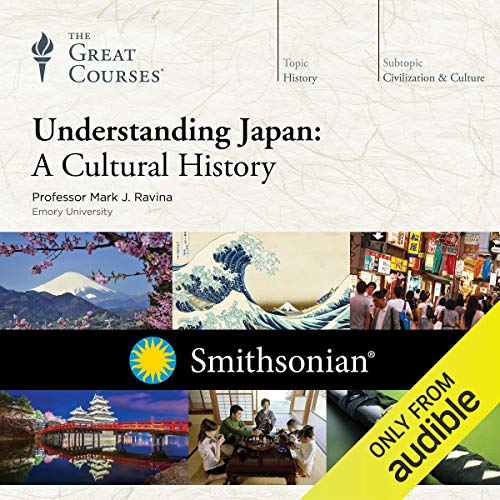
Understanding Japan
Summary
Japan's extraordinary culture is like no other in the world, and it remains mysterious to many of us. And that's unfortunate, because to truly understand Japan's influence on the world stage, one needs to understand Japan's culture - on its own terms. In an exciting partnership with the Smithsonian, The Great Courses presents these 24 lectures that offer an unforgettable tour of Japanese life and culture. Professor Ravina, with the expert collaboration of the Smithsonian's historians, brings you a grand portrait of Japan. From the dawn of Confucianism and the Meiji Restoration to World War II and the economic miracle years of 1955 to 1975, you'll explore landmark periods of Japanese history and learn how broad events and movements introduced, innovated, and revised everything from spirituality to popular entertainment. Along the way you'll get revealing insights into Shinto (Japan's indigenous religion), the art of Katsushika Hokusai, literary works like The Tale of Genji and the haiku of Basho, the everyday lives of samurai, the universal appeal of filmmakers like Akira Kurosawa, foods like yakitori and tempura, and so much more. You'll come away from Professor Ravina's final lecture with a stronger sense of the very soul of this one-of-a-kind nation.
©2015 The Great Courses (P)2015 The Teaching Company, LLC

Great Mythologies of the World
Summary
The deep-seated origins and wide-reaching lessons of ancient myths built the foundation for our modern legacies. Explore the mythologies of Europe, the Americas, Asia, Africa, and the Middle East. Learn what makes these stories so important, distinctive, and able to withstand the test of time. Discover how, despite geographical implausibilities, many myths from across the oceans share themes, morals, and archetypes. PLEASE NOTE: When you purchase this title, the accompanying reference material will be available in your Library section along with the audio.
©2015 The Great Courses (P)2015 The Teaching Company, LLC

The Black Death: The World's Most Devastating Plague
Summary
Many of us know the Black Death as a catastrophic event of the medieval world. But the Black Death was arguably the most significant event in Western history, profoundly affecting every aspect of human life, from the economic and social to the political, religious, and cultural. In its wake the plague left a world that was utterly changed, forever altering the traditional structure of European societies and forcing a rethinking of every single system of Western civilization: food production and trade, the church, political institutions, law, art, and more. In large measure, by the profundity of the changes it brought, the Black Death produced the modern world we live in today. While the story of the Black Death is one of destruction and loss, its breathtaking scope and effects make it one of the most compelling and deeply intriguing episodes in human history. Understanding the remarkable unfolding of the plague and its aftermath provides a highly revealing window not only on the medieval world but also on the forces that brought about the Renaissance, the Protestant Reformation, and modernity itself. Speaking to the full magnitude of this world-changing historical moment, The Black Death: The World's Most Devastating Plague, taught by celebrated medievalist Dorsey Armstrong of Purdue University, takes you on an unforgettable excursion into the time period of the plague, its full human repercussions, and its transformative effects on European civilization. In 24 richly absorbing lectures, you'll follow the path of the epidemic in its complete trajectory across medieval Europe. Majestic in scope and remarkable in detail, this course goes to the heart of one of Western history's most catalytic and galvanizing moments, the effects of which gave us the modern world. PLEASE NOTE: When you purchase this title, the accompanying reference material will be available in your Library section along with the audio.
©2016 The Teaching Company, LLC (P)2016 The Great Courses

Origin Story
Summary
A captivating history of the universe - from before the dawn of time through the far reaches of the distant future. Most historians study the smallest slivers of time, emphasizing specific dates, individuals, and documents. But what would it look like to study the whole of history, from the big bang through the present day - and even into the remote future? How would looking at the full span of time change the way we perceive the universe, the earth, and our very existence? These were the questions David Christian set out to answer when he created the field of "Big History", the most exciting new approach to understanding where we have been, where we are, and where we are going. In Origin Story, Christian takes readers on a wild ride through the entire 13.8 billion years we've come to know as "history". By focusing on defining events (thresholds), major trends, and profound questions about our origins, Christian exposes the hidden threads that tie everything together - from the creation of the planet to the advent of agriculture, nuclear war, and beyond. With stunning insights into the origin of the universe, the beginning of life, the emergence of humans, and what the future might bring, Origin Story boldly reframes our place in the cosmos.
©2018 David Christian (P)2018 Recorded Books

Ancient Mesopotamia
Summary
When we imagine what life might have been like thousands of years in the past, the images we often conjure are primitive ones: reed and mud huts or plain brick dwellings, cooking pits, villagers, and simple farms. That was indeed what life was like in the earliest settlements, but by 5,000 years ago, life in some places had become much more sophisticated than we might think. Impressive achievements - like stepped temples that towered like mountains, elaborate palaces (some with bathrooms and plumbing), and complex houses - were also a part of life for people who lived in cities that arose thousands of years ago, particularly in the fertile region that emerged along the Tigris and Euphrates Rivers. Welcome to Mesopotamia, the ancient name for the region that is now Iraq, a remarkably advanced civilization that flourished for two-thirds of the time that civilization has existed on Earth. Mesopotamians mastered irrigation agriculture; built the first complex urban societies; developed writing, literature, and law; and united vast regions through warfare and diplomacy. While civilizations like Greece and Rome have an unbroken tradition of written histories, the rich history of Mesopotamia has only been recently rediscovered, thanks to the decipherment of Mesopotamia's cuneiform writing less than 200 years ago. In this 24-lecture course taught by Professor Podany, you'll fill in the blanks of your historical understanding as you witness a whole new world opening before your eyes. Riveting stories about kings and priestesses as well as ordinary people from all walks of life transport you back in time, giving you invaluable insights into the history of a landmark region that has long been known as the cradle of civilization. PLEASE NOTE: When you purchase this title, the accompanying reference material will be available in your Library section along with the audio.
©2018 The Great Courses (P)2018 The Teaching Company, LLC

Humans: A Brief History of How We F*cked It All Up
Summary
Modern humans have come a long way in the 70,000 years they’ve walked the earth. Art, science, culture, trade - on the evolutionary food chain, we’re true winners. But it hasn’t always been smooth sailing, and sometimes - just occasionally - we’ve managed to truly f--k things up. Weaving together history, science, politics, and pop culture, Humans offers a panoramic exploration of humankind in all its glory, or lack thereof. From Lucy, our first ancestor, who fell out of a tree and died, to General Zhou Shou of China, who stored gunpowder in his palace before a lantern festival, to the Austrian army attacking itself one drunken night, to the most spectacular fails of the present day, Humans reveals how even the most mundane mistakes can shift the course of civilization as we know it. Lively, wry, and brimming with brilliant insight, this unique compendium offers a fresh take on world history and is one of the most entertaining listens of the year.
©2019 Tom Phillips (P)2019 Harlequin Enterprises, Limited

Ancient Civilizations of North America
Summary
For the past few hundred years, most of what we’ve been taught about the native cultures of North America came from reports authored by the conquerors and colonizers who destroyed them. Now - with the technological advances of modern archaeology and a new perspective on world history - we are finally able to piece together their compelling true stories. In Ancient Civilizations of North America, Professor Edwin Barnhart, Director of the Maya Exploration Center, will open your eyes to a fascinating world you never knew existed - even though you’ve been living right next to it, or even on top of it, for as long as you’ve been on the continent. The peoples of ancient North America were exceptionally knowledgeable about their environment, but their intellectual and artistic curiosity went much beyond the immediate need for food and safety. Beginning thousands of years ago, and without benefit of written language, native peoples became mathematicians, construction and soil engineers, astronomers, urban planners, and more. They developed thriving cities, extensive trade routes, canals to bring water to the desert, and earthworks we still marvel over today. In 24 exciting lectures, you’ll learn about the vibrant cities of Poverty Point, the first city in North America, built about 3,500 years ago, and Cahokia, the largest city of ancient North America. You’ll explore the many ways in which the Chacoan environment provided cultural and religious focus for peoples of the southwest. And you’ll learn about the Iroquoian source of some of our most basic “American” values. PLEASE NOTE: When you purchase this title, the accompanying PDF will be available in your Audible Library along with the audio.
©2018 The Great Courses (P)2018 The Teaching Company, LLC

Understanding Imperial China: Dynasties, Life, and Culture
Summary
A knowledge of China's imperial history is vital for any understanding of its present, as modern China is linked in many ways to the extraordinary culture of its empire. These 24 lectures take you to the heart of life during China's imperial era, through the lives of individual subjects of all social ranks. Across the arc of the course, you'll witness what daily life was like for government bureaucrats, for scholars, for women of the court, for soldiers, merchants, craftspeople, courtesans, imperial cooks, and many others - all against the backdrop of the diversity, the genius, and the majesty of imperial China. You'll hear about such memorable sights as the grand boulevards; splendorous palaces; imposing temples of Chang'an, the medieval world's greatest city; and the Qingming Shanghetu, a 17-foot painted scroll that gloriously portrays Song Dynasty life. And you'll meet unforgettable human beings, whose lives vividly reveal the world around them, such as Ban Zhao, Han-era woman of letters, poet, scholar, and teacher; Tao Yuanming, Daoist luminary and the empire's first great poet; Zhu Yuanzhang, powerful warlord and founder of the Ming Dynasty; and Hong Xiuquan, visionary reformer and architect of the religiously inspired Taiping Rebellion. Understanding Imperial China: Dynasties, Life, and Culture is your passport to this incredible, historic world. PLEASE NOTE: When you purchase this title, the accompanying reference material will be available in your Library section along with the audio.
©2017 The Teaching Company, LLC (P)2017 The Great Courses

Inglorious Empire
Summary
In the 18th century, India's share of the world economy was as large as Europe's. By 1947, after two centuries of British rule, it had decreased six-fold. Beyond conquest and deception, the Empire blew rebels from cannons, massacred unarmed protesters, entrenched institutionalized racism, and caused millions to die from starvation. British imperialism justified itself as enlightened despotism for the benefit of the governed, but Shashi Tharoor takes on and demolishes this position, demonstrating how every supposed imperial "gift" - from the railways to the rule of law - was designed in Britain's interests alone. He goes on to show how Britain's Industrial Revolution was founded on India's deindustrialization and the destruction of its textile industry. In this bold and incisive reassessment of colonialism, Tharoor exposes to devastating effect the inglorious reality of Britain's stained Indian legacy.
©2016 Shashi Tharoor (P)2018 Tantor
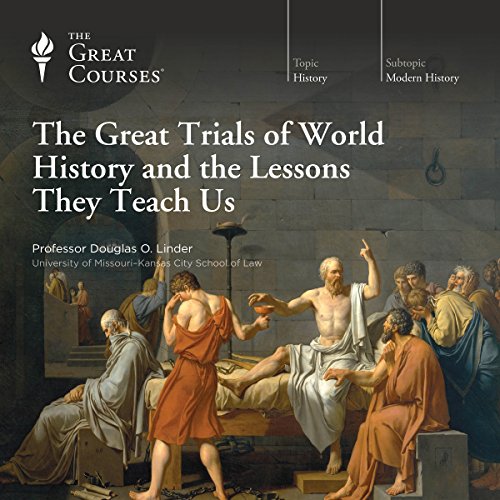
The Great Trials of World History and the Lessons They Teach Us
Summary
No understanding of the past is complete without an understanding of the legal battles and struggles that have done so much to shape it. Inside a survey of world history's greatest trials are the key insights to critical issues we still talk about today, including freedom of speech, the death penalty, religious freedom, and the meaning of equality. Join Professor Linder for these 24 lectures that investigate important legal cases from around the world and across the centuries. From the trials of Socrates in ancient Athens and Thomas More in Henry VIII's England to the Nuremburg Trials in the wake of World War II and the media frenzy of the O. J. Simpson murder case, you'll discover what each of these trials has to teach us about ourselves and our civilization. Professor Linder takes you back in time to revisit some of history's most famous trials from fresh perspectives that ground them in the evolution of human ideas of law and justice, including the Salem Witch Trials, and the Scopes "Monkey" Trial. You'll also encounter less familiar (but equally important) legal battles, including medieval trials by ordeal and the Trial of Giordano Bruno, which would impact the later trial of Galileo. For years, Professor Linder has studied the fascinating intersection between history and jurisprudence. Now he's crafted these lectures to share that fascination with you. PLEASE NOTE: When you purchase this title, the accompanying reference material will be available in your Library section along with the audio.
©2017 The Teaching Company, LLC; 2017 The Great Courses (P)2017 The Great Courses

La grande histoire du monde
Summary
L'histoire du monde de la préhistoire à nos jours expliquée avec le talent d'un conteur qui nous invite à sortir du point de vue strictement européen. Des grands empires de l'Antiquité à la chute de l'URSS, de l'Europe de Charlemagne au Japon du XIXe siècle, de l'Asie des Mongols à l'Afrique de la décolonisation, cet ouvrage nous convie à un voyage extraordinaire au fil des siècles. Procédant par étapes chronologiques, il suit l'évolution des grandes civilisations les unes par rapport aux autres. Il réussit en même temps à nous faire comprendre la façon dont chaque peuple considère son passé. Nous avons tous en tête aujourd'hui l'importance nouvelle de la Chine, de l'Iran, de l'Inde. Nous percevons le rôle essentiel que vont jouer l'Afrique et l'Amérique latine. Nous voyons à quelle vitesse la montée de nouvelles puissances reconfigure le monde. C'est pourquoi il paraît urgent de mieux connaître son histoire. Introduction Prologue : Brève histoire de la préhistoire ; Prologue : Survol de la haute Antiquité ; Première partie : Un monde éclaté Les fondements des trois grandes civilisations : Chapitre 1 : L'Occident, Athènes et Jérusalem ; Chapitre 2 : La Chine, Laozi et Confucius ; Chapitre 3 : L'Inde, Hindouisme et bouddhisme. Quatre empires de l'Antiquité : Chapitre 4 : Un millénaire d'empires perses, des Achéménides aux Sassanides ; Chapitre 5 : L'Empire chinois, du premier empereur à la dynastie Han ; Chapitre 6 : Le premier empire indien et l'âge classique de l'Inde ; Chapitre 7 : L'Empire romain en cinq idées-forces, VIIIe siècle av. J.C-Ve siècle ap. J.C. Le monde au temps d'Haroun al-Rachid : Chapitre 8 : Naissance de l'islam, l'âge d'or arabe, VIIe-XIe siècle ; Chapitre 9 : La Chine des grandes inventions à l'époque de Tang-Song ; Chapitre 10 : Charlemagne et la formation de l'Europe ; Chapitre 11 : Les Vikings ; Chapitre 12 : Un tour du monde de 600 à l'an mil. Le monde au temps des invasions mongoles : Chapitre 13 : Beau et sombre Moyen Âge, XIIe-XIVe siècle ; Chapitre 14 : Le siècle des Mongols ; Chapitre 15 : Les grands empires africains du Moyen Âge ; Chapitre 16 : Un tour du monde au XVe siècle ; Deuxième partie : Un monde reconfiguré Le XVIe siècle : Chapitre 17 : L'Europe décolle ; Chapitre 18 : L'Empire espagnol 1492-1810 ; Chapitre 19 : L'Empire portugais XVIe-XVIIe siècle ; Chapitre 20 : L'Europe au XVIe siècle ; Chapitre 21 : Quatre empires musulmans, XVIe-XVIIe siècle ; Chapitre 22 : Le Japon s'ouvre et se referme, XVIe-début XIXe siècle. Le XVIIe siècle : Chapitre 23 : La guerre de Trente Ans et l'Europe du XVIIe siècle ; Chapitre 24 : La colonisation en Amérique du Nord ; Chapitre 25 : Les traites négrières et le martyre de l'Afrique. Le XVIIIe siècle : Chapitre 26 : La science, les Lumières, le libéralisme ; Chapitre 27 : L'émergence de la Prusse et de la Russie ; Chapitre 28 : La conquête anglaise de l'Inde, XVIIe-XIXe siècle ; Chapitre 29 : L'exploration du Pacifique ; Chapitre 30 : La Chine au XVIIIe siècle ; Chapitre 31 : Le temps des révolutions. Troisième partie : Un monde dominé Le siècle de l'Europe : Chapitre 32 : L'Europe domine le monde, 1815-1914 ; Chapitre 33 : L'Europe au temps des nations, de 1815 au tournant du XIXe siècle ; Chapitre 34 : Les États-Unis en cinq idées-forces ; Chapitre 35 : L'Amérique latine de Bolivar à Zapata ; Chapitre 36 : La Chine humiliée ; Chapitre 37 : Le Japon dans le club des puissances, 1853-1914 ; Chapitre 38 : La ruée vers l'Afrique ; Chapitre 39 : Le déclin de l'Empire ottoman. Le XXe siècle : Chapitre 40 : Une vision mondiale de la Première Guerre ; Chapitre 41 : La reconstitution du monde au sortir de la guerre ; Chapitre 42 : Les débuts de l'URSS et les tentatives d'expansion mondiale du communisme, 1917-1941 ; Chapitre 43 : Le Royaume-Uni, la France, les États-Unis entre les deux guerres ; Chapitre 44 : Les régimes autoritaires et la montée à la guerre, Italie, Allemagne, Japon ; Chapitre 45 : La Seconde Guerre mondiale en quatre temps forts, 1937-1945 ; Chapitre 46 : Le monde en deux blocs, 1947-1991 ; Chapitre 47 : Les moments-clés de la décolonisation ; Chapitre 48 : Le Moyen-Orient depuis 1945 ; Chapitre 49 : La Chine, de Mao à Deng Xiaoping ; Épilogue ; Remerciements.
©2016 Librairie Arthème Fayard (P)2020 Audiolib

The Second World War: Milestones to Disaster
Summary
Churchill's history of the Second World War is, and will remain, the definitive work. Lucid, dramatic, remarkable for its breadth and sweep and for its sense of personal involvement, it is universally acknowledged as a magnificent reconstruction. Please note: This book was originally published in six volumes: 1.The Gathering Storm 2. Their Finest Hour 3. The Grand Alliance 4. The Hinge of Fate5. Closing the Ring 6. Triumph and Tragedy Churchill then condensed these into four volumes, which have since been released as one, rather hefty, publication. Audible has published the unabridged recordings of Churchill's condensed volume, divided into four parts, as follows: 1.Milestone to Disaster 2.Alone 3.The Grand Alliance 4.Triumph and Tragedy
©1959 Cassell and Co. Ltd; 1990 the Esate of Winston Churchill (P)2014 Audible, Inc.

History's Greatest Voyages of Exploration
Summary
Mutiny. Disease. Starvation. Cannibals. From the ancient wayfarers to modern astronauts, world explorers have blazed trails fraught with danger. Yet, as History's Greatest Voyages of Exploration vividly demonstrates, exploration continues to be one of humanity's deepest impulses. Across 24 lectures that unveil the process by which we came to know the far reaches of our planet, you'll witness the awe-inspiring and surprisingly interconnected tale of global exploration. An award-winning history professor from the University of Tennessee, Knoxville, revolutionizes how you view the world as he introduces you to some of the greatest and most influential explorers ever known-successful as well as unsuccessful, admirable as well as flawed. You'll be spellbound as you learn of the treacherous, at times fatal, expeditions into the unknown these adventurers embarked upon, whether to the frozen Poles, Asia, Europe, the Americas, Africa, the ocean's depths, or the final frontier of space. Through it all, you consider what drove these intrepid individuals, from proselytizing and pilgrimage to the lure of wealth, conquest, fame, and new lands, as evidenced by the Vikings' arrival in North America; Marco Polo's journey along the Silk Road to China; Christopher Columbus' "Enterprise of the Indies"; the conquistadors' ravages in Latin America; and the tiny kingdom of Portugal's triumphant circumnavigation of Africa to seize control of trade in the Indian Ocean. In every lesson, you'll follow these fascinating figures - including several remarkable women - as they venture into uncharted territory and put themselves, and often their crews, in dire peril. With Professor Liulevicius' uniquely global approach, you also get a meaningful portrait of the travels of non-Westerners, as well as the perspectives of discovered people. PLEASE NOTE: When you purchase this title, the accompanying reference material will be available in your Library section along with the audio.
©2015 The Teaching Company, LLC (P)2015 The Great Courses
The Perfectionists
Summary
The revered New York Times best-selling author traces the development of technology from the Industrial Age to the Digital Age to explore the single component crucial to advancement - precision - in a superb history that is both an homage and a warning for our future. The rise of manufacturing could not have happened without an attention to precision. At the dawn of the Industrial Revolution in 18th-century England, standards of measurement were established, giving way to the development of machine tools - machines that make machines. Eventually, the application of precision tools and methods resulted in the creation and mass production of items from guns and glass to mirrors, lenses, and cameras - and eventually gave way to further breakthroughs, including gene splicing, microchips, and the Hadron Collider. Simon Winchester takes us back to origins of the Industrial Age, to England where he introduces the scientific minds that helped usher in modern production: John Wilkinson, Henry Maudslay, Joseph Bramah, Jesse Ramsden, and Joseph Whitworth. It was Thomas Jefferson who later exported their discoveries to the fledgling United States, setting the nation on its course to become a manufacturing titan. Winchester moves forward through time, to today’s cutting-edge developments occurring around the world, from America to Western Europe to Asia. As he introduces the minds and methods that have changed the modern world, Winchester explores fundamental questions. Why is precision important? What are the different tools we use to measure it? Who has invented and perfected it? Has the pursuit of the ultra-precise in so many facets of human life blinded us to other things of equal value, such as an appreciation for the age-old traditions of craftsmanship, art, and high culture? Are we missing something that reflects the world as it is, rather than the world as we think we would wish it to be? And can the precise and the natural co-exist in society?
©2018 Simon Winchester (P)2018 HarperCollins Publishers

The Lost City of Z
Summary
A grand mystery reaching back centuries. A sensational disappearance that made headlines around the world. A quest for truth that leads to death, madness or disappearance for those who seek to solve it. The Lost City of Z is a blockbuster adventure narrative about what lies beneath the impenetrable jungle canopy of the Amazon. After stumbling upon a hidden trove of diaries, acclaimed New Yorker writer David Grann set out to solve "the greatest exploration mystery of the 20th century": What happened to the British explorer Percy Fawcett and his quest for the Lost City of Z? In 1925 Fawcett ventured into the Amazon to find an ancient civilization, hoping to make one of the most important discoveries in history. For centuries Europeans believed the world's largest jungle concealed the glittering kingdom of El Dorado. Thousands had died looking for it, leaving many scientists convinced that the Amazon was truly inimical to humankind. But Fawcett, whose daring expeditions helped inspire Conan Doyle's The Lost World, had spent years building his scientific case. Captivating the imagination of millions, Fawcett embarked with his 21-year-old son, determined to prove that this ancient civilization, which he dubbed "Z", existed. Then he and his expedition vanished. Fawcett's fate, and the tantalizing clues he left behind about "Z", became an obsession for hundreds who followed him into the uncharted wilderness. For decades scientists and adventurers have searched for evidence of Fawcett's party and the lost City of Z. As David Grann delved ever deeper into the mystery surrounding Fawcett's quest, and the greater mystery of what lies within the Amazon, he found himself, like the generations who preceded him, being irresistibly drawn into the jungle's "green hell". His quest for the truth and his stunning discoveries about Fawcett's fate and "Z" form the heart of this complex, enthralling narrative.
©2009 David Grann (P)2009 Random House

The Ottoman Empire
Summary
By understanding the dramatic story of the Ottoman Empire - from its early years as a collection of raiders and conquerors to its undeniable power in the 15th and 16th centuries to its catastrophic collapse in the wreckage of the First World War - one can better grasp the current complexities of the Middle East. Over the course of these 36 enlightening lectures, investigate over 600 years of history that covers the nature of Ottoman identity, the achievements of the Sultan's court, and stories of confrontation and cooperation with the West. Befitting a story of such epic scope and grandeur, every lecture is a treasure trove of historical insights into the people, events, themes, and locales responsible for shaping the story of this often-overlooked empire. You'll cover everything from Rumi, the whirling dervishes, and the importance of the sultan's grand viziers to the wars of Sultan Suleiman I, the shadowy politics of the Committee of Union and Progress, and the birth of the Turkish Republic under Kemal Atatürk. Welcome to a fascinating story of the triumph and tragedy, war and peace, intellectual progress and civil insurrection of a great empire that, for all its glory and grandeur, has left an important legacy that will shape the future of the Balkan nation-states, the Turkish Republic, and the Arab world - and those of us in the West as well. PLEASE NOTE: When you purchase this title, the accompanying reference material will be available in your Library section along with the audio.
©2017 The Teaching Company, LLC (P)2017 The Great Courses

Pirate Hunters
Summary
A thrilling new adventure of danger and deep-sea diving, historic mystery and suspense, by the author of the New York Times best seller Shadow Divers. Finding and identifying a pirate ship is the hardest thing to do under the sea. But two men - John Chatterton and John Mattera - are willing to risk everything to find the Golden Fleece, the ship of the infamous pirate Joseph Bannister. While he was at large during the Golden Age of Piracy in the 17th century, Bannister's exploits would have been more notorious than Blackbeard's, more daring than Kidd's, but his story and his ship have been lost to time. If Chatterton and Mattera succeed, they will make history - it will be just the second time ever that a pirate ship has been discovered and positively identified. Soon, however, they realize that cutting-edge technology and a willingness to lose everything aren't enough to track down Bannister's ship. They must travel the globe in search of historic documents and accounts of the great pirate's exploits, face down dangerous rivals, and battle the tides of nations and governments and experts. But it's only when they learn to think and act like pirates - like Bannister - that they become able to go where no pirate hunters have gone before. Fast paced and filled with suspense, fascinating characters, history, and adventure, Pirate Hunters is an unpauseable story that goes deep to discover truths and souls long believed lost.
©2015 Robert Kurson (P)2015 Random House Audio
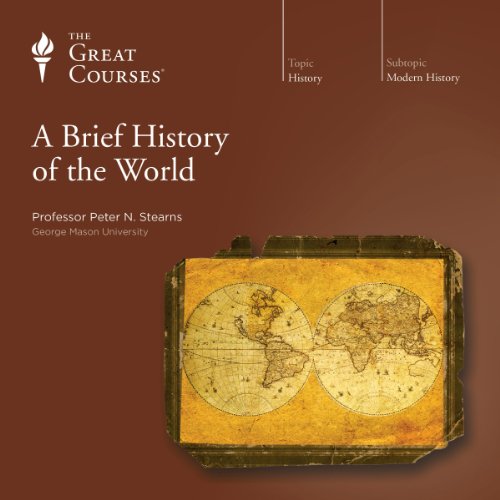
A Brief History of the World
Summary
The construction of the great pyramids of Egypt, the development of democracy in ancient Greece, the glories of ancient Rome - these stories are familiar to students of history. But what about the rest of the world? How do the histories of China and Japan, or Russia, India, and the remote territories of Sub-Saharan Africa and South America fit in with commonly known accounts of Western traditions? Learn the rest of the story with these 36 riveting lectures that survey the expanse of human development and civilization across the globe. From the invention of agriculture in the Neolithic era to the urbanized, technologically sophisticated world of the 21st century, you'll apprehend "the big picture" of world history. You'll examine and compare the peoples, cultures, and nations of Europe, Asia, Africa, and the Americas to understand how, throughout history, peoples all over the world have connected and interacted, traded goods and technology, and conquered and learned from each other. As you travel around the world and through time, Professor Stearns provides surprising insights that will overturn many of your assumptions about history. For instance, you'll see how the invention of agriculture brought with it a number of drawbacks, such as a new inequality between men and women and greater exposure to epidemic diseases. Fascinating episodes like these will give you a deep appreciation for the human experience as it was lived throughout the centuries. PLEASE NOTE: When you purchase this title, the accompanying reference material will be available in your Library section along with the audio.
©2007 The Teaching Company, LLC (P)2007 The Great Courses