Eunice Wong has narrated 10 audiobooks on Listento.it by 14 authors, with an average listener rating of 4.8★ across 367 ratings. The most-rated is The Woo-Woo.

The Woo-Woo
Summary
In this jaw-dropping, darkly comedic memoir, a young woman comes of age in a dysfunctional Asian family whose members blamed their woes on ghosts and demons when in fact they should have been on antipsychotic meds. Lindsay Wong grew up with a paranoid schizophrenic grandmother and a mother who was deeply afraid of the “woo-woo” - Chinese ghosts who come to visit in times of personal turmoil. From a young age, she witnessed the woo-woo’s sinister effects; at the age of six, she found herself living in the food court of her suburban mall, which her mother saw as a safe haven because they could hide there from dead people, and on a camping trip, her mother tried to light Lindsay’s foot on fire to rid her of the woo-woo. The eccentricities take a dark turn, however, when her aunt, suffering from a psychotic breakdown, holds the city of Vancouver hostage for eight hours when she threatens to jump off a bridge. And when Lindsay herself starts to experience symptoms of the woo-woo herself, she wonders whether she will suffer the same fate as her family. On one hand a witty and touching memoir about the Asian immigrant experience and on the other a harrowing and honest depiction of the vagaries of mental illness, The Woo-Woo is a gut-wrenching and beguiling manual for surviving family and oneself.
©2018 Lindsay Wong (P)2018 Audible, Inc.
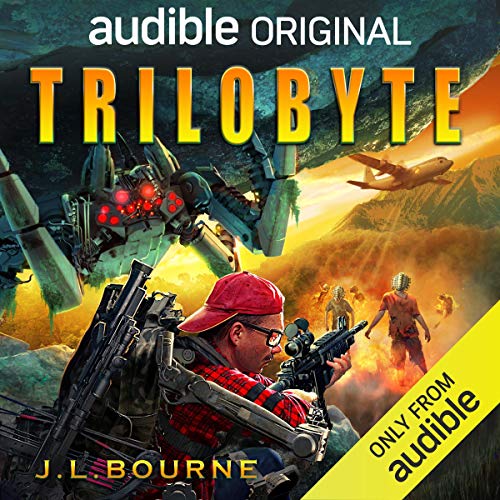
Trilobyte
Summary
The machines brought society to its knees. Now, the last remaining humans fight for survival - and to take back what's theirs. Junior, a robotics expert, tinkers quietly underground. With dozens of machine kills under his belt, he knows the enemy inside and out. Alpha0verride, a reclusive black hat hacker, uses the skills acquired over a life of shady activity to outwit the hyper-intelligent machines swarming in on her. Brick, a special forces operator and one of the few Pentagon survivors, fights his inner demons to embark on the most important mission of his life. Together they are humanity’s last, best hope - if they can only find each other in time. Leveraging his decades of active military and intelligence community service, Trilobyte is the techno-thriller only J. L. Bourne could write.
©2019 J. L. Bourne (P)2019 Audible Originals, LLC.

American Fascists
Summary
Twenty-five years ago, when Pat Robertson and other televangelists first spoke of the United States being a Christian nation that would build a global Christian empire, it was hard to take such hyperbolic rhetoric seriously. Today, such language no longer sounds like hyperbole but poses, instead, a very real threat to our freedoms and our way of life. In American Fascists, the Christian Right's religious legitimacy is challenged, and Hedges argues that, at its core, it is a mass movement fueled by unbridled nationalism and a hatred for the open society. Hedges, who grew up in rural parishes in upstate New York, where his father was a Presbyterian pastor, attacks the movement as someone steeped in the Bible and Christian tradition. He points to the hundreds of senators and members of Congress who have earned between 80 and 100 percent approval ratings from the three most influential Christian Right advocacy groups as one of many signs that the movement is burrowing deep inside the American government in order to subvert it. The movement's call to dismantle the wall between church and state, and the intolerance it preaches against all who do not conform to its warped vision of a Christian America, are pumped into tens of millions of American homes through Christian television and radio stations, and are reinforced through the curriculum of Christian schools. The movement's yearning for apocalyptic violence and its assault on dispassionate, intellectual inquiry are laying the foundation for a new, frightening America.
©2007 Chris Hedges and Eunice Wong (P)2007 Tantor Media Inc.

Remote Five
Summary
Mankind's last stand against the machines begins - now. The machines collapsed society with blinding speed, hunting mankind to the edge of extinction. Yet Junior, a young robotics expert, has managed to survive on his island in the Pacific Northwest. He's leveraged his extensive combat experience to learn even more about the tireless enemies that stalk him. He's ready to escalate the battle - and now he and the hardened soldier Brick have allies. After the fall of the Pentagon and its secondary facility at Mount Weather, a small team managed to escape on an aging gunship to Junior’s island. Their expertise is vital - Dr. Harper Shin wrote the book on robiomechanics, and the two commandos accompanying her are armed to the teeth with the latest military technology. They'll need all the firepower they can muster, because the machines have altered their tactics to finish what they started. But even if the survivors can stand strong and win the day - will victory be worth the price?
©2020 J.L. Bourne (P)2020 Audible Originals, LLC.

Ruin
Summary
"I was utterly consumed." (Rachel Grey, USA Today best-selling author) With her heart literally in his hands, Celia will have to try and bargain with a devil. Edward Fasbender is my captor. Trapped on this island on which he owns everything - including, it seems, me. He told me he would break me, but I thought he meant in the bedroom. It turns out Edward is playing a completely different game. And he won't stop until he's ruined me. Slay Two: Ruin is the second book in the Slay Quartet. Slay One: Rivalry should be heard first.
©2019 Laurelin Paige (P)2019 Laurelin Paige

Why Religion?
Summary
New York Times best seller One of PW’s Best Books of the Year One of Amazon’s Best Books of the Month Why is religion still around in the 21st century? Why do so many still believe? And how do various traditions still shape the way people experience everything from sexuality to politics, whether they are religious or not? In Why Religion? Elaine Pagels looks to her own life to help address these questions. These questions took on a new urgency for Pagels when dealing with unimaginable loss - the death of her young son, followed a year later by the shocking loss of her husband. Here she interweaves a personal story with the work that she loves, illuminating how, for better and worse, religious traditions have shaped how we understand ourselves; how we relate to one another; and, most importantly, how to get through the most difficult challenges we face. Drawing upon the perspectives of neurologists, anthropologists, and historians, as well as her own research, Pagels opens unexpected ways of understanding persistent religious aspects of our culture. A provocative and deeply moving account from one of the most compelling religious thinkers at work today, Why Religion? explores the spiritual dimension of human experience.
©2019 Elaine Pagels (P)2019 HarperAudio

Who Do You Serve, Who Do You Protect?
Summary
What is the reality of policing in the United States? Do the police keep anyone safe and secure other than the very wealthy? How do recent police killings of young Black people in the United States fit into the historical and global context of anti-blackness? This collection of reports and essays (the first collaboration between Truthout and Haymarket Books) explores police violence against Black, Brown, Indigenous, and other marginalized communities, miscarriages of justice, and failures of token accountability and reform measures. It also makes a compelling and provocative argument against calling the police. Contributions cover a broad range of issues including the killing by police of Black men and women, police violence against Latino and Indigenous communities, law enforcement's treatment of pregnant people and those with mental illness, and the impact of racist police violence on parenting, as well as specific stories such as a Detroit police conspiracy to slap murder convictions on young Black men using police informants and the failure of Chicago's much-touted Independent Police Review Authority, the body supposedly responsible for investigating police misconduct. The title Who Do You Serve, Who Do You Protect? is no mere provocation: The book also explores alternatives for keeping communities safe. Contributors include William C. Anderson, Candice Bernd, Aaron Cantú, Thandi Chimurenga, Ejeris Dixon, Adam Hudson, Victoria Law, Mike Ludwig, Sarah Macaraeg, and Roberto Rodriguez.
©2016 Maya Schenwar, Joe Macaré, and Alana Yu-lan Price (P)2021 Audible, Inc.

Bombshell
Summary
Copywriter Ruby Sugars is in a rut. Her life consists of the following: long hours, boring neutral colors, and regular fat shaming from her stick-insect-looking boss. But Ruby isn't really a Bland Betty - she's a complete Bettie Page hottie, with an enviable collection of vintage couture and very naughty vixen lingerie. Now if only she could channel that girl into her real life.... Cue Ruby's best friend, whose recent fixation is "fantasy matchmaking." She's decided that all Ruby needs is one night with a sexy, delectable man...one with a serious thing for curvy pinup girls. And "Lancer" is hot enough to make any girl's fantasy come true. For one night it's pure, X-rated hotness. But come the next morning, this brand-spankin'-new bombshell will get the shock of her life when the man she vowed to see only once shows up again...as her new boss.
©2014 Jody Gehrman (P)2015 Audible, Inc.

Open World Empire: Race, Erotics, and the Global Rise of Video Games
Summary
Seeking ways to understand video games beyond their imperial logics, Patterson turns to erotics to re-invigorate the potential passions and pleasures of play. Video games vastly outpace all other mediums of entertainment in revenue and in global reach. On the surface, games do not appear ideological, nor are they categorized as national products. Instead, they seem to reflect the open and uncontaminated reputation of information technology. Video games are undeniably imperial products. Their very existence has been conditioned upon the spread of militarized technology, the exploitation of already-existing labor and racial hierarchies in their manufacture, and the utopian promises of digital technology. Like literature and film before it, video games have become the main artistic expression of empire today: The open world empire, formed through the routes of information technology and the violences of drone combat, unending war, and overseas massacres that occur with little scandal or protest. Though often presented as purely technological feats, video games are also artistic projects, and as such, they allow us an understanding of how war and imperial violence proceed under signs of openness, transparency, and digital utopia. But the video game, as Christopher B. Patterson argues, is also an inherently Asian commodity: Its hardware is assembled in Asia; its most talented e-sports players are of Asian origin; Nintendo, Sony, and Sega have defined and dominated the genre. Games draw on established discourses of Asia to provide an “Asiatic” space, a playful sphere of racial otherness that straddles notions of the queer, the exotic, the bizarre, and the erotic. Thinking through games like Overwatch, Call of Duty 4: Modern Warfare, Shenmue II, and Alien: Isolation, Patterson reads against empire by playing games erotically, as players do - seeing games as Asiatic playthings that afford new passions, pleasures, desires, and attachments.
©2020 Christopher Patterson (P)2021 Christopher Patterson

Stargazer
Summary
The third installment in the Zero G series by Dan Wells. Zero, Nyx, and the other Pathfinder colonists have adjusted to life on Kaguya. But Earth has built much faster starships-the Dreamcatcher arrives 10 years early, and the Stargazer arrives so early it actually got there before the Pathfinder did! Now the Stargazer is a lost shipwreck, and the race is on to find it, and who should show up looking for it but Nyx's dangerous family: Big Mama, Jim, and Kratt. Nyx and Zero will face kidnappers, pirates, shipwrecks, warlords, dragons, and maybe a new ally or two on their way to save the day once again. Full cast of narrators includes Jonathan Davis, Houston Mahoney, Kathryn Grody, and Mark Sanderlin.
©2020 Dan Wells (P)2021 Audible Originals, LLC.