Jeff Bottoms has narrated 7 audiobooks on Listento.it by 12 authors, with an average listener rating of 4.4★ across 1,451 ratings. The most-rated is Deep Work.
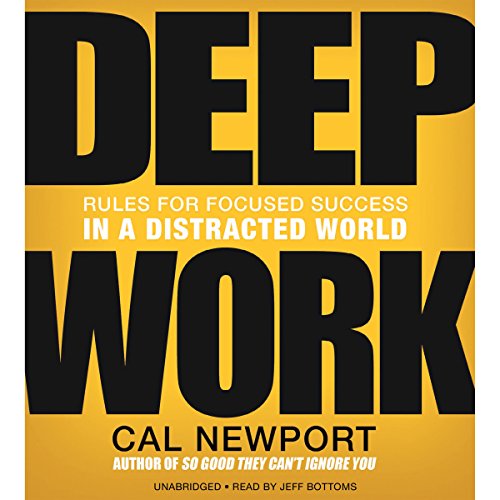
Deep Work
Summary
One of the most valuable skills in our economy is becoming increasingly rare. If you master this skill, you'll achieve extraordinary results. Deep work is the ability to focus without distraction on a cognitively demanding task. It's a skill that allows you to quickly master complicated information and produce better results in less time. Deep work will make you better at what you do and provide the sense of true fulfillment that comes from craftsmanship. In short, deep work is like a superpower in our increasingly competitive 21st-century economy. And yet, most people have lost the ability to go deep - spending their days instead in a frantic blur of email and social media, not even realizing there's a better way. In Deep Work, author and professor Cal Newport flips the narrative on impact in a connected age. Instead of arguing distraction is bad, he instead celebrates the power of its opposite. Dividing this book into two parts, he first makes the case that in almost any profession, cultivating a deep work ethic will produce massive benefits. He then presents a rigorous training regimen, presented as a series of four "rules", for transforming your mind and habits to support this skill. A mix of cultural criticism and actionable advice, Deep Work takes the listener on a journey through memorable stories - from Carl Jung building a stone tower in the woods to focus his mind to a social media pioneer buying a round-trip business-class ticket to Tokyo to write a book free from distraction in the air - and no-nonsense advice, such as the claim that most serious professionals should quit social media and that you should practice being bored. Deep Work is an indispensable guide for anyone seeking focused success in a distracted world. PLEASE NOTE: When you purchase this title, the accompanying reference material will be available in your Library section along with the audio.
©2016 Cal Newport (P)2016 Hachette Audio

The Levelling
Summary
A brilliant analysis of the transition in world economics, finance, and power as the era of globalization ends and gives way to new power centers and institutions. The world is at a turning point similar to the fall of communism. Then, many focused on the collapse itself, and failed to see that a bigger trend, globalization, was about to take hold. The benefits of globalization - through the freer flow of money, people, ideas, and trade - have been many. But rather than a world that is flat, what has emerged is one of jagged peaks and rough, deep valleys characterized by wealth inequality, indebtedness, political recession, and imbalances across the world's economies. These peaks and valleys are undergoing what Michael O'Sullivan calls "the levelling" - a major transition in world economics, finance, and power. What's next is a levelling-out of wealth between poor and rich countries, of power between nations and regions, of political accountability from elites to the people, and of institutional power away from central banks and defunct 20th-century institutions such as the WTO and the IMF. O'Sullivan then moves to ways we can develop new, pragmatic solutions to such critical problems as political discontent, stunted economic growth, the productive functioning of finance, and political-economic structures that serve broader needs. The Levelling comes at a crucial time in the rise and fall of nations. It has special importance for the US as its place in the world undergoes radical change - the ebbing of influence, profound questions over its economic model, societal decay, and the turmoil of public life.
©2019 Michael O'Sullivan (P)2019 Hachette Audio

A Terrible Glory
Summary
A rousing and meticulously researched account of the notorious Battle of Little Big Horn and its unforgettable cast of characters from Sitting Bull to Custer himself. In June of 1876, on a desolate hill above a winding river called "the Little Bighorn", George Armstrong Custer and all 210 men under his direct command were annihilated by almost 2,000 Sioux and Cheyenne. The news of this devastating loss caused a public uproar, and those in positions of power promptly began to point fingers in order to avoid responsibility. Custer, who was conveniently dead, took the brunt of the blame. The truth, however, was far more complex. A Terrible Glory is the first audiobook to relate the entire story of this endlessly fascinating battle and the first to call upon all the significant research and findings of the past 25 years - which have changed significantly how this controversial event is perceived. Furthermore, it is the first to bring to light the details of the US Army cover-up - and unravel one of the greatest mysteries in US military history. Scrupulously researched, A Terrible Glory will stand as a landmark work. Brimming with authentic detail and an unforgettable cast of characters - from Sitting Bull and Crazy Horse to Ulysses Grant and Custer himself - this is history with the sweep of a great novel. PLEASE NOTE: When you purchase this title, the accompanying PDF will be available in your Audible Library along with the audio.
©2008 James Donovan (P)2019 Hachette Audio
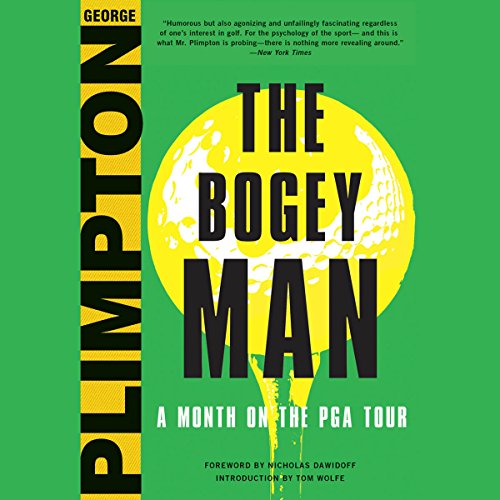
The Bogey Man
Summary
George Plimpton chronicles his month spent on the PGA tour in The Bogey Man, now recorded and including an introduction by Tom Wolfe. What happens when a weekend athlete - of average skill at best - joins the professional golf circuit? George Plimpton, one of the finest participatory sports journalists, spent a month of self-imposed torture on the tour to find out. Along the way, he meets amateurs, pros, caddies, officials, fans, and hangers-on. In The Bogey Man, we find golf legends, adventurers, stroke-saving theories, superstitions, and other golfing lore and, best of all, Plimpton's thoughts and experiences - frustrating, humbling, and sometimes thrilling - from the first tee to the last green. This intriguing classic, which remains one of the wittiest books ever written on golf, features Arnold Palmer, Dow Finsterwald, Walter Hagan, and many other golf greats and eccentrics all doing what they do best.
©2016 George Plimpton (P)2016 Hachette Audio

A Tiger Among Us
Summary
Foreword by Chuck Hagel, former Secretary of Defense and Senator from Nebraska Adaptable. Cunning. Ferocious. Fearless. The Indochinese tiger is just one of the formidable predators roaming Vietnam's jungle. In 1966 a small band of US Special Forces soldiers - most especially Bennie Adkins - spent four grueling days facing down the "tiger" among them. While the rain and mist of an early March moved over the valley, then-Sergeant First Class Bennie Adkins and 16 other Green Berets found themselves holed up in an undermanned and unfortified position at Camp A Shau, a small training and reconnaissance camp located right next to the infamous Ho Chi Minh Trail, North Vietnam's major supply route. And with the rain came the North Vietnamese Army in force. Surrounded 10-to-1, the Green Berets endured constant mortar and rifle fire, direct assaults, treasonous allies, and volatile jungle weather. But there was one among them who battled ferociously, like a tiger, and when they finally evacuated, he carried the wounded to safety. Forty-eight years later, Command Sergeant Major Bennie Adkins's valor was recognized when he received this nation's highest military award, the Medal of Honor. Filled with the sights, smells, and sounds of a raging battle fought in the middle of a tropical forest, A Tiger Among Us is a riveting tale of bravery, valor, skill, and resilience. PLEASE NOTE: When you purchase this title, the accompanying reference material will be available in your Library section along with the audio.
©2018 Bennie G. Adkins and Katie Lamar Jackson (P)2018 Hachette Audio

Reckless
Summary
Henry Kissinger's role in the Vietnam War prolonged the American tragedy and doomed the government of South Vietnam. The American war in Vietnam was concluded in 1973 after eight years of fighting, bloodshed, and loss. Yet the terms of the truce that ended the war were effectively identical to what had been offered to the Nixon administration four years earlier. Those four years cost America and Vietnam thousands of lives and billions of dollars, and they were the direct result of the supposed master plan of the most important voice in American foreign policy: Henry Kissinger. Using newly available archival material from the Nixon Presidential Library, Kissinger's personal papers, and material from the archives in Vietnam, Robert K. Brigham punctures the myth of Kissinger as an infallible mastermind. Instead, he constructs a portrait of a rash, opportunistic, and suggestible politician. It was personal political rivalries, the domestic political climate, and strategic confusion that drove Kissinger's actions. There was no great master plan or Bismarckian theory that supported how the US continued the war or conducted peace negotiations. Its length was doubled for nothing but the ego and poor judgment of a single figure. This distant tragedy, perpetuated by Kissinger's actions, forever changed both countries. Now, perhaps for the first time, we can see the full scale of that tragedy and the machinations that fed it.
©2018 Robert K. Brigham (P)2018 Hachette Audio

Fire in the Lake
Summary
Frances FitzGerald's landmark history of Vietnam and the Vietnam War, "A compassionate and penetrating account of the collision of two societies that remain untranslatable to one another." (New York Times Book Review) This magisterial work, based on Frances FitzGerald's many years of research and travels, takes us inside the history of Vietnam - the traditional, ancestor-worshiping villages, the conflicts between Communists and anti-Communists, Catholics and Buddhists, generals and monks, the disruption created by French colonialism, and America's ill-fated intervention - and reveals the country as seen through Vietnamese eyes. Originally published in 1972, Fire in the Lake was the first history of Vietnam written by an American, and subsequently won the Pulitzer Prize, the Bancroft Prize, and the National Book Award. With a clarity and insight unrivaled by any author before it or since, Frances FitzGerald illustrates how America utterly and tragically misinterpreted the realities of Vietnam.
©1972, 2009 Frances FitzGerald (P)2018 Hachette Audio