Jiddu Krishnamurti has narrated 12 audiobooks on Listento.it by 1 author, with an average listener rating of 4.8★ across 15 ratings. The most-rated is The State of Not Knowing Is Intelligence.

The State of Not Knowing Is Intelligence
Summary
The role of the teacher. 26 March 1971. Duration: 56 minutes. There is much talk of a spiritual revolution among young people. Do you see in this very mixed phenomenon any hope of a new flowering for civilisation or possibility of growth? One can go into oneself at tremendous depths and find out everything. To go into oneself is the problem. Not being able to do it, we ask for help. If there were no books, no gurus, what would you do? Why do we divide energy at all? The observer comes into being only when wanting to change 'what is'. The state of not knowing is intelligence. Inner space. 26 March 1971. Duration: 61 minutes. Is it possible to be free of the centre so that the centre doesn't create space around itself and build a wall? Can the centre be still or fade away? Can consciousness empty itself of its content? Is love within the field of consciousness? If you don't form an image now, the past images have no place. Are there environments which can be conducive to liberation? The company of the good doesn't teach me what is good and what is false or true. I have to see it.
©1971 Krishnamurti Foundation Trust Ltd. (P)2016 Krishnamurti Foundation Trust Ltd.

Self Knowledge Is the Beginning of Wisdom
Summary
Is thought detrimental? 15 August 1965. Duration: 63 minutes. Why does one seek pleasure? Can the mind face only facts and not thought? Why have I never said, 'Thought is poison' to myself? Meeting something one doesn't know, facing something which has no answer. Acting without knowing. What is a state of mind which is silent? Time is detrimental. Are we twisting everything to our core of pleasure? Am I aware of the process of thinking? 18 August 1965. Duration: 60 minutes. Can I see that thought is destructive except where it is essential? Why is it that we don't see something immediately? Do you know when you are thinking? Is the thing that we call thinking thinking at all? Do you think from the background noise when a problem arises? When the mind becomes totally aware of the background, is there thinking when a problem arises? What happens when I am aware of this hum, this noise incessantly going on? Is the background noise different from the observer? How am I to live an everyday life with complete silence? What will make me see that thought breeds frustration? 21 August 1965. Duration: 78 minutes. What is the function of thought? Can the mind see the fact that thought will always breed frustration? Function is necessary, but function with status, position and power must breed frustration. Without frustration thought says to itself, 'I am not seeking. I don't want anything.' If there is no thought, what happens? The very perception of the limitation of thought is the act of opening the door rather than thought opening the door. To function without prestige, without frustration, that itself is an extraordinary state, meaning to function without self-centred activity. From where do attachment and detachment come? 24 August 1965. Duration: 65 minutes. What is the relationship of the brain to the totality of the mind? Fear of not being, fear of isolation, fear of not having pleasure, fear of having no relationship, is the soil from which the stem of contradiction grows. I want to be free of this stem to see what happens if there is no attachment, no detachment, because I am not afraid. Is there a peace with no entity saying, 'I am peaceful'? A complete stillness. 25 August 1965. Duration: 65 minutes. Is there a single movement that will completely transform my whole way of life? The passion is there, but the perfume doesn't take place. What am I to do? Am I in a position of a man who for the first time is walking on a road by himself and discovering? Does one know what complete stillness means? It is only from a very still mind that a mutation takes place. Is there an ending to thought, therefore an ending to time? If I have no thought and therefore no time, and so no wasting of energy, there is no movement; therefore there is complete stillness.
©1949 Krishnamurti Foundation of America. (P)2016 Krishnamurti Foundation Trust Ltd.

Truth Actuality and the Limits of Thought
Summary
What is truth, and what is reality? 18 May 1975. Duration: 70 minutes. What is truth, and what is reality? Anything that thought thinks about or reacts upon or projects - that is reality. And that reality has nothing to do with truth. The art of seeing is to place reality where it is and not move that in order to get truth. You can't get truth. How am I to empty that consciousness and yet retain knowledge - otherwise I couldn't function - and reach a state which will comprehend reality? Seeing 'what is' is action. 24 May 1975. Duration: 122 minutes. If truth is something totally different from reality, then what place has action in daily life, in relation to truth and reality? Seeing 'what is' is action. What place has love in truth? When I separate you, in that separation love cannot exist. How are you to convey the sense of truth to a student? As long as I live in the field of reality, which has its own energy, that energy will not free me. When the mind is empty, when the mind is nothing, not a thing, in that there is perception. Thought cannot bring about an insight. 31 May 1975. Duration: 81 minutes. Is there thinking without the word? The action brought about by thought into the investigation of an analysis is always incomplete. Insight is complete. It is not fragmented, as thought is. So thought cannot bring about insight. I must have an insight into conditioning, otherwise I can't dissolve it. What takes place when I have an insight that the observer is the observed? In nothingness there is complete security and stability. The intelligence of love. 14 June 1975. Duration: 87 minutes. Why has desire become such an extraordinarily important thing in life? How does desire arise from perception? Can I desire truth? Is the energy of nothingness different from the energy of things? Is that nothingness a hypothesis, a theory, a verbal structure, or truth? In dying to the reality, only then there is nothingness. Attention implies that there is no centre. 22 June 1975. Duration: 126 minutes. Consciousness, because it is in constant movement, has never found an energy which is not contradictory, which is not produced by desire and thought. Can thought ever see its own movement and the futility of its own movement? Attention implies that there is no centre. Is there a perception, a seeing outside the space which is part of consciousness? There are two human beings; one gets conditioned, and the other doesn't. Why? How has it happened the other doesn't get conditioned? How does this perception, which is beyond attention, beyond awareness, beyond concentration come about?
©1975 Krishnamurti Foundation Trust Ltd. (P)2016 Krishnamurti Foundation Trust Ltd.

One Sees or Understands Only When the Mind Is Quiet
Summary
To look without a concept is to be aware of the observer and the thing observed. 20 May 1967. Duration: 88 minutes. Violence and sorrow are not limited to the West or the East; they are parts of the human structure psychologically. Is it possible to bring about a change radically, a total revolution in the psyche itself, not through time? The first and last freedoms are when the mind is totally free from concepts and the mechanical process of building a formula. It is an art to look, which is much more important than any art in the world, any painting, music or book; because when we can look so totally and completely, being directly in contact, there is an ending. If one has cancer, how can one be free from death? Where there is pleasure, there is the shadow of pain. 21 May 1967. Duration: 83 minutes. The whole movement of living, which is relationship, is a movement in action. What is consciousness? When do you say, 'I am conscious, I am aware, I am attentive'? Is there actually a division between the conscious and the unconscious, or it is a total movement, operating all the time? The mind that pursues pleasure must inevitably invite its opposite, which is pain. The two go together; they are not separate. If you love your own child, your attention to your child is fairly complete, bu tif you are a teacher you cannot give attention to all the students. Is it possible to renew the mind? 24 May 1967. Duration: 81 minutes. When the mind is living through imagination and thought, it is incapable of living in the complete fullness of the present. Thought has created time - not chronological time but psychological time. That is, 'I will be', 'I should be'. Is it possible for the brain to be quiet, to give an interval between the old and the new? This interval is the timeless nature in which thought cannot possibly enter. That which has continuity is repetitive, which is time. It's only when time comes to an end that there is something new taking place. To die every day to every problem, every pleasure, and not carry over any problem at all; so the mind remains tremendously attentive, active, clear. Since love is not desire or pleasure, how does one come upon it? Is the feeling of responsibility a part of the order and discipline you were talking about? Why don't people get angry with what you are saying?
©1967 Krishnamurti Foundation Trust Ltd. (P)2016 Krishnamurti Foundation Trust Ltd.

To Learn About Oneself One Has to Learn Anew Each Minute
Summary
To perceive 'what is' is the basis of truth. 7 February 1971. Duration: 86 minutes. Where there is division, there must be conflict. A mind in conflict must inevitably be distorted, and therefore it cannot possibly see clearly what is truth. We need a total change, a deep revolution, psychological revolution, the inward revolution, without which you cannot possibly create a new society. Is it possible to observe, to perceive without the observer? How are images formed? Can the image building come to an end? Knowledge is absolutely necessary. Is it possible that knowledge, which the brain has accumulated through centuries, does not interfere with relationships? Direct perception is freedom. 10 February 1971. Duration: 80 minutes. Can the mind living in this world ever be free, not only superficially but profoundly, at the very root of its existence? 'Freedom from' is an abstraction, but freedom in observing 'what is' and going beyond it is actual freedom. How do I observe greed? Do I observe it as an outsider looking in, or do I observe it without the observer? Without the mind being free, you cannot live in order. Three years have passed; I have no energy to be aware of my reactions. Can we seek God through observation? Love is that quality of mind in which there is no division. 14 February 1971. Duration: 89 minutes. To live in this world with intelligence, in spite of all the complications. Is it possible to be free of fear, not only the superficial fear in relationship but the deep-rooted fear? Thought nourishes, sustains and gives continuity to fear and pleasure. When you are learning, your mind is awake. Truth isn't second-hand; you can't get it through a guru, a book; you have to learn about it. The beauty of learning is that you don't know what truth is. What is love? A man who has not love in his heart but the things made by thought will make a monstrous world, will construct a society that is totally immoral. To find out, you must undo everything that you have done. What does it mean to die? A mind in meditation is concerned only with meditation, not with the meditator. 17 February 1971. Duration: 87 minutes. If you can put aside your favourite systems, if you can understand that concentration is merely a resistance and therefore constant conflict and wastage of energy, then we can find out for ourselves what is necessary for a mind that is in a state of meditation. To learn about oneself, a living thing, you have to watch, learn anew each minute. What is will? Consciousness is heritage, the result of time. Consciousness is the content of itself, which is time, sorrow, confusion, misery. Intelligence has no heritage. What is a mind that is completely silent? How does one cope with the extraordinary energy that human beings have?
©1968 Krishnamurti Foundation of America. (P)2016 Krishnamurti Foundation Trust Ltd.

Can the Mind Observe Without Comparison
Summary
Living with a sustained seriousness. 21 February 1970. Duration: 91 minutes. What does it mean to be serious? Becoming. Why do I compare myself with you or with somebody else? Do I look at people through images? Can the brain operate without recourse to the past? 22 February 1970. Duration: 92 minutes. Is there self-progress? Conflict. Security. Any form of division within oneself is a source of conflict. Can the brain be quiet? What makes one control? 14 March 1970. Duration: 97 minutes. Violence. Why do you control? Security means to be in a state in which there is no choice at all. The mind has become sensitive because it has observed, not because it has experienced. Either you see the fact with the past or you see the fact as it is now. The word is of the past. Being serious without belief. 15 March 1970. Duration: 77 minutes. Can the intellect, a fragment, ever be serious? Serious in the sense of a sustained observation without any distortion. Control. What is living? How does it happen that one can be completely harmonious? What does awareness mean? Attention leads to learning. 21 March 1970. Duration: 93 minutes. Inattention and attention. Observing without the word. What is the function of sleep? Is love a matter of culture, a thing of pleasure and therefore dependency? Fear in consciousness. 22 March 1970. Duration: 89 minutes. How does it happen that the deep layers hidden in consciousness can be exposed? Comparison between what is and what has been and what will be is the process of fear. Can the mind observe without comparison? What is order? 28 March 1970. Duration: 81 minutes. Order and disorder. Why does the mind accumulate? How do you receive something that is not of the mind? How is one to be entirely free of fear? 29 March 1970. Duration: 90 minutes. Fear. All the escaping and the strengthening of fear comes because we are inattentive. What is sleep?
©1970 Krishnamurti Foundation Trust Ltd. (P)2016 Krishnamurti Foundation Trust Ltd.
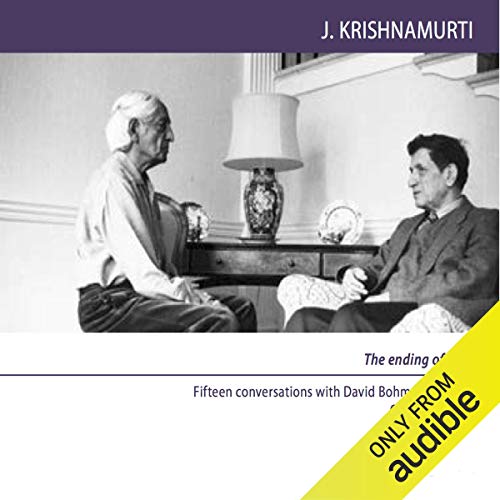
The Ending of Time
Summary
The roots of psychological conflict. 1 April 1980. Duration: 82 minutes. Has humanity taken a wrong turn? What is the root of this tremendous inward conflict of humanity? When I am trying to become something, it is a constant battle. Can the brain itself see that it is caught in time and as long as it is moving in that direction conflict is eternal, endless? Can the mind realise, resolve a psychological problem immediately? Has mankind journeyed through millennia to come to this: that I am nothing and therefore I am everything and all energy? Cleansing the mind of the accumulation of time. 2 April 1980. Duration: 79 minutes. Time is the enemy of man. Is there a beginning which is not enmeshed in time? We said nothingness is everything, and so it is total energy. It is undiluted, pure, uncorrupted energy. Is there something beyond that? Has man ever been free from the 'I'? That emptiness can exist only when there is death of the particular. Why has man given supreme importance to thought? 8 April 1980. Duration: 84 minutes. Is the 'ground' indifferent to mankind, as the physical universe appears to be? How does one find out if there is something more than the merely physical? Why is it that theories are necessary and useful in organising facts about matter outwardly, and yet inwardly, psychologically they are in the way, of no use at all? Seeking security for myself, for my family, for my group, for my tribe, has brought about division. Why has man given importance to thought as the supreme thing? If I accept I am irrational completely, I am rational. Breaking the pattern of egocentric activity. 10 April 1980. Duration: 79 minutes. What will make a human being change deeply, fundamentally, radically? Will I, as a human being, give up my egocentric activity completely? The more knowledge I have acquired, as I have evolved, as I have grown, as I have experienced, it has strengthened me, and I have been walking on that path for millennia. Perhaps I may have to look at this problem totally differently - which is not to walk on that path at all; to discard all knowledge I have acquired. Explanations have been the boat on which to cross to the other shore. The man on the other shore says there is no boat. Cross! What happens to me when I meet something that is completely solid, immovable, absolutely true? Psychological knowledge has made us dull. The ground of being and the mind of man. 12 April 1980. Duration: 71 minutes. Why has having ideas become so important? What is the difference between a religious mind and a philosophic mind? What is the human mind's relationship to the 'ground'? Why has man accumulated knowledge?
©1980 Krishnamurti Foundation Trust Ltd. (P)2016 Krishnamurti Foundation Trust Ltd.

Can There Be Complete Freedom from Thought?
Summary
Complete freedom from thought. 9 September 1972. Duration: 76 minutes. Learning is instant perception and action. What place has thought in learning? To learn about freedom, must thought be completely silent? Does insight into freedom take time? Can thinking, however rational, bring about a psychological revolution in us? Is thought always conditioned? Is freedom the nonexistence of thought? My very being is related to thought. If you want to see something new, what do you do? To have insight, let go of the old and listen. Learning is not memorizing. Is feeling another way of thinking? Isn't the need to love and be loved essential? Needing love is love of self. If I don't change now what will the future be? 10 September 1972. Duration: 86 minutes. Is thought responsible for fragmentation? Does fragmentation have its own activity? What is the energy that perceives the total and doesn't live in fragmentation? Does comparison bring about fear and pleasure? Is thought seeking security in belief and dogma? Can the mind learn instantly all the content of the unconscious in which there are deep, secret fears? Does analysis imply time and division? Is consciousness separate from its content? To get at the root of fear means learning about not being. What about guilt? If freedom is responsibility, how do I act? 16 September 1972. Duration: 78 minutes. What is the action that will be a total response to the world around us? Can one respond totally without learning about love and death in relation to daily life? Do we live, or do we tolerate living? Do we live according to ideas and conclusions based on belief, dogma and memory? Is there an action which dissipates all images? Is love a relationship in which there is no image? Is disorder a relationship in which there is the image? Can a mind seeking comfort learn about death? Find out whether death is something to be avoided or to be lived with naturally. Can the mind free itself from the known? What relationship have literature, beauty and art to our daily lives? Were you conditioned by the masters? Can one help someone in distress? To come upon the new, thought must be quiet. 17 September 1972. Duration: 66 minutes. If one is serious, one must learn for oneself if there is such a thing as the I'm measurable. Thought cannot find the immeasurable because thought is measurement and time. Can thought, realizing its limitations, be quiet? Can the mind see its content clearly, and the limitation, lack of space and time-binding quality of its consciousness? When you say, 'I do not know', does the content have importance? There are various systems of meditation, gadgets, yoga, to make the mind quiet. These are unimportant. Is truth the very perception of the false? When the mind has perceived the truth of something, what is time?
©1972 Krishnamurti Foundation Trust Ltd. (P)2016 Krishnamurti Foundation Trust Ltd.

Can One Live a Life in Which There Is No Comparison at All?
Summary
Attention implies the total abandonment of the 'me'. 6 March 1971. Duration: 100 minutes. Can the mind undergo a radical revolution? How do you observe the world? What solves our human problem is observing the whole process of ourselves without judging, condemning, translating or rejecting - just to observe. Question topics following the talk include: being disturbed in order to know, being confused and transcendental meditation. Violence, pleasure and fear. 7 March 1971. Duration: 89 minutes. We have accepted violence as a way of life, and yet at the same time we want peace. Can one live a life in which there is no comparison at all? Pleasure is the continuance of an experience that is never finished. We are living in the past. How can the conscious mind investigate the total hidden mind? Is pleasure love? 13 March 1971. Duration: 96 minutes. Can thought ever solve the whole problem of existence? What is the function of thought? Why has sex become so extraordinarily important? Chastity is the freedom from all image. Is love desire? A new thing can take place only when there is an ending of the old. Question topics following the talk include: getting better, controlling thought, the process of invention, vegetarianism and images. Meditation means a life that is totally different every minute of the day. 14 March 1971. Duration: 94 minutes. Attention leads to learning. 21 March 1970. Duration: 93 minutes. Inattention and attention. Observing without the word. What is the function of sleep? Is love a matter of culture, a thing of pleasure and therefore dependency? Fear in consciousness. 22 March 1970. Duration: 89 minutes. How does it happen that the deep layers hidden in consciousness can be exposed? Comparison between what is with what has been and what will be is the process of fear. Can the mind observe without comparison? What is order? 28 March 1970. Duration: 81 minutes. Order and disorder Why does the mind accumulate? How do you receive something that is not of the mind? How is one to be entirely free of fear? 29 March 1970. Duration: 90 minutes. Fear. All the escaping and the strengthening of fear comes because we are inattentive. What is sleep?
©1971 Krishnamurti Foundation Trust Ltd. (P)2016 Krishnamurti Foundation Trust Ltd.

Thought Stillness and Time
Summary
Is thought detrimental? 15 August 1965. Duration: 63 minutes. Why does one seek pleasure? Can the mind face only facts and not thought? Why have I never said, 'Thought is poison' to myself? Meeting something one doesn't know, facing something which has no answer. Acting without knowing. What is a state of mind which is silent? Time is detrimental. Are we twisting everything to our core of pleasure? Am I aware of the process of thinking? 18 August 1965. Duration: 60 minutes. Can I see that thought is destructive, except where it is essential? Why is it that we don't see something immediately? Do you know when you are thinking? Is the thing that we call thinking thinking at all? Do you think from the background noise when a problem arises? When the mind becomes totally aware of the background, is there thinking when a problem arises? What happens when I am aware of this hum, this noise incessantly going on? Is the background noise different from the observer? How am I to live an everyday life with complete silence? What will make me see that thought breeds frustration? 21 August 1965. Duration: 78 minutes. What is the function of thought? Can the mind see the fact that thought will always breed frustration? Function is necessary, but function with status, position and power must breed frustration. Without frustration thought says to itself, 'I am not seeking. I don't want anything.' If there is no thought, what happens? The very perception of the limitation of thought is the act of opening the door rather than thought opening the door. To function without prestige, without frustration, that itself is an extraordinary state, meaning to function without self-centred activity.
©1965 Krishnamurti Foundation of America. (P)2016 Krishnamurti Foundation Trust Ltd.

Is There a Movement Other than the Movement of Thought
Summary
What is the operation of thought? 14 July 1974. Duration: 84 minutes. In the world around us and inside us, is there a relationship between the inner and the outer? Are you free to listen, or do you listen with interpretation and prejudices? Do I observe the content of my consciousness as an outsider? Can one observe the content without choice? If you look with eyes that are divided, is there not conflict between you and another? Is division between the observer and the observed? Is it intelligent for thought to create and maintain division while talking about peace? Is there an intelligence which is not cunning and is not the function or result of thought? Questions from the audience follow the talk. Is there energy not based on idea or ideology? 16 July 1974. Duration: 84 minutes. Why is thought divisive? The desire to change in a particular direction gives an energy that is divisive. Will you free the mind taking time, through analysis, or can you look totally and therefore be totally free? Does choice less rejection of the false give a different kind of energy? Does a foundation give me direction, or does it bring confusion? Is the operation of intelligence insight? Questions from the audience follow the talk. Can thought bring order? 18 July 1974. Duration: 87 minutes. Are thoughts, feelings, reactions and relationships merely mechanical? Is there any other movement? Where there is a cause, there is time, and so living becomes relative. Is my relationship with another based on opinions, memories, demands and sexual appetites? Is there a way of living which has no cause? Do I actually see disorder or only its description? Is it only when the 'me' is nonexistent that I am related? What takes place when the mind has order and a sense of total relationship? Can the mind be free of the word to look and discover its disorder? Questions from the audience follow the talk. Can the mind not be a slave to knowledge? 21 July 1974. Duration: 93 minutes. When consciousness invents a superconsciousness, is it a part of thought aware of the past? Is there a part of the brain which has not been touched by the known? Is it our education to escape from 'what is' through ideals?
©1974 Krishnamurti Foundation Trust Ltd. (P)2016 Krishnamurti Foundation Trust Ltd.

Knowledge and Learning Are Two Different Things
Summary
A radical transformation in the psyche itself. 8 November 1968. Duration: 80 minutes. To communicate we must know that the word is not the thing and also be in that state of mind whose quality is attention, care. That can take place only if we are serious. We are the world, and the world is us. To bring about a radical transformation, which is so essential in society, there must be radical transformation in ourselves. Analysis of violence does not end violence, nor is violence ended by thinking of nonviolence. There is no teacher outside, no saviour, no master; you yourself have to change, and therefore you have to learn to observe, to know yourself. Knowledge and learning are two different things. What is this silence you talk about? The silence that I am experiencing comes and goes. Thought is the cause of fear. 10 November 1968. Duration: 76 minutes. Though we have plenty of energy, apparently we lack the drive, enthusiasm, vitality to bring about a change in ourselves. As long as there is fear, there must be violence, aggression, anger, hatred. Thought is the source of fear. Is it possible to live everyday life without thought interfering? Thought is always old. When you worship thought, you are worshipping something that is dead. Could you discuss the process of verbalisation that goes on when one observes? How do we get rid of this separation, division in ourselves? The benediction of meditation. 17 November 1968. Duration: 67 minutes. We shall explore together into this life, existence, in which is included relationship, love and death, not merely as a phenomenon but as something tremendously significant, to be cherished, deeply lived. Meditation is the approach to this problem of living. It is only a free mind that is capable of attention in which there is no achieving or losing or fear. It is only a quiet, attentive mind that can understand this immense problem of living. It is only the quiet, meditative mind that can come upon what is called love. What is living? The observer cannot possibly do anything about envy because he is the cause and the effect. Whatever he does with regard to envy is still envy. What does it mean to die, knowing the organism comes to an end? What does it mean to die psychologically, inwardly? Freedom of choice is not freedom. 11 November 1968. Duration: 83 minutes. What do we mean by free will? Is there such thing? Is choice ever necessary? Freedom exists only when I perceive very clearly, when the mind sees things as they are. Is it possible to be free in society? Is love the absence of hate? To find out what truth is, you must be free of propaganda - the propaganda of the Church, the propaganda of literature, propaganda of tradition - so that you see things clearly for yourself.
©1968 Krishnamurti Foundation Trust Ltd. (P)2016 Krishnamurti Foundation Trust Ltd.