John E. Finn has narrated 3 audiobooks on Listento.it by 7 authors, with an average listener rating of 4★ across 79 ratings. The most-rated is 36 Books That Changed the World.

36 Books That Changed the World
Summary
Certain works of literature, history, science, philosophy, political theory and religion offer powerful examples of how books can spark revolutions, birth great religions, spur scientific advancements, shape world economies, teach us new ways of thinking, and much more. And with this fascinating collection crafted from our extensive library of courses, you can now get a single course that represents 36 of our best lectures on literary works that changed the world. In the company of an unparalleled roster of award-winning professors from a range of disciplines, you'll get fresh perspectives on books you only thought you knew - and intriguing introductions to some works you may not have known played key roles in getting us to where we are today. These include The Analects, the Liber Abaci, A Dictionary of the English Language, The Jungle, The Feminine Mystique, and more. If you've taken another course with these professors before, get a reminder of just why you enjoyed them. And if you've never heard some of them before, who knows? You may just discover your next favorite Great Courses professor. More than that, you'll rediscover just how powerful the printed word can be. You'll also learn how the mark of a truly great book isn't that it just changes the lives of individual readers-but the lives of entire civilizations.
©2014 The Great Courses (P)2014 The Teaching Company, LLC

The First Amendment and You: What Everyone Should Know
Summary
A mere 45 words, the First Amendment to the Constitution stands as a pillar of our democracy and has had an incalculable influence on the development of human freedom in the United States and the Western world. To study the First Amendment is to learn something about the meaning of America and who "We the People" are - and to see the significant and far-reaching cultural implications of this fundamental constitutional provisions.These twelve practical lectures offer a guide to understanding the protections and limitations implied by the First Amendment. You'll learn what and whom it protects, and why it matters to you personally. You'll consider questions of how we define speech, the meaning of "religion," and when the state can interfere with your rights. You'll also explore the questions courts and citizens will be grappling with for years to come: How does the First Amendment apply to the Internet? Does the First Amendment apply to video games? Should new communication technologies make courts reconsider well-settled rules? Is social media subject to existing principles, to new ones, or to none at all? Throughout these lectures, Professor Finn returns to a fundamental theme: What the First Amendment protects is largely a function of why it protects it-the why being America's commitment to democracy and liberty. In pursuit of these ideals, courts have often placed a higher value on political speech, although no such distinction is made in the Constitution. You'll examine numerous landmark Supreme Court decisions, including Citizens United v. Federal Election Commission.
©2012 The Teaching Company, LLC (P)2012 The Great Courses
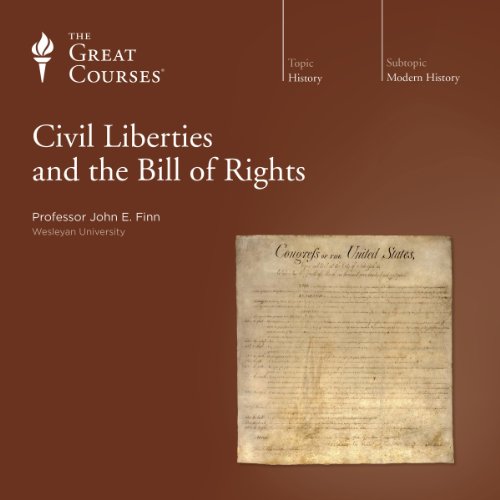
Civil Liberties and the Bill of Rights
Summary
The civil liberties and constitutional rights possessed by our nation's citizens - not only in theory, but in the courtroom, where the state can be forced to honor those liberties - are a uniquely American invention. And when we were taught history and learned about the Constitution and its Bill of Rights, we were always made aware of that uniqueness, of the extraordinary experiment that gave to every citizen of this new nation a gift possessed by no others. Now you can learn exactly what that gift was - in a series of 36 lectures based on Supreme Court opinions from dozens of the Court's most important landmark decisions, presented by an award-winning teacher who is also an internationally recognized expert in constitutional law. You'll learn just what liberties and rights the Founders wanted the new government to protect, as well as how we get from what Professor Finn calls the Constitution's "wonderfully elastic and vague" language to the finely tuned specifics of the Supreme Court's opinions about speech, abortion, and religion, and so much more. And you'll grasp the hard truth that no matter how unwavering the Constitution's language on any subject may appear, things are almost invariably more complicated than it would seem at first reading. The result is a legacy of questions that multiplies with each passing decade, and explains why generations of jurists and legal scholars, not to mention legislators, presidents, and citizens, have argued so long and hard about the meaning of what often appears to be unambiguous phrasing. PLEASE NOTE: When you purchase this title, the accompanying reference material will be available in your Library section along with the audio.
©2006 The Teaching Company, LLC (P)2006 The Great Courses