John Graham has narrated 4 audiobooks on Listento.it by 4 authors, with an average listener rating of 2★ across 1 ratings. The most-rated is Horatio Nelson.
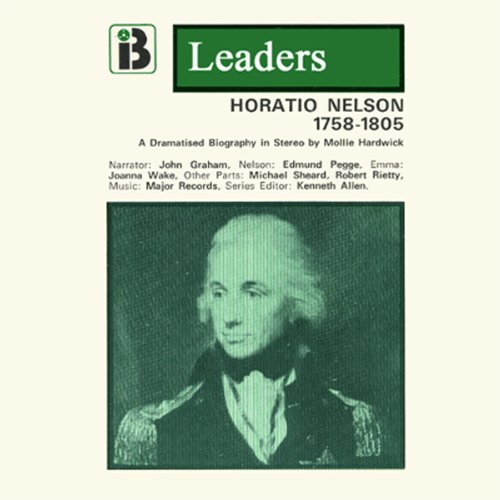
Horatio Nelson
Summary
"Captain Nelson is a little man who cannot boast of being handsome, but who will, in my view, one day astonish the world." So said Sir William Hamilton to his wife Emma, when Captain Nelson first sailed into Naples Bay in 1793. Even that shrewd Ambassador could hardly have guessed how great the "little man" would become. Superb seaman and strategist, born leader of men, saviour of Britain from the menace of invasion by Napoleon, he won glory at the price of disfigurement, mutilation, and death at the moment of his crowning glory at the glorious Battle of Trafalgar. Brave as a lion in battle, his private character was of gentleness and charm that captivated all who knew him; a rare quality in a fighting man. His love for his mistress, the beautiful Emma Hamilton, was as passionate as his devotion to his country, and is an unforgettable part of his heroic story. The part of Horatio Nelson is played by Edmund Pegge and the part of Emma Hamilton is played by Joanna Wake. Other parts are played by Michael Sheard and Robert Rietty.
©1976 Mollie Hardwick (P)1976 Ivan & Inge Berg

The Prophesies of Nostradamus (Dramatised)
Summary
Michael Nostradamus is regarded as the most accurate prophet of all time. His prophesies were collected and published in a book called The Centuries, which was the 14th Century's best-seller after the Bible. Nostradamus foretold the future of Catherine de Medici and all her children. He forecasted the execution of Charles the 1st of England, the protectorship of Oliver Cromwell, the terror of the French Revolution, and the rise and fall of Napoleon. As for the 20th century, Nostradamus predicted the German inflation of the 1930s, the war against Hitler, and aspects of General Franco's life. The most terrifying of his declarations, revealed here, has thankfully not materialized.
©1979 David Pinner (P)1979 Ivan and Inge Berg

Monsters of the Earth (Dramatised)
Summary
The earth teems with strange creatures. Most we know about. But there are others that seem to flit like ghosts in the background of our experience. Large footprints in the Himalayan snows start speculation about the yeti or abominable snowman. A harsh cry in the African jungle sparks fears of the dreaded chemosit. A dark shape rears up from the waters of a Scottish loch. Could it be Nessie, the Loch Ness monster? What about the sea serpents so feared by ancient mariners? Be prepared for strange and extraordinary tales in this dramatized investigation.
©1979 Robert Chapman (P)1979 Ivan and Inge Berg

The Mystery of the Pyramids (Dramatised)
Summary
Ten miles west of Cairo is the plateau of Giza. There, starkly dominating the skyline, stands the largest stone construction on the planet. Its structure shows a highly developed understanding of mathematics, astronomy, precision engineering, navigational theory, and geography. According to sci-fi author David McIlwaine, carbon 14 dating, the most reliable (though not infallible) scientific method of establishing age, places the construction at around 70,000 years BC, at least 60,000 years before man's discovery of these sciences. The Pyramid of Cheops is an almost total enigma. It is not a tomb, it does not appear to be a monument, yet it was built to endure the ravages of time. All conventional attempts to find a reason for the existence of the Great Pyramid - other than the simplistic one of a personal monument to Cheops - have failed conspicuously. A number of bizarre and fantastic alternative theories have been proposed and investigated. Some of the conclusions reached seem to bear more relation to science fiction than to science fact. They talk of strange and inexplicable forces, observed events that defy the laws of physics and molecular biology, and unknown energy fields that have an extraordinary effect on the human mind. Is this the stuff of what Egyptologists call "pyramidiocy"? Or is it something more?
©1979 David McIlwaine (P)1979 Ivan and Inge Berg