Micah Hanks has narrated 15 audiobooks on Listento.it by 18 authors, with an average listener rating of 4.2★ across 61 ratings. The most-rated is Denisovan Origins.

Denisovan Origins
Summary
Reveals the profound influence of the Denisovans and their hybrid descendants upon the flowering of human civilization around the world Traces the migrations of the sophisticated Denisovans and their interbreeding with Neanderthals and early human populations more than 40,000 years ago Shows how Denisovan hybrids became the elite of ancient societies, including the Adena mound-building culture Explores the Denisovans’ extraordinary advances, including precision-machined stone tools and jewelry, tailored clothing, and celestially-aligned architecture Ice-age cave artists, the builders at Göbekli Tepe, and the mound-builders of North America all share a common ancestry in the Solutreans, Neanderthal-human hybrids of immense sophistication, who dominated southwest Europe before reaching North America 20,000 years ago. Yet, even before the Solutreans, the American continent was home to a powerful population of enormous stature, giants remembered in Native American legend as the Thunder People. New research shows they were hybrid descendants of an extinct human group known as the Denisovans, whose existence has now been confirmed from fossil remains found in a cave in the Altai region of Siberia. Tracing the migrations of the Denisovans and their interbreeding with Neanderthals and early human populations in Asia, Europe, Australia, and the Americas, Andrew Collins and Greg Little explore how the new mental capabilities of the Denisovan-Neanderthal and Denisovan-human hybrids greatly accelerated the flowering of human civilization over 40,000 years ago. They show how the Denisovans displayed sophisticated advances, including precision-machined stone tools and jewelry, tailored clothing, celestially-aligned architecture, and horse domestication. Examining evidence from ancient America, the authors reveal how Denisovan hybrids became the elite of the Adena mound-building culture, explaining the giant skeletons found in Native American burial mounds. The authors also explore how the Denisovans’ descendants were the creators of a cosmological death journey and viewed the Milky Way as the Path of Souls. Revealing the impact of the Denisovans upon every part of the world, the authors show that, without early man’s hybridization with Denisovans, Neanderthals, and other yet-to-be-discovered hominid populations, the modern world as we know it would not exist.
©2019 Andrew Collins and Gregory L. Little (P)2019 Inner Traditions Audio

The Lost Book of Enki
Summary
The companion volume to The Earth Chronicles series that reveals the identity of mankind’s ancient gods Explains why these “gods” from Nibiru, the Anunnaki, genetically engineered Homo sapiens, gave Earthlings civilization, and promised to return Zecharia Sitchin’s best-selling series The Earth Chronicles provided humanity’s side of the story concerning our origins at the hands of the Anunnaki, “those who from heaven to earth came.” In The Lost Book of Enki, we now view this saga from the perspective of Lord Enki, an Anunnaki leader revered in antiquity as a god, who tells the story of these extraterrestrials’ arrival on Earth from the planet Nibiru. In his previous, works Sitchin compiled the complete story of the Anunnaki’s impact on human civilization from fragments scattered throughout Sumerian, Akkadian, Babylonian, Assyrian, Hittite, Egyptian, Canaanite, and Hebrew sources. Missing from these accounts, however, was the perspective of the Anunnaki themselves. What was life like on their own planet? What motives propelled them to settle on Earth - and what drove them from their new home? Convinced of the existence of a lost book that held the answers to these questions, the author began his search for evidence. Through exhaustive research of primary sources, he has here re-created tales as the memoirs of Enki, the leader of these first “astronauts.” What takes shape is the story of a world of mounting tensions, deep rivalries, and sophisticated scientific knowledge that is only today being confirmed. An epic tale of gods and men unfolds, challenging every assumption we hold about our past and our future.
©2002, 2004 Zecharia Sitchin. All Rights Reserved. (P)2002 Inner Traditions Audio. All Rights Reserved.
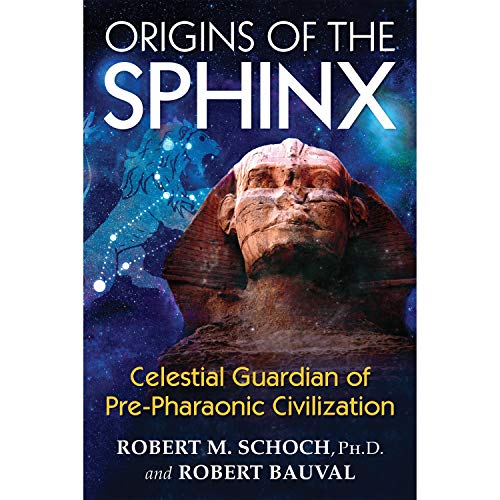
Origins of the Sphinx
Summary
New research and evidence that the Sphinx is thousands of years older than previously thought. Contrasts what Egyptologists claim about the Sphinx with historical accounts and new research, including reanalysis of seismic studies and updates to Schoch’s water weathering research and Bauval’s Orion Correlation Theory Examines how the Sphinx is contemporaneous with Göbekli Tepe, aligned with the constellation Leo, and was recarved during the Old Kingdom era of Egypt Reveals that the Sphinx was built during the actual historical Golden Age of ancient Egypt, the period known in legend as Zep Tepi No other monument in the world evokes mystery like the Great Sphinx of Giza. It has survived the harsh climate of Egypt for thousands of years and will remain long after our own civilization is gone. According to orthodox Egyptology, the Sphinx was built around 2500 BCE as a memorial to the Pharaoh Khafre. Yet this “fact” has scant to no supportive evidence. When was the Sphinx really built and, most importantly, why? In this provocative collaboration from two Egyptology outsiders, Robert M. Schoch, PhD, and Robert Bauval combine their decades of research to show how the Sphinx is thousands of years older than the conventional Egyptological timeline and was built by a long forgotten pre-Pharaonic civilization. They examine the known history of the Sphinx, contrasting what Egyptologists claim with prominent historical accounts and new research, including updates to Schoch’s geological water weathering research and reanalysis of seismic studies. Building on Bauval’s Orion Correlation Theory, they investigate the archaeoastronomical alignments of the monuments of the Giza Plateau and reveal how the pyramids and Sphinx were built to align with the constellations of Orion and Leo. Analyzing the evidence for a significantly older construction phase at Giza and the restoration and recarving of the Sphinx during the Old Kingdom era, they assert that the Sphinx was first built by an advanced pre-Pharaonic civilization that existed circa 12,000 years ago on the Giza Plateau, contemporaneous with the sophisticated Göbekli Tepe complex. The authors examine how the monuments at Giza memorialize Zep Tepi, the Golden Age of legend shown here to be an actual historical time period from roughly 10,500 BCE through 9700 BCE. Moving us closer to an understanding of the true age and purpose of the Great Sphinx, Schoch and Bauval provide evidence of an early high civilization witnessed by the Great Sphinx before the end of the last ice age. PLEASE NOTE: When you purchase this title, the accompanying PDF will be available in your Audible Library along with the audio.
©2017 Robert M. Schoch and Robert Bauval. All Rights Reserved. (P)2020 Simon & Schuster Audio

Far-Seer
Summary
The Face of God is what every young saurian learns to call the immense, glowing object which fills the night sky on the far side of the world. Young Afsan is privileged, called to the distant Capital City to apprentice with Saleed the court astrologer. But when the time comes for Afsan to make his coming-of-age pilgrimage, to gaze upon the Face of God, his world is changed forever- for what he sees will test his faith...and may save his world from disaster!
©1992 Robert J. Sawyer (P)2016 Audible, Inc.
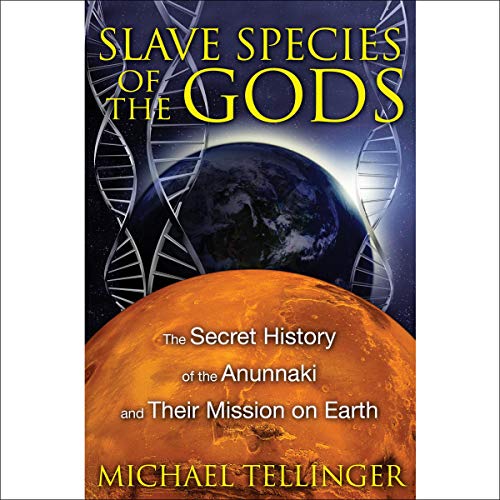
Slave Species of the Gods: The Secret History of the Anunnaki and Their Mission on Earth, 2nd Edition
Summary
Our origins as a slave species and the Anunnaki legacy in our DNA Reveals compelling new archaeological and genetic evidence for the engineered origins of the human species, first proposed by Zecharia Sitchin in The 12th Planet Shows how the Anunnaki created us using pieces of their own DNA, controlling our physical and mental capabilities by inactivating their more advanced DNA Identifies a recently discovered complex of sophisticated ruins in South Africa as the city of the Anunnaki leader Enki Scholars have long believed that the first civilization on Earth emerged in Sumer some 6,000 years ago. However, as Michael Tellinger reveals, the Sumerians and Egyptians inherited their knowledge from an earlier civilization that lived at the southern tip of Africa and began with the arrival of the Anunnaki more than 200,000 years ago. Sent to Earth in search of life-saving gold, these ancient Anunnaki astronauts from the planet Nibiru created the first humans as a slave race to mine gold - thus beginning our global traditions of gold obsession, slavery, and god as dominating master. Revealing new archaeological and genetic evidence in support of Zecharia Sitchin’s revolutionary work with pre-biblical clay tablets, Tellinger shows how the Anunnaki created us using pieces of their own DNA, controlling our physical and mental capabilities by inactivating their more advanced DNA - which explains why less than 3 percent of our DNA is active. He identifies a recently discovered complex of sophisticated ruins in South Africa, complete with thousands of mines, as the city of Anunnaki leader Enki and explains their lost technologies that used the power of sound as a source of energy. Matching key mythologies of the world’s religions to the Sumerian clay tablet stories on which they are based, he details the actual events behind these tales of direct physical interactions with “god,” concluding with the epic flood - a perennial theme of ancient myth - that wiped out the Anunnaki mining operations. Tellinger shows that, as humanity awakens to the truth about our origins, we can overcome our programmed animalistic and slave-like nature, tap in to our dormant Anunnaki DNA, and realize the longevity and intelligence of our creators as well as learn the difference between the gods of myth and the true loving God of our universe.
©2005, 2012 Michael Tellinger. All Rights Reserved. (P)2019 Inner Traditions Audio. All Rights Reserved.

The Return of Odin
Summary
A controversial examination of the influence and presence of the Norse god Odin in contemporary history and culture. It: Documents Odin’s role in the rise of Nazi Germany, the 1960s counterculture revolution, nationalist and ecological political movements, and the occult revival Examines the spiritual influence of Odin in relation to Jesus Christ Profiles key individuals instrumental in the rise of the modern pagan renaissance Exploring the influence of the Norse god Odin in the modern world, Richard Rudgley reveals Odin’s central role in the pagan revival and how this has fueled a wide range of cultural movements and phenomena, including Nazi Germany, the 1960s counterculture revolution, the Lord of the Rings, the ecology movement, and the occult underground. Rudgley argues that it is Odin and not Jesus Christ who is the single most important spiritual influence in modern Western civilization. He analyzes the Odin archetype - first revealed by Carl Jung’s famous essay on Wotan - in the context of pagan religious history and explains the ancient idea of the Web - a cosmic field of energies that encompasses time, space, and the hidden potentials of humanity - the pagan equivalent to the Tao of Eastern tradition. The author examines the importance of the concept of wyrd, which corresponds to “fate” or “destiny”, exploring techniques to read destiny such as the runes as well as the existence of yoga in prehistoric and pagan Europe, which later produced the Norse Utiseta, an ancient system of meditation. Rudgley documents how the Odin archetype came into play in Nazi Germany with the rise of Hitler and the pagan counterculture of the 1960s. He examines how the concept of subterranean and mythic realms, such as the Hollow Earth, Thule, and Agartha, and mysterious energies like Vril were manifested in both occult and profane ways and investigates key occult figures like Madame Blavatsky, Guido von List, and Karl Wiligut. He provides pagan analyses of Tolkien and the Lord of the Rings and documents the impact the Odin archetype has had on nationalist and fascist groups in America and Europe. Examining pagan groups in Europe and America that use the Norse template, Rudgley reveals true paganism as holistic and intimately connected with the forces at work in the life of the planet. Showing how this “green” paganism can be beneficial for dealing with the adverse consequences of globalization and the ongoing ecological crisis, he explains how, when repressed, the Odin archetype is responsible for regressive tendencies and even mass-psychosis - a reflection of the unprecedented chaos of Ragnarok - but if embraced, the Odin archetype makes it possible for like-minded traditions to work together in the service of life.
©2006, 2018 Richard Rudgley. All Rights Reserved. (P)2019 Inner Traditions Audio. All Rights Reserved.

Occulture
Summary
This audiobook explores the role of magic and the occult in art and culture from ancient times to today. It: Examines key figures behind esoteric cultural developments, such as Carl Jung, Anton LaVey, Paul Bowles, Aleister Crowley, and Rudolf Steiner Explores the history of magic as a source of genuine counterculture and compares it with our contemporary soulless, digital monoculture Reveals how the magic of art can be restored if art is employed as a means rather than an end and offers strategies to rekindle intuitive creativity Art, magic, and the occult have been intimately linked since our prehistoric ancestors created the first cave paintings some 50,000 years ago. As civilizations developed, these esoteric forces continued to drive culture forward, both visibly and behind the scenes, from the Hermetic ideas of the Renaissance to the ethereal worlds of 19th-century Symbolism to the occult interests of the Surrealists. In this deep exploration of “occulture” - the liminal space where art and magic meet - Carl Abrahamsson reveals the integral role played by magic and occultism in the development of culture throughout history, as well as their relevance to the continuing survival of art and creativity. Blending magical history and esoteric philosophy with his more than 30 years’ experience in occult movements, Abrahamsson examines the phenomena and people who have been seminal in modern esoteric developments, including Carl Jung, Anton LaVey, Paul Bowles, Aleister Crowley, and Rudolf Steiner. Revealing how art and magic were initially one and the same, the author explores the history of magic as a source of genuine counterculture and compares it with our contemporary soulless, digital monoculture. He reveals how the magic of art can be restored if art is employed as a means rather than an end - if it is intense, emotional, violent, and expressive - and offers strategies for creating freely, magically, even spontaneously, with intent unfettered by the whims of trends, a creative practice akin to chaos magic that assists both creators and spectators to live with meaning. He also looks at intuition and creativity as the cornerstones of genuine individuation, explaining how insights and illuminations seldom come in collective forms. Exploring magical philosophy, occult history, the arts, psychology, and the colorful grey areas in between, Abrahamsson reveals the culturally and magically transformative role of art and the ways the occult continues to transform culture to this day.
©2018 Carl Abrahamsson. All Rights Reserved. (P)2019 Inner Traditions Audio. All Rights Reserved.

The Return of Holy Russia
Summary
A history of how mystical and spiritual influences have shaped Russia’s identity and politics and what it means for the future of world civilization Examines Russia’s spiritual history, from its pagan origins and Eastern Orthodox mysticism to secret societies, Rasputin, Roerich, Blavatsky, and Dostoyevsky Explains the visionary writings of the spiritual philosophers of Russia’s Silver Age, which greatly influence Putin today Explores what Russia’s unique identity and its history of messianic politics and apocalyptic thought mean for its future on the world stage At the turn of the 20th century, a period known as the Silver Age, Russia was undergoing a powerful spiritual and cultural rebirth. It was a time of magic and mysticism that saw a vital resurgence of interest in the occult and a creative intensity not seen in the West since the Renaissance. This was the time of the God-Seekers, pilgrims of the soul and explorers of the spirit who sought the salvation of the world through art and ideas. These sages and their visions of Holy Russia are returning to prominence now through Russian president Vladimir Putin, who, inspired by their ideas, envisions a new “Eurasian” civilization with Russia as its leader. Exploring Russia’s long history of mysticism and apocalyptic thought, Gary Lachman examines Russia’s unique position between East and West and its potential role in the future of the world. Lachman discusses Russia’s original Slavic paganism and its eager adoption of mystical and apocalyptic Eastern Orthodox Christianity. He explores the Silver Age and its “occult revival” with a look at Rasputin’s prophecies, Blavatsky’s Theosophy, Roerich’s “Red Shambhala”, and the philosophies of Berdyaev and Solovyov. He looks at Russian Rosicrucianism, the Illuminati Scare, Russian Freemasonry, and the rise of other secret societies in Russia. He explores the Russian character as that of the “holy fool”, as seen in the great Russian literature of the 19th century, especially Dostoyevsky. He also examines the psychic research performed by the Russian government throughout the 20th century and the influence of Evola and the esoteric right on the spiritual and political milieus in Russia. Through in-depth exploration of the philosophies that inspire Putin’s political regime and a look at Russia’s unique cultural identity, Lachman ponders what they will mean for the future of Russia and the world. What drives the Russian soul to pursue the apocalypse? Will these philosophers lead Russia to dominate the world, or will they lead it into a new cultural epoch centered on spiritual power and mystical wisdom?
©2020 by Gary Lachman. All Rights Reserved. (P)2020 Inner Traditions Audio. All Rights Reserved.

The Cygnus Key
Summary
New evidence showing that the earliest origins of human culture, religion, and technology derive from the lost world of the Denisovans: Explains how Göbekli Tepe and the Giza pyramids are aligned with the constellation of Cygnus and show evidence of enhanced sound-acoustic technology. Traces the origins of Göbekli Tepe and the Giza pyramids to the Denisovans, a previously unknown human population remembered in myth as a race of giants. Shows how the ancient belief in Cygnus as the origin point for the human soul is as much as 45,000 years old and originally came from southern Siberia. Built at the end of the last ice age around 9600 BCE, Göbekli Tepe in southeast Turkey was designed to align with the constellation of the celestial swan, Cygnus - a fact confirmed by the discovery at the site of a tiny bone plaque carved with the three key stars of Cygnus. Remarkably, the three main pyramids at Giza in Egypt, including the Great Pyramid, align with the same three stars. But where did this ancient veneration of Cygnus come from? Showing that Cygnus was once seen as a portal to the sky-world, Andrew Collins reveals how, at both sites, the attention toward this star group is linked with sound acoustics and the use of musical intervals “discovered” thousands of years later by the Greek mathematician Pythagoras. Collins traces these ideas as well as early advances in human technology and cosmology back to the Altai-Baikal region of Russian Siberia, where the cult of the swan flourished as much as 20,000 years ago. He shows how these concepts, including a complex numeric system based on long-term eclipse cycles, are derived from an extinct human population known as the Denisovans. Not only were they of exceptional size - the ancient giants of myth - but archaeological discoveries show that this previously unrecognized human population achieved an advanced level of culture, including the use of high-speed drilling techniques and the creation of musical instruments. The author explains how the stars of Cygnus coincided with the turning point of the heavens at the moment the Denisovan legacy was handed to the first human societies in southern Siberia 45,000 years ago, catalyzing beliefs in swan ancestry and an understanding of Cygnus as the source of cosmic creation. It also led to powerful ideas involving the Milky Way’s Dark Rift, viewed as the Path of Souls and the sky-road shamans travel to reach the sky-world. He explores how their sound technology and ancient cosmologies were carried into the West, flowering first at Göbekli Tepe and then later in Egypt’s Nile Valley. Collins shows how the ancient belief in Cygnus as the source of creation can also be found in many other cultures around the world, further confirming the role played by the Denisovan legacy in the genesis of human civilization.
©2018 Andrew Collins. All Rights Reserved (P)2019 Inner Traditions Audio. All Rights Reserved.

The Mysterious Life and Faked Death of Jesse James
Summary
A deep investigation into historical documents that prove the notorious outlaw Jesse James faked his own death. Presents the legend of Jesse James and counters it with the real story, based on family records Provides photographic evidence, a journal of Jesse James’, and historical records that prove James faked his death, verified by experts and civic authorities Debunks the 1995 DNA test results of James’ supposed remains The story of the notorious outlaw Jesse James’ assassination at the hands of Robert Ford has been clouded with mystery ever since its inception. Now, James’ great-great-grandchildren Daniel and Teresa Duke present the results of more than 20 years of exhaustive research into state and federal records, photographs, newspaper reports, diaries, and a 1995 DNA test in search of the truth behind Jesse James’ demise. Explaining how the accepted version of the history of Jesse James is wrong, the authors confirm their family’s oral tradition that James faked his own death in 1882 and lived out his remaining days in Texas. They methodically unravel the legend surrounding his death, with evidence vetted by qualified experts and civic authorities. They share the journal of their great-great-grandfather, kept from 1871 to 1876 and verified to be written in James’ handwriting. They reveal forensically confirmed photographs of James before and after his supposed killing, including one of James attending his own funeral. Examining James’ life both before and after his faked death, they provide an account of where he lived and who he associated with, including his interactions with secret societies. They compare the contradictory newspaper reports of James’ death with accounts by his family and associates, which support that the man buried as James was actually his cousin, and reveal how James tricked authorities into believing he had been killed. Further supporting their claim, the authors debunk the DNA test results of the exhumation of James’ body in 1995. The Dukes detail the ways in which the test was fraudulent, an assertion supported by the deputy counselor for Clay County at the time of the testing. Backed by a wealth of evidence, the descendants of Jesse James conclusively prove what really happened to America’s Robin Hood.
©2020 Daniel Duke and Teresa Duke. All Rights Reserved. (P)2020 Inner Traditions Audio. All Rights Reserved.
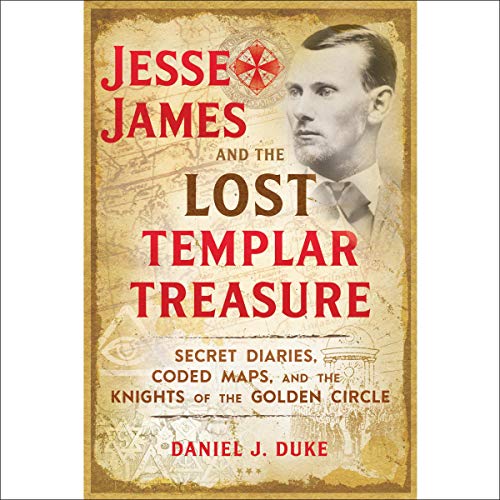
Jesse James and the Lost Templar Treasure
Summary
An investigation into the lost treasures of Jesse James and the Freemasons and their connections to the Templars, Rosicrucians, and the Founding Fathers
Explains how Jesse James used techniques involving sacred geometry, gematria, and esoteric symbols to hide his treasures and encode maps
Provides instructions for using the encoding template employed by Jesse James and the Freemasons to hide and recover treasure and sacred relics
Shows how the encoding template confirms the existence of treasures on Oak Island and Victorio Peak and can be traced to a 16th-century book containing a secret map of the New World and the “hooked X” of the Knights Templar
Jesse James left behind secret diaries and coded treasure maps. Working to decrypt these maps, Daniel J. Duke - the great-great grandson of Jesse James - reveals hidden treasures yet to be recovered as well as connections between the infamous train robber and Freemasonry, the Knights Templar, the Founding Fathers, and Jewish mysticism.
The author explains how Jesse James faked his death and lived out his final years under the name James L. Courtney. He uncovers James’ affiliation with the Knights of the Golden Circle, a secret society that buried Confederate gold across the United States, and shows how the hidden treasures coded into James’ maps were not affiliated with the KGC but with the Freemasons, the Knights Templar, and the treasure of the Temple Mount. Using sacred geometry, gematria, and the Kabbalistic Tree of Life symbol, the author explains the encoded map technique used by the Freemasons to hide and later recover treasures, an esoteric template known as the “Veil”. He shows how the Veil template confirms the locations of Jesse James’ recovered treasures in Texas as well as other suspected treasure locations, such as the Oak Island Money Pit and Victorio Peak in New Mexico.
Tracing knowledge of the Veil template back through the centuries, the author reveals the Veil hidden on the cover of a 16th-century book that contains a secret map of the New World and the “hooked X” symbol of the Knights Templar. He shows how the template was used not only to hide treasures but also sacred knowledge and relics, such as within the Bruton Vault, which originally contained secrets tied to Francis Bacon, the Freemasons, the Rosicrucians, and the founding of the United States. Applying the Veil template alongside the esoteric secrets of Poussin’s famous painting, Et In Arcadia Ego, and Cassini’s Celestial Globe, Duke shows how the template reveals other Templar and Freemason treasure sites scattered throughout America and around the world.
PLEASE NOTE: When you purchase this title, the accompanying PDF will be available in your Audible Library along with the audio.
©2019 Daniel J. Duke (P)2019 Inner Traditions Audio

Primal Wisdom of the Ancients
Summary
Examines how the similarities of symbols and wisdom across many cultures point to an ancient civilizing plan and system of ancient instruction. Reveals the shared cosmological knowledge of Dogon and Maori cultures, ancient Egypt, Gobekli Tepe, Vedic India, the pre-Indian Sakti civilization, Buddhism, the Tibetan Bon religion, and the kabbalistic tradition of the Hebrews Explores symbols and techniques used to frame and preserve instructed knowledge as it was transmitted orally from generation to generation Explains how this shared ancient knowledge relates to the precessional year and the cycles of time known as the yugas Exploring the mystery of why so many ancient cultures, separated by time and distance, share remarkably similar cosmological philosophies and religious symbolism, Laird Scranton reveals how this shared creation tradition upholds the idea that ancient instruction gave birth to the great civilizations, each of which preserves fragments of the original knowledge. Looking at the many manifestations of this shared cosmological knowledge, including in the Dogon and Maori cultures and in ancient Egypt, Gobekli Tepe, Vedic India, Buddhism, the Tibetan Bon religion, and the kabbalistic tradition of the Hebrews, Scranton explores the thought processes that went into formulating the archetype themes and metaphors of the ancient symbolic system. He examines how commonly shared principles of creational science are reflected in key terms of the ancient languages. He discusses how the primal cosmology also transmitted key components of sacred science, such as sacred geometry, knowledge of material creation, and the nature of a nonmaterial universe - evidence for which lies in the orientation of ancient temples, the drama of initiations and rituals, and countless traditional myths. He analyzes how this shared knowledge relates to the precessional year and the cycles of time known as the yugas. He also explores evidence of the concept of a nonmaterial twin universe to our own - the “above” to our “below” in the famous alchemical and hermetic maxim. Through his extensive research into the interconnected wisdom of the ancients, Scranton shows that the forgotten instructional tradition at the source of this knowledge was deliberately encoded to survive for countless generations. By piecing it back together, we can discover the ancient plan for guiding humanity forward toward greater enlightenment. PLEASE NOTE: When you purchase this title, the accompanying PDF will be available in your Audible Library along with the audio.
©2020 Laird Scranton. All Rights Reserved. (P)2020 Inner Traditions Audio. All Rights Reserved.

Doctoring the Devil
Summary
Who were the old conjurors and witches of Appalachia? What were their practices and beliefs? How can you learn the ways of conjuring for yourself? Appalachian folk magic and conjuring are little known today, but 40 or 50 years ago just about every person you might ask in Appalachia either knew something about it themselves or knew someone who did it. These practices and “superstitions” are at the core of Appalachian culture. In Doctoring the Devil, Jake Richards speaks to those questions and more, offering the various ways of rooting out the “devil” - any unfriendly spirit bringing bad luck, poor health, and calamities of all sorts. Like the blue smoky mists that glide up the Appalachians, Jake leads listeners up the hillsides too, introducing us to folks along the way - hunters, farmers, blacksmiths, faith healers, preachers, and root-diggers. We’ll also meet the local spirits and learn root ways. Further up the hill, we delve into Jake’s notebooks - a personal collection of tried-and-true Appalachian recipes and roots for conjuring love, money, justice, and success.
©2021 Jake Richards (P)2021 Dreamscape Media, LLC

Magic in the Landscape
Summary
Learn to cultivate a traditional, beneficial relationship with the land by embracing the forgotten practices of our ancestors. Details the ancient art of geomancy and Earth magic, including how to work with ley lines, astrology, and the four directions to honor a space and make it a place of power Explores the magic of the land around us and how our ancestors interacted with earth energies and the forces of nature Discusses the power of boundaries and magic circles, the proper “feng shui” of graveyards and cemeteries, and magically powerful places such as crossroads, fairgrounds, and the mystic triangles found in “no-man’s lands” Our ancestors were deeply aware of the magical power of their local landscape, no matter where they lived. Every interaction with their environment - from building to farming to the layout of ancient cities - took into account terrestrial energies, ancestral memory, and the many seen and unseen presences in nature. They developed sophisticated procedures for orienting their living spaces and respectfully working with the magic of the landscape. Yet, much of the art of geomancy and of working with the forces of nature has been forgotten by modern builders, architects, foresters, gardeners, and homeowners. The treatment of land as mere property has led to a loss of its meaning for those who dwell upon it. Our landscape has become disenchanted. In this audiobook, geomancy expert and scholar Nigel Pennick details the ancient and sacred practices of geomancy and earth magic and reveals how we can re-enchant and reconnect to the sacred landscape that surrounds us, whether you live rurally, in the suburbs, or in cities. Pennick begins with a vivid look at our modern “wasteland” and what he calls “the ensouled world”, with specific examples from Britain and Iceland of our ancestors’ way of perceiving the world in which they lived. Exploring the art of geomancy, he examines how its techniques work with ley lines, astrology, and the old understanding of the four directions and the eight winds to honor a space and make it a place of power. He looks at the power of boundaries and magic circles, including laying ghosts and dismissing spirits, as well as the proper “feng shui” for cemeteries and graveyards. The author then takes the listener back into the traditional landscape to discuss magically powerful places, such as crossroads, the occult nature of the “fairground”, and the mystic triangles found in what are popularly known as “no-man’s lands”. Revealing how the landscape can be re-enchanted, Pennick shows how the magic of place is a living system with which each of us can interact.
©2020 Nigel Pennick. All Rights Reserved. (P)2020 Inner Traditions Audio. All Rights Reserved.

Icelandic Magic
Summary
A practical guide to the magical systems of pre-Christian Iceland Reveals spells and workings drawn directly from surviving magical books from the 16th to 20th century preserved at the National Library in Reykjavík Explores the history of magic in Iceland through original translations of Icelandic folktales about famous magicians and about legendary grimoires, such as the Galdrabók, the oldest and most complete book of its kind Explains how to personalize the spells through the creation of unique signs and symbols based on the mythic names of Odin and Icelandic magical alphabets During the Christianization of Europe in the Middle Ages, many books of magic were lost as the ancient pagan traditions were suppressed. But in Iceland the practice of recording magical spells in books continued in secret for centuries, on a scale not seen elsewhere. Now housed in the National Library in Reykjavík, these surviving grimoires, which represent only a hundredth of what was lost, reveal a rich magical tradition that continued to evolve into the 20th century. Drawing directly from the actual surviving Icelandic books of magic, Stephen Flowers presents a complete system of magic based on Icelandic lore and magical practices from the 16th century onward. He explores the history of magic in Iceland in pagan and early Christian times and reveals specific practical techniques and ritual templates that readers can adapt to their unique purposes. Illustrating traditional Icelandic magical practices and the Icelanders’ attitudes toward them, he shares original translations of Icelandic folktales about famous magicians, such as the legend of Gray-Skin, and about legendary grimoires, such as the Galdrabók, the oldest and most complete book of its kind. After initiating the reader into the grammar and symbols of Icelandic magic through history and lore, Flowers then presents an extensive catalog of actual spells and magical workings from the historical Icelandic books of magic. These examples provide ready-made forms for practical experimentation as well as an exemplary guide on how to create signs and symbols for more personalized magical work. The author also includes guidance on creating unique magical signs from the 100 mythic names of Odin, which he translates and interprets magically, and from Icelandic magical alphabets, symbols that connect Icelandic magic to the ancient runic tradition. PLEASE NOTE: When you purchase this title, the accompanying PDF will be available in your Audible Library along with the audio.
©2016 Stephen E. Flowers, Ph.D.. All Rights Reserved. (P)2020 Inner Traditions Audio. All Rights Reserved.