The Anthropology category has 155 audiobooks on Listento.it, with an average listener rating of 4.5★ across 7,559 ratings. The most-rated is Sapiens.

Sapiens
Summary
Destined to become a modern classic in the vein of Guns, Germs, and Steel, Sapiens is a lively, groundbreaking history of humankind told from a unique perspective. One hundred thousand years ago, at least six species of human inhabited the earth. Today there is just one. Us. Homo Sapiens. How did our species succeed in the battle for dominance? Why did our foraging ancestors come together to create cities and kingdoms? How did we come to believe in gods, nations, and human rights; to trust money, books, and laws; and to be enslaved by bureaucracy, timetables, and consumerism? And what will our world be like in the millennia to come? In Sapiens, Dr. Yuval Noah Harari spans the whole of human history, from the very first humans to walk the earth to the radical - and sometimes devastating - breakthroughs of the cognitive, agricultural, and scientific revolutions. Drawing on insights from biology, anthropology, paleontology, and economics, he explores how the currents of history have shaped our human societies, the animals and plants around us, and even our personalities. Have we become happier as history has unfolded? Can we ever free our behavior from the heritage of our ancestors? And what, if anything, can we do to influence the course of the centuries to come? Bold, wide-ranging and provocative, Sapiens challenges everything we thought we knew about being human: our thoughts, our actions, our power...and our future.
©2017 Yuval Noah Harari (P)2017 Penguin Random House Canada

Born to Run
Summary
Full of incredible characters, amazing athletic achievements, cutting-edge science, and, most of all, pure inspiration, Born to Run is an epic adventure that began with one simple question: Why does my foot hurt? In search of an answer, Christopher McDougall sets off to find a tribe of the world's greatest distance runners and learn their secrets, and in the process shows us that everything we thought we knew about running is wrong. Isolated by the most savage terrain in North America, the reclusive Tarahumara Indians of Mexico's deadly Copper Canyons are custodians of a lost art. For centuries they have practiced techniques that allow them to run hundreds of miles without rest and chase down anything from a deer to an Olympic marathoner while enjoying every mile of it. Their superhuman talent is matched by uncanny health and serenity, leaving the Tarahumara immune to the diseases and strife that plague modern existence. With the help of Caballo Blanco, a mysterious loner who lives among the tribe, the author was able not only to uncover the secrets of the Tarahumara but also to find his own inner ultra-athlete, as he trained for the challenge of a lifetime: a 50-mile race through the heart of Tarahumara country pitting the tribe against an odd band of Americans, including a star ultramarathoner, a beautiful young surfer, and a barefoot wonder. With a sharp wit and wild exuberance, McDougall takes us from the high-tech science labs at Harvard to the sun-baked valleys and freezing peaks across North America, where ever-growing numbers of ultrarunners are pushing their bodies to the limit, and, finally, to the climactic race in the Copper Canyons. Born to Run is that rare book that will not only engage your mind but inspire your body when you realize that the secret to happiness is right at your feet, and that you, indeed all of us, were born to run.
©2009 Knopf (P)2009 Random House

What Doesn't Kill Us
Summary
What Doesn't Kill Us, a New York Times best seller, traces our evolutionary journey back to a time when survival depended on how well we adapted to the environment around us. Our ancestors crossed deserts, mountains, and oceans without even a whisper of what anyone today might consider modern technology. Those feats of endurance now seem impossible in an age where we take comfort for granted. But what if we could regain some of our lost evolutionary strength by simulating the environmental conditions of our forbears? Investigative journalist and anthropologist Scott Carney takes up the challenge to find out: Can we hack our bodies and use the environment to stimulate our inner biology? Helping him in his search for the answers is Dutch fitness guru Wim Hof, whose ability to control his body temperature in extreme cold has sparked a whirlwind of scientific study. Carney also enlists input from an army scientist, a world-famous surfer, the founders of an obstacle course race movement, and ordinary people who have documented how they have cured autoimmune diseases, lost weight, and reversed diabetes. In the process he chronicles his own transformational journey as he pushes his body and mind to the edge of endurance, a quest that culminates in a record-bending 28-hour climb to the snowy peak of Mt. Kilimanjaro wearing nothing but a pair of running shorts and sneakers. An ambitious blend of investigative reporting and participatory journalism, What Doesn't Kill Us explores the true connection between the mind and the body and reveals the science that allows us to push past our perceived limitations.
©2017 Scott Carney (P)2017 Scott Carney

The Gene
Summary
From the Pulitzer Prize-winning, best-selling author of The Emperor of All Maladies, a magnificent history of the gene and a response to the defining question of the future: What becomes of being human when we learn to "read" and "write" our own genetic information? The extraordinary Siddhartha Mukherjee has written a biography of the gene as deft, brilliant, and illuminating as his extraordinarily successful biography of cancer. Weaving science, social history, and personal narrative to tell us the story of one of the most important conceptual breakthroughs of modern times, Mukherjee animates the quest to understand human heredity and its surprising influence on our lives, personalities, identities, fates, and choices. Throughout the narrative, the story of Mukherjee's own family - with its tragic and bewildering history of mental illness - cuts like a bright red line, reminding us of the many questions that hang over our ability to translate the science of genetics from the laboratory to the real world. In superb prose and with an instinct for the dramatic scene, he describes the centuries of research and experimentation - from Aristotle and Pythagoras to Mendel and Darwin, from Boveri and Thomas Morgan to Crick, Watson, and Rosa Franklin, all the way through the revolutionary 21st-century innovators who mapped the human genome. As The New Yorker said of The Emperor of All Maladies, "It's hard to think of many books for a general audience that have rendered any area of modern science and technology with such intelligence, accessibility, and compassion.... An extraordinary achievement." A riveting, revelatory, and magisterial history of a scientific idea coming to life and an essential preparation for the moral complexity introduced by our ability to create or "write" the human genome, The Gene is a must-listen for everyone concerned about the definition and future of humanity. This is the most crucial science of our time, intimately explained by a master. PLEASE NOTE: When you purchase this title, the accompanying reference material will be available in your Library section along with the audio.
©2016 Siddhartha Mukherjee (P)2016 Simon & Schuster

Debt - Updated and Expanded
Summary
Now in audio, the updated and expanded edition: David Graeber's "fresh...fascinating...thought-provoking...and exceedingly timely" (Financial Times) history of debt. Here, anthropologist David Graeber presents a stunning reversal of conventional wisdom: He shows that before there was money, there was debt. For more than 5,000 years, since the beginnings of the first agrarian empires, humans have used elaborate credit systems to buy and sell goods - that is, long before the invention of coins or cash. It is in this era, Graeber argues, that we also first encounter a society divided into debtors and creditors. Graeber shows that arguments about debt and debt forgiveness have been at the center of political debates from Italy to China, as well as sparking innumerable insurrections. He also brilliantly demonstrates that the language of the ancient works of law and religion (words like "guilt", "sin", and "redemption") derive in large part from ancient debates about debt, and shape even our most basic ideas of right and wrong. We are still fighting these battles today without knowing it.
©2014 David Graeber (P)2015 Gildan Media LLC

Born to Run
Summary
Full of incredible characters, amazing athletic achievements, cutting-edge science, and, most of all, pure inspiration, Born to Run is an epic adventure that began with one simple question: Why does my foot hurt? In search of an answer, Christopher McDougall sets off to find a tribe of the world's greatest distance runners and learn their secrets - and in the process shows us that everything we thought we knew about running is wrong. Isolated by the most savage terrain in North America, the reclusive Tarahumara Indians of Mexico's deadly Copper Canyons are custodians of a lost art. For centuries they have practiced techniques that allow them to run hundreds of miles without rest and chase down anything from a deer to an Olympic marathoner while enjoying every mile of it. Their superhuman talent is matched by uncanny health and serenity, leaving the Tarahumara immune to the diseases and strife that plague modern existence. With the help of Caballo Blanco, a mysterious loner who lives among the tribe, the author was able not only to uncover the secrets of the Tarahumara but also to find his own inner ultra-athlete, as he trained for the challenge of a lifetime: a 50-mile race through the heart of Tarahumara country pitting the tribe against an odd band of Americans, including a star ultramarathoner, a beautiful young surfer, and a barefoot wonder. With a sharp wit and wild exuberance, McDougall takes us from the high-tech science labs at Harvard to the sun-baked valleys and freezing peaks across North America, where ever-growing numbers of ultra runners are pushing their bodies to the limit, and, finally, to the climactic race in the Copper Canyons. Born to Run is that rare book that will not only engage your mind but inspire your body when you realize that the secret to happiness is right at your feet, and that you, indeed all of us, were born to run.
©2009 Christopher McDougall (P)2012 Audible Ltd

A Brief History of Everyone Who Ever Lived
Summary
A National Geographic Best Book of the Year In our unique genomes, every one of us carries the story of our species - births, deaths, disease, war, famine, migration, and a lot of sex. But those stories have always been locked away - until now. Who are our ancestors? Where did they come from? Geneticists have suddenly become historians, and the hard evidence in our DNA has completely upended what we thought we knew about ourselves. Acclaimed science writer Adam Rutherford explains exactly how genomics is completely rewriting the human story - from 100,000 years ago to the present. PLEASE NOTE: When you purchase this title, the accompanying PDF will be available in your Audible Library along with the audio.
©2016 Adam Rutherford (P)2018 Tantor

Ten Arguments for Deleting Your Social Media Accounts Right Now
Summary
Ten Arguments for Deleting Your Social Media Accounts Right Now is a timely call-to-arms from a Silicon Valley pioneer. You might have trouble imagining life without your social media accounts, but virtual reality pioneer Jaron Lanier insists that we’re better off without them. In his important new audiobook, Lanier, who participates in no social media, offers powerful and personal reasons for all of us to leave these dangerous online platforms behind before it’s too late. Lanier’s reasons for freeing ourselves from social media’s poisonous grip include its tendency to bring out the worst in us, to make politics terrifying, to trick us with illusions of popularity and success, to twist our relationship with the truth, to disconnect us from other people even as we are more “connected” than ever, to rob us of our free will with relentless targeted ads. How can we remain autonomous in a world where we are under continual surveillance and are constantly being prodded by algorithms run by some of the richest corporations in history that have no way of making money other than being paid to manipulate our behavior? How could the “benefits” of social media possibly outweigh the catastrophic losses to our personal dignity, happiness, and freedom? Lanier remains a tech optimist, so while demonstrating the evil that rules social media business models today, he also envisions a humanistic setting for social networking that can direct us towards richer and fuller way of living and connecting with our world.
©2018 Jaron Lanier (P)2018 Macmillan Audio

The Antidote
Summary
The Antidote is a series of journeys among people who share a single, surprising way of thinking about life. What they have in common is a hunch about human psychology: that it’s our constant effort to eliminate the negative that causes us to feel so anxious, insecure, and unhappy. And that there is an alternative "negative path" to happiness and success that involves embracing the things we spend our lives trying to avoid. It is a subversive, galvanizing message, which turns out to have a long and distinguished philosophical lineage ranging from ancient Roman Stoic philosophers to Buddhists. Oliver Burkeman talks to life coaches paid to make their clients’ lives a living hell, and to maverick security experts such as Bruce Schneier, who contends that the changes we’ve made to airport and aircraft security since the 9/11 attacks have actually made us less safe. And then there are the "backwards" business gurus, who suggest not having any goals at all and not planning for a company’s future. Burkeman’s new audiobook is a witty, fascinating, and counterintuitive listen that turns decades of self-help advice on its head and forces us to rethink completely our attitudes toward failure, uncertainty, and death.
©2012 Oliver Burkeman (P)2013 Audible, Inc.

Everything All at Once
Summary
Bill Nye has been the public face of science for more than 20 years. In Everything All at Once, the New York Times best-selling author urges listeners to become activists and agents of change. Everything All at Once is an exciting, inspiring call to unleash the power of the nerd mindset that exists within us all. Nye believes we'll never be able to tackle our society's biggest, most complex problems if we don't even know how to solve the small ones. Step by step, he shows his listeners the key tools behind his everything-all-at-once approach: radical curiosity, a deep desire for a better future, and a willingness to take the actions needed to make it a reality. Problem solving is a skill that anyone can harness to create change, and Bill Nye is here to teach us how. Each chapter describes a principle of problem solving that Nye himself uses - methodical, fact-based approaches to life that aspires to leave no stone unturned. He explains how the nerd mindset leads to a richer and more meaningful life; far more than that, it can help address hunger, crime, poverty, pollution, and even assist the democratic process. Throughout the book, Nye draws on his own experiences - leavened with his trademark humor and self-deprecation - to show how he came to think like a Science Guy, and how you can, too. By the end you will be ready to sort out problems, recognize solutions, and join him in changing the world.
©2017 Bill Nye (P)2017 Recorded Books

Civilization
Summary
The rise to global predominance of Western civilization is the single most important historical phenomenon of the past five hundred years. All over the world, an astonishing proportion of people now work for Western-style companies, study at Western-style universities, vote for Western-style governments, take Western medicines, wear Western clothes, and even work Western hours. Yet six hundred years ago the petty kingdoms of Western Europe seemed unlikely to achieve much more than perpetual internecine warfare. It was Ming China or Ottoman Turkey that had the look of world civilizations. How did the West overtake its Eastern rivals? And has the zenith of Western power now passed? In Civilization: The West and the Rest, bestselling author Niall Ferguson argues that, beginning in the fifteenth century, the West developed six powerful new concepts that the Rest lacked: competition, science, the rule of law, consumerism, modern medicine, and the work ethic.
©2011 Niall Ferguson (P)2011 Tantor
![Cover art for Sapiens. De animales a dioses [Sapiens: From Animals to Gods]](https://m.media-amazon.com/images/I/51RJHzs4VqL._SL500_.jpg)
Sapiens. De animales a dioses [Sapiens: From Animals to Gods]
Summary
El libro de no ficción del AÑO Un best seller internacional con más de un millón de ejemplares vendidos Lúcido e iluminador: la historia de la humanidad en un solo volumen. Este es el fascinante relato de nuestra extraordinaria historia: de simios sin importancia a amos del mundo. ¿Cómo logró nuestra especie imponerse en la lucha por la existencia? ¿Por qué nuestros ancestros recolectores se unieron para crear ciudades y reinos? ¿Cómo llegamos a creer en dioses, en naciones o en los derechos humanos; a confiar en el dinero, en los libros o en las leyes? ¿Cómo acabamos sometidos a la burocracia, a los horarios y al consumismo? ¿Y cómo será el mundo en los milenios venideros? En De animales a dioses, Yuval Noah Harari traza una breve historia de la humanidad, desde los primeros humanos que caminaron sobre la Tierra hasta los radicales y a veces devastadores avances de las tres grandes revoluciones que nuestra especie ha protagonizado: la cognitiva, la agrícola y la científica. A partir de hallazgos de disciplinas tan diversas como la biología, la antropología, la paleontología o la economía, Harari explora cómo las grandes corrientes de la historia han modelado nuestra sociedad, los animales y las plantas que nos rodean e incluso nuestras personalidades. ¿Hemos ganado en felicidad a medida que ha avanzado la historia? ¿Seremos capaces de liberar alguna vez nuestra conducta de la herencia del pasado? ¿Podemos hacer algo para influir en los siglos futuros? Audaz, ambicioso y provocador, este libro cuestiona todo lo que creíamos saber sobre el ser humano: nuestros orígenes, nuestras ideas, nuestras acciones, nuestro poder... y nuestro futuro. El fuego nos dio poder. La conversación hizo posible que cooperáramos. La agricultura alimentó nuestra ambición. La mitología sostuvo la ley y el orden. El dinero ofreció algo en lo que confiar. Las contradicciones crearon la cultura. La ciencia nos hizo imparables. Please note: This audiobook is in Spanish.
©2013 Yuval Noah Harari (P)2017 Penguin Random House Grupo Editorial, S.A.U.
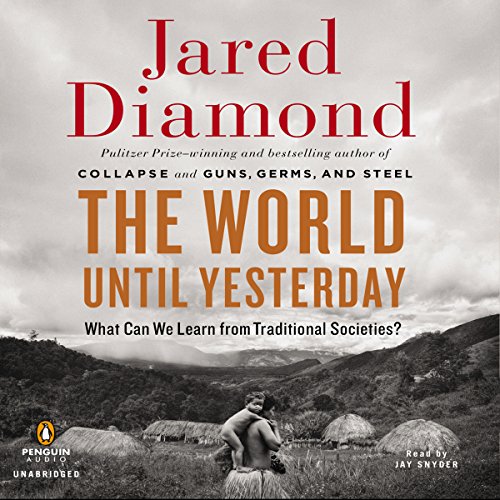
The World Until Yesterday
Summary
Most of us take for granted the features of our modern society, from air travel and telecommunications to literacy and obesity. Yet for nearly all of its six million years of existence, human society had none of these things. While the gulf that divides us from our primitive ancestors may seem unbridgeably wide, we can glimpse much of our former lifestyle in those largely traditional societies still or recently in existence. Societies like those of the New Guinea Highlanders remind us that it was only yesterday - in evolutionary time - when everything changed and that we moderns still possess bodies and social practices often better adapted to traditional than to modern conditions. The World Until Yesterday provides a mesmerizing firsthand picture of the human past as it had been for millions of years - a past that has mostly vanished - and considers what the differences between that past and our present mean for our lives today. This is Jared Diamond’s most personal book to date, as he draws extensively from his decades of field work in the Pacific islands, as well as evidence from Inuit, Amazonian Indians, Kalahari San people, and others. Diamond doesn’t romanticize traditional societies - after all, we are shocked by some of their practices - but he finds that their solutions to universal human problems such as child rearing, elder care, dispute resolution, risk, and physical fitness have much to teach us. A characteristically provocative, enlightening, and entertaining book, The World Until Yesterday will be essential and delightful listening.
©2012 Jared Diamond (P)2012 Penguin Audio

The Social Leap
Summary
In the compelling popular science tradition of Sapiens and Guns, Germs, and Steel, a groundbreaking and eye-opening exploration that applies evolutionary science to provide a new perspective on human psychology, revealing how major challenges from our past have shaped some of the most fundamental aspects of our being. The most fundamental aspects of our lives - from leadership and innovation to aggression and happiness - were permanently altered by the "social leap" our ancestors made from the rain forest to the Savannah. Their struggle to survive on the open grasslands required a shift from individualism to a new form of collectivism, which forever altered the way our mind works. It changed the way we fight and our proclivity to make peace, it changed the way we lead and the way we follow, it made us innovative but not inventive, it created a new kind of social intelligence, and it led to new sources of life satisfaction. In The Social Leap, William von Hippel lays out this revolutionary hypothesis, tracing human development through three critical evolutionary inflection points to explain how events in our distant past shape our lives today. From the mundane, such as why we exaggerate, to the surprising, such as why we believe our own lies and why fame and fortune are as likely to bring misery as happiness, the implications are far-reaching and extraordinary. Blending anthropology, biology, history, and psychology with evolutionary science, The Social Leap is a fresh and provocative look at our species that provides new clues about who we are, what makes us happy, and how to use this knowledge to improve our lives.
©2018 William von Hippel (P)2018 HarperCollins Publishers

Misreading Scripture with Western Eyes
Summary
What was clear to the original readers of Scripture is not always clear to us. Because of the cultural distance between the biblical world and our contemporary setting, we often bring modern Western biases to the text. For example: When Western readers hear Paul exhorting women to "dress modestly", we automatically think in terms of sexual modesty. But most women in that culture would never wear racy clothing. The context suggests that Paul is likely more concerned about economic modesty - that Christian women not flaunt their wealth through expensive clothes, braided hair, and gold jewelry. Some readers might assume that Moses married "below himself" because his wife was a dark-skinned Cushite. Actually, Hebrews were the slave race, not the Cushites, who were highly respected. Aaron and Miriam probably thought Moses was being presumptuous by marrying "above himself". Western individualism leads us to assume that Mary and Joseph traveled alone to Bethlehem. What went without saying was that they were likely accompanied by a large entourage of extended family. Biblical scholars Brandon O'Brien and Randy Richards shed light on the ways that Western readers often misunderstand the cultural dynamics of the Bible. They identify nine key areas where modern Westerners have significantly different assumptions about what might be going on in a text. Drawing on their own cross cultural experience in global mission, O'Brien and Richards show how better self-awareness and understanding of cultural differences in language, time, and social mores allow us to see the Bible in fresh and unexpected ways. Getting beyond our own cultural assumptions is increasingly important for being Christians in our interconnected and globalized world. Learn to read Scripture as a member of the global body of Christ.
©2012 E. Randolph Richards and Brandon J. O'Brien (P)2014 Audible, Inc.

A Long Way Home
Summary
At only five years old, Saroo Brierley got lost on a train in India. Unable to read or write or recall the name of his hometown or even his own last name, he survived alone for weeks on the rough streets of Calcutta before ultimately being transferred to an agency and adopted by a couple in Australia. Despite his gratitude, Brierley always wondered about his origins. Eventually, with the advent of Google Earth, he had the opportunity to look for the needle in a haystack he once called home and pore over satellite images for landmarks he might recognize or mathematical equations that might further narrow down the labyrinthine map of India. One day, after years of searching, he miraculously found what he was looking for and set off to find his family. A Long Way Home is a moving, poignant, and inspirational true story of survival and triumph against incredible odds. It celebrates the importance of never letting go of what drives the human spirit: Hope.
©2014 Saroo Brierley (P)2014 Blackstone Audio, Inc.

The Mushroom at the End of the World
Summary
Matsutake is the most valuable mushroom in the world - and a weed that grows in human-disturbed forests across the northern hemisphere. Through its ability to nurture trees, matsutake helps forests to grow in daunting places. It is also an edible delicacy in Japan, where it sometimes commands astronomical prices. In all its contradictions, matsutake offers insights into areas far beyond just mushrooms and addresses a crucial question: what manages to live in the ruins we have made? A tale of diversity within our damaged landscapes, The Mushroom at the End of the World follows one of the strangest commodity chains of our times to explore the unexpected corners of capitalism. Here, we witness the varied and peculiar worlds of matsutake commerce: the worlds of Japanese gourmets, capitalist traders, Hmong jungle fighters, industrial forests, Yi Chinese goat herders, Finnish nature guides, and more. These companions also lead us into fungal ecologies and forest histories to better understand the promise of cohabitation in a time of massive human destruction.
©2015 Princeton University Press (P)2017 Tantor

Free to Learn
Summary
Our children spend their days being passively instructed and made to sit still and take tests, ?often against their will. We call this imprisonment schooling yet wonder why kids become bored and misbehave. Even outside of school children today seldom play and explore without adult supervision and are afforded few opportunities to control their own lives. The result: anxious, unfocused children who see schooling ?and life? as a series of hoops to struggle through. In Free to Learn, developmental psychologist Peter Gray argues that our children, if free to pursue their own interests through play, will not only learn all they need to know but will do so with energy and passion. Children come into this world burning to learn, equipped with the curiosity, playfulness, and sociability to direct their own education. Yet we have squelched such instincts in a school model originally developed to indoctrinate, not to promote intellectual growth. To foster children who will thrive in today's constantly changing world, we must entrust them to steer their own learning and development. Drawing on evidence from anthropology, psychology, and history, Gray demonstrates that free play is the primary means by which children learn to control their lives, solve problems, get along with peers, and become emotionally resilient. This capacity to learn through play evolved long ago, in hunter-gatherer bands where children acquired the skills of the culture through their own initiatives. And these instincts still operate remarkably well today, as studies at alternative, democratically administered schools show. When children are in charge of their own education, they learn better ?and at lower cost than the traditional model of coercive schooling. A brave, counterintuitive proposal for freeing our children from the shackles of the curiosity-killing institution we call school, Free to Learn suggests that it's time to stop asking what's wrong with our children and start asking what's wrong with the system. It shows how we can act ?both as parents and as members of society ?to improve children's lives and promote their happiness and learning.
©2013 Peter Gray (P)2018 Hachette Audio

Intelligence in Nature
Summary
Anthropologist Jeremy Narby has altered how we understand the Shamanic cultures and traditions that have undergone a worldwide revival in recent years. Now, in one of his most extraordinary journeys, Narby travels the globe - from the Amazon Basin to the Far East - to probe what traditional healers and pioneering researchers understand about the intelligence present in all forms of life. Intelligence in Nature presents overwhelming illustrative evidence that independent intelligence is not unique to humanity alone. Indeed, bacteria, plants, animals, and other forms of nonhuman life display an uncanny penchant for self-deterministic decisions, patterns, and actions. Narby presents the first in-depth anthropological study of this concept in the West. He not only uncovers a mysterious thread of intelligent behavior within the natural world but also probes the question of what humanity can learn from nature's economy and knowingness in its own search for a saner and more sustainable way of life.
©2005 Jeremy Narby (P)2017 Tantor

Denisovan Origins
Summary
Reveals the profound influence of the Denisovans and their hybrid descendants upon the flowering of human civilization around the world Traces the migrations of the sophisticated Denisovans and their interbreeding with Neanderthals and early human populations more than 40,000 years ago Shows how Denisovan hybrids became the elite of ancient societies, including the Adena mound-building culture Explores the Denisovans’ extraordinary advances, including precision-machined stone tools and jewelry, tailored clothing, and celestially-aligned architecture Ice-age cave artists, the builders at Göbekli Tepe, and the mound-builders of North America all share a common ancestry in the Solutreans, Neanderthal-human hybrids of immense sophistication, who dominated southwest Europe before reaching North America 20,000 years ago. Yet, even before the Solutreans, the American continent was home to a powerful population of enormous stature, giants remembered in Native American legend as the Thunder People. New research shows they were hybrid descendants of an extinct human group known as the Denisovans, whose existence has now been confirmed from fossil remains found in a cave in the Altai region of Siberia. Tracing the migrations of the Denisovans and their interbreeding with Neanderthals and early human populations in Asia, Europe, Australia, and the Americas, Andrew Collins and Greg Little explore how the new mental capabilities of the Denisovan-Neanderthal and Denisovan-human hybrids greatly accelerated the flowering of human civilization over 40,000 years ago. They show how the Denisovans displayed sophisticated advances, including precision-machined stone tools and jewelry, tailored clothing, celestially-aligned architecture, and horse domestication. Examining evidence from ancient America, the authors reveal how Denisovan hybrids became the elite of the Adena mound-building culture, explaining the giant skeletons found in Native American burial mounds. The authors also explore how the Denisovans’ descendants were the creators of a cosmological death journey and viewed the Milky Way as the Path of Souls. Revealing the impact of the Denisovans upon every part of the world, the authors show that, without early man’s hybridization with Denisovans, Neanderthals, and other yet-to-be-discovered hominid populations, the modern world as we know it would not exist.
©2019 Andrew Collins and Gregory L. Little (P)2019 Inner Traditions Audio