Paul Heitsch has narrated 87 audiobooks on Listento.it by 92 authors, with an average listener rating of 4.6★ across 405 ratings. The most-rated is The Psychedelic Experience.

The Human Factor
Summary
Captain Jason Burke is a man apart, and not just because he's the only of his kind for thousands of light-years in any direction. The changes to his body and to his genetic code have made him faster, stronger, more able to survive in his dangerous occupation...but they've also ensured that he'll never truly fit in with others of his species. He always assumed he would live and die with his crew and never lay eyes on another human again. He was wrong. The mercenary captain learns through back-channel information that Earth may be in danger and, worse, that he may have been a contributing factor. He now faces the choice of ignoring the problem and allowing his own species to fight their own battles or returning to help and risk making the situation worse. Can he just sit idly by while his species faces such a dire threat?
©2016 Joshua Dalzelle (P)2016 Audible, Inc.

Redemption
Summary
There is a fine line between right and wrong, good and evil. For years Jason Burke has straddled that line as best he can, always convinced that despite the violence carried out by him and his team they were firmly on the right side of that line. But as he reflects on his time with Omega Force, he begins to have his doubts. When strange happenings from the mysterious Avarian Empire cross the expanse and Jason and Omega Force are pulled into the conflict, they must pick sides between two superpowers, all without knowing whom they can trust. At every turn, friends reveal themselves to be enemies, and enemies might be friends. All he knows for certain is that if they make it through the mission things will never be as they were.
©2015 Joshua Dalzelle (P)2015 Audible, Inc.

A Great and Noble Scheme
Summary
In 1755, New England troops embarked on a "great and noble scheme" to expel 18,000 French-speaking Acadians ("the neutral French") from Nova Scotia, killing thousands, separating innumerable families, and driving many into forests where they waged a desperate guerrilla resistance. The right of neutrality - to live in peace from the imperial wars waged between France and England - had been one of the founding values of Acadia. Its settlers traded and intermarried freely with native Mikmaq Indians and English Protestants alike. But the Acadians' refusal to swear unconditional allegiance to the British Crown in the mid-18th century gave New Englanders, who had long coveted Nova Scotia's fertile farmland, pretense enough to launch a campaign of ethnic cleansing on a massive scale. John Mack Faragher draws on original research to weave 150 years of history into a gripping narrative of both the civilization of Acadia and the British plot to destroy it.
©2005 John Mack Faragher (P)2019 Tantor

The Mind of the Leader
Summary
Join the global movement that's making corporations more people-centric to achieve great results. The world is facing a global leadership crisis. Seventy-seven percent of leaders think they do a good job of engaging their people, yet 88 percent of employees say their leaders don't engage enough. There is also a high level of suffering in the workplace: 35 percent of employees would forgo a pay raise to see their leaders fired. This is an enormous waste of human talent - despite the fact that $46 billion is spent each year on leadership development. Based on extensive research, including assessments of more than 35,000 leaders and interviews with 250 C-level executives, The Mind of the Leader concludes that organizations and leaders aren't meeting employees' basic human needs of finding meaning, purpose, connection, and genuine happiness in their work. But more than a description of the problem, The Mind of the Leader offers a radical, yet practical, solution. To solve the leadership crisis, organizations need to put people at the center of their strategy. They need to develop managers and executives who lead with three core mental qualities: mindfulness, selflessness, and compassion. Using real-world inspirational examples from Marriott, Accenture, McKinsey & Company, LinkedIn, and many more, The Mind of the Leader shows how this new kind of leadership turns conventional leadership thinking upside down. It represents a radical redefinition of what it takes to be an effective leader - and a practical, hard-nosed solution to every organization's engagement and execution problems.
©2018 Rasmus Hougaard and Jacqueline Carter (P)2018 Tantor

Buddhism Is Not What You Think
Summary
Best-selling author and renowned Zen teacher Steve Hagen penetrates the most essential and enduring questions at the heart of the Buddha's teachings: How can we see the world in each moment, rather than merely as what we think, hope, or fear it is? How can we base our actions on reality, rather than on the longing and loathing of our hearts and minds? How can we live lives that are wise, compassionate, and in tune with reality? And how can we separate the wisdom of Buddhism from the cultural trappings and misconceptions that have come to be associated with it? Drawing on down-to-earth examples from everyday life and stories from Buddhist teachers past and present, Hagen tackles these fundamental inquiries with his trademark lucid, straightforward prose. The newcomer to Buddhism will be inspired by this accessible and provocative introduction, and those more familiar with Buddhism will welcome this much needed hands-on guide to understanding what it truly means to be awake. By being challenged to question what we take for granted, we come to see the world as it truly is. Buddhism Is Not What You Think offers a profound and clear path to a life of joy and freedom.
©2003 Steve Hagen (P)2018 Vibrance Press

Climate Change
Summary
From Joseph Romm, Chief Science Advisor for National Geographic's Years of Living Dangerously series and one of Rolling Stone's "100 people who are changing America," Climate Change offers user-friendly, scientifically rigorous answers to the most difficult (and commonly politicized) questions surrounding what climatologist Lonnie Thompson has deemed "a clear and present danger to civilization." New questions about climate change addressed in this guide include: Analysis of the Paris climate agreement, including the United States' withdrawal Implications of the clean energy revolution, from solar and wind power to batteries and electric cars The latest on climate science, including updates on efforts to stem or slow climate change Insights into what Donald Trump's presidency means for climate action in the US and internationally As the global response to climate change continues to evolve, Climate Change: What Everyone Needs to Know® offers smart, unbiased answers to the most difficult questions in an area dogged by misunderstanding and politicization.
©2018 Joseph Romm (P)2018 HighBridge, a division of Recorded Books

Crashback
Summary
Out in the Pacific Ocean, there is a war taking place. It is a "warm war", a shoving match between the United States, since World War II the uncontested ruler of the seas, and China, which now possesses the world's largest navy. The Chinese regard the Pacific, and especially the South China Sea, as their ocean, and they're ready to defend it. Each day the heat between the two countries increases as the Chinese try to claim the South China Sea for their own, and the United States insists on asserting freedom of navigation. Throughout Southern Asia, countries such as Vietnam, Malaysia, the Philippines, Singapore, and South Korea respond with outrage as China turns coral reefs into manmade islands capable of supporting airstrips and then attempts to enforce 12-mile-radius, shoot-down zones. The immediate danger is that the five trillion dollars in international trade that passes through the area will grind to a standstill. The ultimate danger is that the US and China will be drawn into all-out war. In Crashback, journalist Michael Fabey describes how every year the US is "losing sea". He predicts the next great struggle between military superpowers will play out in the Pacific, and his book, more than any other, is an accurate preview of how that conflict might unfold.
©2017 Michael Fabey (P)2017 Tantor

Red Mist: Marilyn Monroe. JFK. Murder. Assassination. One Witness.
Summary
You are US Army military intelligence trainee David Dengler. Following army MI protocol, you are sent on a training exercise to a city you've never visited before and ordered to surveil a public person ("public persons" having little recourse if their privacy is invaded). You can't believe your good fortune. You draw the assignment to surveil Marilyn Monroe. It is early August 1962, and you have just been made a witness to the murder of Hollywood's biggest star.
©2009 Richard Taylor (P)2017 Richard Keith Taylor

A Sorrow in Our Heart
Summary
A biography of the famous Shawnee describes Tecumseh's plan to amalgamate all North American tribes into one people, his role as statesman and military strategist, and his death in the Battle of Thames.
©1992 Allan W. Eckert (P)2019 Tantor

Champions Day
Summary
How a single day revealed the history and foreshadowed the future of Shanghai. It is November 12, 1941, and the world is at war. In Shanghai, just weeks before Pearl Harbor, thousands celebrate the birthday of China's founding father, Sun Yat-sen, in a new city center built to challenge European imperialism. Across town, crowds of Shanghai residents from all walks of life attend the funeral of China's wealthiest woman, the Chinese-French widow of a Baghdadi Jewish businessman whose death was symbolic of the passing of a generation that had seen Shanghai's rise to global prominence. But it is the racetrack that attracts the largest crowd of all. At the center of the International Settlement, the heart of Western colonization - but also of Chinese progressivism, art, commerce, cosmopolitanism, and celebrity - Champions Day unfolds, drawing tens of thousands of Chinese spectators and Europeans alike to bet on the horses. In a sharp and lively snapshot of the day's events, James Carter recaptures the complex history of Old Shanghai. Champions Day is a kaleidoscopic portrait of city poised for revolution.
©2020 James Carter (P)2020 HighBridge, a division of Recorded Books

Nobody Hates Trump More than Trump: An Intervention
Summary
"Nobody Hates Trump More than Trump: An Intervention is perhaps the only genuinely original thing you have read yet about Donald Trump. It can be read in a variety of ways: as a psychological investigation of Trump, as a philosophical meditation on the relationship between language and power, as a satirical compilation of the 'collected wit and wisdom of Donald Trump', and above all as a dagger into the rhetoric of American political discourse - a dissection of the politesse that gave rise to and sustains Trump. The book’s central thesis is that we have met the enemy and he is us. Who else but David Shields would make such an argument, let alone pull it off with such intelligence, brio, and wit, not to mention leaked off-air transcripts from Fox News?" (Brian Fawcett, Dooney’s Cafe)
“The best book, so far, on the political and cultural implications of Trump’s presidency. Shields has the widest range of curiosity of any American writer I’m aware of, and he almost never wastes your time. He nails what’s off-kilter and crazy about Donald Trump and the political psychosis he represents at least a hundred times, and in dozens of insightful ways. Shields is good enough, in this book, to earn the designation of being the writer most likely to be picked up and murdered should either right - or left - wing fundamentalists take power in the United States. This is a designation that hasn’t been conferred on an American writer since Philip K. Dick. What I’m saying is that Shields is that good. He is one of a very small group of true 21st century writers worthy of the tag, and I salute him as a master.” (Jeff Simon, Buffalo News)
©2018 David Shields (P)2019 Andi Arndt / Lyric Audiobooks LLC

The Indian World of George Washington
Summary
In this sweeping new biography, Colin Calloway uses the prism of George Washington's life to bring focus to the great Native leaders of his time - Shingas, Tanaghrisson, Bloody Fellow, Joseph Brant, Red Jacket, Little Turtle - and the tribes they represented: the Iroquois Confederacy, Lenape, Miami, Creek, Delaware; in the process, he returns them to their rightful place in the story of America's founding. The Indian World of George Washington spans decades of Native American leaders' interactions with Washington, from his early days as surveyor of Indian lands to his military career against both the French and the British to his presidency, when he dealt with Native Americans as a head of state would with a foreign power, using every means of diplomacy and persuasion to fulfill the new republic's destiny by appropriating their land. By the end of his life, Washington knew more than anyone else in America about the frontier and its significance to the future of his country. The Indian World of George Washington offers a fresh portrait of the most-revered American and the Native Americans whose story has been only partially told. Calloway's biography invites us to look again at the history of America's beginnings and see the country in a whole new light.
©2018 Colin G. Calloway (P)2019 HighBridge, a division of Recorded Books

Radical Hope
Summary
Shortly before he died, Plenty Coups, the last great Chief of the Crow Nation, told his story - up to a certain point. "When the buffalo went away the hearts of my people fell to the ground", he said, "and they could not lift them up again. After this nothing happened." It is precisely this point - that of a people faced with the end of their way of life - that prompts the philosophical and ethical inquiry pursued in Radical Hope. In Jonathan Lear's view, Plenty Coups' story raises a profound ethical question that transcends his time and challenges us all: How should one face the possibility that one's culture might collapse? This is a vulnerability that affects us all - insofar as we are all inhabitants of a civilization, and civilizations are themselves vulnerable to historical forces. How should we live with this vulnerability? Can we make any sense of facing up to such a challenge courageously? Using the available anthropology and history of the Indian tribes during their confinement to reservations, and drawing on philosophy and psychoanalytic theory, Lear explores the story of the Crow Nation at an impasse as it bears upon these questions - and these questions as they bear upon our own place in the world.
©2006 the President and Fellows of Harvard College (P)2019 Tantor

Six Minutes to Freedom
Summary
Dear President Bush, My name is Kimberly Anne Muse. I am writing this letter not for me but for my father, Kurt Frederick Muse. As you should know by now, he is a political prisoner in Panama... Born in the United States and raised in Panama, Kurt Muse grew up with a deep love for his adopted country. But the crushing regime of General Manuel Noriega in the late 1980s threatened his, and a nation's, freedom. A nightmare of murder and unexplained disappearances compelled Kurt and a few trusted friends to begin a clandestine radio campaign, urging the people of Panama to rise up for their basic human rights. Six Minutes to Freedom is the remarkable tale of Kurt Muse's arrest and harrowing months of imprisonment; his eyewitness accounts of torture; and the plight of his family as they fled for their lives. It is also the heart-pounding account of the only American civilian ever rescued by the elite Delta Force. Timelier than ever, this is a thrilling and highly personal narrative about one man's courage and dedication to his beliefs.
©2006 Kurt Muse and Associates LLC & John Gilstrap, Inc. (P)2019 Tantor

Target: JFK
Summary
The true story of a mysterious, dashing stuntman-turned-spy who may have been behind John F. Kennedy's assassination. His name was René Dussaq. He was born in Buenos Aires and educated in Geneva and Cuba. He was a daring WWII paratrooper who parachuted behind enemy lines for dangerous undercover work in support of the French Resistance. He was a handsome, charming man who briefly worked as a Hollywood stuntman. He was also a spy who may have killed John F. Kennedy. The shocking new book Target: JFK reveals minute-after-minute of incredible, never-before-reported evidence that René Dussaq is the missing link in the assassination mystery that has puzzled America for half a century.
©2016 Robert K. Wilcox (P)2016 Blackstone Audio, Inc.

Sweet Taste of Liberty
Summary
The unforgettable saga of one enslaved woman's fight for justice - and reparations Born into slavery, Henrietta Wood was taken to Cincinnati and legally freed in 1848. In 1853, a Kentucky deputy sheriff named Zebulon Ward colluded with Wood's employer, abducted her, and sold her back into bondage. She remained enslaved throughout the Civil War, giving birth to a son in Mississippi and never forgetting who had put her in this position. By 1869, Wood had obtained her freedom for a second time and returned to Cincinnati, where she sued Ward for damages in 1870. Astonishingly, after eight years of litigation, Wood won her case: In 1878, a Federal jury awarded her $2,500. More important than the amount, though the largest ever awarded by an American court in restitution for slavery, was the fact that any money was awarded at all. McDaniel's audiobook is an epic tale of a Black woman who survived slavery twice and who achieved more than merely a moral victory over one of her oppressors. Above all, Sweet Taste of Liberty is a portrait of an extraordinary individual as well as a searing reminder of the lessons of her story, which establish beyond question the connections between slavery and the prison system that rose in its place.
©2019 W. Caleb McDaniel (P)2020 Tantor

The Hidden History of the JFK Assassination
Summary
November 22, 2013 marks the 50th anniversary of the tragedy that has haunted America ever since. For the first time, this concise and compelling book pierces the veil of secrecy to fully document the small, tightly-held conspiracy that killed President John F. Kennedy. It explains why he was murdered, and how it was done in a way that forced many records to remain secret for almost 50 years. The Hidden History of the JFK Assassination draws on exclusive interviews with more than two dozen associates of John and Robert Kennedy, in addition to former FBI, Secret Service, military intelligence, and Congressional personnel, who provided critical first-hand information. The book also uses government files - including the detailed FBI confession of notorious Mafia godfather Carlos Marcello - to simply and clearly reveal exactly who killed JFK. Using information never published before, the book uses Marcello's own words to his closest associates to describe the plot. This book builds on the work of the last Congressional committee to investigate JFK's murder, which concluded that JFK "was probably assassinated as a result of a conspiracy," and that godfathers "[Santo] Trafficante [and Carlos] Marcello had the motive, means, and opportunity to assassinate President Kennedy."
©2013 Lamar Waldron (P)2018 Tantor

Other Side of the Night
Summary
After every disaster, someone has something to hide.... A few minutes before midnight on April 14, 1912, the "unsinkable" RMS Titanic, on her maiden voyage to New York, struck an iceberg. Less than three hours later she lay at the bottom of the Atlantic Ocean. While the world has remained fascinated by the tragedy, the most amazing drama of those fateful hours was not played out aboard the doomed liner. It took place on the decks of two other ships, one 58 miles distant from the sinking Titanic, the other barely 10 miles away. The masters of the steamships Carpathia and Californian, Captain Arthur Rostron and Captain Stanley Lord, were informed within minutes of each other that their vessels had picked up the distress signals of a sinking ship. Their actions in the hours and days that followed would become the stuff of legend, as one would choose to take his ship into dangerous waters to answer the call for help, while the other would decide that the hazard to himself and his command was too great to risk responding. After years of research, Daniel Allen Butler now tells this incredible story, moving from ship to ship on the icy waters of the North Atlantic - in real time - to recount how hundreds of people could have been rescued, but in the end only a few outside of the meager lifeboats were saved. He then looks alike at the U.S. Senate investigation in Washington, and ultimately the British Board of Trade inquiry in London, where the actions of each captain are probed, questioned, and judged, until the truth of what actually happened aboard the Titanic, the Carpathia and the Californian is revealed. Daniel Allen Butler, a maritime and military historian, is the best-selling author of "Unsinkable": The Full Story of RMS Titanic, Distant Victory: The Battle of Jutland and the Allied Triumph in the First World War, and The First Jihad: The Battle for Khartoum and the Dawn of Militant Islam. He is an internationally recognized authority on maritime subjects and a popular guest-speaker for several cruise lines. Butler lives and works in Los Angeles, California.
©2009 Daniel Allen Butler (P)2013 Audible, Inc.
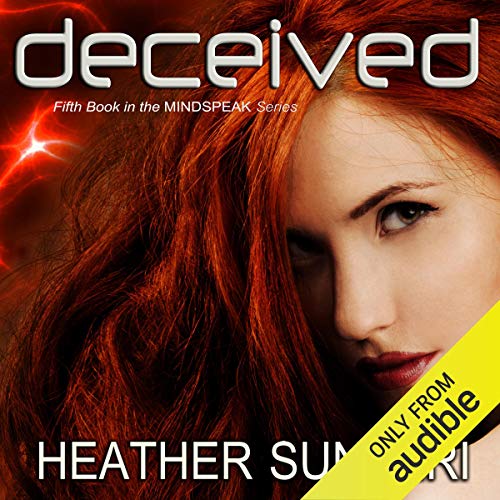
Deceived
Summary
The passionate, impulsive Briana Howard and the sly, snarky Jonas Whitmeyer make a perfect mess of a couple. Both are stubborn, smart, and sexy. They're also human clones with supernatural powers. Jonas had resigned himself to a solitary life on the remote island of Palmyra, home of Sandra Whitmeyer's clandestine clone-growing lab. With young clones now inexplicably dying, Jonas is torn between feeling responsible for cleaning up his mother's mistakes - alone - and his desire to be with Bree. A heated tussle on Palmyra leaves Jonas and Briana further apart than ever. Bree storms off to Portland, Oregon, but not before encountering clones of a loved one lost long ago. Jonas tracks down Briana in Portland, where they race to discover the truth about ties between the Howards and the Whitmeyers against a host of obstacles and enemies. Will Jonas and Bree find a way to be together amid an ever-shifting maze of deceit, misdirection, and danger unearthed by the darkest of family secrets?
©2016 Heather Sunseri (P)2017 Audible, Inc.

Bill Clinton
Summary
Bill Clinton: a president of contradictions. He was a Rhodes Scholar and a Yale Law School graduate, but he was also a fatherless child from rural Arkansas. He was one of the most talented politicians of his age, but he inspired enmity of such intensity that his opponents would stop at nothing to destroy him. He was the first Democrat since Franklin Roosevelt to win two successive presidential elections, but he was also the first president since Andrew Johnson to be impeached. In this incisive biography of America's 42nd president, Michael Tomasky examines Clinton's eight years in office, a time often described as one of peace and prosperity, but in reality a time of social and political upheaval, as the culture wars grew ever more intense amid the rise of the Internet (and with it, online journalism and blogging); military actions in Somalia, Iraq, Bosnia, and Kosovo; standoffs at Waco and Ruby Ridge; domestic terrorism in Oklahoma City; and the rise of al-Qaeda. It was a time when Republicans took control of Congress and a land deal gone bad turned into a constitutional crisis, as lurid details of a sitting president's sexual activities became the focus of public debate. Tomasky's clear-eyed assessment of Clinton's presidency offers a new perspective on what happened, what it all meant, and what aspects continue to define American politics to this day. In many ways, we are still living in the age of Clinton.
©2017 Michael Tomasky (P)2017 Blackstone Audio, Inc.