Robert Caruso has narrated 3 audiobooks on Listento.it by 3 authors. The most-rated is The White Supremacy Mith.

Devil and Satanism
Summary
Satanism is undoubtedly a complex phenomenon and has been the subject of different definitions that highlight its different aspects and orientations. From a historical-sociological point of view, Satanism can be defined as the adoration or veneration, by organized groups, through repeated cultural or liturgical practices, of the character called Satan or devil in the Bible, whether this is understood as a person or a mere symbol. Instead, from a theological point of view (and one that embraces wider realities), one could speak of Satanism even by failing to explicitly worship the devil or even denying its existence, maintaining hatred of God and putting into practice those magical and occult practices, most often immoral and violent, which would allow a man to become like God. Satanist is a broad and varied category: Some are theistic and believe in the existence of a literal Satan, while others use Lucifer as the original symbol of resistance and bringer of enlightenment to humankind. Much like any religion or worldview, there’s a huge variety in what Satanists believe. This book aims to be a great start to understand the many aspects of Satanism and the devil.
©2020 Jack De Blasio (P)2021 Jack De Blasio

YouTube Success Strategies for Beginners 2020
Summary
Do you want to be a successful Youtuber? Are you finding it difficult to settle for a profitable niche? Do you want to avoid the pitfalls of most YouTubers encounter starting out? Do you want to increase your subscriber base? Then it would help if you had this audiobook. One thing is to have an impressive skill, and another is learning how to monetize it. In this age and time, people have constantly reinvented themselves, creating a niche in what they know best to do and therefore monetizing it. We can agree that no matter how skillful you are, if you don't know how to utilize it, your skills are wasted. If your dream is escaping the unending rat race of poverty, earning big figures just by pushing out video contents about something as simple as how to cook your favorite dish, Derick Richard has something for you. This audioook emerges from the author's deliberate attempt at trying to share what works and what doesn't when it comes to becoming a famous and successful YouTuber. In this audioook, Derick goes beyond the ordinary steps involved and dives into what it takes precisely to identify your YouTube niche and using YouTube analytics to grow your channels fast. Derick explained, albeit clearly, his tried and tested steps to know which particular video editing software you should invest your money in. He amplifies basic editing tricks and tips, telling it straight about why each video editing works and which is preferable over the other. His only word for you is to stay glued and enjoy a full ride to establishing your own Youtube channel within some hours of thinking about it. Other information you will get from this audiobook: Understanding the Youtube algorithm Tricks to Youtube advertising Steps to Youtube channel success Required equipment for Youtube mastery Youtube optimization strategies Youtube video production hacks Video making ideas Youtube subscription growth strategies Increasing your Youtube income How to create engaging Youtube videos And lots more Wait no further, buy this audiobook to start moving from a beginner to a pro YouTuber using our strategies.
©2020 Konrad Christopher (P)2020 Konrad Christopher
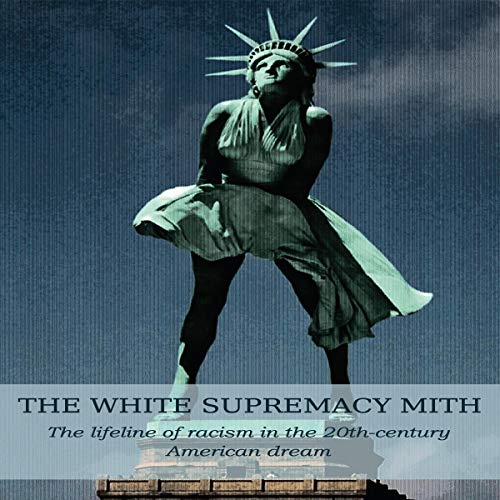
The White Supremacy Mith
Summary
As the possibilities of the 21st century appear on the horizon, it seems an appropriate time to look back on and critically analyze the past century which also began with reflection and expectations. Although many people in the United States are sure that "as far as race relations go, things have gotten better," a closer look at examples of material and popular culture from either end of the 20th century illustrates that "things have stayed very much the same". Even though the original "scientific" ideas that constructed our understanding of race are now presented in more subtle forms, their legacy continues to perpetuate the divisions that preserve inequality in our society. Some people speak about the shift from earlier blatant to overt forms of racism which might seem to imply that things have gotten better. Instead, It exists a subtle, covert, and possibly more insidious brand of racism [that surfaced and created] what has been referred to as America's "second reconstruction". The "new racism" began to emerge in the late 1970s and solidified in the Reagan era. It has taken the form of social and public policies, sanctioned by the courts and America's political elites. The resulting budget cuts in public education, housing, medical care, and other services that assist the poor ensure that black and Hispanic people remain the poorest Americans. Historically, African Americans consistently remained at the bottom of the social hierarchy, as some immigrants managed to rise to higher levels. Now, new immigration laws prevent "third world" minorities, and particularly "Hispanic" people from becoming a part of the "American Dream." This more subtle and "new racism" is in reaction to and follows the "racial progress" of the heightened civil rights and black power movements during the 1960s and1970s when black Americans organized nationally and took to the streets to protest racism and oppression. African American's demands for political and social change pushed politicians to begin dismantling the obvious signs of racism. Laws that legislated segregation based on race in education, housing, employment, and suffrage were slowly repealed. The blatant images that also worked to maintain the status quo - images that were designed to ridicule and construct stereotypes of African Americans also seemed to slowly disappear. However, a closer look at contemporary material culture shows that the old images live through their descendants and are still very much with us. Like their earlier counterparts, printed advertisements, television commercials, children's books, popular movies, "scientific" films and exhibitions, and pictorial natural history magazines produced for Americans during the past one hundred years have continued to provide tangible evidence of white supremacist assumptions. These tangible materials are "consumed" at all age levels, and they are connected to broad-based intellectual constructs. At the beginning of this century, the discipline of anthropology, the "science" of eugenics, and the ideas of social Darwinism continued to build on earlier assumptions and capture the imagination of many people. The relationship between these abstract arguments and concrete culture has maintained a perpetual and vicious cycle, even with a few sporadic doses of antidote. It is important to point out that the negative effect of the white supremacy myth impacts African Americans and Africans in very real ways, and that without social action the mere discussion of racism is ineffective. This book aims to provide history and context to convince listeners to take action and become more vigilant in critiquing the barrage of images and words that influence us every day.
©2021 Elias Jefferson (P)2021 Elias Jefferson