Annie Ernaux has 6 audiobooks on Listento.it, narrated by 4 narrators, with an average listener rating of 3.5★ across 2 ratings. The most-rated is The Years.

The Years
Summary
The Years is a personal narrative of the period of 1941 to 2006 told through the lens of memory, impressions past and present - even projections into the future - photos, books, songs, radio, television, and decades of advertising and headlines, contrasted with intimate conflicts and written notes from six decades of diaries. Local dialect, words of the time, slogans, brands, and names for ever-proliferating objects are given a voice here. The voice we recognize as the author's continually dissolves and re-emerges. Ernaux makes the passage of time palpable. Time itself, inexorable, narrates its own course, consigning all other narrators to anonymity. A new kind of autobiography emerges, at once subjective and impersonal, private and collective. On its 2008 publication in France, The Years came as a surprise. Although Ernaux had, for years, been hailed as a beloved best-selling and award-winning author, The Years was in many ways a departure: both an intimate memoir written by entire generations and a story of generations telling a very personal story.
©2019 Dreamscape Media, LLC (P)2019 Dreamscape Media, LLC

Happening
Summary
In 1963, Annie Ernaux, 23 and unattached, realizes she is pregnant. Shame arises in her like a plague: Understanding that her pregnancy will mark her and her family as social failures, she knows she cannot keep the child. In a France where abortion was illegal, she attempted, in vain, to self-administer the abortion with a knitting needle. Fearful and desperate, she finally located an abortionist and ended up in a hospital emergency ward where she nearly died. In Happening, Ernaux sifts through her memories and her journal entries dating from those days. Clearly, cleanly, she gleans the meanings of her experience.
©2019 Dreamscape Media, LLC (P)2019 Dreamscape Media, LLC

La place
Summary
"Enfant, quand je m'efforçais de m'exprimer dans un langage châtié, j'avais l'impression de me jeter dans le vide. Une de mes frayeurs imaginaires, avoir un père instituteur qui m'aurait obligée à bien parler sans arrêt en détachant les mots. On parlait avec toute la bouche. Puisque la maîtresse me "reprenait", plus tard j'ai voulu reprendre mon père, lui annoncer que "se parterrer" ou "quart moins d'onze heures" n'existaient pas. Il est entré dans une violente colère. Une autre fois : "Comment voulez-vous que je ne me fasse pas reprendre, si vous parlez mal tout le temps !" Je pleurais. Il était malheureux. Tout ce qui touche au langage est dans mon souvenir motif de rancœur et de chicanes douloureuses, bien plus que l'argent."
©1983 Editions Gallimard (P)2020 Editions Gallimard
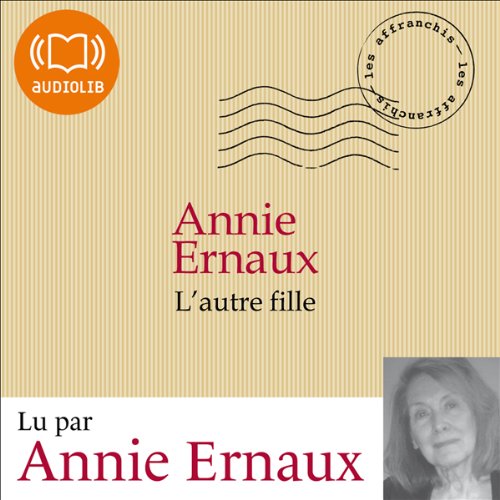
L'autre fille
Summary
Un dimanche de ses dix ans, à la dérobée, Annie apprend qu'elle n'est pas enfant unique. Avant sa naissance, ses parents ont perdu une première fille, emportée par la diphtérie. Plus jamais Annie n'entendra un mot sur cette sœur inconnue dont elle ne semble être que la remplaçante, voire le négatif. Comment percer le mystère de cette petite sainte dont l'identité redéfinit la place d'Annie dans le trio familial ? Soixante ans plus tard, c'est l'écriture d'une lettre à cet étrange fantôme qui permet enfin à l'auteur d'approcher son double et de cerner l'origine de sa vocation d'écrivain. Dans le style fluide et acéré qui rend son œuvre unique et a fait d'elle l'un des plus grands écrivains français, Annie Ernaux revient sur un secret de famille fondateur et universel.
© Marabout (Hachette Livre), 2011© et (p) Audiolib 2011

A Man's Place
Summary
Barely educated and valued since childhood strictly for his labor, Ernaux's father had grown into a hard, practical man who showed his family little affection. Narrating his slow ascent towards material comfort, Ernaux's cold observation reveals the shame that haunted her father throughout his life. She scrutinizes the importance he attributed to manners and language that came so unnaturally to him as he struggled to provide for his family with a grocery store and cafe in rural France. Over the course of the book, Ernaux grows up to become the uncompromising observer now familiar to the world, while her father matures into old age with a staid appreciation for life as it is and for a daughter he cautiously, even reluctantly, admires.
©2019 Dreamscape Media, LLC (P)2019 Dreamscape Media, LLC

Une femme
Summary
Annie Ernaux s'efforce ici de retrouver les différents visages et la vie de sa mère, morte le 7 avril 1986, au terme d'une maladie qui avait détruit sa mémoire et son intégrité intellectuelle et physique. Elle, si active, si ouverte au monde. Quête de l'existence d'une femme, ouvrière, puis commerçante anxieuse de "tenir son rang" et d'apprendre. Mise au jour, aussi, de l'évolution et de l'ambivalence des sentiments d'une fille pour sa mère : amour, haine, tendresse, culpabilité, et, pour finir, attachement viscéral à la vieille femme diminuée. "Je n'entendrai plus sa voix... J'ai perdu le dernier lien avec le monde dont je suis issue."
©1988 Editions Gallimard (P)2020 Editions Gallimard