Barbara W. Tuchman has 9 audiobooks on Listento.it, narrated by 5 narrators, with an average listener rating of 4.4★ across 1,657 ratings. The most-rated is Such a Fun Age.

Such a Fun Age
Summary
A Best Book of the Year: The Washington Post NPR Chicago Tribune Slate Parade Elle Real Simple InStyle Good Housekeeping Vox Kirkus Reviews Library Journal BookPage Longlisted for the 2020 Booker Prize An instant New York Times best seller A Reese's Book Club x Hello Sunshine Book Pick "The most provocative page-turner of the year." (Entertainment Weekly) "I urge you to read Such a Fun Age." (NPR) A striking and surprising debut novel from an exhilarating new voice, Such a Fun Age is a bighearted story about race and privilege, set around a young Black babysitter, her well-intentioned employer, and a surprising connection that threatens to undo them both. Alix Chamberlain is a woman who gets what she wants and has made a living with her confidence-driven brand, showing other women how to do the same. So she is shocked when her babysitter, Emira Tucker, is confronted while watching the Chamberlains' toddler one night, walking the aisles of their local high-end supermarket. The store's security guard, seeing a young Black woman out late with a White child, accuses Emira of kidnapping two-year-old Briar. A small crowd gathers, a bystander films everything, and Emira is furious and humiliated. Alix resolves to make things right. But Emira herself is aimless, broke, and wary of Alix's desire to help. At 25, she is about to lose her health insurance and has no idea what to do with her life. When the video of Emira unearths someone from Alix's past, both women find themselves on a crash course that will upend everything they think they know about themselves and each other. With empathy and piercing social commentary, Such a Fun Age explores the stickiness of transactional relationships, what it means to make someone "family", and the complicated reality of being a grown up. It is a searing debut for our times.
©2019 Kiley Reid (P)2019 Penguin Audio

Highway of Tears
Summary
A searing and revelatory account of the missing and murdered Indigenous women and girls of Highway 16, and an indictment of the society that failed them.
For decades, Indigenous women and girls have gone missing or been found murdered along an isolated stretch of highway in northwestern British Columbia. The highway is known as the Highway of Tears, and it has come to symbolize a national crisis.
Journalist Jessica McDiarmid meticulously investigates the devastating effect these tragedies have had on the families of the victims and their communities, and how systemic racism and indifference have created a climate where Indigenous women and girls are over-policed, yet under-protected. Through interviews with those closest to the victims - mothers and fathers, siblings and friends - McDiarmid provides an intimate, first-hand account of their loss and relentless fight for justice. Examining the historically fraught social and cultural tensions between settlers and Indigenous peoples in the region, McDiarmid links these cases to others across Canada - now estimated to number up to 4,000 - contextualizing them within a broader examination of the undervaluing of Indigenous lives in the country.
Highway of Tears is a powerful story about our ongoing failure to provide justice for missing and murdered Indigenous women and girls, and a testament to their families and communities' unwavering determination to find it.
PLEASE NOTE: When you purchase this title, the accompanying PDF will be available in your Audible Library along with the audio.
©2019 Jessica McDiarmid (P)2019 Doubleday Canada
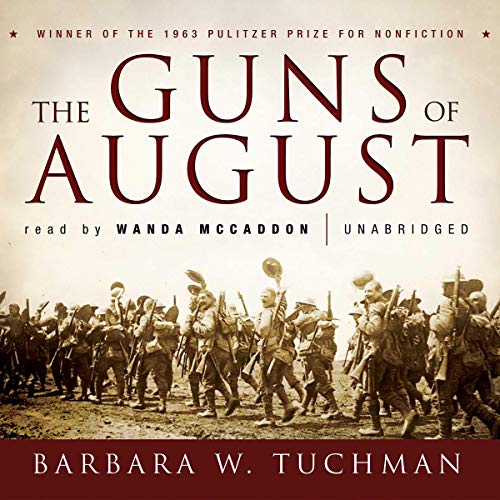
The Guns of August
Summary
In this Pulitzer Prize-winning classic, historian Barbara Tuchman brings to life the people and events that led up to World War I. This was the last gasp of the Gilded Age, of Kings and Kaisers and Czars, of pointed or plumed hats, colored uniforms, and all the pomp and romance that went along with war. How quickly it all changed...and how horrible it became. Tuchman masterfully portrays this transition from 19th to 20th Century, focusing on the turning point in the year 1914: the month leading up to the war and the first month of the war. With fine attention to detail, she reveals how and why the war started, and why it could have been stopped but wasn't, managing to make the story utterly suspenseful even when we already know the outcome.
©1990 Dr. Lester Tuchman (P)2005 Blackstone Audio, Inc.

A Distant Mirror
Summary
The 14th century reflects two contradictory images: on the one hand, a glittering time of crusades and castles, cathedrals and chivalry, and the exquisitely decorated Books of Hours; and on the other, a time of ferocity and spiritual agony, a world of chaos and the plague. Barbara Tuchman reveals both the great rhythms of history and the grain and texture of domestic life as it was lived. Here are the guilty passions, loyalties and treacheries, political assassinations, sea battles and sieges, corruption in high places and a yearning for reform, satire and humor, sorcery and demonology, and lust and sadism on the stage. Here are proud cardinals, beggars, feminists, university scholars, grocers, bankers, mercenaries, mystics, lawyers, and tax collectors, and, dominating all, the knight in his valor and "furious follies", a "terrible worm in an iron cocoon".
©1978 Barbara W. Tuchman (P)2005 Blackstone Audiobooks

The March of Folly
Summary
In The March of Folly, two-time Pulitzer Prize winning historian Barbara Tuchman tackles the pervasive presence of folly in governments through the ages. Defining folly as the pursuit by governments of policies contrary to their own interests, despite the availability of feasible alternatives, Tuchman details four decisive turning points in history that illustrate the very heights of folly in government: the Trojan War, the breakup of the Holy See provoked by the Renaissance popes, the loss of the American colonies by Britain's George III, and the United States' persistent folly in Vietnam. The March of Folly brings the people, places, and events of history magnificently alive for today's listener.
©1984 Barbara Tuchman (P)2009 Blackstone Audio, Inc.

The Proud Tower
Summary
"The diplomatic origins, so-called, of the War are only the fever chart of the patient; they do not tell us what caused the fever. To probe for underlying causes and deeper forces one must operate within the framework of a whole society and try to discover what moved the people in it." (Barbara W. Tuchman) The fateful quarter-century leading up to World War I was a time when the world of privilege still existed in Olympian luxury and the world of protest was heaving in its pain, its power, and its hate. The age was the climax of a century of the most accelerated rate of change in history, a cataclysmic shaping of destiny. In The Proud Tower, Barbara Tuchman concentrates on society rather than the state. With an artist's selectivity, Tuchman brings to vivid life the people, places, and events that shaped the years leading up to the Great War: the Edwardian aristocracy and the end of their reign; the Anarchists of Europe and America, who voiced the protest of the oppressed; Germany, as portrayed through the figure of the self-depicted hero, Richard Strauss; the sudden gorgeous blaze of Diaghilev's Russian Ballet and Stravinsky's music; the Dreyfus Affair; the two Peace Conferences at the Hague; and, finally, the youth, ideals, enthusiasm, and tragedy of Socialism, epitomized in the moment when the heroic Jean Jaures was shot to death on the night the War began and an epoch ended.
©1996 Barbara W. Tuchman (P)2005 Blackstone Audiobooks

The Zimmermann Telegram
Summary
In the dark winter of 1917, as World War I was deadlocked, Britain knew that Europe could be saved only if the United States joined the war. But President Wilson remained unshakable in his neutrality. Then, with a single stroke, the tool to propel America into the war came into a quiet British office. One of countless messages intercepted by the crack team of British decoders, the Zimmermann telegram was a top-secret message from Berlin inviting Mexico to join Japan in an invasion of the United States. Mexico would recover her lost American territories while keeping the U.S. occupied on her side of the Atlantic. How Britain managed to inform America of Germany's plan without revealing that the German codes had been broken makes for an incredible, true story of espionage, intrigue, and international politics, as only Barbara W. Tuchman could tell it.
©1958 Barbara W. Tuchman (P)2010 Blackstone Audio, Inc.

Practicing History
Summary
Master historian Barbara W. Tuchman looks at history in a unique way and draws lessons from what she sees. This accessible introduction to the subject of history offers striking insights into America's past and present, trenchant observations on the international scene, and thoughtful pieces on the historian's role. Here is a splendid body of work, the story of a lifetime spent "practicing history".
©1981 Alma Tuchman, Lucy T. Eisenberg, and Jessica Tuchman Matthews; Introduction copyright 1981 by Barbara Tuchman (P)2009 Blackstone Audio, Inc.

Bible and Sword
Summary
Two-time Pulitzer Prize - winning historian Barbara Tuchman explores the complex relationship of Britain to Palestine that led to the founding of the modern Jewish state - and to many of the problems that plague the Middle East today. From early times, the British people have been drawn to the Holy Land through two major influences: the translation of the Bible into English and, later, the imperial need to control the road to India and access to the oil in the Middle East. Under these influences, one cultural and the other political, countless Englishmen - pilgrims, crusaders, missionaries, merchants, explorers, and surveyors - have made their way to the land of the ancient Hebrews. With the lucidity and vividness that characterizes her work, Barbara Tuchman brings to life the development of these twin motives - the Bible and the sword - in the consciousness of the British people, until they were finally brought together at the end of World War I when Britain's conquest of Palestine from the Turks and the solemn moment of entering Jerusalem were imminent. Requiring a gesture of matching significance, that event evoked the Balfour Declaration of 1917, establishing a British-sponsored national home for the modern survivors of the people of the Old Testament. In her account, first published in 1956, Ms. Tuchman demonstrates that the seeds of today's troubles in the Middle East were planted long before the first efforts at founding a modern state of Israel.
©1984 Barbara W. Tuchman (P)2009 Blackstone Audio, Inc.