Israel Bouseman has 16 audiobooks on Listento.it, narrated by 12 narrators, with an average listener rating of 4.1★ across 40 ratings. The most-rated is Bushido: The Soul of Japan.

Bushido: The Soul of Japan
Summary
Bushido. This one word contains a wealth of meaning. Honor and grace, strength and compassion, loyalty and vengeance. Bushido is the warrior code of the samurai, a standard of conduct and an unwritten guide for right behavior and attitude. It is the core principle of ethics in Japan, an ideal that extends into every aspect of life and character. In this work, Bushido: The Soul of Japan, Inazo Nitobe explores the concept of Bushido and translates it onto a form accessible to western understanding. Nitobe examines each aspect of the Bushido code, showing how it corresponds to courage, honesty, benevolence, and politeness, and how it leads one to an understanding of loyalty and self-control. This work is a study of the way of the samurai, an exploration of the ideal that drove the fiercest and most honorable warrior class in human history. Bushido: The Soul of Japan was written at the turn of the 20th Century, providing the west a new and unprecedented avenue for the understanding of eastern thought. It captured the hearts and minds of those who encountered it, resulting in more than 10 editions in print. The work was so admired by President Theodore Roosevelt that he bought several copies to distribute among his friends, ensuring that each had access to this wealth of wisdom, and clarity of ethical thought. The AudioLearn version of Bushido: The Soul of Japan is preceded by a summary that explores the life of the author and the background of the book itself. Also included are an overview, synopsis, analysis, and an exploration of the historical context of the work. If you are interested in samurai, martial arts, eastern thought, or the ethical code of the warrior, then this is an audiobook that you won't want to miss.
©2017 AudioLearn (P)2017 AudioLearn

The Prince by Niccolo Machiavelli
Summary
The Prince, is the best known work by Italian diplomat, Nicolo Machiavelli. It is, in essence, a manual for rulership. The Prince, was a distinctly original work, written in the late Renaissance, and characterized by a realistic, perhaps even ruthless perspective, of both human nature and politics. It inspired the term "Machiavellian", and brought it into common use to describe unscrupulous politics. Machiavelli is seen as the father of modern political theory. His perspective in The Prince reflects a unique insight into human nature, and the nature of statecraft, offering clear, and powerful instructions for anyone in the field of politics, from the Renaissance to the modern era. The audiobook version of The Prince, is prefaced with a biography of the author and a background of the work itself, shedding some light on the mind that produced it, and the era which shaped his perspective. Also included are an overview, synopsis, and analysis of the work. The summary is capped with a brief look at the historical context of Machiavelli's work, as well as the criticisms it has evoked, and the impact he has had on society. This is an ideal work for those interested in history, politics, or sociology, a unique and useful work, which offers a plethora of instructions for dealing with power on any level.
©2017 AudioLearn (P)2017 AudioLearn

The Critique of Pure Reason by Immanuel Kant
Summary
Immanuel Kant stands as one of the founding fathers of the school of modern philosophy. His work evoked a paradigm shift in the approach to philosophy and was the starting point for many revolutionary thinkers who followed, including Schopenhauer and Nietzsche. The Critique of Pure Reason is a work that examines the faculty of reason and the qualities inherent in human thought. Before this time the influence of the knower on that which was sought to be known was not considered in a thorough and developed manner. Kant attempted with this critique to establish a limit to the knowable based on the nature of human cognition. His work was an attempt to address the failings in philosophy and metaphysics and provide a solid foundation for the proper use of reason to expand knowledge. In this attempt, he can be said to be successful, as his work evoked a shift in philosophical trajectory, which allows all thinkers subsequent to him to stand out from those who came before him in their handling of the subject of philosophy. The narration of this landmark text is preceded by a summary, which includes a biography and background information of the author, as well as an overview, a synopsis, and an analysis of the work. Capping the summary is an investigation of the historical context of Kant's work as well as an examination of the criticisms and social impact that it evoked. This work represents an essential link to understanding the philosophy of the modern era and is a must-hear for students of philosophy or for anyone with an interest in the nature of thought.
©2016 AudioLearn (P)2016 AudioLearn

The Ethics
Summary
Ethics is one of the most unique works in Western philosophy, an attempt to handle metaphysics, theology, anthropology, and ontology through the lens of geometric proofs. Spinoza felt that the path to happiness is through reason, in the use of the mind to demystify our existence and liberate us from passions and superstitions. Benedict de Spinoza is a key figure in Western philosophy and had a significant influence on philosophers such as Hegel, Schopenhauer, and Nietzsche. Ethics is Spinoza's masterpiece, the most comprehensive summary of his thought and perspective. The full narration of the work is preceded by a summary, which includes an overview and synopsis of the work, a biography of the author, and the historical context of the piece. This presentation of Ethics is ideal for the sincere philosophy scholar and for anyone interested in history or metaphysics.
©2017 AudioLearn (P)2017 AudioLearn

A Treatise of Human Nature
Summary
A Treatise of Human Nature is the first work ever published by David Hume, a man who revolutionized our understanding of philosophy. Hume was an advocate of the skeptical school of philosophy and a key figure in the Scottish Enlightenment. He looks at the nature of human experience and cognition, showing that philosophy and reason can only be reflections of our nature. The naturalistic science of man that Hume expresses in this work forms the foundation for all later philosophical inquiry. Kant gave Hume credit for "awakening [him] from his dogmatic slumber". With this influence alone, Hume initiated the clearest critique of reason that Western civilization has produced in the history of philosophy. Hume's work formed the psychological foundation for modern psychology. He showed the limits and proper application of reason in human life. He also examined the passions and morality, showing how they arise in human experience and how they are connected to both reason and action. In essence, A Treatise of Human Nature is a thorough, well-considered, and inspired examination of human psychology and the implications that the structure of our thought and experience has on our knowledge. The full narration of Hume's text is preceded by a summary, which includes a biography, background information on the work, and an overview of the material covered. The summary also includes a synopsis and analysis of the text as well as an examination of its historical context, its social impact, and the criticisms it evoked. This work is suitable for students of philosophy or psychology or for anyone interested in coming to a deeper understanding of the nature of the mind.
Public Domain (P)2015 AudioLearn

Utilitarianism by John Stuart Mill
Summary
John Stuart Mill was the most influential British philosopher of the 19th century. His works spanned a startling variety of topics including logic, metaphysics, epistemology, ethics, political philosophy, and social theory. All of Mill's writings were aimed at the support and expansion of philosophical radicalism, and he had a significant influence on social theory, political theory, and political economy. His work, Utilitarianism, published in 1863, has been described as "the most influential philosophical articulation of a liberal humanistic morality that was produced in the 19th century." Utilitarianism addresses the subject of ethics, exploring the subject that has been perhaps the most puzzling for philosophers and thinkers of all ages. What is right? What is good? How can we use an understanding of the right and good to provide a moral framework that leads humanity to happiness, balance, and progress in all ways? Mill's work on this topic, though highly criticized in his own era, is still taught in university ethics courses around the world. The narration of the work is preceded by a summary that explores Mill's life and the background of his philosophy. Also included are an overview of the work, a synopsis and analysis, and an examination of the historical context of the piece. The AudioLearn edition of Utilitarianism is suitable for philosophers and students, and for all who wish to delve into history and ethical philosophy.
©2017 AudioLearn (P)2017 AudioLearn

The Principles of Aesthetics
Summary
The Principles of Aesthetics can be considered the definitive work on aesthetics, the philosophy of art, beauty, and taste. It is the result of a series of lectures given by Dewitt H. Parker, and gives a comprehensive review of a truly extensive subject. Every person has some sense of the beautiful and the ugly. We all admire certain images, combinations of sound, taste, smell, or feeling. But where does this enjoyment come from? If our tastes were all alike, we could find precise formulae that define the beautiful and discover the keys to the nature of art. But our tastes differ from one person to the next, and even from one moment to the next. This is what makes beauty a mystery. Art is a grasping at the intangible reality that surrounds and transcends our attempts to order the world. This is what makes the philosophy of aesthetics so fascinating. At the very least, it gives us insight into our nature as human beings. At best, it can let us glimpse the nature of truth beyond reason and intention. It has been said that art imitates nature. Perhaps some ephemeral quality of the natural world is reflected in our sense of beauty and taste. The philosophy of aesthetics is focused on these questions. It delves into the mysterious pool from which artists and poets derive their inspiration. With this piece, Dewitt H. Parker gives us a beautiful and thorough introduction into a field that points towards the mysteries of the human experience. A summary precedes the full narration, giving a biography of the author, as well as an overview, synopsis, and analysis of the work. The summary is capped by a brief look at the historical context of Dewitt's work, as well as the criticism and social impact it evoked.
©2017 AudioLearn (P)2017 AudioLearn
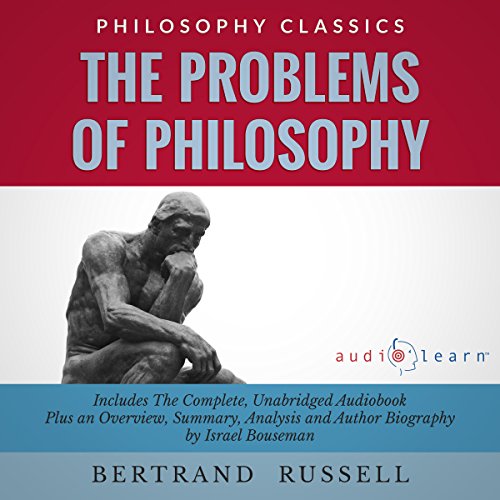
The Problems of Philosophy by Bertrand Russell
Summary
Bertrand Russell is, without a doubt, one of the most prominent and influential figures in philosophy in the 20th century. His work was a significant influence on minds such as Albert Einstein, Isaac Asimov, and Noam Chomsky. With The Problems of Philosophy, he brings a complicated subject into easy reach. Russell uses this work to highlight the main philosophical subjects examined through the course of history. The Problems of Philosophy reviews the ideas of notable philosophers such as Plato, Aristotle, Descartes, Hume, Locke, Kant, and Hegel, while keeping to language anyone can grasp. True genius can explain a complex subject in simple terms, and Russell expresses his genius well in this small but comprehensive text. The Problems of Philosophy outlines philosophical inquiry in a way that opens it to the novice, while providing a valuable review for those well versed in the subject. A summary precedes the narration of the full text, giving a biography of the author and background information on the work. Also included are an overview, synopsis, and analysis. The summary is concluded with an examination of the historical context, criticisms, and social impact of Russell's work. This work is a must-hear for those interested in the field of philosophy, and an excellent introduction for the general listeners.
©2017 AudioLearn (P)2017 AudioLearn

A Pluralistic Universe by William James
Summary
The Pluralistic Universe is a product of the mind of William James, thought to be one of the most influential thinkers of the early 19th century. James was known as the father of American psychology and the founder of the school of radical empiricism. The Pluralistic Universe is a collection of lectures that James gave at Oxford University between 1908 and 1909. They contain the earliest expression of some of his most profound metaphysical thoughts. James has an unorthodox approach to philosophy. He critically reviews the accepted perspective of classic philosophers from Plato to Kant, highlighting the inconsistencies in their work and providing a compelling alternative to their conclusions. This is the work of the philosopher's philosopher, a man who had the insight to pierce the veil of dogma and cut through the academic language that separates philosophy from the language of life. The Pluralistic Universe is a must-hear for students of philosophy and for anyone interested in the nature of thought and existence.
©2015 AudioLearn (P)2015 AudioLearn

A Short History of Greek Philosophy by John Marshall
Summary
A Short History of Greek Philosophy takes the listener on a tour of the golden age of philosophy. Marshall shines a spotlight on the origins of Western thought, giving an elegant and concise review of the major philosophers and schools of thought in Greece. He begins at the dawn of the era with Thales and Anaximander, and visits every notable originator of thought in Greek history, leading finally to the Sceptics, Epicureans, and Stoics. In this slim work, the works of Socrates, Plato, and Aristotle are explored with precision and grace. Marshall details the philosophical context that created the foundation for the greatest thinkers in Western history and shows the road taken by philosophy as a result of their influence. A Short History of Greek Philosophy covers the vast subject of Greek philosophy in a way that is simultaneously brief, authentic, and interesting. It is accessible to the casual listener and explores the subject with a depth and clarity that will appeal to the serious philosopher. Twenty-five editions of this work have been published since it was originally written in 1891. Marshall's comprehensive handling of Greek philosophy has been recognized by scholars and universities and is currently held by more than 600 libraries worldwide. This version of the work is preceded by a summary that effectively reviews the major ideas present in each section, giving the new listener an easy entry point to this vast wealth of material, and giving a review for those already versed in the subject. It is an excellent introduction to Greek philosophy that will appeal to students of philosophy and to anyone interested in the basis of Western thinking.
©2017 AudioLearn (P)2017 AudioLearn

Three Contributions to the Theory of Sex by Sigmund Freud
Summary
Sigmund Freud is known as the father of psychoanalysis and is perhaps the most significant figure in the history of psychology. He was the first to have recognized the influence of the unconscious and to have developed a theory of the structure of the mind that took it into account. Freud's ideas, including coping mechanisms, repression, denial, libido, and ego have become household terms, key elements of the modern understanding of the human experience. At the same time, we cannot explore Freud's perspective without encountering the biases, shortcomings, and historical limitations that each person of genius has worked to overcome. These limitations are clear and evident in Freud's perspective, including his extreme emphasis on sexuality as the cause of all psychological dysfunction and his perception of the feminine nature. Without his exploration and description of these elements of contemporary thought, however, a number of these perspectives would likely have persisted to this day. The works of Sigmund Freud are the foundation of modern psychology. They display a brilliance and insight into the mind which overshadows the understanding of many of those to follow. This insight is demonstrated beautifully in Three Contributions to the Theory of Sex, one of the first serious psychological examinations of the role of sexuality in the human experience. The AudioLearn version of the text is preceded by a comprehensive summary, including an overview, synopsis, and analysis of the work. Also included are a brief biography of Sigmund Freud and an examination of his impact on history and society, as well as an exploration of the key criticisms that arose in response to his work. This version of Three Contributions to the Theory of Sex is ideal for those who wish to understand the workings of the mind and for any who would like to explore Freud's life and his revolutionary impact on the field of psychology.
©2016 AudioLearn (P)2016 AudioLearn

Representative Men by Ralph Waldo Emerson
Summary
Ralph Waldo Emerson was one of the most influential figures in America during the 19th century. This audiobook, Representative Men, gives an account of how he understood genius, its place in society, its mechanism, and the historical accounts that supported his views. It is fitting that a man of such influence be remembered through his account of greatness in others. In this work, he provides in this work a novel view of the function of history and intelligence. Emerson shows how the great men of history have stood upon the shoulders of those who have prepared the way. He poignantly explores the historical foundation necessary for works of genius to shine out and make a mark upon the times. The full narration of this work is preceded by a lecture-by-lecture summary. The summary also includes a biography of Emerson himself, as well as background information about the work. Also included are an overview, synopsis, and analysis of the text. The summary is concluded by a section which explores the historical context, social impact, and criticisms of Emerson and his work.
©2015 AudioLearn (P)2015 AudioLearn

Criminal Psychology
Summary
Criminal Psychology was published by Hans Gross in 1910, and stands to this day as the definitive manual for applied psychology in the legal field. With this book Gross re-examined the basic assumptions of the legal profession and rebuilt them from the ground up. His approach to psychology is as meticulous as his approach to the field of law, accepting and incorporating only those aspects of psychology which could be proven beyond a reasonable doubt, and applying them in a specific, focused manner. A comprehensive summary precedes the narration of the text and includes a biography, background information on the author, and a review by chapter. Also included are an overview, synopsis, analysis of the text, and a section which explores the historical context, criticisms, and social impact of this landmark work. This is a must-listen for students of law or psychology and for anyone interested in the nature of the mind and the workings of law.
©2014 AudioLearn (P)2014 AudioLearn

Evidence as to Man's Place in Nature
Summary
Evidence as to Man's Place in Nature was written in 1863 by Thomas Henry Huxley. In this work, Huxley presents evidence for the evolution of man and ape from a common ancestor. Evidence as to Man's Place in Nature was the first book in history devoted to the topic of human evolution, and it discussed this theory in light of anatomical and other evidence. Backed by this evidence, the book popularized the theory of evolution amongst a wider readership than ever before, making it known to the layperson that evolution applied as fully to man as to all other life. Huxley was a prominent member of the scientific community and an early advocate of evolutionism. He was a well-respected man, highly visible to the public, and a key figure in the establishment of scientific professionalism. His work and public debates served to explore the idea of evolution and to usher in widespread acceptance, forming the foundation of our current understanding of biology and the place of man in the cosmos. Evidence as to Man's Place in Nature addresses the implications of the theory of evolution for the origin of humanity, and the relation of humans to other animals. It brought Darwin's theory home, forcing the scientific community to face the subject of human evolution head-on. The narration of the full text of Evidence as to Man's Place in Nature is preceded by a summary which includes a biography of the author, as well as an overview and synopsis of the work. Also included are an analysis and an investigation of the historical context, criticisms, and social impact evoked by the work. Evidence as to Man's Place in Nature is a key piece of historical scientific literature, marking a turning point of the Western paradigm. It is a fascinating listen for students of history and science alike.
©2017 AudioLearn (P)2017 AudioLearn

Philosophy of Fine Art by Georg Wilhelm Friedrich Hegel
Summary
Georg Wilhelm Friedrich Hegel's Aesthetics, or Philosophy of Fine Art, is part of a rich German aesthetic tradition that stretches from the middle of the 18th century into the modern era. Hegel wrote this work early in the German exploration of aesthetics, and it served as a foundation piece for the philosophies of all who followed him. Hegel, with Aesthetics and other works, had a profound impact on the philosophies of Nietzsche, Heidegger, and Adorno. In this work, he explores the nature of beauty and the historical development of art. Hegel addresses each style of art in turn, considering architecture, sculpture, painting, music, and poetry in detail. He also offers distinct and in-depth analyses of Egyptian art, Greek sculpture, and both ancient and modern tragedy. Philosophy of Fine Art is regarded as one of the greatest aesthetic theories produced since Aristotle's Poetics. The AudioLearn version of Hegel's Philosophy of Fine Art is preceded by a chapter-by-chapter summary that details the themes and perspectives addressed in the main work. The summary also provides an exploration of the life of the author and the background of the piece. Also included are an overview, a synopsis, and an analysis of the work. The summary is concluded by an examination of the historical context and social impact of the piece and a brief look at the criticisms associated with it. Philosophy of Fine Art is a key work of aesthetic philosophy and an essential text for students of philosophy and art as well as for anyone interested in the nature of aesthetics.
©2017 AudioLearn (P)2017 AudioLearn

Evolution and Ethics and Other Essays
Summary
Thomas Henry Huxley was a prominent member of the scientific community and an early advocate of evolutionism. His work and public debates served to explore this idea and to usher in widespread acceptance, forming the foundation of our current understanding of biology and the place of man in the cosmos. Evolution and Ethics is a work which highlights the ethical and theological implications of the theory of evolution. This work is a compilation by Huxley of his grandest and most sweeping work, that which had the greatest social impact. He was a well respected man, highly visible to the public, and a key figure in the establishment of scientific professionalism. His work reflects the movement to scientific materialism which supplanted the religious perspective as the dominant viewpoint among European thinkers. The narration of the full text of Evolution and Ethics is preceded by a summary which includes a biography of the author, an overview and a synopsis of the work. Also included are an analysis and an investigation of the historical context, criticisms, and social impact evoked by the work. Evolution and Ethics is one of the key works which fosters an understanding of the impact which the theory of evolution had upon society in and the theological implications of this revolutionary perspective.
©2014 AudioLearn (P)2014 AudioLearn