Sigmund Freud has 20 audiobooks on Listento.it, narrated by 24 narrators, with an average listener rating of 4.3★ across 208 ratings. The most-rated is In the Dream House.

In the Dream House
Summary
In the Dream House is Carmen Maria Machado's engrossing and wildly innovative account of a relationship gone bad, and a bold dissection of the mechanisms and cultural representations of psychological abuse. Tracing the full arc of a harrowing relationship with a charismatic but volatile woman, Machado struggles to make sense of how what happened to her shaped the person she was becoming. And it's that struggle that gives the book its original structure: each chapter is driven by its own narrative trope - the haunted house, erotica, the bildungsroman - through which Machado holds the events up to the light and examines them from different angles. She looks back at her religious adolescence, unpacks the stereotype of lesbian relationships as safe and utopian, and widens the view with essayistic explorations of the history and reality of abuse in queer relationships. Machado's dire narrative is leavened with her characteristic wit, playfulness, and openness to inquiry. She casts a critical eye over legal proceedings, fairy tales, Star Trek, and Disney villains, as well as iconic works of film and fiction. The result is a wrenching, riveting book that explodes our ideas about what a memoir can do and be.
©2019 Carmen Maria Machado (P)2019 HighBridge, a division of Recorded Books

Civilization and Its Discontents
Summary
First published in 1930, Civilization and Its Discontents is one of the most influential works of pioneering psychologist Sigmund Freud. Focusing on the tension between the primitive drives of the individual and the demands of civilization for order and conformity, Freud draws upon his psychoanalytic theories to explain the fundamental structures, conflicts, and consequences of society. Written in the aftermath of World War I, Civilization and Its Discontents advances the idea that humans' instinctive desires---violent urges and sexual drives---create the need for law and structure, which, when implemented, create constant feelings of discontent. A seminal work in psychology, Civilization and Its Discontents has sparked debate since its publication and continues to be widely read today. This edition is the translation by James Strachey.
©1961 Institute of Psychoanalysis (P)2011 Tantor

The Interpretation of Dreams
Summary
What are the most common dreams and why do we have them? What does a dream about death mean? What do dreams of swimming, failing, or flying symbolize? First published by Sigmund Freud in 1899, The Interpretation of Dreams considers why we dream and what it means in the larger picture of our psychological lives. Delving into theories of manifest and latent dream content, the special language of dreams, dreams as wish fulfillments, the significance of childhood experiences, and much more, Freud, widely considered the "father of psychoanalysis", thoroughly and thoughtfully examines dream psychology. Encompassing dozens of case histories and detailed analyses of actual dreams, this landmark text presents Freud's legendary work as a tool for comprehending our sleeping experiences.
Public Domain (P)2011 Tantor

A General Introduction to Psychoanalysis
Summary
This series of 28 lectures was given by Sigmund Freud (1856-1939), the founder of psychoanalysis, during the First World War and first published in English in 1920. The purpose of this general introduction was to present his work and ideas - as they had matured at that point - to a general public; and even though there was to be considerable development and change over the ensuing years, these talks still offer a valuable and remarkably approachable entry point to his revolutionary concepts. The talks are divided into three parts: 'The Psychology of Errors' (which later became known as 'Freudian Slips'), 'The Dream' (his broad views on interpretation) and 'General Theory of Neuroses'. Within these sections appear many of his concepts which have found their way into the wider consciousness of modern man - the key role of sex in forming our thoughts and behavior, the Oedipus complex, the libido, sublimation, fixation, regression and suppression and the unconscious. He was determined to show how psychoanalysis could help reveal the causes of neuroses and lead to clarity for the patient - as opposed to the approach taken by psychiatrists. Freud refers to his early use of hypnotism, which he later discarded, and many more steps which led him to his conclusions that the powerful part played by sexual impulses, often dating back to childhood, pursued individuals into adulthood. Freud's text is well served by a clear presentation from Nigel Carrington. Translation by G. Stanley Hall.
Public Domain (P)2016 Ukmei Productions Ltd

The Unconscious
Summary
Brought to you by Penguin. This Penguin Classic is performed by Michael Pennington, one of the founders of the English Shakespeare Company, known for his stage work with the RSC, and who played Carl Jung in the BBC drama, Freud. This definitive recording includes an introduction by Mark Cousins. One of Freud's central achievements was to demonstrate how unacceptable thoughts and feelings are repressed into the unconscious, from where they continue to exert a decisive influence over our lives. This volume contains a key statement about evidence for the unconscious, and how it works, as well as major essays on all the fundamentals of mental functioning. Freud explores how we are torn between the pleasure principle and the reality principle, how we often find ways both to express and to deny what we most fear, and why certain men need fetishes for their sexual satisfaction. His study of our most basic drives, and how they are transformed, brilliantly illuminates the nature of sadism, masochism, exhibitionism and voyeurism.
©2005 Graham Frankland (P)2019 Penguin Audio

Civilization and Its Discontents, Totem and Taboo
Summary
Sigmund Freud (1856-1939) is remembered as the father of psychoanalysis. Civilization and Its Discontents (1930) is one of his key works. In it he considers the conflict between the needs of the individual acting both egotistically and altruistically in the pursuit of happiness and the myriad demands of civilised society and the ensuing tensions this clash of needs and demands generates. Consequently it remains a key text for anyone wishing to understand the breadth and depth of Freud’s thinking on the human condition. His analysis of the modern human’s situation, forced to repress and sublimate innate natural, sexual drives in order to satisfy society’s seemingly endless requirements, and the conflicts and consequences for mental health inherent in this, make it as relevant today as when it was written. In Totem and Taboo (1913) Freud made what he called a first attempt at explaining problems of racial psychology and addressing neurotic symptoms as mental and emotional maladjustments to experience and environment. He hoped thereby to deepen the understanding of the mind by investigating its manifestations in primitive, noncivilised humans as documented by a range of writers and investigators in the scientific disciplines of sociology, anthropology and psychology. The work consists of four essays. This essential text is an ambitious undertaking because in it Freud seeks to unravel the mysteries of myth and religion by investigating the nature and qualities of sacrifice and the sacred, the primal myth and the parts these play in the generation of prohibitions, transgressions, guilt experience and expiation, as states and processes. Freud delves into the work of the great minds of his day, engaging with J. G. Frazer’s The Golden Bough and Totemism and Exogamy, Reinach’s Code du Totemisme, W. Wundt’s Elements of the Psychology of Race and a host of others. He considers the nominalistic, sociological and psychological theories they postulated. This was the investigation that led him to conclude that 'the beginnings of religion, ethics, society and art meet in the Oedipus complex’. This work would accelerate the split with his longtime colleague C. J. Jung, partly as result of the states and processes he identifies in primitive religions, belief systems and thought processes which he traces from the earliest times through Greek tragedy and medieval Passion plays up to the 20th century. This led him to articulate the importance of the interplay of the individual psyche with the psyche of the mass, as well as to develop the notion of intergenerational psychic continuity and the linked processes of thinking, doing and inhibition. This would later be refined in Civilization and Its Discontents. Civilization and Its Discontents is translated by Joan Riviere. Totem and Taboo is translated by A. A. Brill.
Public Domain (P)2019 Ukemi Productions Ltd

Academy for Misfit Witches Series 1
Summary
A strong siren, sexy dragon-shifters, a murderous mage, a zombie witch army, and an ancient fae legend make this fast burn reverse harem romance a wild, steamy adventure! One night with three sexy dragon shifters changes everything... My grandfather, the most powerful wizard in all four realms, wants me dead. After my magical academy is razed by my grandfather's mages, I'm left with no choice but to trust my life to three rebel dragon shifters with a penchant for mischief and devastating smiles. But how can I learn to trust them when everyone I've ever loved has betrayed me? And even if our mutual attraction overcomes the test of immortal prejudice, we still need to survive the advancing witch army, whose wands are armed with the unbreakable curse. Hopefully, I can figure out how to unlock the powerful siren voice inside me before it's too late. Contains mature themes.
©2019 Tara West (P)2020 Tantor

The Psychopathology of Everyday Life
Summary
The Psychopathology of Everyday Life, which appeared first in 1901 and was then expanded in a series of subsequent editions, has proved to be one of Freud's most popular works, and one of his most influential during his lifetime. It was here that he proposed that many slips and errors of memory common to the average man in everyday life actually signals unconscious issues that beset the individual, and, if examined, can be extremely revealing. Freud opens the work with the following statement: 'During the year 1898 I published a short essay on the Psychic Mechanism of Forgetfulness. I shall now repeat its contents and take it as a starting-point for further discussion. I have there undertaken a psychologic analysis of a common case of temporary forgetfulness of proper names, and from a pregnant example of my own observation I have reached the conclusion that this frequent and practically unimportant occurrence of a failure of a psychic function - of memory - admits an explanation which goes beyond the customary utilization of this phenomenon.' This 'phenomenon' was a personal matter for Freud himself. He observed its frequent and varied appearance as an important tool in his psychoanalytic work. He analyses the subject through 12 chapters, including Forgetting of Proper Names, Foreign Words, Childhood and Concealing Memories, Mistakes in Speech, Reading and Writing, Erroneously Carried-out Actions, and Determinism, Chance and Superstitious Beliefs. The Psychopathology of Everyday Life is a key work in psychology and psychoanalysis, yet very accessible. It is presented in a clear and direct manner by Derek Le Page.
Public Domain (P)2016 Ukemi Productions Ltd

The Interpretation of Dreams
Summary
The Interpretation of Dreams by Sigmund Freud is one of the most significant books of the 20th century. Though dreams and their role in human consciousness have been a continuing thread in religion and art and life down the centuries, Freud's look at the subject through the prism of his emerging practice and study of psychoanalysis provided a startlingly new and challenging perspective. First published in German in 1899, it sold slowly; but over the following decade he revised and expanded it in response to his experiences working with patients, reviewing his own dreams, and discussions and debates with colleagues. It was translated into numerous languages. In this extensive work he considers the meaning of dreams experienced by individuals generation after generation: dreams of flying, of death, of anger, of sex, of fear, of power. What do they signify, in general terms and in relation to individuals and their own personal situations? In this seminal book, Freud relates and discusses case histories and the effects of analysis. The remembered dreams have navigated the various passages of unconscious and preconscious filters to emerge into daylight, undergoing internal censorship and wish fulfilment and change and many other factors. So what are these dreams really saying or revealing? What anxiety or hope are they signaling? Sexuality plays a key role - this book contains the first emergence of Freud's Oedipus complex, among other sexual issues. The Interpretation of Dreams is not an easy book - Freud himself produced an abridged version. But its influence on the 20th century, and particularly on Western awareness and society, cannot be underestimated. This classic translation of The Interpretation of Dreams by A. A. Brill dates from 1932 and contains all the major revisions made by Freud, and his footnotes. It has an important place in the audio recordings of Freud's major work, read clearly by Derek Le Page for Ukemi Audiobooks.
Public Domain (P)2017 Ukemi Productions Ltd

Three Essays on the Theory of Sexuality, Beyond the Pleasure Principle, The Ego and the Id
Summary
Here are three key works by Sigmund Freud which, published in the first decades of the 20th century, underpinned his developing views and had such a dramatic effect on world society. In the uncompromising Three Essays on the Theory of Sexuality (1905), he declared that 'sexual aberrations' are not limited to the insane but exist in 'normal' people to a greater or lesser degree. The three essays are divided between sexual perversions, childhood sexuality and puberty. Twenty-first century society has opened and developed the subject considerably, but it is still salutary to return to one of the most important early discussions. Freud presents the force of the unconscious in the sexual instinct and complexes such as the castration complex and the Oedipus complex, the latter of which he first noted in The Interpretation of Dreams. In Beyond the Pleasure Principle (1920) Freud corrects his earlier view that libido or sexual drive is the overwhelming force behind human activity. Now he balances the drive of 'Eros' with 'Thanatos', the destruction or death principle. Along with the pleasure principle, he argues, there lies a tendency for people to self-harm in many ways, either literally or by replaying painful events or thoughts of the past - deliberately invoking 'unpleasure' (psychological discomfort or pain). Beyond the Pleasure Principle remains one of the most criticised texts in the Freud oeuvre. In The Ego and the Id (1923), Freud outlined his study of the human psyche, the result of many years of psychoanalytical practice. Based on the concepts of the 'conscious' and 'unconscious', three elements in the psychic apparatus come into play - the id (instinctual trends), the superego (the critical and moralising role) and the ego (the more conscious control that decides between the two). In the recording, the three works presented here are not only of interest in themselves but show the developing nature of Freud's thought and work over two decades. They are read clearly by Derek Le Page.
Public Domain (P)2017 Ukemi Productions Ltd

The Ego and the Id
Summary
The most important book ever written in psychology.
Public Domain (P)2019 Deaver Brown

Three Contributions to the Theory of Sex by Sigmund Freud
Summary
Sigmund Freud is known as the father of psychoanalysis and is perhaps the most significant figure in the history of psychology. He was the first to have recognized the influence of the unconscious and to have developed a theory of the structure of the mind that took it into account. Freud's ideas, including coping mechanisms, repression, denial, libido, and ego have become household terms, key elements of the modern understanding of the human experience. At the same time, we cannot explore Freud's perspective without encountering the biases, shortcomings, and historical limitations that each person of genius has worked to overcome. These limitations are clear and evident in Freud's perspective, including his extreme emphasis on sexuality as the cause of all psychological dysfunction and his perception of the feminine nature. Without his exploration and description of these elements of contemporary thought, however, a number of these perspectives would likely have persisted to this day. The works of Sigmund Freud are the foundation of modern psychology. They display a brilliance and insight into the mind which overshadows the understanding of many of those to follow. This insight is demonstrated beautifully in Three Contributions to the Theory of Sex, one of the first serious psychological examinations of the role of sexuality in the human experience. The AudioLearn version of the text is preceded by a comprehensive summary, including an overview, synopsis, and analysis of the work. Also included are a brief biography of Sigmund Freud and an examination of his impact on history and society, as well as an exploration of the key criticisms that arose in response to his work. This version of Three Contributions to the Theory of Sex is ideal for those who wish to understand the workings of the mind and for any who would like to explore Freud's life and his revolutionary impact on the field of psychology.
©2016 AudioLearn (P)2016 AudioLearn

Le malaise dans la culture
Summary
En 1929, Freud s'adresse à Lou Andreas-Salomé : "Très chère Lou... ce livre traite de la culture, du sentiment de culpabilité, du bonheur et d'autres choses élevées du même genre et me semble, assurément à juste titre, tout à fait superflu quand je le compare à mes travaux précédents qui procédaient toujours de quelque nécessité intérieure. Mais que pouvais-je faire d'autre ? Il n'est pas possible de fumer et de jouer aux cartes toute la journée. (...) J'écris et le temps passe ainsi très agréablement. Tandis que je m'adonne à ce travail, j'ai découvert les vérités les plus banales." Freud analyse ici les relations de l'homme à la culture, édifiée sur le renoncement pulsionnel, l'opposition entre culture et sexualité et l'étude du surmoi. "L'homme est un loup pour l'homme ; qui donc, d'après toutes les expériences de la vie et de l'histoire, a le courage de contester cette maxime ? " Sigmund Freud Nathalie Roussel s'empare du texte de Freud avec intelligence, nous le restitue sous une forme posée et nous permet d'appréhender la pensée de Freud de façon claire.
(p) 2010 Frémeaux et Associés - La Librairie Sonore© 2010 Groupe Frémeaux Colombini SAS - PUF

Psychopathologie de la vie quotidienne
Summary
Oublier un nom, casser un bibelot familier, se tromper de clefs, commettre un lapsus, être superstitieux, tous ces petits accidents ordinaires doivent s'interpréter comme des manifestations de l'inconscient. En effet celui-ci travaille sans cesse, infatigablement. Freud a montré comment le rêve était la voie royale d'accès à l'inconscient. Il dessine dans cet ouvrage de 1901 d'autres chemins vers cette part qui échappe à notre contrôle et qui, par ses manifestations, traduit nos désirs. Clarté, intelligence du texte : telles sont les indispensables qualités que Michel Raimbault met au service de cet ouvrage devenu canonique.
©1923/1967 / 2001 Editions Payot & Rivages, pour la présente traduction. Traduit de l'allemand par Samuel Jankélévitch / Editions Payot & Rivages, pour la présente édition (P)2012 Audiolib
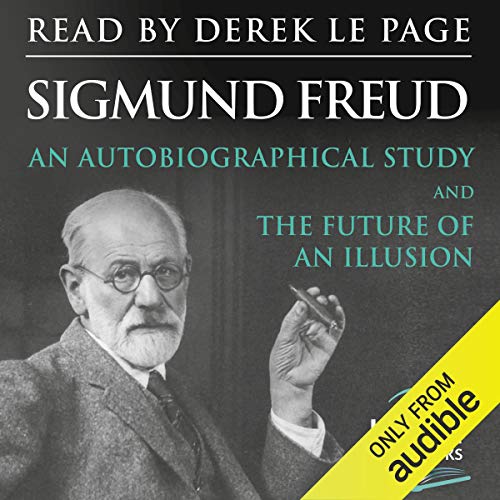
An Autobiographical Study and The Future of an Illusion
Summary
Sigmund Freud (1856-1939) reveals himself in this autobiography, which is simultaneously an account of the early history of psychoanalysis, to have been an outsider from the start. This fascinating account describes the journey of a young, Jewish doctor setting out to find his way in the world of professional medicine, his relationships and collaborations, friendships made and lost and his investigations into cocaine, hypnosis and the cathartic method which contributed to the evolution of his conceptual framework and practices. He acknowledges his debts to Josef Breuer, Jean Martin Charcot and others, who provided him with the seeds of his theory of sexual repression, which in turn led him to investigate the sex lives of neurasthenics and the symptoms of anxiety neurosis. All of these were key elements in the creation of the scientific discipline of psychoanalysis. He highlights the importance of patient observation and describes in detail the processes by which he identified the aetiological factors pertaining to different kinds of disorder. His account of the discoveries that made the genesis of psychoanalysis possible and the difficulties that had to be overcome to truly internationalise it and thereby consolidate his legacy is a remarkable reflection on his life’s work. He describes his time in the United States and the results of meeting with Harvard neurologist James J. Putnam and the philosopher William James. He outlines how the transition from catharsis to psychoanalysis was far more than a mere name change or a cosmetic exercise but was informed by his studies in infantile sexuality and the biphasic onset of human sexual life, as well as the conceptualisation of the existence of the ego, id and superego. He charts his life’s path, outlining how he came to integrate insights deriving from the Oedipus complex postulate, the free association method and the transference hypothesis, into his work; and he mentions most of the major figures in the field in passing, including Carl Gustav Jung and Alfred Adler, who split from his approach to develop their own methods. In The Future of an Illusion he considers the role of religion in culture and critically assesses the nature of the sacred experience and religious thinking. In order to avoid the dangers of producing a science biased monologue, he carries out a kind of dialectic discussion between science and religion, expounding his own rational beliefs but juxtaposing them with those of a hypothetical defender of the religious position, both of which voices are skilfully brought to life in Derek Le Page’s reading. He argues logically and systematically in the rational humanistic tradition that the scientific approach leads to an awakening of the mind and an awareness that religion is essentially a kind of wish fulfilment, an illusion, albeit one that makes life more bearable and satisfying for millions of believers. Science, he concludes, is not an illusion, but it would be illusory to imagine that the truths it offers could be obtained in any other way.
©2019 Sigmund Freud (P)2019 Ukemi Productions Ltd

100 quotes by Sigmund Freud in Chinese Mandarin
Summary
Sigmund Freud is the father of psychoanalysis, a clinical method of treatment through dialogue. Modern thought owes him his theoretical description of the structure and functioning of the unconscious, through the discovery of the essential role of transference in the analytic process, the redefinition of sexuality including its infantile forms, the analysis of dreams, symptom formation and the mechanisms of repression. His ideas are still controversial, but his work has suffused the whole of Western thought. The idea of an ego who is not master in its own house shattered intellectual foundations, and its legacy are everywhere in our everyday life. We have selected for you 100 of the most interesting quotes by the first psychoanalyst; they will help you gain a better understanding of his thinking, his work, and your own mysterious depths.
©2018 Compagnie du Savoir (P)2018 Compagnie du Savoir
![Cover art for Lo siniestro [The Uncanny]](https://m.media-amazon.com/images/I/514tAmKaj1L._SL500_.jpg)
Lo siniestro [The Uncanny]
Summary
Lo siniestro, forma uno de estos dominios. No cabe duda que dicho concepto está próximo a los de lo espantable, angustiante, espeluznante, pero no es menos seguro que el término se aplica a menudo en una acepción un tanto indeterminada, de modo que casi siempre coincide con lo angustiante en general. Sin embargo, podemos abrigar la esperanza de que el empleo de un término especial (***siniestro***) de notar determinado concepto, será justificado por el hallazgo en él de un núcleo particular. En suma: quisiéramos saber cuál es ese núcleo, ese sentido esencial y propio que permite discernir, en lo angustioso, algo que además es siniestro. Please note: This audiobook is in Spanish.
Public Domain (P)2012 Jaime Arredondo Tovar

Dreams
Summary
According to Freud, our unconscious impulses are not random, but packed with meaning, taking on color, form, and even a storyline. All dreams are actually wish fulfillments, and interpreting them can bridge the gap to the conscious, resulting in more meaningful living.
©2005 Joss Recording (P)2005 Tantor Media, Inc.

The Sigmund Freud Collection
Summary
This collection features some of the most prominent works written by Sigmund Freud (1856-1939), the founding father of psychoanalysis. These are the original authorized translations approved by the author; they were translated into English by prominent psychologists of his time, like A.A. Brill, M. D. Eder, Alfred B. Kuttner, and G. Stanley Hall. The collection contains: A General Introduction to Psychoanalysis; Psychopathology of Everyday Life; Three Contributions to the Theory of Sex; Totem and Taboo; Leonardo Da Vinci; Dream Psychology; On Aphasia: A Monograph; The Origin and Development of Psychoanalysis; Beyond the Pleasure Principle; Group Psychology and the Analysis of the Ego; Studies on Hysteria; Jokes and Their Relation to the Unconscious; Delusion and Dream Reflections; On War and Death; The Interpretation of Dreams; On Narcissism: an Introduction; The History of the Psychoanalytic Movement; Dream Psychology; Psychoanalysis for Beginners; Resemblances Between the Psychic Lives of Savages and Neurotics.
Public Domain (P)2020 Museum Audiobooks

Group Psychology and the Analysis of the Ego
Summary
An insight into the area of group psychology from a seminal figure in the study of the mind whose works include The Interpretation of Dreams, Civilization and Its Discontents, The Ego and the Id, and others.
In Group Psychology and the Analysis of the Ego, Freud examines phenomena such as the herd instinct, the occurrence of what he terms "artificial" groups including the church and the army, and the role of the libido in groups.
Group Psychology and the Analysis of the Ego by Sigmund Freud was first published in 1921 in German as Massenpsychologie und Ich-Analyse.
This audiobook is based on the authorized English translation by James Strachey which was published a year later in 1922. All of Freud’s footnotes have been retained and inserted in the main text. The translator's footnotes which related primarily to word choice and translation decisions have not been included. A translator's note to the print edition states that all technical terms have been translated in accordance with the glossary to be published as a supplement to the International Journal of Psycho-Analysis.
Please note: Freud made some slight changes and additions in the later editions of this work, and the translator made a considerably altered version of the translation on or about 1940.
Public Domain (P)2019 Partner Audio Pty Ltd