Joseph J. Ellis has 8 audiobooks on Listento.it, narrated by 8 narrators, with an average listener rating of 4.8★ across 4 ratings. The most-rated is His Excellency.

His Excellency
Summary
Acclaimed author Joseph J. Ellis penned the National Book Award-winning American Sphinx and the Pulitzer Prize-winning Founding Brothers, a fixture on The New York Times best seller list for an entire year, and one of the most popular history books of all time. Now this master historian turns his attention to the most exalted American hero, Founding Father and first President George Washington. Washington has always been a larger-than-life enigmatic figure. On the day he was given command of the continental army, he recorded only the temperature and where he ate dinner in his journal. But recently, his papers were catalogued at the University of Virginia. Ellis had primary access to the 90-volume papers, allowing him to paint a thorough and fascinating portrait. From the French and Indian War to Mount Vernon, from the American Revolution to the presidency, Ellis delivers what will stand the test of time as the definitive biography of the greatest American icon.
©2004 Joseph J. Ellis (P)2004 Recorded Books, LLC
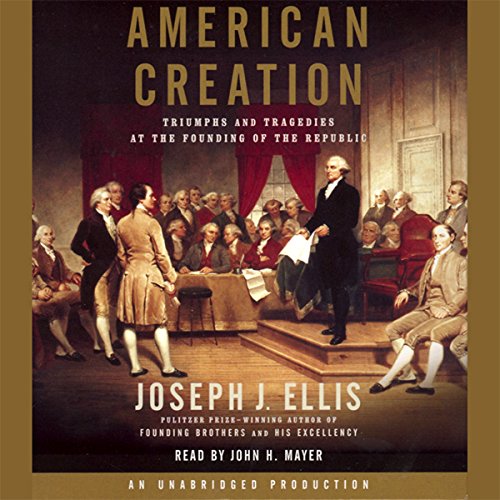
American Creation
Summary
From the first shots fired at Lexington to the signing of the Declaration of Independence to the negotiations for the Louisiana Purchase, Joseph J. Ellis guides us through the decisive issues of the nation's founding and illuminates the emerging philosophies, shifting alliances, and personal and political foibles of our now iconic leaders: Washington, Jefferson, Madison, Hamilton, and Adams. He casts an incisive eye on the founders' achievements, arguing that the American Revolution was, paradoxically, an evolution, and that part of what made it so extraordinary was the gradual pace at which it occurred. He explains how the idea of a strong federal government was eventually embraced by the American people and details the emergence of the two-party system, which stands as the founders' most enduring legacy. Ellis is equally incisive about their failures, and he makes clear how their inability to abolish slavery and to reach a just settlement with the Native Americans has played an equally important role in shaping our national character. With eloquence and insight, Ellis strips the mythic veneer of the revolutionary generation to reveal men both human and inspired, possessed of both brilliance and blindness. American Creation is an audiobook that delineates an era of flawed greatness, at a time when understanding our origins is more important than ever.
©2007 Joseph J. Ellis (P)2007 Random House, Inc. Random House Audio, a division of Random House, Inc.

Founding Brothers
Summary
An illuminating study of the intertwined lives of the founders of the American republic - John Adams, Aaron Burr, Benjamin Franklin, Alexander Hamilton, Thomas Jefferson, James Madison, and George Washington. During the 1790s, which Ellis calls the most decisive decade in our nation's history, the greatest statesmen of their generation - and perhaps any - came together to define the new republic and direct its course for the coming centuries. Ellis focuses on six discrete moments that exemplify the most crucial issues facing the fragile new nation: Burr and Hamilton's deadly duel and what may have really happened; Hamilton, Jefferson, and Madison's secret dinner, during which the seat of the permanent capital was determined in exchange for passage of Hamilton's financial plan; Franklin's petition to end the "peculiar institution" of slavery - his last public act - and Madison's efforts to quash it; Washington's precedent-setting Farewell Address, announcing his retirement from public office and offering his country some final advice; Adams' difficult term as Washington's successor and his alleged scheme to pass the presidency on to his son; and finally Adams and Jefferson's renewed correspondence at the ends of their lives, in which they compared their different views of the Revolution and its legacy. In a lively and engaging narrative, Ellis recounts the sometimes collaborative, sometimes archly antagonistic interactions between these men and shows us the private characters behind the public personas: Adams, the ever-combative iconoclast whose closest political collaborator was his wife, Abigail; Burr - crafty, smooth, and one of the most despised public figures of his time; Hamilton, whose audacious manner and deep economic savvy masked his humble origins; Jefferson, renowned for his eloquence but so reclusive and taciturn that he rarely spoke more than a few sentences in public; Madison - small, sickly, and paralyzingly shy yet one of the most effective debaters of his generation; and the stiffly formal Washington, the ultimate realist, larger than life, and America's only truly indispensable figure. Ellis argues that the checks and balances that permitted the infant American republic to endure were not primarily legal, constitutional, or institutional but intensely personal, rooted in the dynamic interaction of leaders with quite different visions and values. Revisiting the old-fashioned idea that character matters, Founding Brothers informs our understanding of American politics - then and now - and gives us a new perspective on the unpredictable forces that shape history.
©2003 Joseph J. Ellis (P)2016 Random House Audio

Passionate Sage
Summary
John Adams, one of the Founding Fathers of our nation and its second president, spent nearly the last third of his life in retirement, grappling with contradictory views of his place in history and fearing his reputation would not fare well in the generations after his death. And indeed, future generations did slight him, elevating Jefferson and Madison to lofty heights while Adams remained way back in the second tier. Now, in a witty, clear, and thoughtful narrative of Adams's later life at his home in Quincy, Joseph Ellis explores the mind and personality of the man, as well as the earlier events that shaped his thinking. Listeners will discover Adams to be both contentious and lovable, generous and petty, and perhaps the most intellectually profound of the revolutionary generation, whose perspective on America's prospects has relevance for us today.
©1993 Joseph J. Ellis (P)1995 Blackstone Audio, Inc.

Revolutionary Summer
Summary
A distinctive portrait of the crescendo moment in American history from the Pulitzer-winning American historian, Joseph Ellis. The summer months of 1776 witnessed the most consequential events in the story of our country’s founding. While the thirteen colonies came together and agreed to secede from the British Empire, the British were dispatching the largest armada ever to cross the Atlantic to crush the rebellion in the cradle. The Continental Congress and the Continental Army were forced to make decisions on the run, improvising as history congealed around them. In a brilliant and seamless narrative, Ellis meticulously examines the most influential figures in this propitious moment, including George Washington, John Adams, Thomas Jefferson, Benjamin Franklin, and Britain’s Admiral Lord Richard and General William Howe. He weaves together the political and military experiences as two sides of a single story, and shows how events on one front influenced outcomes on the other. Revolutionary Summer tells an old story in a new way, with a freshness at once colorful and compelling.
©2013 Joseph J. Ellis (P)2013 Random House

American Dialogue
Summary
The award-winning author of Founding Brothers and The Quartet now gives us a deeply insightful examination of the relevance of the views of George Washington, Thomas Jefferson, James Madison, and John Adams to some of the most divisive issues in America today. The story of history is a ceaseless conversation between past and present, and in American Dialogue, Joseph J. Ellis focuses the conversation on the often-asked question "What would the Founding Fathers think?" He examines four of our most seminal historical figures through the prism of particular topics, using the perspective of the present to shed light on their views and, in turn, to make clear how their now centuries-old ideas illuminate the disturbing impasse of today's political conflicts. He discusses Jefferson and the issue of racism, Adams and the specter of economic inequality, Washington and American imperialism, and Madison and the doctrine of original intent. Through these juxtapositions - and in his hallmark dramatic and compelling narrative voice - Ellis illuminates the obstacles and pitfalls paralyzing contemporary discussions of these fundamentally important issues. Cover image: Three Flags, 1958 by Jasper Johns. Encaustic on canvas (three panels) © Jasper Johns/Licensed by VAGA, New York, NY; Print: Whitney Museum of American Art, New York, USA/Bridgeman Images
©2018 Joseph J. Ellis (P)2018 Random House Audio

The Quartet
Summary
From Pulitzer Prize-winning American historian Joseph J. Ellis, the unexpected story of why the 13 colonies, having just fought off the imposition of a distant centralized governing power, would decide to subordinate themselves anew. We all know the famous opening phrase of Lincoln's Gettysburg Address: "Four score and seven years ago our fathers brought forth on this Continent a new Nation." The truth is different. In 1776, 13 American colonies declared themselves independent states that only temporarily joined forces in order to defeat the British. Once victorious, they planned to go their separate ways. The triumph of the American Revolution was neither an ideological nor a political guarantee that the colonies would relinquish their independence and accept the creation of a federal government with power over their autonomy as states. The Quartet is the story of this second American founding and of the men most responsible - George Washington, Alexander Hamilton, John Jay, and James Madison. These men, with the help of Robert Morris and Gouverneur Morris, shaped the contours of American history by diagnosing the systemic dysfunctions created by the Articles of Confederation, manipulating the political process to force the calling of the Constitutional Convention, conspiring to set the agenda in Philadelphia, orchestrating the debate in the state ratifying conventions, and, finally, drafting the Bill of Rights to assure state compliance with the constitutional settlement. Ellis has given us a gripping and dramatic portrait of one of the most crucial and misconstrued periods in American history: the years between the end of the Revolution and the formation of the federal government. The Quartet unmasks a myth and in its place presents an even more compelling truth - one that lies at the heart of understanding the creation of the United States of America.
©2015 Joseph J. Ellis (P)2015 Random House Audio

American Sphinx
Summary
For a man who insisted that life on the public stage was not what he had in mind, Thomas Jefferson certainly spent a great deal of time in the spotlight - and not only during his active political career. After 1809, his longed-for retirement was compromised by a steady stream of guests and tourists who made of his estate at Monticello a virtual hotel, as well as by more than one thousand letters per year, most from strangers, which he insisted on answering personally. In his twilight years Jefferson was already taking on the luster of a national icon, which was polished off by his auspicious death (on July 4, 1896); and in the subsequent 17 decades of his celebrity - now verging, thanks to virulent revisionists and television documentaries, on notoriety - has been inflated beyond recognition of the original person. For the historian Joseph J. Ellis, the experience of writing about Jefferson was "as if a pathologist, just about to begin an autopsy, has discovered that the body on the operating table was still breathing." In American Sphinx, Ellis sifts the facts shrewdly from the legends and the rumors, treading a path between vilification and hero worship in order to formulate a plausible portrait of the man who still today "hover[s] over the political scene like one of those dirigibles cruising above a crowded football stadium, flashing words of inspiration to both teams". For, at the grass roots, Jefferson is no longer liberal or conservative, agrarian or industrialist, pro- or anti-slavery, privileged or populist. He is all things to all people. His own obliviousness to incompatible convictions within himself (which left him deaf to most forms of irony) has leaked out into the world at large - a world determined to idolize him despite his foibles. From Ellis we learn that Jefferson sang incessantly under his breath; that he delivered only two public speeches in eight years as president, while spending 10 hours a day at his writing desk; that sometimes his political sensibilities collided with his domestic agenda, as when he ordered an expensive piano from London during a boycott (and pledged to "keep it in storage"). We see him relishing such projects as the nailery at Monticello that allowed him to interact with his slaves more palatably, as pseudo-employer to pseudo-employees. We grow convinced that he preferred to meet his lovers in the rarefied region of his mind rather than in the actual bedchamber. We watch him exhibiting both great depth and great shallowness, combining massive learning with extraordinary naïveté, piercing insights with self-deception on the grandest scale. We understand why we should neither beatify him nor consign him to the rubbish heap of history, though we are by no means required to stop loving him. He is Thomas Jefferson, after all - our very own sphinx.
©1997 Joseph J. Ellis (P)2021 Random House Audio