Joseph Stromberg has 4 audiobooks on Listento.it, narrated by 4 narrators. The most-rated is Central America.

World War II
Summary
Historians have said that World War II was a continuation of World War I, but with greater violence and less regard for the values of civilization. The Treaty of Versailles, which had officially ended WWI, had caused the European balance of power to swing wildly. Germany had been stripped of her colonies, divided into pieces, and burdened with a staggering war debt. New nations were created; old hostilities were renewed. Some of these hostilities had found a voice in a new political philosophy: fascism. In the Pacific, Japan's ambitions would bring her into conflict with America. Both nations laid claim to the markets of Asia; in particular, to the fabled markets of China. Both were willing to use force to obtain them. In Germany, Hitler established a Third Reich, to last a thousand years. In Italy, Mussolini declared a new Roman Empire to reinstate the glory that had been Rome. In Japan, Emperor Hirohito presided over the Empire of the Rising Sun. Against these forces stood Britain, France, and the Netherlands, countries that wanted the map of the world to remain unchanged. The result was war. On the sidelines, America would watch and wait as the outlines of the war unfolded. On December 7, 1941, a day that will live in infamy, Japanese planes bombed the American naval installation at Pearl Harbor. The United States was now at war with Japan in the Pacific. The United States was also at war with the Axis powers in Europe. The Pacific and European War became formally linked. In 1941, prospects for the Allied powers were not bright. Then, Hitler made a fatal blunder: his German army invaded Russia. In Italy, Mussolini lost control of the people. In the Pacific, the Japanese war machine was on the defensive. As the war tilted in favor of the Allies, the three major Allied powers, America, Britain, and Soviet Russia, met at three major conferences during 1943-1945. At these meetings they would divide up the postwar world.
©1990 Knowledge Products, Inc. (P)1990 Knowledge Products, Inc.

The Philippines
Summary
Strategically located, the Philippine Islands have been one of the keys to American policy in the Pacific. But this loose island chain has a better history, vacillating between oppression and rebellion. America's military installations here ensure that she will be caught in any Filipino conflict.
©1991 Knowledge Products, Inc. (P)1991 Knowledge Products, Inc.

Colombia and Panama
Summary
Colombia in the 1980s became known for its role in the illegal drug trade, and for political instability and violence caused by this problem. But much of this is a recent development in Colombia's history that began in the 1530s, when Spain conquered local Indian kingdoms. This is the story of how Spain's "new Granada" evolved into Venezuela, Ecuador, Panama, and modern Colombia. The World's Political Hot Spots series explains the basis of conflicts in some of the world's most politically sensitive areas. Many of these regions are in today's headlines, and tensions recently have become violent in virtually all of them. Each presentation covers up to 10 centuries of background, revealing how and why today's problems occur.
©1992 Carmichael & Carmichael, Inc. / Knowledge Products (P)1992 Carmichael & Carmichael, Inc. / Knowledge Products
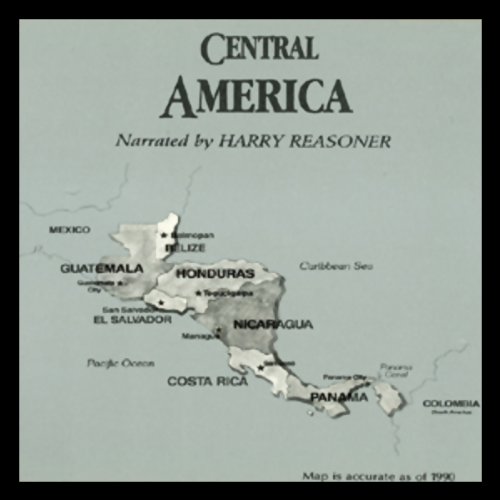
Central America
Summary
A cluster of five countries, Guatemala, Honduras, El Salvador, Nicaragua, and Costa Rica, are commonly referred to as Central America. Although these nations differ in their histories and politics, they share at least one factor; they have been caught up in the turmoil of America's foreign policy in this region. This audiobook depicts the chain of events that have led to the Central America we view on television.
©1991 Knowledge Products, Inc. (P)1991 Knowledge Products, Inc.