Michael Rank has 5 audiobooks on Listento.it, narrated by 4 narrators, with an average listener rating of 4.7★ across 7 ratings. The most-rated is Off the Edge of the Map.

Off the Edge of the Map
Summary
From the #1 bestselling author of History's Greatest Generals comes an exciting new book on the greatest explorers in history and how their discoveries shaped the modern world. Whether it is Rabban Bar Sauma, the 13th-century Chinese monk commissioned by the Mongols to travel West form a military alliance against the Islam; Marco Polo, who opened a window to the East for Europe; or Captain James Cook, whose maritime voyages of discovery created the global economy of the 21st century, each of these explorers had an indelible impact on the modern world. This audiobook will look at the 11 greatest explorers in history. Some travelled for religious piety, such as Ibn Battuta, who travelled from North Africa to Indonesia in the 1300s, visiting every Islamic pilgrimage site between - and becoming counselor to over 30 heads of state. Others travelled for profit, such as Ferdinand Magellan, who wanted to consolidate Spain's holdings on the spice trade. Still others travelled for discovery, such as Ernest Shackleton, who led two dozen men to the bottom of the world in an attempt to cross Antarctica on foot. Whatever their reason for discovery, these explorers still inspire us today to push the limits of human achievement - and discover something about ourselves in the process.
©2014 Michael Rank (P)2014 Michael Rank

The Most Productive People in History: 18 Extraordinarily Prolific Inventors, Artists, and Entrepreneurs, from Archimedes to Elon Musk
Summary
They never knew how he did it. Few composers write more than one or two symphonies in their lifetimes. Beethoven spent a year on his shorter symphonies but more than six years on his 9th Symphony. The prodigy Mozart finished his last three symphonies (39, 40, and 41) in the span of a few weeks. His 25th Symphony took only two days. None of these speed records match those of baroque composer Georg Philipp Telemann. Friends with both Johann Sebastian Bach and George Frideric Handel, he was the most prolific composer in history and considered to be a leading German composer at a time when giants roamed the earth. During his duties as court musician for Count Erdmann II of Promnitz in Poland, he composed at least 200 overtures in a two-year period. Over his lifetime Telemann's oeuvre consists of more than 3,000 pieces, although “only” 800 survive to this day. Telemann was not the only person whose productivity defied all reason. Greek scientist Archimedes discovered mathematical phenomena that weren't confirmed for 17 centuries. He also single-handedly defended Syracuse from the Romans by building massive catapults, a huge iron claw that could pick ships up out of the ocean, and even a solar-powered death ray. Ibn Sina was a medieval mathematician who wrote hundreds of treatises, including a medical compendium used in European universities for the next 400 years. Philipp II of Spain ruled a global empire from his throne in Madrid in the 1500s. Isaac Newton invented classical physics and was one of the inventors of calculus. Benjamin Franklin wrote, published, politicked, invented, experimented, and humored, sometimes all at the same time. Theodore Roosevelt won the presidency twice, was the first American to earn a belt in judo, hunted, wrote numerous books, and read four hours a day even during the busiest moments of his political life. This book will explore the lives of the 17 most productive people in history.
©2015 Scott Rank (P)2018 Scott Rank
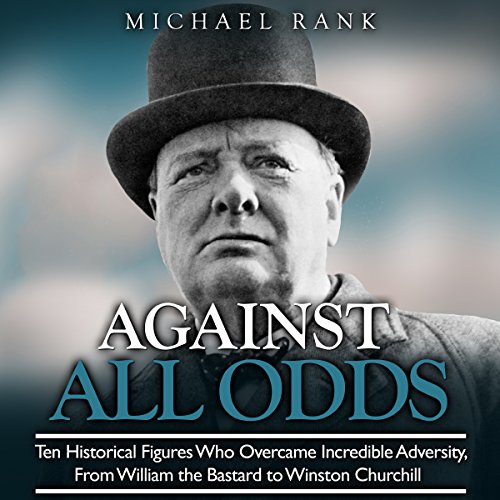
Against All Odds
Summary
From the number one best-selling author of Travelers and Explorers That Pushed the Boundaries of the Known World comes an exciting new look at historical figures that overcame unimaginable adversity and the inspirational stories they have left behind for us. Whether it is household names like John Rockefeller (who became the world's first billionaire despite growing up in a log cabin with a bigamist father), Winston Churchill (a has-been politician with a stutter who became England's salvation in World War Two), William the Conqueror (the bastard child of a peasant who conquered England in 1066), or lesser-known people like James Holman (a 19th-century explorer who traveled a distance as far as the Earth to the moon despite being completely blind), each of these people achieved greatness despite the universe putting every obstacle in their way. This audiobook looks at 10 people throughout history who rose to greatness against all odds. Some had to overcome physical challenges, such as Demosthenes, an orphaned boy in ancient Greece with a crippling speech impediment who became the greatest orator of his age. Others overcame mental challenges, such as Abraham Lincoln, whose depression was so great that in his 20s Lincoln's friends thought he would claim his own life...and continued to think so even after he became president. Still others overcame gender barriers, such as Joan of Arc, who engineered France's victory against England in the Hundred Years War despite no military experience, no powerful friends, and no ability to read. Whatever the challenges these incredible people faced, their stories still inspire us today to stop making excuses and discover how much we can really accomplish when we rise up against life's challenges.
©2017 Michael Rank (P)2018 Michael Rank

History's Most Insane Rulers
Summary
Few mixtures are as toxic as absolute power and insanity. When nothing stands between a leader's delusion whims and seeing them carried them out, all sorts of bizarre outcomes are possible. Whether it is Ottoman Sultan Ibrahim I practicing archery on palace servants and sending out his advisers to find the fattest woman in the empire for his wife or Turkmenistan President Turkmenbashi renaming the days of the week after himself and constructing an 80-foot golden statue that revolves to face the sun, crazed leaders have plagued society for millenia. This audiobook will look at the lives of the ten most mentally unbalanced figures in history. Some suffered from genetic disorders that led to schizophrenia, such as French King Charles VI, who thought he was made of glass. Others believed themselves to be God's representatives on earth and wrote religious writings that they guaranteed to the reader would get them into heaven, even if they were barely literate. Whatever their background, these rulers show that dynastic politics made sure that a rightful heir always got on the throne - despite that heir's mental condition - and that power can destroy a mind worse than any mental illness.
©2013 Michael Rank (P)2013 Michael Rank

The Most Powerful Women in the Middle Ages
Summary
The idea of a powerful woman in the Middle Ages seems like an oxymoron. Females in this time are imagined to be damsels in distress, trapped in a high tower, and waiting for knights to rescue them, all while wearing traffic-cones for a hat. After rescue, their lives improved little. Their career choices were to be either docile queens, housewives, or be burned at the stake for witchcraft. But what if this image of medieval women is a complete fiction? It turns out that it is. Powerful female rulers fill the Middle Ages. Anglo-Saxon queen Aethelflaed personally led armies into direct combat with Vikings in the 900s and saved England from foreign invasion. Byzantine Empress Theodora kept the empire from falling apart during the Nika Revolts and stopped her husband Justinian from fleeing Constantinople. Catherine of Siena almost single-handedly restored the papacy to Rome in the 1300s and navigated the brutal and male-dominated world of Italian politics. Joan of Arc completely reversed the fortunes of France in the Hundred Years War and commanded assaults on English fortresses despite being an illiterate 17-year-old peasant. This audiobook will look at the lives of the ten most powerful women in the Middle Ages. Whether it is the famed scholar Anna Komnene, who wrote the first narrative history, or Ottoman Queen Mother Kosem Sultan, who ruled the Islamic empire through three of her sons - all these women held extraordinary levels of power at a time when women were thought to not have any. It will explore how they managed to ascend the throne, what made their accomplishments so notable, and the impact they had on their respective societies after their deaths. It will also describe the historical background of these women, their cultures, and what about it helped or hindered their rise. Their stories still echo down to today. They are a testimony to the resiliency of individuals to accomplish extraordinary things, even if society puts on them enormous constraints.
©2013 Michael Rank (P)2013 Michael Rank