Ralph Raico has 4 audiobooks on Listento.it, narrated by 6 narrators, with an average listener rating of 4.6★ across 5 ratings. The most-rated is Communist Manifesto and Social Contract (Knowledge Products) Giants of Political Thought Series.

Communist Manifesto and Social Contract (Knowledge Products) Giants of Political Thought Series
Summary
Communist Manifesto examines the theory and goals expounded by Karl Marx. Marx argues that history flows inevitably toward a social revolution, which will result in a society without economic classes. The influence on Marx of Hegel, Feuerbach, and other philosophers is examined, as is his friendship and collaboration with Engels. Social Contract, by Rousseau, argues that people secure their liberty by entering into an implied contract with government. Rather than being protected by natural rights, their liberty is secured by the "general will", one of the most famous and troublesome ideas in political theory. This presentation explores Rousseau's concept of social order and its implications for individual freedom and the good of society.
©1986 Knowledge Products, Inc. (P)1986 Knowledge Products, Inc.

Russia and the Soviet Union
Summary
Recent events have made it clear that the Soviet Union is not a monolith; it's a collection of nationalities, many with serious objections to union. The demise of communism holds great promise and great danger not only for the Soviets, but for the world. This audiobook examines how the region's long history led to modern reality.
©1991 Knowledge Products, Inc. (P)1991 Knowledge Products, Inc.
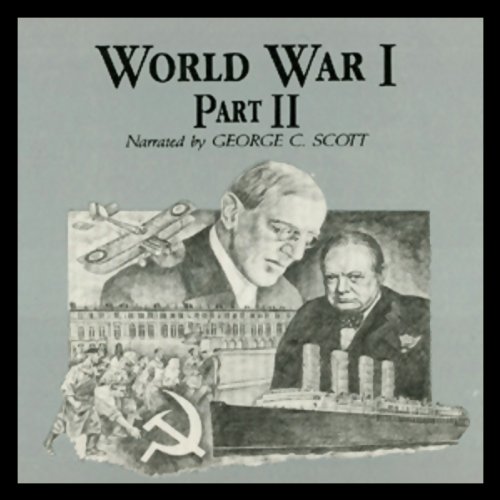
World War I, Part 2
Summary
On April 25th, 1898, the United States declared war on Spain. Less than seven months later, a victorious America claimed the former Spanish colonies of Cuba, Puerto Rico, Guam, and the Philippine Islands. To the American diplomat John Hay, the Spanish-American War was "a splendid little war". It had been popular, brief, and inexpensive, especially in terms of casualties. But the conflict marked a change in America's international role. No longer content within her own borders, the United States looked overseas. In Europe, power was poised in balance. Germany longed to become a weltmacht, a world power. Britain struggled to preserve her empire. Both France and Russia expanded, and the Balkan states agitated for independence from Austria. Treaties were signed; alliances were consummated. Now the actions of any one power would determine the foreign policy of the others. By early August 1914, the world was convulsed by the first world war, which engulfed Europe. On the western front, there was constant carnage, but little movement. Soldiers bled and died to win a stretch of dirt, which was quickly lost again. Europe seemed to be deadlocked in a bloodletting frenzy. As the nation-states battled, they awaited the response of the greatest of the neutral powers: the United States. Halfway across the world, an officially neutral American was being drawn into the conflict. On May 7, 1915, a German U-boat sank the British ship Lusitania, and 1,200 people died, including 128 Americans. Diplomatic relations between Germany and America slowly decayed until, finally, President Wilson ordered American merchant ships to be armed. Within days, U-boats opened fire on American streamers. On April 6, 1917, the U.S. declared war on Germany. And at the 11th hour of the 11th day of November 1918, the guns fell silent. Germany had surrendered.
©1989 by Knowledge Products, Inc. (P)1989 by Knowledge Products, Inc.

Democracy in America
Summary
Alexis de Tocqueville, a young French aristocrat, captured the essence of nineteenth-century America in his penetrating work, Democracy in America. The democratic concept of equality was emerging as a political reality in America, and it threatened the aristocracy of Europe; it produced a society of individualists hungry for self improvement. In this classic treatise, Tocqueville weighed the advantages of democracy against its dangers. He asked: Is the tendency toward equality a tendency toward liberty? Can the majority be restrained to protect the freedom of individuals and minorities? In pondering these questions, Tocqueville presented an unsurpassed picture of American government, culture, and attitudes. He proclaimed a new nation with a new theory of human interaction: America, ruled by the will of the majority.
©1987 Carmichael & Carmichael, Inc. (P)1987 Carmichael & Carmichael, Inc.