Seneca has 10 audiobooks on Listento.it, narrated by 9 narrators, with an average listener rating of 4.6★ across 79 ratings. The most-rated is Letters from a Stoic.

Letters from a Stoic
Summary
Brought to you by Penguin. This Penguin Classic is performed by Julian Glover, Olivier Award winning actor, also known for his roles in Game of Thrones and Harry Potter and the Chamber of Secrets. This definitive recording includes an Introduction by Robin Campbell. A philosophy that saw self-possession as the key to an existence lived 'in accordance with nature', Stoicism called for the restraint of animal instincts and the severing of emotional ties. These beliefs were formulated by the Athenian followers of Zeno in the fourth century BC, but it was in Seneca (c. 4 BC- AD 65) that the Stoics found their most eloquent advocate. Stoicism, as expressed in the Letters, helped ease pagan Rome's transition to Christianity, for it upholds upright ethical ideals and extols virtuous living, as well as expressing disgust for the harsh treatment of slaves and the inhumane slaughters witnessed in the Roman arenas. Seneca's major contribution to a seemingly unsympathetic creed was to transform it into a powerfully moving and inspiring declaration of the dignity of the individual mind.
Public Domain (P)2019 Penguin Audio

How to Die
Summary
"It takes an entire lifetime to learn how to die", wrote the Roman Stoic philosopher Seneca (c. 4 BC-65 AD). He counseled readers to "study death always", and took his own advice, returning to the subject again and again in all his writings, yet he never treated it in a complete work. How to Die gathers in one volume, for the first time, Seneca's remarkable meditations on death and dying. Edited and translated by James S. Romm, How to Die reveals a provocative thinker and dazzling writer who speaks with a startling frankness about the need to accept death or even, under certain conditions, to seek it out. Seneca believed that life is only a journey toward death and that one must rehearse for death throughout life. Here, he tells us how to practice for death, how to die well, and how to understand the role of a good death in a good life. He stresses the universality of death, its importance as life's final rite of passage, and its ability to liberate us from pain, slavery, or political oppression. Featuring beautifully rendered new translations, How to Die also includes an enlightening introduction, notes, the original Latin texts, and an epilogue presenting Tacitus's description of Seneca's grim suicide. Introduced, edited, and translated by James S. Romm
©2018 Princeton University Press (P)2018 HighBridge, a division of Recorded Books

How to Keep Your Cool
Summary
In his essay On Anger (De Ira), the Roman Stoic thinker Seneca (c. 4 BC-AD 65) argues that anger is the most destructive passion: "No plague has cost the human race more dear." This was proved by his own life, which he barely preserved under one wrathful emperor, Caligula, and lost under a second, Nero. This splendid new translation of essential selections from On Anger, presented with an enlightening introduction, offers listeners a timeless guide to avoiding and managing anger. Drawing on his great arsenal of rhetoric, including historical examples (especially from Caligula's horrific reign), anecdotes, quips, and soaring flights of eloquence, Seneca builds his case against anger with mounting intensity. Like a fire-and-brimstone preacher, he paints a grim picture of the moral perils to which anger exposes us, tracing nearly all the world's evils to this one toxic source. But he then uplifts us with a beatific vision of the alternate path, a path of forgiveness and compassion that resonates with Christian and Buddhist ethics. Seneca's thoughts on anger have never been more relevant than today, when uncivil discourse has increasingly infected public debate. Whether seeking personal growth or political renewal, listeners will find, in Seneca's wisdom, a valuable antidote to the ills of an angry age.
©2019 Princeton University Press (P)2019 HighBridge, a division of Recorded Books

Stoicism Collection: Meditations, On the Shortness of Life, and Enchiridion
Summary
This Stoicism audiobook collection contains three of the most influential Stoic pieces. Marcus Aurelius, Seneca, and Epictetus helped to shape Stoicism with their writings of "Meditations", "On the Shortness of Life", and "Enchiridion". In his personal writings of "Meditations", Marcus Aurelius records private notes to himself as a source for his own guidance and self-improvement. "On the Shortness of Life" by Seneca is a moral essay in which Seneca brings up many Stoic principles on the nature of time, namely that people waste much of it in meaningless pursuits. According to the essay, nature gives people enough time to do what is important, and the individual must allot it properly. In general, time is best used by living in the present moment in pursuit of the intentional, purposeful life. Finally, "Enchiridion" by Epictetus is a short manual of Stoic ethical advice and an excellent summary of Stoic principles. The narration of this Stoicism collection is great for anyone interested in Stoicism and is narrated brilliantly by Johnathan Waters.
Public Domain (P)2018 Combray Media

On the Shortness of Life: Stoic Principles for Self-Improvement
Summary
De Brevitate Vitae (English: On the Shortness of Life), written sometime around the year 49 AD by Seneca the Younger, discusses many Stoic principles on the nature of time and humanity itself. Enjoy riveting discussions and perspectives on these themes as Seneca delves into your thoughts. You will be fascinated as you explore one of the greatest minds and his perception of how we should perceive time. Many of the truths you will find in this piece are not only timeless, but pertinent to humanity - even to this day. "People are frugal in guarding their personal property, but as soon as it comes to squandering time, they are most wasteful of the one thing in which it is right to be stingy."
©2017 Bassett Publishing (P)2017 Bassett Publishing

On the Shortness of Life, On the Happy Life, and Other Essays
Summary
As former tutor and adviser to Emperor Nero, philosopher and statesman Seneca was acutely aware of how short life can be - his own life was cut short when the emperor ordered him to commit suicide (for alleged involvement in a conspiracy). And Seneca proved true to his words - his lifelong avowal to Stoicism enabled him to conduct himself with dignity to the end. During his rich and busy life, Seneca wrote a series of essays that have advised and enriched the lives of generations down to the present day. This collection contains five of the key essays - 'On the Shortness of Life', 'On the Happy Life', 'On the Tranquil Mind', 'On Providence' and 'On the Firmness of the Wise Person' - and they are replete with observations to remember. 'Those who forget the past, neglect the present, and fear for the future have a life that is very brief and troubled,' Seneca warns. 'You have all the fears of mortals and all the desires of immortals.' 'As long as we wander at random, not following any guide except the shouts and discordant clamours of those who invite us to proceed in different directions, our short life will be wasted in useless roamings.' Clarity, steadfastness and true enjoyment are his watchwords.
Public Domain (P)2016 Ukemi Productions Ltd

On Anger, on Leisure, on Clemency
Summary
'On Anger' is one of Seneca's most important essays. At some length he investigates the nature of anger: how and why it emerges, the effect it has on the individual and those to whom it is directed, and how to manage it and prevent it even from arising. For, Seneca considers, anger simply serves no purpose - it does not bring courage in war, prevent others misbehaving or punish miscreants. In short it has a negative effect on all. In 'On Leisure' he takes a short look at what is really meant by the term. 'On Clemency' has a special fascination, for in writing it he was addressing specifically his former pupil, Emperor Nero. Did he realise that the boy he knew - full of promise and beneficence - was to become a tyrant? While delivering his Stoic advice in his characteristically controlled and reasonable manner, Seneca gives us a remarkably contemporary insight into Roman attitudes and manners. Anger may be inappropriate, but this was a society where slaves, torture, crucifixion, and the right of the powerful to exercise their power at will was taken for granted, as some of Seneca's shocking tales and anecdotes demonstrate!
Public Domain (P)2016 Ukemi Productions Ltd

How to Give: An Ancient Guide to Giving and Receiving
Summary
Timeless wisdom on generosity and gratitude from the great Stoic philosopher Seneca To give and receive well may be the most human thing you can do-but it is also the closest you can come to divinity. So argues the great Roman Stoic thinker Seneca in his longest and most searching moral treatise, "On Benefits" (De Beneficiis). James Romm's splendid new translation of essential selections from this work conveys the heart of Seneca's argument that generosity and gratitude are among the most important of all virtues. For Seneca, the impulse to give to others lies at the very foundation of society; without it, we are helpless creatures, worse than wild beasts. But generosity did not arise randomly or by chance. Seneca sees it as part of our desire to emulate the gods, whose creation of the earth and heavens stands as the greatest gift of all. Seneca's soaring prose captures his wonder at that gift, and expresses a profound sense of gratitude that will inspire today's audiences. Complete with an enlightening introduction, How to Give is a timeless guide to the profound significance of true generosity.
©2020 Princeton University Press (P)2020 HighBridge, a division of Recorded Books

On the Happy Life - The Complete Dialogues
Summary
In his dialogues, the Stoic philosopher Seneca outlines his thoughts on how to live in a troubled world. Tutor to the young emperor Nero, Seneca wrote practical philosophical exercises that draw upon contemporary Roman life and illuminate the intellectual concerns of the day. The dialogues also have much to say to the modern listener, as they range widely across subjects such as the shortness of life, tranquility of mind, anger, mercy, happiness, and grief at the loss of a loved one. Seneca's accessible, aphoristic style makes his writing especially attractive as an introduction to Stoic philosophy, and belies its reputation for austerity and dogmatism. PLEASE NOTE: When you purchase this title, the accompanying PDF will be available in your Audible Library along with the audio.
Public Domain (P)2021 Naxos Audiobooks
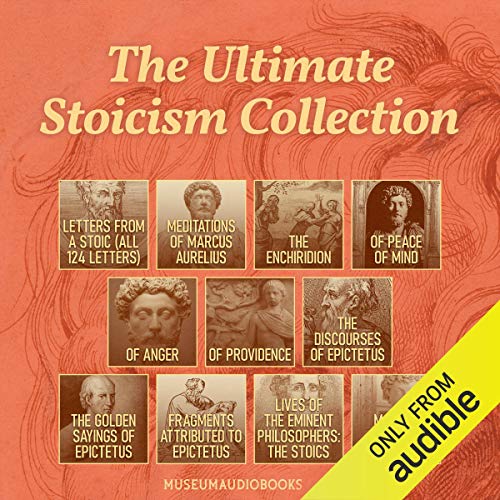
The Ultimate Stoicism Collection
Summary
Stoicism, a school of Hellenistic thought founded in Athens in the third century BC, was one of the most sublime philosophies in the history of Western civilization. It is a way of living that focuses on reality instead of fantasy or idealism. According to its teachings, the path to peace and happiness is found in accepting the moment as it presents itself, by not allowing oneself to be ruled by the desire for pleasure or by the fear of pain. The Ultimate Stoicism Collection includes: Letters from a Stoic (All 124 Letters) was written by Seneca during his retirement and sent to his friend Lucilius Junior, a procurator of Sicily. Seneca's major contribution to Stoicism was to humanize a system that could appear cold and unrealistic. The letters reveal how far in advance of his time Seneca's ideas were, for example his disgust at the shows in the Roman arena or his criticism of the treatment of slaves. Meditations of Marcus Aurelius is a series of personal writings by Marcus Aurelius, Roman emperor from 161 to 180 AD, recording his private notes to himself and ideas on Stoic philosophy. The Enchiridion is a collection of the most profound teachings of Epictetus who taught that philosophy is a way of life and not just a matter of theory. The Enchiridion is a canonical text of Stoic philosophy and contains all the fundamentals. Among them is the principle of not being concerned with that which is out of one’s control. Misfortune should not disturb the individual at all and should not be perceived negatively. Epictetus teaches that the only genuine value exists in virtuous action and accepting everything that happens in the world. He believed that one should do what is right and remain indifferent to criticism. Of Peace of Mind is a dialogue written by Seneca the Younger during the years 49 to 62 AD. It concerns the state of mind of Seneca's friend Annaeus Serenus, and how to cure Serenus of anxiety, worry, and disgust with life. Of Anger: With respect to the emotions, Seneca distinguishes between involuntary reactions and full-blown emotions, which involve assent and thus are voluntary. They are voluntary in the sense that assent is in the agent’s power. This is a key piece of Stoic doctrine - that whether we are foolish or wise, it is in our power to assent or not assent to impressions. "Of Providence" is a short essay in the form of a dialogue in six brief sections, to deal with the problem of the coexistence of the Stoic design of providence with the evil in the world. The dialogue is opened by Lucilius complaining with his friend Seneca that adversities and misfortunes can happen to good men too. How can this fit with the goodness connected with the design of providence? Seneca answers according to the Stoic point of view. The Discourses of Epictetus is a series of informal lectures, compiled by Seneca’s pupil Arrian. The Stoic emphasis on endurance, self-restraint, and the power of the will to withstand calamity could often appear cold and inhuman. Epictetus, however, offers the most humane interpretation of Stoic ideals by using humor, imaginary conversations, and homely comparisons to put his message across. It is a practical philosophy that directs students to focus attention on their opinions, anxieties, passions, and desires. The Golden Sayings of Epictetus: In these aphorisms, the philosopher reflects on our mortality and the knowledge that we will suffer in this life. However, each of us has the choice to endure with dignity those setbacks that we cannot control, he contends. Acceptance is core in Stoic doctrine. The wisdom of Epictetus has its roots in Socrates, confirming that we get upset by our judgement’s of circumstances, not by the circumstance itself. Fragments Attributed to Epictetus: Epictetus taught that philosophy is a way of life, not just a theoretical discipline. The idea that we should only focus our efforts on what is inside our sphere of choice and that we ought to train ourselves to be indifferent to what is outside that sphere is repeated throughout his Discourses and these Fragments. To Epictetus, all external events are beyond our control, and we should calmly accept whatever happens. However, individuals are responsible for their own actions, which they can examine and control through self-discipline. Lives of the Eminent Philosophers is devoted to the Stoics like Zeno of Citium, Ariston of Chios, Herillus, Dionysius the Renegade, Cleanthes, and Sphaerus. Marcus Aurelius Biography covers the life, the times, and the philosophy of Marcus Aurelius (121-180). The 17th emperor of Rome preserved and protected the Empire, mainly by keeping the Parthians in the east and the northern barbarians at bay.
Public Domain (P)2020 Museum Audiobooks