Epictetus has 12 audiobooks on Listento.it, narrated by 14 narrators, with an average listener rating of 4.7★ across 108 ratings. The most-rated is The Manual.

The Manual
Summary
"If it is beyond your power to control, let it go." "Do not wish that all things will go well with you, but that you will go well with all things." "In this way, you overcome life's challenges, rather than being overcome by them." Epictetus (c. AD 50-135) was a former Roman slave (he was also lame in one leg, and walked with a crutch) who went on to become a great teacher. His philosophy, Stoicism, was practical, not theoretical - aimed at relieving human suffering here and now. The Manual is a collection of Epictetus' essential teachings and pithy sayings, compiled by one of his students. It is the most accessible and actionable guide to Stoic philosophy, as relevant today as it was in the Roman Empire. This new edition, published by Ancient Renewal, is rendered in contemporary English by Sam Torode.
©2017 Sam Torode (P)2017 Sam Torode

The Enchiridion: Adapted for the Contemporary Reader (Epictetus)
Summary
The Enchiridion The Enchiridion or Manual of Epictetus (Enchiridion is Greek for "that which is held in the hand") is a short manual of Stoic ethical advice. This manual has been carefully adapted in to modern English to allow for easy listening. Enjoy!
©2017 James Harris (P)2017 James Harris

The Enchiridion & Discourses
Summary
The Enchiridion is the famous manual of ethical advice given in the second century by the Stoic philosopher Epictetus. Born to a Greek slave, Epictetus grew up in the environment of the Roman Empire and, having been released from bonds of slavery, became a Stoic in the tradition of its originators, Zeno (third Century BCE) and Seneca (first century CE). Epictetus didn't leave a formal written legacy, but his pupil, Arrian, collected his teachings, and posterity now has The Enchiridion and The Discourses. The first is a short compilation of Stoical precepts - how to live an ethical life. It is essentially about everyday life, and it maintained its popularity throughout the succeeding centuries, on par with the other principal concise Stoic document from the Roman period, Meditations by Marcus Aurelius - who had clearly read it. The Enchiridion is presented here as the translation by Thomas W. Higginson. The Discourses, a much longer text again compiled by Arrian, contains a more comprehensive view of the teachings of Epictetus. The Discourses is translated by George Long.
Public Domain (P)2016 Ukemi Productions Ltd

Stoicism Collection: Meditations, On the Shortness of Life, and Enchiridion
Summary
This Stoicism audiobook collection contains three of the most influential Stoic pieces. Marcus Aurelius, Seneca, and Epictetus helped to shape Stoicism with their writings of "Meditations", "On the Shortness of Life", and "Enchiridion". In his personal writings of "Meditations", Marcus Aurelius records private notes to himself as a source for his own guidance and self-improvement. "On the Shortness of Life" by Seneca is a moral essay in which Seneca brings up many Stoic principles on the nature of time, namely that people waste much of it in meaningless pursuits. According to the essay, nature gives people enough time to do what is important, and the individual must allot it properly. In general, time is best used by living in the present moment in pursuit of the intentional, purposeful life. Finally, "Enchiridion" by Epictetus is a short manual of Stoic ethical advice and an excellent summary of Stoic principles. The narration of this Stoicism collection is great for anyone interested in Stoicism and is narrated brilliantly by Johnathan Waters.
Public Domain (P)2018 Combray Media

Discourses: Complete Books 1-4
Summary
The Discourses of Epictetus are a series of extracts from the teachings of the Stoic philosopher Epictetus. This is the complete version containing books one - four. Each book has been carefully adapted in to modern English to allow for easy listening. Enjoy!
©2018 James Harris (P)2018 James Harris

How to Be Free
Summary
Born a slave, the Roman Stoic philosopher Epictetus (c. 55-135 AD) taught that mental freedom is supreme, since it can liberate one anywhere, even in a prison. In How to Be Free, A. A. Long - one of the world's leading authorities on Stoicism and a pioneer in its remarkable contemporary revival - provides a superb new edition of Epictetus's celebrated guide to the Stoic philosophy of life (the Encheiridion) along with a selection of related reflections in his Discourses. Freedom, for Epictetus, is not a human right or a political prerogative but a psychological and ethical achievement, a gift that we alone can bestow on ourselves. We can all be free, but only if we learn to assign paramount value to what we can control (our motivations and reactions), treat what we cannot control with equanimity, and view our circumstances as opportunities to do well and be well, no matter what happens to us through misfortune or the actions of other people. How to Be Free features splendid new translations and a compelling introduction that sets Epictetus in context and describes the importance of Stoic freedom today. The result is an unmatched introduction to this powerful method of managing emotions and handling life's situations, from the most ordinary to the most demanding.
©2018 Princeton University Press (P)2018 HighBridge, a division of Recorded Books

Manual for Living
Summary
The little book by Epictetus called Enchiridion or Manual has played a disproportionately large role in the rise of modern attitudes and modern philosophy. As soon as it had been translated into the vernacular languages, it became a best seller among independent intellectuals, among anti-Christian thinkers, and among philosophers of a subjective cast. Montaigne had a copy of the Enchiridion among his books. Pascal violently rejected the megalomaniac pride of the Stoic philosopher. Frederick the Great carried the book with him on all campaigns. It was a source of inspiration and encouragement to Anthony, Earl of Shaftesbury, in the serious illness which ended only in his death; many pages of his diaries contain passages copied from the Enchiridion. It has been studied and widely quoted by Scottish philosophers like Francis Hutcheson, Adam Smith, and Adam Ferguson who valued Stoic moral philosophy for its reconciliation of social dependency and personal independence.
Public Domain (P)2018 Bassett Publishing

The Enchiridion
Summary
The Enchiridion or Manual of Epictetus is a short manual of Stoic ethical advice from the 2nd century Greek Stoic philosopher Epictetus. The focus is on applying philosophy in daily life. The primary theme is that one should accept what happens. The Enchiridion, along with the Meditations of Marcus Aurelius and Seneca's Letters from a Stoic, is one of three key texts from which the modern world knows Stoicism.
Public Domain (P)2019 HN Publishing

The Encheiridion and Discourses
Summary
Born into slavery in the first century AD, Epictetus was a leading Greek philosopher of the Stoic school. He spent most of his life in Rome before the Emperor Domitian banished all philosophers from the city in AD 93; his exile then took him to Nicopolis in Greece. His teachings were recorded by his pupil Arrian, who published both the Encheiridion and Discourses. The Discourses, which Arrian claimed to have taken down during lectures he attended, comprised eight books of which we have only four. The Encheiridion (Handbook) is a distillation of the main ideas found in the Discourses. Throughout these works is the strong sense of Stoic philosophy, with its emphasis on self-examination and self-knowledge, being presented as a practical way of living rather than a theoretical code. PLEASE NOTE: When you purchase this title, the accompanying PDF will be available in your Audible Library along with the audio.
Public Domain (P)2020 Naxos AudioBooks

Enchiridion
Summary
The Enchirdion is a compilation of Stoic practical precepts, a great introduction to Stoicism. The primary theme is that one should accept what happens.
Public Domain (P)2018 Our Life Publishing

Discourses and Selected Writings
Summary
Brought to you by Penguin. Epictetus, a Greek stoic and freed slave, ran a thriving philosophy school in Nicropolis in the early second century AD. His animated discussions were celebrated for their rhetorical wizardry and were written down by Arrian, his most famous pupil. Together with the Enchiridion, a manual of his main ideas, and the fragments collected here, The Discourses argue that happiness lies in learning to perceive exactly what is in our power to change and what is not, and in embracing our fate to live in harmony with god and nature. In this personal, practical guide to the ethics of stoicism and moral self-improvement, Epictetus tackles questions of freedom and imprisonment, illness and fear, family, friendship and love, and leaves an intriguing document of daily life in the classical world.
Public Domain (P)2021 Penguin Audio
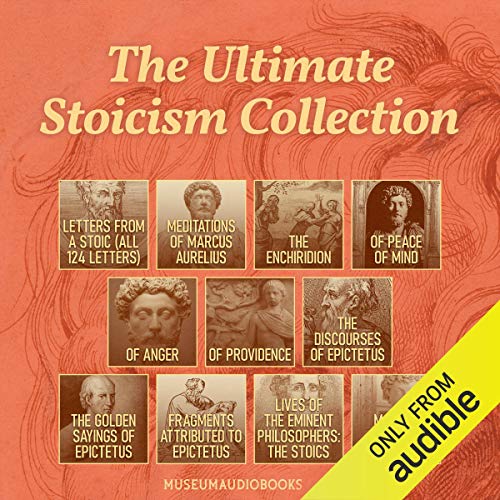
The Ultimate Stoicism Collection
Summary
Stoicism, a school of Hellenistic thought founded in Athens in the third century BC, was one of the most sublime philosophies in the history of Western civilization. It is a way of living that focuses on reality instead of fantasy or idealism. According to its teachings, the path to peace and happiness is found in accepting the moment as it presents itself, by not allowing oneself to be ruled by the desire for pleasure or by the fear of pain. The Ultimate Stoicism Collection includes: Letters from a Stoic (All 124 Letters) was written by Seneca during his retirement and sent to his friend Lucilius Junior, a procurator of Sicily. Seneca's major contribution to Stoicism was to humanize a system that could appear cold and unrealistic. The letters reveal how far in advance of his time Seneca's ideas were, for example his disgust at the shows in the Roman arena or his criticism of the treatment of slaves. Meditations of Marcus Aurelius is a series of personal writings by Marcus Aurelius, Roman emperor from 161 to 180 AD, recording his private notes to himself and ideas on Stoic philosophy. The Enchiridion is a collection of the most profound teachings of Epictetus who taught that philosophy is a way of life and not just a matter of theory. The Enchiridion is a canonical text of Stoic philosophy and contains all the fundamentals. Among them is the principle of not being concerned with that which is out of one’s control. Misfortune should not disturb the individual at all and should not be perceived negatively. Epictetus teaches that the only genuine value exists in virtuous action and accepting everything that happens in the world. He believed that one should do what is right and remain indifferent to criticism. Of Peace of Mind is a dialogue written by Seneca the Younger during the years 49 to 62 AD. It concerns the state of mind of Seneca's friend Annaeus Serenus, and how to cure Serenus of anxiety, worry, and disgust with life. Of Anger: With respect to the emotions, Seneca distinguishes between involuntary reactions and full-blown emotions, which involve assent and thus are voluntary. They are voluntary in the sense that assent is in the agent’s power. This is a key piece of Stoic doctrine - that whether we are foolish or wise, it is in our power to assent or not assent to impressions. "Of Providence" is a short essay in the form of a dialogue in six brief sections, to deal with the problem of the coexistence of the Stoic design of providence with the evil in the world. The dialogue is opened by Lucilius complaining with his friend Seneca that adversities and misfortunes can happen to good men too. How can this fit with the goodness connected with the design of providence? Seneca answers according to the Stoic point of view. The Discourses of Epictetus is a series of informal lectures, compiled by Seneca’s pupil Arrian. The Stoic emphasis on endurance, self-restraint, and the power of the will to withstand calamity could often appear cold and inhuman. Epictetus, however, offers the most humane interpretation of Stoic ideals by using humor, imaginary conversations, and homely comparisons to put his message across. It is a practical philosophy that directs students to focus attention on their opinions, anxieties, passions, and desires. The Golden Sayings of Epictetus: In these aphorisms, the philosopher reflects on our mortality and the knowledge that we will suffer in this life. However, each of us has the choice to endure with dignity those setbacks that we cannot control, he contends. Acceptance is core in Stoic doctrine. The wisdom of Epictetus has its roots in Socrates, confirming that we get upset by our judgement’s of circumstances, not by the circumstance itself. Fragments Attributed to Epictetus: Epictetus taught that philosophy is a way of life, not just a theoretical discipline. The idea that we should only focus our efforts on what is inside our sphere of choice and that we ought to train ourselves to be indifferent to what is outside that sphere is repeated throughout his Discourses and these Fragments. To Epictetus, all external events are beyond our control, and we should calmly accept whatever happens. However, individuals are responsible for their own actions, which they can examine and control through self-discipline. Lives of the Eminent Philosophers is devoted to the Stoics like Zeno of Citium, Ariston of Chios, Herillus, Dionysius the Renegade, Cleanthes, and Sphaerus. Marcus Aurelius Biography covers the life, the times, and the philosophy of Marcus Aurelius (121-180). The 17th emperor of Rome preserved and protected the Empire, mainly by keeping the Parthians in the east and the northern barbarians at bay.
Public Domain (P)2020 Museum Audiobooks