Steven Johnson has 11 audiobooks on Listento.it, narrated by 8 narrators, with an average listener rating of 4★ across 89 ratings. The most-rated is Where Good Ideas Come From.

Where Good Ideas Come From
Summary
One of our most innovative, popular thinkers takes on - in exhilarating style - one of our key questions: "Where do good ideas come from?" With Where Good Ideas Come From, Steven Johnson pairs the insight of his best-selling Everything Bad Is Good for You and the dazzling erudition of The Ghost Map and The Invention of Air to address an urgent and universal question: What sparks the flash of brilliance? How does groundbreaking innovation happen? Answering in his infectious, culturally omnivorous style, using his fluency in fields from neurobiology to popular culture, Johnson provides the complete, exciting, and encouraging story of how we generate the ideas that push our careers, our lives, our society, and our culture forward.
©2010 Steven Johnson (P)2010 Penguin Audio

The Ghost Map
Summary
This is a thrilling historical account of the worst cholera outbreak in Victorian London and a brilliant exploration of how Dr. John Snow's solution revolutionized the way we think about disease, cities, science, and the modern world. The Ghost Map takes place in the summer of 1854. A devastating cholera outbreak seizes London just as it is emerging as a modern city: more than two million people packed into a 10-mile circumference, a hub of travel and commerce, teeming with people from all over the world, continually pushing the limits of infrastructure that's outdated as soon as it's updated. Dr. John Snow, whose ideas about contagion had been dismissed by the scientific community, is spurred to intense action when the people in his neighborhood begin dying. With enthralling suspense, Johnson chronicles Snow's day-by-day efforts as he risks his own life to prove how the epidemic is being spread. From the dynamic thinker routinely compared to Malcolm Gladwell, E.O. Wilson, and James Gleick, The Ghost Map is a riveting story with a real-life historical hero. It brilliantly illuminates the intertwined histories of the spread of viruses, the rise of cities, and the nature of scientific inquiry. These are topics that have long obsessed Johnson, and The Ghost Map is a true triumph of the kind of multidisciplinary thinking for which he's become famous. This is a book that, like the work of Jared Diamond, presents both vivid history and a powerful and provocative explanation of what it means for the world we live in.
©2006 Steven Johnson (P)2006 Tantor Media Inc.

Farsighted
Summary
A groundbreaking book about making once-in-a-lifetime decisions, from the best-selling author of How We Got to Now and Where Good Ideas Come From Plenty of books offer useful advice on how to get better at making quick-thinking, intuitive choices. But what about more consequential decisions, the ones that affect our lives for years or centuries to come? Our most powerful stories revolve around these kinds of decisions: where to live, whom to marry, what to believe, whether to start a company, how to end a war. Full of the beautifully crafted storytelling and novel insights that Steven Johnson's fans know to expect, Farsighted draws lessons from cognitive science, social psychology, military strategy, environmental planning, and great works of literature. Everyone thinks we are living in an age of short attention spans, but we've actually learned a lot about making long-term decisions over the past few decades. Johnson makes a compelling case for a smarter and more deliberative decision-making approach. He argues that we choose better when we break out of the myopia of single-scale thinking and develop methods for considering all the factors involved. There's no one-size-fits-all model for the important decisions that can alter the course of a life, an organization, or a civilization. But Farsighted explains how we can approach these choices more effectively and how we can appreciate the subtle intelligence of choices that shaped our broader social history.
©2018 Steven Johnson (P)2018 Penguin Audio

How We Got to Now
Summary
From the New York Times best-selling author of Where Good Ideas Come From and Everything Bad Is Good for You, a new look at the power and legacy of great ideas. In this volume, Steven Johnson explores the history of innovation over centuries, tracing facets of modern life (refrigeration, clocks, and eyeglass lenses, to name a few) from their creation by hobbyists, amateurs, and entrepreneurs to their unintended historical consequences. Filled with surprising stories of accidental genius and brilliant mistakes - from the French publisher who invented the phonograph before Edison but forgot to include playback, to the Hollywood movie star who helped invent the technology behind Wi-Fi and Bluetooth - How We Got to Now investigates the secret history behind the everyday objects of contemporary life. In his trademark style, Johnson examines unexpected connections between seemingly unrelated fields: how the invention of air-conditioning enabled the largest migration of human beings in the history of the species - to cities such as Dubai or Phoenix, which would otherwise be virtually uninhabitable; how pendulum clocks helped trigger the industrial revolution; and how clean water made it possible to manufacture computer chips. Accompanied by a major six-part television series on PBS, How We Got to Now is the story of collaborative networks building the modern world, written in the provocative, informative, and engaging style that has earned Johnson fans around the globe.
©2014 Steven Johnson (P)2014 Penguin Audio

Enemy of All Mankind
Summary
“Thoroughly engrossing...a spirited, suspenseful, economically told tale whose significance is manifest and whose pace never flags.” (The Wall Street Journal) From the New York Times best-selling author of The Ghost Map and Unexpected Life, the story of a pirate who changed the world. Henry Every was the 17th century’s most notorious pirate. The press published wildly popular - and wildly inaccurate - reports of his nefarious adventures. The British government offered enormous bounties for his capture, alive or (preferably) dead. But Steven Johnson argues that Every’s most lasting legacy was his inadvertent triggering of a major shift in the global economy. Enemy of All Mankind focuses on one key event - the attack on an Indian treasure ship by Every and his crew - and its surprising repercussions across time and space. It’s the gripping tale of one of the most lucrative crimes in history, the first international manhunt, and the trial of the 17th century. Johnson uses the extraordinary story of Henry Every and his crimes to explore the emergence of the East India Company, the British Empire, and the modern global marketplace: a densely interconnected planet ruled by nations and corporations. How did this unlikely pirate and his notorious crime end up playing a key role in the birth of multinational capitalism? In the same mode as Johnson’s classic nonfiction historical thriller The Ghost Map, Enemy of All Mankind deftly traces the path from a single struck match to a global conflagration.
©2020 Steven Johnson (P)2020 Penguin Audio

How We Got to Now
Summary
Did you drink a glass of water today? Did you turn on a light? Did you think about how miraculous either one of those things is when you did it? Of course not - but you should, and New York Times best-selling author Steven Johnson has. This adaptation of his adult book and popular PBS series explores the fascinating and interconnected stories of innovations - like clean drinking water and electricity - that changed the way people live. Innovation starts with a problem whose solution sets in motion all kinds of unexpected discoveries. That's why you can draw a line from pendulums to punching the clock at a factory, from ice blocks to summer movie blockbusters, from clean water to computer chips. In the lively storytelling style that has made him a popular, best-selling author Steven Johnson looks at how accidental genius, brilliant mistakes, and unintended consequences shape the way we live in the modern world. Johnson's "long zoom" approach connects history, geography, politics, and scientific advances with the deep curiousity of inventors or quirky interests of tinkerers to explain how innovation truly comes about. His fascinating account is organized into six topics: glass, cold, sound, clean, time, light. Johnson's fresh exploration of these simple, single-syllable word concepts creates an endlessly absorbing story that moves from lightning strikes in the prehistoric desert to the herculean effort to literally raise up the city of Chicago to laser labs straight out of a sci-fi movie. In other words, it's the story of how we got to now!
©2018 Steven Johnson (P)2018 Listening Library

Wonderland
Summary
From the New York Times best-selling author of How We Got to Now and Where Good Ideas Come From, a look at the world-changing innovations we made while keeping ourselves entertained. This history of popular entertainment takes a long-zoom approach, contending that the pursuit of novelty and wonder is a powerful driver of world-shaping technological change. Steven Johnson argues that throughout history, the cutting edge of innovation has lain wherever people have been working the hardest to keep themselves and others amused. Johnson's storytelling is just as delightful as the inventions he describes, full of surprising stops along the journey, from simple concepts to complex modern systems. He introduces us to the colorful innovators of leisure: the explorers, proprietors, showmen, and artists who changed the trajectory of history with their luxurious wares, exotic meals, taverns, gambling tables, and magic shows. Johnson compellingly argues that observers of technological and social trends should be looking for clues in novel amusements. You'll find the future wherever people are having the most fun.
©2016 Steven Johnson (P)2016 Penguin Audio

Mind Wide Open
Summary
Brilliantly exploring today's cutting edge brain research, Mind Wide Open allows readers to understand themselves and the people in their lives as never before. Using a mix of experiential reportage, personal storytelling, and fresh scientific discovery, Steven Johnson describes how the brain works and how its systems connect to the day-to-day realities of individual lives.Johnson embarks on this path as his own test subject, participating in a battery of tests and experiments in search of a modern answer to the oldest of questions: who am I? He explores how we "read" other people, how the brain processes frightening events, what the neurochemistry is behind love and sex, how our brain teems with powerful chemicals closely related to recreational drugs, why music moves us to tears, and where our breakthrough ideas come from.Johnson suggests that learning about the brain's mechanics can widen one's self-awareness as powerfully as any therapy, meditation or drug. To read Mind Wide Open is to rethink family histories, individual fates, and the very nature of the self.
©2003 Steven Johnson (P)2004 Tantor Media, Inc.

Everything Bad Is Good for You
Summary
From the author of the New York Times bestseller Mind Wide Open comes a groundbreaking assessment of popular culture as it's never been considered before: through the lens of intelligence. Forget everything you’ve ever read about the age of dumbed-down, instant-gratification culture. In this provocative, unfailingly intelligent, thoroughly researched, and surprisingly convincing book, Steven Johnson draws from fields as diverse as neuroscience, economics, and media theory to argue that the pop culture we soak in every day - from Lord of the Rings to Grand Theft Auto to The Simpsons - has been growing more sophisticated with each passing year, and, far from rotting our brains, is actually posing new cognitive challenges that are actually making our minds measurably sharper. You will never regard the glow of the video game or television screen the same way again.
©2006 Steven Johnson (P)2006 Penguin Audio
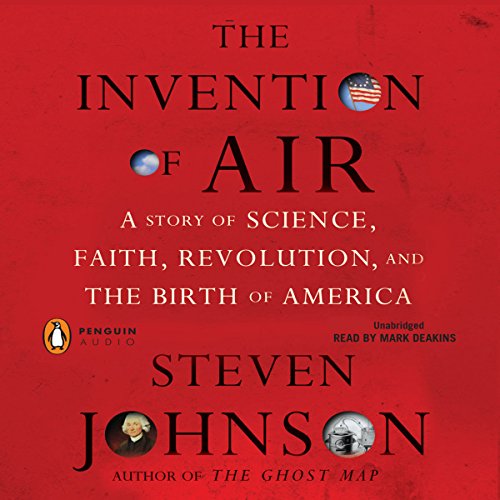
The Invention of Air
Summary
Best-selling author Steven Johnson recounts - in dazzling, multidisciplinary fashion - the story of the brilliant man who embodied the relationship between science, religion, and politics for America's Founding Fathers. The Invention of Air is a title of world-changing ideas wrapped around a compelling narrative, a story of genius and violence and friendship in the midst of sweeping historical change that provokes us to recast our understanding of the Founding Fathers. It is the story of Joseph Priestley - scientist and theologian, protege of Benjamin Franklin, friend of Thomas Jefferson - an 18th-century radical thinker who played pivotal roles in the invention of ecosystem science, the discovery of oxygen, the founding of the Unitarian Church, and the intellectual development of the United States. And it is a story that only Steven Johnson, acclaimed juggler of disciplines and provocative ideas, can do justice to. In the 1780s, Priestley had established himself in his native England as a brilliant scientist, a prominent minister, and an outspoken advocate of the American Revolution, who had sustained long correspondences with Franklin, Jefferson, and John Adams. Ultimately, his radicalism made his life politically uncomfortable, and he fled to the nascent United States. Here, he was able to build conceptual bridges linking the scientific, political, and religious impulses that governed his life. And through his close relationships with the Founding Fathers - Jefferson credited Priestley as the man who prevented him from abandoning Christianity - he exerted profound if little-known influence on the shape and course of our history. As in his last best-selling work, The Ghost Map, Steven Johnson here uses a dramatic historical story to explore themes that have long engaged him.
©2008 Steven Johnson (P)2008 Penguin Audiobooks

Future Perfect
Summary
Combining the deft social analysis of Where Good Ideas Come From with the optimistic arguments of Everything Bad Is Good for You, New York Times best-selling author Steven Johnson's Future Perfect makes the case that a new model of political change is on the rise, transforming everything from local governments to classrooms, from protest movements to health care. Johnson paints a compelling portrait of this new political worldview - influenced by the success and interconnectedness of the Internet, but not dependent on high-tech solutions - that breaks with the conventional categories of liberal or conservative thinking. With his acclaimed gift for multi-disciplinary storytelling and big ideas, Johnson explores this new vision of progress through a series of fascinating narratives: from the "miracle on the Hudson" to the planning of the French railway system; from the battle against malnutrition in Vietnam to a mysterious outbreak of strange smells in downtown Manhattan; from underground music video artists to the invention of the Internet itself. At a time when the conventional wisdom holds that the political system is hopelessly gridlocked with old ideas, Future Perfect makes the timely and inspiring case that progress is still possible, and that new solutions are on the rise. This is a hopeful, affirmative outlook for the future, from one of the most brilliant and inspiring visionaries of contemporary culture.
©2012 Steven Johnson (P)2012 Penguin Audio