The Great Courses has 635 audiobooks on Listento.it, narrated by 479 narrators, with an average listener rating of 4.5★ across 19,831 ratings. The most-rated is A Column of Fire.

The Life and Operas of Verdi
Summary
The Italians have a word for the sense of dazzling beauty produced by effortless mastery: sprezzatura. And perhaps no cultural form associated with Italy is as steeped in the love of sprezzatura as opera, a genre the Italians invented. No composer has embodied the ideal of sprezzatura as magnificently as Giuseppe Verdi, the gruff, self-described "farmer" from the Po Valley who gave us 28 operas and remains to this day the most popular composer in the genre's 400-year-old history. His operas are produced more than those of any other composer, and one source claims that his La Traviata (1853) has been staged live somewhere around the world every evening for the past 100 years! This series of 32 lectures from one of music's most acclaimed teachers combines biography with a variety of musical excerpts to reveal the treasures of creativity that account for this popularity. It explores in depth and detail both the famous and not-so-famous Verdi operas, as well as his one great concert work, the Requiem Mass of 1874; his early songs; and his very last composition, a setting of the Stabat Mater. You trace his development from a more or less conventional composer of operas in the traditional Italian bel canto (beautifully sung) style to a creator of truly innovative musical dramas in which the power of music to intensify and explore human emotion is exploited to the fullest degree. PLEASE NOTE: When you purchase this title, the accompanying reference material will be available in your Library section along with the audio.
©2003 The Teaching Company, LLC (P)2003 The Great Courses

The Nature of Matter: Understanding the Physical World
Summary
Matter is the raw material of the universe. Discover how the immense variety of matter - stars, mountains, plants, people - is generated by a limited number of chemical elements that combine in simple, well-defined ways. Consider carbon, a relatively common atom with many faces: diamond, which is the hardest known mineral; graphite, which is among the softest known substances; and carbon nanotubes, which are 300 times stronger than steel and have remarkable electrical properties. In the 24 engaging lectures of The Nature of Matter, no scientific background is needed to appreciate such miracles of everyday life as a bouncing rubber ball or water's astonishing power to dissolve. Moreover, the study of matter has led directly to such inventions as semiconductor circuits for computers, new fabrics for clothes, and powerful adhesives for medicine and industry. These discoveries were hard won by scientific sleuths, but we can all sit back and enjoy the details - just as we delight in the solution to a good detective story. Since prehistoric times, knowledge of materials has driven the development of civilization. The Stone Age was succeeded by the Bronze Age, the Iron Age, the Industrial Age, and now the age of silicon - the element that is the basis of the semiconductor revolution. Where will new methods and materials take us next? Professor Ball notes that the "fun part about being a chemist is that we still have lots of combinations of these raw materials to explore". Join this outstanding teacher and researcher on this exciting journey of discovery into the substance of everyday life. PLEASE NOTE: When you purchase this title, the accompanying reference material will be available in your Library section along with the audio.
©2015 The Great Courses (P)2015 The Teaching Company, LLC

The Lives of Great Christians
Summary
Meet some of Christianity's luminary figures - the followers of Jesus who have practiced and preached their beliefs for centuries. Whether well known or obscure or even nameless, their actions and achievements, their abilities and energies have changed the course of history and the nature of belief. These 24 inspirational lectures will inspire you by the many ways these figures found to live lives of faith. You'll stand spellbound in the crowd, listening to Bernardino and Augustine preach and teach. You'll visit the solitary cells and see the visions of Bernard, Clare, and Catherine. You'll witness the negotiations as Gregory VII and Leo IX reform the church. And you'll hear the verdicts of heresy against John Hus and against Martin Luther. More than doctrine or theology or even prayer, Christianity, for many, is the daily effort to live one's faith in every time and place. Professor Cook introduces you to those who have done so over the centuries and shows the many paths they found. If you seek your own path, their lives will inspire you. You will understand how Christians' faith has changed Christianity, and how these believers can help light your own way. And if you are wondering what Christians value and how they practice those values, you will see real lives that exemplify Christian faith in action. Christianity didn't just change believers; it defined all of Europe, eastern as well as western, and set many of the world's nations on a course still apparent today.
©2007 The Teaching Company, LLC (P)2007 The Great Courses

What Science Knows About Cancer
Summary
The landscape of cancer treatment and prevention is a vastly different place than it was even a decade ago. Thanks to a relatively new focus on molecular medicine, researchers are gaining a deeper understanding of the mechanisms involved in the disease, poising them on the brink of huge breakthroughs. What Science Knows About Cancer reports from the front lines of the war on cancer with a clear and scientifically precise - yet thoroughly accessible - guide to how the disease develops, thrives, and can potentially be conquered. An abundance of edifying charts and slides provide a rich visual reference for the information presented, while in-depth accounts of patient histories, clinical trials, and epidemiologic studies enrich your experience and aid comprehension. Taught by David Sadava, a laboratory researcher at the City of Hope Medical Center and an award-winning professor of biology at The Claremont Colleges, this fascinating 24-lecture course leaves no stone unturned in explaining the amazing ways cancer works to subvert the body, and how new therapies can reverse these insidious processes. Cancer isn't necessarily something any of us likes to think about, but knowledge truly is power. PLEASE NOTE: When you purchase this title, the accompanying PDF will be available in your Audible Library along with the audio.
©2013 The Great Courses (P)2013 The Teaching Company, LLC

The Agency: A History of the CIA
Summary
There’s a fundamental tension buried within the heart of the CIA’s mission to protect the American people: between democratic accountability and the inherent need for secrecy. Ultimately, it’s US citizens who bear the responsibility of staying informed about what the CIA has done and continues to do. In these 24 engrossing lectures, explore the roles the CIA has played in recent American history, from the eve of the Cold War against communism to the 21st-century War on Terror. You’ll delve into some of the most remarkable successes, including the sound intelligence CIA spy planes provided during the Cuban Missile Crisis and the admirable performance of the CIA throughout much of the Vietnam War, as well as historic failures, including the agency’s slowness spotting the rise of radical Islamism (including the September 11 attacks). In many cases, the lectures lead you to consider important questions about the nature of the CIA and its role in shaping modern history. What makes particular regions of the world ripe for the CIA’s attention? How successful are techniques like drone strikes, rendition, and interrogation? How does the CIA compare with its depiction in much of popular culture? Here, in Professor Wilford’s unbiased exploration of the CIA’s inner workings, is everything you need to come to your own conclusions about what “the Agency” might have done right, what it might have done wrong, and what it should do in the future. PLEASE NOTE: When you purchase this title, the accompanying PDF will be available in your Audible Library along with the audio.
©2019 The Great Courses (P)2019 The Teaching Company, LLC

Philosophy as a Guide to Living
Summary
We've all asked ourselves whether there is any meaning in human life. But for philosophers, this is just the first question of many: Is such a question even answerable by philosophy? And if so, can the practice of philosophy itself pursue a positive answer? Can philosophy prove life has any meaning? These 24 accessible lectures offer a thoughtful and stimulating discussion of how some of the greatest minds in the past three centuries have pondered why we are here and what journey we might be on. It's also a chance for you to take your own journey, as Professor Erickson guides you along the intellectual road traveled by a host of powerful thinkers. You'll consider the post-Enlightenment ideas of Kant, Hegel, Schopenhauer, and other European philosophers. Then you'll trace the line of thought through such intellectuals as Marx, Kierkegaard, Nietzsche, Freud, Heidegger, Sartre, Camus, Foucault, and Habermas. Most importantly, however, Professor Erickson has designed a course that requires no prior background in philosophy and avoids the often-intimidating language in which serious philosophy can be expressed. And he has done so without diminishing the extraordinary intellectual depth that each of the philosophers included here bring to the debate. The avenues opened by these thinkers do not, of course, explain the meaning of life - or even if such a meaning exists. But they do take us further along a fascinating and worthwhile journey that will almost certainly never end.
©2006 The Teaching Company, LLC (P)2006 The Great Courses

Law School for Everyone: Constitutional Law
Summary
Americans wage many of today’s fiercest policy debates and culture wars as battles over constitutional meaning. It’s because constitutional law is so fundamental to our democracy that law schools across the country teach the subject. It's the area of law that determines what federal and state governments are permitted to do, and what rights you have as an individual citizen of the United States. In these 12 lectures, you'll get the same accessible, well-rounded introduction to constitutional law as a typical law student - but with the added benefit of noted constitutional scholar Eric Berger's brilliant insights. Taking you through all three branches of the federal government, Professor Berger uses some of the most important legal cases in the United States to probe the open-ended nature of the Constitution’s language and illustrate how legal reasoning has defined the power relationships that the Constitution governs. You’ll examine pivotal Supreme Court cases to learn how interpreting the Constitution has radically affected American society. You’ll consider the Supreme Court’s role in deciding - and sometimes avoiding - questions of constitutionality. And you’ll investigate how changes in public opinion can influence how the Supreme Court interprets the Constitution. While the open-ended nature of the Constitution’s language makes constitutional law often uncertain, these lectures offer you a better understanding of its many nuances, as well as its profound importance for the future of the United States. PLEASE NOTE: When you purchase this title, the accompanying PDF will be available in your Audible Library along with the audio.
©2019 The Great Courses (P)2019 The Teaching Company, LLC

Francis of Assisi
Summary
These 12 lectures by Professors Cook and Herzman will give you a rounded, fully informed introduction to the luminous Francis of Assisi and will tell the intellectually and spiritually rewarding story of how his influence has glowed across the centuries. Just who was Assisi? Despite his continuing influence and the fairly ample writings about him that date from his own time, Francis remains somewhat elusive in history. It is not easy to meet the man who, at about the age of 25, renounced his family and inheritance to serve his God in poverty, simplicity, and obedience. Yet these lectures, with their mastery of history, theology, art, and literature, expertly unlock two sources that are the most revealing and plentiful-written narratives of Francis's life and the images created for Franciscan churches. In charting the life, times, and legacy of Francis, Professors Cook and Herzman include a great deal about the world around Francis as well as on the artwork, the ministries, and the religious communities that he inspired. But through it all shines their deeply human sense of the man himself and what he stood for-things which, they argue, are needed as much today as ever they were when Francis trod the byways of Italy to show what it means to live life to the full in faith, hope, and love. By the time you finish the last lecture, you'll find yourself in agreement that, whatever your background or beliefs, Francis of Assisi remains as fascinating and inspiring a man today as he was more than 800 years ago.
©2000 The Teaching Company, LLC (P)2000 The Great Courses

The History of Christianity in the Reformation Era
Summary
It still takes a major effort of historical imagination to enter the minds of those who lived during the Reformation Era, who were willing to suffer martyrdom or martyr others for what we would regard as minor doctrinal differences. These 36 lectures are designed to take you inside the minds of those who supported the Reformation and those who resisted it. They cover the three broad religious traditions that endured or arose during these years: Roman Catholicism, both as it existed on the cusp of the Reformation and as it changed to meet the Protestant challenge; Protestantism, meaning the forms approved by political authorities, such as Lutheranism, Calvinism, and Anglicanism; and "radical" Protestantism, meaning the forms often at odds with political authorities, such as Anabaptism. The goal: to understand historically the theological and devotional aspects of each of these three broad traditions on its own terms and to grasp the overall ramifications of religious conflict for the subsequent course of modern Western history. Along the way you'll encounter the era's many influential figures, including: Erasmus, Martin Luther, Charles V, Henry VIII, Ignatius Loyola, John Calvin, and Menno Simons. Professor Gregory also raises questions that any student of the period must ponder. Was the late medieval Church vigorous or, as Martin Luther and others came to insist, horribly corrupt? How do the events of the Reformation reveal the shifting balance between religious and secular authorities? Did the Reformation succeed or fail? Ultimately, the long-term payoff of these lecture series is a better understanding of the relationship between the world of early modern Europe - and the modern world to which it gave rise. PLEASE NOTE: When you purchase this title, the accompanying reference material will be available in your Library section along with the audio.
©2001 The Teaching Company, LLC (P)2001 The Great Courses

War, Peace, and Power: Diplomatic History of Europe, 1500-2000
Summary
For much of the past five centuries, the history of the European continent has been a history of chaos, its civilization thrown into turmoil by ferocious wars or bitter religious conflicts - sometimes in combination - that have made and remade borders, created and eliminated entire nations, and left a legacy that is still influencing our world. This 36-lecture series from an award-winning teacher and honored scholar pursues an explanation for this chaos that goes beyond the obvious ones of political ambition, religious intolerance, the pursuit of state power, or the fear of another state's aspirations. In pursuing that explanation, Professor Liulevicius offers everyone interested in the "why" of history a remarkable look into the evolution of the European continent and the modern state system. His provocative lectures allow us to peer through the revealing lens of statecraft to show us its impact on war, peace, and power and how that impact may well be felt in the future. As you learn to examine key points on history's diplomatic timeline in the context of attempting to establish - successfully and not - a lasting idea of order in the European world, you'll begin to grasp the key Professor Liulevicius offers to understanding the dynamics of international politics. And you'll see how such key concepts as the balance of power, power itself, sovereignty, and "reason of state" - the raison d'état first enunciated by France's powerful Cardinal Richelieu - fit into those dynamics. PLEASE NOTE: When you purchase this title, the accompanying reference material will be available in your Library section along with the audio.
©2007 The Teaching Company, LLC (P)2007 The Great Courses

Beethoven's Piano Sonatas
Summary
A revolutionary man living in a revolutionary time, Beethoven used the piano as his personal musical laboratory. The piano sonata became, more than any other genre of music, a place where he could experiment with harmony, motivic development, the contextual use of form, and, most important, his developing view of music as a self-expressive art. Beethoven's 32 piano sonatas include some of his most popular works as well as some of his most experimental. More than any other of his amazing works, Beethoven's piano sonatas are his personal testament, expressed in his own voice. These 24 marvelous lectures touch on every one of these fascinating pieces, approaching them chronologically, from the terse and powerful first sonata of 1795 to the revolutionary Hammerklavier Sonata of 1818 and the radical last three sonatas of 1820-1822. The sonatas are not simply compositions for the piano but are about the developing technology of the piano itself, an evolving instrument that Beethoven pushed to its limits and then beyond, ultimately writing music for an idealized piano that didn't come into existence until 40 years after his death. Because Beethoven died 50 years before the invention of sound recording, we will never hear his voice or the sound of his playing. Instead, Professor Greenberg plays you hundreds of excerpts of Maestro Claude Frank's recordings over the span of the course. Truly, Beethoven's piano music is his voice, emerging from his mind through his fingers to our ears and hearts. PLEASE NOTE: When you purchase this title, the accompanying reference material will be available in your Library section along with the audio.
©2005 The Teaching Company, LLC (P)2005 The Great Courses
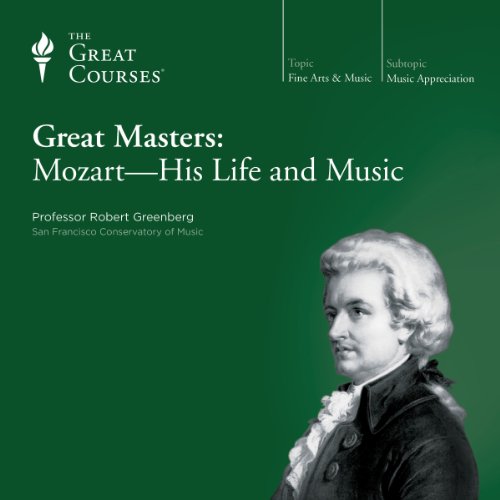
Great Masters: Mozart - His Life and Music
Summary
Even from the perspective of time, it is nearly impossible to grasp the full contribution made to music by Wolfgang Amadeus Mozart in his brief and glorious life. He composed his first symphony at the age of 8 and reached full artistic maturity by the time he was only 20. And when he died at the age of 35, he left a legacy of more than 600 works of brilliance - symphonies, chamber music, operas, and more - most composed during an incredibly productive 20-year period. But even though it can well take a lifetime to fully grasp the achievement of the man described by Rossini as "the only composer who had as much knowledge as genius and as much genius as knowledge", every step of that journey toward understanding will be a joy - one you can begin with this fascinating eight-lecture series, which can serve as both a stand-alone introduction to this extraordinary composer or as the gateway to a lifetime of appreciation and pleasure. Beginning with an examination of the many myths that surround Mozart to this day, Professor Greenberg offers not only an understanding of his music, but also a realistic view of Mozart the boy and man, from his emergence as youthful prodigy to his posthumous deification.You'll learn about his difficult and ultimately doomed relationship with his father, his troubled marriage, his relationships with luminaries like Haydn, Emperor Joseph II, and his operatic librettist, Lorenzo da Ponte, and the triumphs and disappointments that marked his career - including the astonishing and inexplicable creative recovery that enabled him to create his great Masonic opera, The Magic Flute, only months before his death. PLEASE NOTE: When you purchase this title, the accompanying reference material will be available in your Library section along with the audio.
©2000 The Teaching Company, LLC (P)2000 The Great Courses

Books That Matter: The City of God
Summary
Augustine of Hippo's masterpiece The City of God is one of the greatest books ever written, yet its size - nearly 1,000 pages - too often intimidates even serious readers. Composed in the years after the sack of Rome in the fifth century, it ushers you on an astounding historical and theological journey through the final years of the ancient world. What made this book so powerful? What mysteries lie within it? What relevance does the 1,600-year-old text have for our world today? And how should contemporary readers approach this monumental text? Now is your chance to answer these questions and more with this profound survey of one of the world's truly great books. Over the course of 24 in-depth lectures, Professor Mathewes guides you chapter by chapter through Augustine's magnum opus, introducing you not only to the book's key arguments but also to the historical context necessary to comprehend The City of God's true power. Here, you'll discover that Augustine was a surprisingly modern man with a clear-eyed outlook on a world in transition - and whose ideas continue to influence us today. Witness how he wrestled with some of the thorniest philosophical challenges of any time, including the problem of evil, faith versus reason, fate versus free will, and the very nature of God. Although there are no easy answers, Augustine's approach is ultimately therapeutic, helping readers live "happy in hope", which, he argues, is the only true happiness in a fallen world. Whether you come to this book as a Christian, a philosopher, a historian, a literature lover, or simply someone who wants fresh insight into our world today, Augustine will revolutionize the way you think about politics, religion, history, and our relationship to the divine. Professor Mathewes delivers a magnificent introduction to one of the world's truly great books. PLEASE NOTE: When you purchase this title, the accompanying reference material will be available in your Library section along with the audio.
©2016 The Great Courses (P)2016 The Teaching Company, LLC

The Greatest Controversies of Early Christian History
Summary
Without the presence of Christianity, our world would be considerably different. Whether we view it in religious, social, or political terms, Christianity has deeply and integrally influenced the Western worldview and way of life. Yet, throughout Christian history, compelling controversies have existed surrounding the faith's first three centuries, when it grew from a persecuted sect into a powerful religion. These controversies bring into question many commonly accepted beliefs about Christianity. In this course, an award-winning professor and New York Times best-selling author offers a penetrating investigation of the 24 most pivotal controversies, shedding light on fallacies that obscure an accurate view of the religion and how it evolved into what it is today. In each lecture, you'll delve into a key issue in Christianity's early development: Did the Jews Kill Jesus? Was Jesus Raised from the Dead? Did the Disciples Write the Gospels? Did Early Christians Accept the Trinity? Is the Book of Revelation about Our Future? Who Chose the Books of the New Testament? You'll delve into the conception of the meshiach (messiah) in Jewish tradition, and the basis for the core Christian claim that a suffering messiah was predicted in the Jewish scriptures. In grasping Paul's role in the early faith, you contemplate the key differences between the teachings of Jesus himself and the Christian view of his death and resurrection. And you trace the ambiguous role in early Christianity of the Jewish scriptures, and how these books came to be accepted as the Christian Old Testament. Explore these and other intriguing questions in this unique inquiry into the core of Christian tradition. PLEASE NOTE: When you purchase this title, the accompanying reference material will be available in your Library section along with the audio.
©2013 The Great Courses (P)2013 The Teaching Company, LLC

America and the New Global Economy
Summary
Globalization continues to be a force in our economic climate. And the origins of this globalized economy, its effects on important contemporary concerns, and its future trends are just a few of the intriguing issues you explore in these 36 lectures. Go beyond the economy of the United States and examine the recent history of economies in other countries and regions. As you journey with Professor Taylor through the last 50 years of world economic history, you'll explore international perspectives on the new global economy and develop a richer understanding of our increasingly interconnected world. To get a comprehensive picture of the new global economy, you consider the individual economies of countries including China (which may be the world's largest economy through much of the 21st century), India (the accelerated growth of which is based in service industries), and the Middle East (where most economies are surprisingly quite small). You'll also focus on a range of economic issues that have important ramifications for everyone, such as labor laws, population growth, and international economic agencies such as the World Bank and the World Trade Organization. Taken together, these lectures are a comprehensive look at economic globalization you can't get from reading the business section of a newspaper. They're your opportunity to grasp the economic histories, issues, and trends that affect us. With the knowledge gained from these lectures, you're able to understand the latest developments in our global economy and better prepare for a future in which all our economies will be linked. PLEASE NOTE: When you purchase this title, the accompanying reference material will be available in your Library section along with the audio.
©2008 The Teaching Company, LLC (P)2008 The Great Courses

Sacred Texts of the World
Summary
With few exceptions, the world's religions are anchored in their sacred texts-core writings that express the ideals and vision of the faiths, forming a basis for belief and action. Humanity's library of sacred writings is a huge canon that includes many of the most influential books ever written. In addition to the Hebrew and Christian bibles and the Quran of Islam, major sacred writings include the Hindu Vedas, the Buddhist Sutras, Daoism's Daodejing, and the Analects of Confucius, as well as the beloved texts of religions such as Zoroastrianism and Jainism, and modern faiths such as Baha'i. These are texts that people live by and, at times, are willing to die for. In these 36 lectures, Professor Hardy takes you deeply into the body of sacred writings that have played a fundamental role in human culture and history. Discussing a broad range of texts, the course examines the scriptures of seven major religions, as well as nine lesser known or smaller faiths, including texts from the ancient Egyptian and Mayan societies. In addition to studying the scriptures of the Judeo-Christian and Islamic worlds, you'll discover religious texts from vastly differing cultures around the world. These richly insightful lectures highlight a global legacy of faith, thought, and spirituality. PLEASE NOTE: When you purchase this title, the accompanying reference material will be available in your Library section along with the audio.
©2014 The Great Courses (P)2014 The Teaching Company, LLC

How Science Shapes Science Fiction
Summary
Science fiction can often seem to be pure imaginative fantasy with only the trappings of science. But many authors are more fluent in real science than many readers and viewers may realize. With the success our smaller Audible Original course on this subject, we thought it was time to extend the topic and present a more expansive look at the fascinating intersection of fiction and reality, which is what we have set out to do with How Science Shapes Science Fiction. Professor Charles L. Adler of St. Mary’s College of Maryland was the perfect choice for this subject, as he is both a longtime science-fiction fan and a real-world scientist. Professor Adler’s talent for using literature to shine a light on science - both the accurate and not-so-accurate versions employed by creators, spanning two centuries - makes this course a great survey for fans of both science fact and science fiction. PLEASE NOTE: When you purchase this title, the accompanying PDF will be available in your Audible Library along with the audio.
©2021 The Great Courses (P)2021 The Teaching Company, LLC

Science Wars: What Scientists Know and How They Know It
Summary
Choose one: (A) Science gives us objective knowledge of an independently existing reality, or (B) Scientific knowledge is always provisional and tells us nothing that is universal, necessary, or certain about the world. Made your choice? Welcome to the science wars. This long-running battle over the status of scientific knowledge began in ancient Greece, raged furiously among scientists, social scientists, and humanists during the 1990s, and has reemerged in today's conflict between science and religion over issues like evolution. This series of 24 lectures explores the history of competing conceptions of scientific knowledge and their implications for science and society, beginning with the onset of the Scientific Revolution in the 1600s up until today. It will provide you with an understanding of how science works that is as important as ever. Though it may seem that the accelerating pace of discoveries, inventions, and unexpected insights into nature over the centuries should secure foundations of scientific inquiry, that is far from true, as every day's headlines demonstrate. By the end of these lectures, you will understand what science is, and you will be enlightened about a fascinating problem you might not even have known existed. "There have been a raft of popular books about what scientists know," says Professor Goldman, "but to the best of my knowledge, there is not a single one of these popular books that focuses centrally on the question of how scientists know what they know." These lectures are an answer to that critical need. PLEASE NOTE: When you purchase this title, the accompanying reference material will be available in your Library section along with the audio.
©2006 The Teaching Company, LLC (P)2006 The Great Courses

The 1st Victim
Summary
New Year's Day is a time for new beginnings, but Minneapolis homicide detectives Sam Kovac and Nikki Liska are focused on endings: specifically, the tragic end of their latest murder victim, an unidentified young woman discovered on the side of the freeway. Believed to be the victim of a serial killer, Kovac and Liska are determined to do the girl the small justice of returning her body to her family as they investigate her case, but it is no simple task matching the broken corpse to any of the scores of missing persons reports, especially when no one seems to be looking for her. Meanwhile, recent widow Jeannie Reiser is frantic when she is unable to get in touch with her daughter, Rose, who, as an 18-year-old, is a legal adult rather than a missing child in the eyes of the law. Jeannie's desperate attempts to get the police to believe her child is in trouble lead her closer and closer to the New Year's Doe and to an evil even Sam Kovac and Nikki Liska may be unable to stop. Tami Hoag once again proves her place as "one of the most intense suspense writers around" (Chicago Tribune) with The 1st Victim.
©2013 Tami Hoag (P)2013 Brilliance Audio, Inc.

The Desolations of Devil's Acre
Summary
The fate of peculiardom hangs in the balance in this epic conclusion to the number-one best-selling Miss Peregrine’s Peculiar Children series. The last thing Jacob Portman saw before the world went dark was a terrible, familiar face. Suddenly, he and Noor are back in the place where everything began - his grandfather’s house. Jacob doesn’t know how they escaped from V’s loop to find themselves in Florida. But he does know one thing for certain: Caul has returned. After a narrow getaway from a blood-thirsty hollow, Jacob and Noor reunite with Miss Peregrine and the peculiar children in Devil’s Acre. The Acre is being plagued by desolations - weather fronts of ash and blood and bone - a terrible portent of Caul’s amassing army. Risen from the Library of Souls and more powerful than ever, Caul and his apocalyptic agenda seem unstoppable. Only one hope remains - deliver Noor to the meeting place of the seven prophesied ones. If they can decipher its secret location. Jacob and his friends will face deadly enemies and race through history’s most dangerous loops in this thrilling pause-resister, the final adventure in the beloved Miss Peregrine’s Peculiar Children series. *This audiobook includes a PDF of haunting vintage photographs from the book. PLEASE NOTE: When you purchase this title, the accompanying PDF will be available in your Audible Library along with the audio.
©2021 Ransom Riggs (P)2021 Listening Library