The Great Courses has 635 audiobooks on Listento.it, narrated by 479 narrators, with an average listener rating of 4.5★ across 19,831 ratings. The most-rated is A Column of Fire.

Law School for Everyone: Legislation and Regulation
Summary
A relatively recent addition to more traditional law school topics like torts and contracts, legislation and regulation have become more and more of a mainstay in some of the country’s top law schools. Over the course of 12 nuanced and balanced lectures, examine a host of topics including the nature of regulation, the merits of lawmaking by legislation, the challenge of interpreting statutes, and the role of federal agencies in our legal system. Along the way, confront intriguing - and controversial - questions about the letter versus the spirit of the law, how much authority independent federal agencies should have, and when a court or the president should step in to impose their own interpretations. Also, get introductions to concepts like the intelligible principle (the standard, set by Congress, designed to guide and limit an agency’s authority) and hard-look reviews (court-conducted reviews designed to focus on the substance of agency decision making). Given the increasingly prominent role of legislation and regulation in today’s national discourse, it’s critical for law students and everyday leaders alike to understand how these forms of law govern countless aspects of our lives - including everything from workplace safety to the speed of your internet connection. These lectures are a fascinating introduction to how we, as citizens, can make sense of the law so we can comply with it - or challenge it when necessary. PLEASE NOTE: When you purchase this title, the accompanying PDF will be available in your Audible Library along with the audio.
©2019 The Great Courses (P)2019 The Teaching Company, LLC

Making History: How Great Historians Interpret the Past
Summary
How do historians create their histories? What role do the historian's viewpoint and method play in what we accept as truth? Answer these and other questions as you go inside the minds of our greatest historians and explore the idea of written history as it has shaped humanity's story over 2,000 years. These 24 intriguing lectures introduce you to the seminal thinking of historians such as: Herodotus, considered by many the first history writer, who replaced the poetic imagination of Homer with istorieis, or inquiry; Livy, the author of a 142-volume didactic history of Rome that spanned three continents and seven centuries; David Hume, who framed English history with an evolutionary vision of economic, political, and intellectual freedom; and Edward Gibbon, whose monumental Decline and Fall of the Roman Empire forged a complex picture of epic collapse and decay. From the dramatic and military exploits of Xenophon and Thucydides in ancient Greece to Macaulay's dynamic career in the 19th century, from the bloody era of Christian Reformation to the revolutions of the Enlightenment, Professor Guelzo takes you into the trenches with great minds throughout history. And beneath the surface of written history, you'll examine the processes that create accepted views of historical events, and you'll uncover the ways in which understanding how history is written is crucial to understanding historical events themselves. The journey rewards you with an unforgettable insight into our human heritage and the chance to look with discerning eyes at human events in their deeper meanings.
©2008 The Teaching Company, LLC (P)2008 The Great Courses
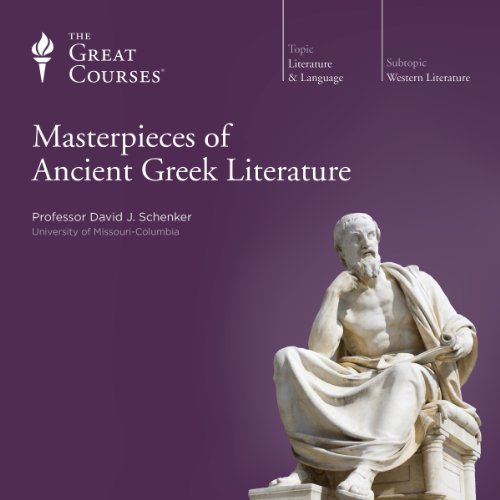
Masterpieces of Ancient Greek Literature
Summary
The ancient Greeks left the world that came after them - particularly our own and our ways of seeing it - an incalculable legacy. Mention politics, philosophy, law, medicine, history, even the visual arts, and we barely scratch the surface of what we owe this extraordinary culture. How can we best learn about these people who have given us so much, who have deepened and enriched our understanding of ourselves, and whose world remains far closer than we might imagine? The 36 lectures of this sparkling series from a frequently honored teacher is an outstanding place to begin, as Professor Schenker opens up to us the epics of Homer; the dramatic genius of the playwrights Aeschylus, Sophocles, Euripides, and Aristophanes; and the poems of Archilochus, Sappho, and many others. He includes some of the world's greatest works of history and philosophy, and he gives rhetoric and oratory their proper due, as well. Beginning with Homer and the two great epics credited to him, the Iliad and the Odyssey - including a provocative discussion of whether Homer even existed - Professor Schenker offers a wide-ranging overview of the subject that is both instructive and entertaining. His lectures are rich in anecdote, so that the works are set against a vivid backdrop of their times, as exemplified by his description of the debut of Aeschylus's the Eumenides, first staged in Athens in 458 B.C.E. You'll learn that the presentation was said to have elicited full-blown terror in its audience. When the Furies - the hideous, avenging spirits roused from sleep by the ghost of the murdered Clytemnestra - appeared in the audience, men are said to have shrieked and fainted, with pregnant women miscarrying on the spot.
©2007 The Teaching Company, LLC (P)2007 The Great Courses

The Life and Work of Mark Twain
Summary
Samuel Clemens, the man known to history as Mark Twain, was more than one of America's greatest writers. He was our first true celebrity, one of the most photographed faces of the 19th and 20th centuries. This series of 24 lectures by an acclaimed teacher and scholar explores Twain's dual identities - as one of our classical authors and as an almost mythical presence in our nation's cultural life. The lectures are a gateway to both appreciating Twain's literary achievements and to understanding his life, highlighting seven of his major works - Innocents Abroad, Roughing It, "Old Times on the Mississippi," The Adventures of Tom Sawyer, Adventures of Huckleberry Finn, A Connecticut Yankee in King Arthur's Court, and The Tragedy of Pudd'nhead Wilson - each replete with the issues that most interested and concerned Twain over the course of that life. But you also learn that there are even deeper depths to explore. Although Twain may have died a widely beloved figure, he himself once wrote: "Everyone is a moon and has a dark side that he never shows to anybody." Professor Railton shows you that in his private life, Samuel Clemens struggled with doubt, disappointment, despair, and an increasing misanthropy that was greater than any contained in his most sarcastic satires. Even his closest friends almost lost patience with his rantings on how to exterminate what he called "the damned human race." Dr. Railton also explores in some detail the unpublished manuscripts, discovered after his death, that reveal this dark and despairing side of Mark Twain. They include such partly completed works as The Enchanted Sea Wilderness, The Great Dark, and Three Thousand Years Among the Microbes.
©2002 The Teaching Company, LLC (P)2002 The Great Courses

Masterpieces of Short Fiction
Summary
More than simply a shorter version of the novel, the short story is a unique and rewarding literary form in itself. It offers a world in miniature faithfully captured by the author's mastery of character, plot, setting, image, and theme. The time it takes to read a short story may be brief, but its impact lasts much longer. Short story writers see by the light of the flash," says author and Nobel Laureate Nadine Gordimer. "Theirs is the art of the only thing that one can be sure of - the present moment." These 24 lectures guide you deep into 23 renowned works written by some of the acknowledged masters of the genre, illuminating the remarkable variety, breathtaking artistry, and profound themes to be found in such miniature masterpieces as Nathaniel Hawthorne's "Young Goodman Brown," Isaac Babel's "My First Goose," Ernest Hemingway's "The Killers," Shirley Jackson's "The Lottery," and more. Using examples from the stories themselves, Professor Krasny illuminates each author's virtuosic development of character, plot, setting, imagery, theme, and language. As you progress through the course, you hone your ability to recognize and assess these elements.
©2008 The Teaching Company, LLC (P)2008 The Great Courses

Luther: Gospel, Law, and Reformation
Summary
How did one man - a humble monk and Bible professor - spark a religious rebellion that changed the course of history? What made Martin Luther's theology so explosive in 16th-century Europe? How did this late-medieval man launch the Protestant Reformation and help create the modern world? And how should we think of him: hero or heretic, rebel or tormented soul? Find out the answer to these questions and more in this series of 24 engaging lectures. You'll approach Martin Luther as someone who is so interesting to study precisely because he is so controversial. This is an opportunity to understand why Luther's thinking had such a volatile impact on his and our times and why his life continues to be a subject of vigorous religious and historical debate. Professor Cary explores in depth Luther's subtle, challenging, and sometimes disturbing theology. After examining the genesis of Luther's great theological breakthrough - the doctrine of justification by faith alone - Professor Cary traces the full evolution of Luther's thought, from his early and frightening concept of justification through self-hatred to his later and equally unsettling notion of unfree will and predestination. You will gain insight into this inspiring religious thinker who presented the Christian gospel as a message of comfort, joy, and freedom; an exceptional writer who did for German what Dante did for Italian; and a prominent theological and intellectual leader who appealed to ordinary Christians by sharing their most cherished values: marriage and everyday family values.
©2004 The Teaching Company, LLC (P)2004 The Great Courses

Thinking about Cybersecurity: From Cyber Crime to Cyber Warfare
Summary
Cyberspace is the 21st century’s greatest engine of change. Telecommunications, commercial and financial systems, government operations, food production - virtually every aspect of global civilization now depends on interconnected cyber systems to operate; systems that have helped advance medicine, streamline everyday commerce, and so much more. Thinking about Cybersecurity: From Cyber Crime to Cyber Warfare is your guide to understanding the intricate nature of this pressing subject. Delivered by cybersecurity expert and professor Paul Rosenzweig, these 18 engaging lectures will open your eyes to the structure of the Internet, the unique dangers it breeds, and the ways we’re learning how to understand, manage, and reduce these dangers. In addition, Professor Rosenzweig offers sensible tips on how best to protect yourself, your network, or your business from attack or data loss. Disclaimer: The views expressed in this course are those of the professor and do not necessarily reflect the position or policy of the U.S. Department of Homeland Security, the U.S. Department of Defense, or the U.S. government. PLEASE NOTE: When you purchase this title, the accompanying reference material will be available in your Library section along with the audio.
©2013 The Teaching Company, LLC (P)2013 The Great Courses

The Western Literary Canon in Context
Summary
What exactly is the Western literary canon? Why does it contain certain works and not others? And what do particular works in the Western canon tell us about the development of literature and civilization? Explore these and other thought-provoking lectures with a thorough investigation of more than 30 key works of the Western canon and the critical roles they played - and continue to play - in the development of Western literature. Over the course of 36 lectures, you'll discover the exciting stories behind these classic works and their often surprising connections with one another. You'll gain invaluable insights into the stories behind these masterpieces and some of the important elements involved in canon formation, including the influence of editors on the New Testament, the influence of culture on Homer's and Virgil's epics, and the influence of education on J.R.R. Tolkien. You'll also examine the unique connections between each work and its predecessors, allowing you to participate in a riveting literary discussion and examine how history's greatest writers have "talked" with one another, from the way Virgil's Aeneid echoes the Homeric epics the Iliad and the Odyssey to the way John Milton's Paradise Lost is a catalog of the canonic works that precede it, from Plato's "The Apology of Socrates" to William Shakespeare's Hamlet. A panoramic look at literature, this course is your opportunity to witness a rich literary dialogue and take an amazing journey through thousands of years of literary beauty, grace, and humanity.
©2008 The Teaching Company, LLC (P)2008 The Great Courses

Liberty on Trial in America
Summary
We like to believe that the founding principle of the United States is liberty. “Give me liberty, or give me death!” Patrick Henry famously said in 1775 to encourage the Virginia colonists to fight for their freedom. It was liberty for which he was willing to sacrifice his life. So, you would think that when the United States of America was formed, our citizenry could finally enjoy a plethora of hard-won liberties. But that was not the case. While the new Americans no longer suffered from taxation without representation, many of the liberties we enjoy today were not part of their lives. In Liberty on Trial in America: Cases that Defined Freedom, you will learn how liberty increased in our country when individuals sued for those freedoms, when cases were brought specifically to test the limits of the Constitution with its Amendments, and even when a jury in a local case returned an unexpected verdict that helped change the thinking of the times. In 24 fascinating lectures, Professor Douglas O. Linder of the University of Missouri-Kansas City School of Law takes you behinds the scenes of the trials that brought many of the liberties we enjoy today. You’ll learn what happened when Anne Hutchinson dared to speak her religious ideas in the Massachusetts Bay Colony of the 1600s, when Susan B. Anthony decided to vote in a national election, when activists promoted radical ideas in the 1880s in Chicago, when Jehovah’s Witnesses decided their children should not be forced to salute the American flag in school, and more. PLEASE NOTE: When you purchase this title, the accompanying PDF will be available in your Audible Library along with the audio.
©2020 The Great Courses (P)2020 The Teaching Company, LLC
Science in the Twentieth Century: A Social-Intellectual Survey
Summary
As the 19th century drew to a close, the age-old quest to understand the physical world appeared to be complete, except for a few minor details. In fact, Albert Michelson, the first American to win a Nobel Prize in the sciences, noted that, "It seems probable that most of the grand underlying principles have been firmly established." And he was far from alone among his peers. Scientists in 1900 had no inkling of the other mind-boggling developments that lay in wait: plate tectonics, genetic engineering, space probes, nanotechnology, big bang theory, electronic computers, nuclear weapons, artificial intelligence, and many other astounding products of the human mind. Indeed, by the end of the 20th century, nearly every 19th-century theory of natural and social phenomena would be overthrown or superseded. This dynamic transformation has not been a matter of revolution, but of evolution, as you'll learn in this fascinating 36-lecture exploration of scientific growth filled with ideas, anecdotes, and insights. You'll see how 20th-century scientists have built on crucial 19th-century concepts such as energy, natural selection, atoms, fields, and waves to assemble a body of knowledge to stun even the most farsighted scientific thinkers of that not-too-distant past. You'll come away with a new appreciation of how scientific knowledge expands, as Professor Goldman addresses a tremendous range of scientific and technological topics, including science and society, physics, mathematics, psychology, cosmology, telecommunications, meteorology, and archaeology.
©2004 The Teaching Company, LLC (P)2004 The Great Courses

Modern British Drama
Summary
Waiting for Godot. The Importance of Being Earnest. Rosencrantz and Guildenstern Are Dead. Since Shakespeare's time, no period has produced more brilliant and various theatrical dramas in Great Britain than in the past 100 years. Professor Saccio has selected the major British playwrights of the past century to cover Wilde, Shaw, Coward, Beckett, Osborne, Pinter, Stoppard, Churchill, and Hare. Why this roster of modern British playwrights? As you'll discover while exploring their great works in these eight lectures, some of them celebrate (or satirize) elite manners, some explore the changes in a kingdom that once ruled a quarter of the globe, some assault the sociopolitical establishment, and some probe the Existential anxiety of the modern age. "Unlike other media, dramatic art occurs in a certain place in time; in the 'here and now,'" states Professor Saccio. You'll examine the role theater has played in British culture and society over the past 100 years. You'll witness the evolution of the stylistic conventions of the British play, from the genteel drawing-room comedies of the late 19th century to the radical political theater of the late 20th century. Throughout this brief survey of some of the great innovators of the dramatic arts of the modern era, you'll understand how and why modern British drama has changed so dramatically, and you'll realize the importance of the political and social context in which these works were written.
©1994 The Teaching Company, LLC (P)1994 The Great Courses
European Thought and Culture in the 20th Century
Summary
As a sequel to European Thought and Culture in the 19th Century, Professor Kramer tackles the major intellectual themes and debates that decisively shaped 20th-century European culture. These 24 lectures cover an amazingly wide range of thinkers and writers, the key historical circumstances and challenges they faced, and the fascinating and subtle ways in which their works relate to one another and to the larger story of modern European culture. You'll look at influential writers such as Stéphane Mallarmé, Joseph Conrad, Henrik Ibsen, Virginia Woolf, and Primo Levi; important painters such as Henri Matisse, Pablo Picasso, Georges Braque, and Wassily Kandinsky; philosophers and theorists such as Ludwig Wittgenstein, Albert Einstein, Edmund Husserl, Jean-Paul Sartre, and Jürgen Habermas; and other key figures in the human and social scientists, including Émile Durkheim, John Maynard Keynes, Hannah Arendt, and Carl Jung. With a focus on context, cultural innovations, and responses to World War I and World War II, Professor Kramer lends coherence and liveliness to what might otherwise seem a bewildering gathering of intellectuals. But by learning about their lives, their works, and the connections between their ideas, you'll gain a keener insight into a host of movements and trends in the modern intellectual life-including positivism, literary modernism, feminism, structuralism, and Cubism and Abstract Expressionism in painting.
©2002 The Teaching Company, LLC (P)2002 The Great Courses

The American Mind
Summary
Americans pride themselves on being doers rather than thinkers, but ideas are at the very root of what it means to be an American. Behind this nation's diverse views on religion, education, social equality, democracy, and other vital issues is a long-running intellectual debate about the right ordering of the human, natural, and divine worlds. Indeed, America is an enduring hotbed of ideas. Such great thinkers as Jonathan Edwards, Thomas Jefferson, Abraham Lincoln, William James, Martin Luther King, Jr., and many others engaged in lively and often contentious debate that helped mold America's institutions and attitudes. This immensely stimulating conversation made the United States what it is today - and provides the subject for these 36 fascinating lectures. In this course, you will delve deeply into the philosophical underpinnings of the nation, forged by the Puritans and the leaders of the American Revolution. You will also explore many other aspects of the elaborate structure that became modern America, tracing ideas in politics, religion, education, philosophy, psychology, anthropology, literature, social theory, and science - proving that Americans have a much richer intellectual tradition than generally imagined. You'll learn about such philosophical movements as transcendentalism, pragmatism, and conservatism. You'll study the transatlantic philosophy of the Puritans, the spiritual revival of the Great Awakening, and the passion for reason sparked by the Enlightenment. And you'll trace the origin and evolution of America's colleges, which have served as a battleground of ideas, sometimes in an almost literal sense. PLEASE NOTE: When you purchase this title, the accompanying reference material will be available in your Library section along with the audio.
©2005 The Teaching Company, LLC (P)2005 The Great Courses

Unsung Heroes of World War II: Europe
Summary
World War II is one of the most harrowing and impactful events in human history. Our imaginations may be captured by the sweeping military battles, but the story of war is the story of humans, everyday people trying to do their bit in a world falling apart around them. In France, for instance, you’ll find a young, unassuming mother who became the leader of the largest and most important Allied spy network in occupied France. In Poland, a brilliant, young mathematician successfully broke Germany’s Enigma code, laying the groundwork for the famed British codebreaking operation at Bletchley Park. In Belgium, a 23-year-old nurse from Brussels created an escape line that smuggled hundreds of shot-down British and American airmen out of enemy territory and back to freedom. What did these three very different people have in common? They were all unsung heroes of war, men and women of courage and conscience who helped change the course of history but who, for various reasons, have slipped into history’s shadows. Unsung Heroes of World War II: Europe is your chance to meet these and other everyday heroes who have never been given the credit they deserved. Taught by historian Lynne Olson, author of seven acclaimed books about World War II, these 12 scintillating lectures offer a trove of stories across Europe and America that you likely have never heard before. Delve into a world of citizens holding onto illicit radios so they can listen to broadcasts from the BBC, a beacon of liberty for those living in occupied territory. Mingle with spies listening to secrets, gathering intelligence, and taking risks to share information with the Allies. Meet the politicians behind the scenes who orchestrated great events. With a storyteller’s true gift for setting a scene and an eye for interesting details, Professor Olson takes you into the shadows of history to introduce you to some of the most courageous figures in the war - all of whom did their best to defeat tyranny and restore freedom in their own countries and the world at large. Disclaimer: Please note that this recording may include references to supplemental texts or print references that are not essential to the program and not supplied with your purchase. PLEASE NOTE: When you purchase this title, the accompanying PDF will be available in your Audible Library along with the audio.
©2020 The Great Courses (P)2020 The Teaching Company, LLC

Memory and the Human Lifespan
Summary
What if your memory suddenly vanished, so that you could no longer summon recollections of anything at all? What if you couldn't even remember yourself - not your name, your school, where you worked, or even the face of the total stranger staring back at you from the mirror? If all of your memories were gone, would "self" even have a meaning? The truth is that while you may think of human memory as a capacity - a way to call up important facts or episodes from your past - it is much, much more, a collection of systems that provide the continuity of consciousness that allows the concept of "you" to make sense, creating the ongoing narrative that makes your life truly yours. This intriguing series of 24 lectures by an honored researcher and teacher explains not only how the various aspects of your memory operate, but the impact memory has on your daily experience of life. By understanding how the brain organizes and encodes information, you can better harness its extraordinary powers to fine-tune how it works for you and use this information to help reshape your very experience of being alive. The lectures explore topics like: the different kinds of systems that make memory possible; how those systems work together to build and access memories of specific events, solve problems, learn basic tasks like brushing your teeth, or acquire the skills to play a musical instrument; the kinds of memory deficits that result when various parts of the brain are damaged or deteriorate; how memory shapes not only your experience of the past but also of the present, as well as your expectations of the future; and how your memory systems develop throughout your life. PLEASE NOTE: When you purchase this title, the accompanying reference material will be available in your Library section along with the audio.
©2011 The Teaching Company, LLC (P)2011 The Great Courses

Origins of the Human Mind
Summary
For thousands of years, the human mind has been shrouded in mystery. But with the latest advancements in both our understanding of the brain and the technology we use to look inside it, scientists have vastly improved their grasp of the human mind. Now, more than at any other point in human history, we can better explain and describe how the human mind has evolved; how our genes and environments work together to mold the people we become; and the sources, symptoms, and potential treatment methods for debilitating mental disorders like depression, attention-deficit hyperactivity disorder, autism, and many others. The human mind and its complexities lie at the heart of who we are as human beings. And grasping its origins, no matter how mysterious they can sometimes be, is essential to a well-rounded understanding of answers to questions that have fascinated and perplexed humanity throughout history. This 24-lecture series is your guide to the latest information and viewpoints on what scientists know about this fascinating subject. Taught by an award-winning teacher whose training as a clinical psychologist straddles both the science of the mind and its impact on individual lives, their comprehensive approach reveals how that science applies to the life of our species - and to your own life as well. The lectures explore theories about how the mind works on both an evolutionary and individual scale. Each offers its own fascinating insights. But by examining them both individually and together, Professor Hinshaw reveals similarities and differences in viewpoints and approaches that wouldn't be apparent from a focus on just one - providing you with the best possible picture about what the mind truly is. PLEASE NOTE: When you purchase this title, the accompanying reference material will be available in your Library section along with the audio.
©2010 The Teaching Company, LLC (P)2010 The Great Courses

Business Law: Negligence and Torts
Summary
These eight lectures address two important questions: When is someone else legally responsible for harm done to you? When are you legally responsible for harm done to someone else? This course of eight lectures discusses torts, the body of law designed to redress through civil litigation harms done to persons. As with all bodies of law, in order to analyze the legal implications of a potentially tortious action, it is necessary to blend common sense and pragmatic thinking with an understanding of legal definitions as they have evolved over time. This series not only explains the basics of this substantive body of law, but it also gives insight through examples of how the law is based on a logical idea of a just outcome. Topics you'll explore here include the basic foundations of torts law, the three categories of which it is composed, and the legal factors necessary to find a person liable for a tort; negligence, especially of property owners, and the defenses that can be offered against allegations of negligence; the expanding tort of infliction of emotional distress, which can be either negligent or intentional, but which must pass several specific tests before it can be definitely labeled tortious; third-party intervention in contracts and prospective business; the legal implications of misappropriation of information; and trademark law. Please note: This course is not intended to provide financial or investment advice. All investments involve risk: Past performance does not guarantee future success. You acknowledge that any reliance on any information from the materials contained in this course shall be at your own risk. PLEASE NOTE: When you purchase this title, the accompanying reference material will be available in your Library section along with the audio.
©1994 The Teaching Company, LLC (P)1994 The Great Courses

Shocking Psychological Studies and the Lessons They Teach
Summary
We live in a time of amazing new technologies - and an unparalleled level of surveillance. Virtually every aspect of human behavior is tracked millions of times a day through the technology that we all, often without giving it a thought, use every day. The collected data has the potential of providing vital insight into the human experience, but can the scientific community explore the psychosocial experience of humanity without making victims of us all? Professor Thad Polk, of the University of Michigan, invites you to join him for Shocking Psychological Studies and the Lessons They Teach, a six-lecture course exploring a range of shocking psychological experiments from the past that have nonetheless contributed significant insight into the human condition. Dr. Polk elucidates the contemporary ethical principles now in place to protect both subjects and science, but admits that with every new technological and scientific advancement, there also comes a new set of ethical conundrums for researchers to grapple with. Psychological research today adheres to the Belmont Report’s principles, a set of three ethical principles established in 1976 following the aftermath of research studies that critically failed to protect the rights of the research subjects. Through a look at a series of influential, but flawed, studies, ranging from syphilis to stuttering to psychoactive drugs, Professor Polk explores these ethical principles and how they, in retrospect, might have been applied. As he concludes Shocking Psychological Studies and the Lessons They Teach, Professor Polk acknowledges that as science still grapples with the ethics of studying human subjects, past mistakes have helped us to create a safer and more enlightened field of scientific research, adhering to ethical research principles. PLEASE NOTE: When you purchase this title, the accompanying reference material will be available in your Library section along with the audio.
©2020 The Great Courses (P)2020 The Teaching Company, LLC

Privacy, Property, and Free Speech: Law and the Constitution in the 21st Century
Summary
Although the courts have struggled to balance the interests of individuals, businesses, and law enforcement, the proliferation of intrusive new technologies puts many of our presumed freedoms in legal limbo. For instance, it's not hard to envision a day when websites such as Facebook or Google Maps introduce a feature that allows real-time tracking of anyone you want, based on face-recognition software and ubiquitous live video feeds. Does this scenario sound like an unconstitutional invasion of privacy? These 24 eye-opening lectures immerse you in the Constitution, the courts, and the post-9/11 Internet era that the designers of our legal system could scarcely have imagined. Professor Rosen explains the most pressing legal issues of the modern day and asks how the framers of the U.S. Constitution and the Bill of Rights would have reacted to aspects of the modern life such as full-body scans, cell phone surveillance, and privacy in cloud servers. Called "the nation's most widely read and influential legal commentator" by the Los Angeles Times, Professor Rosen is renowned for his ability to bring legal issues alive - to put real faces and human drama behind the technical issues that cloud many legal discussions. Here he asks how you would decide particular cases about liberty and privacy. You'll come away with a more informed opinion about whether modern life gives even the most innocent among us reason to worry. PLEASE NOTE: When you purchase this title, the accompanying reference material will be available in your My Library section along with the audio.
©2012 The Teaching Company, LLC (P)2012 The Great Courses

Discovering Your Roots
Summary
Genealogy is a journey of self-discovery that can teach you as much about yourself as about those who came before you. But there's an obstacle that holds many of us back from unearthing our family history: uncertainty about how to go about it. With Dr. Colletta's 15 lectures, you'll learn the same skills and methodologies the experts use to solve genealogical mysteries, to create compelling nonfiction narratives, and to uncover information from the long-forgotten past in the most effective ways possible. These lectures provide you with smart and savvy ways to find-and use-the most helpful online and print resources available today, including U.S. population censuses, the Periodical Source Index (PERSI), and the National Archives and Records Administration. You'll also learn tools of the trade for working with these and other sources, as well as countless tips for making your own research more useful. You'll also discover how to write engaging historical narratives that can inform and entertain family members or general audiences. You'll explore seven steps for personalizing biographical facts; specific ways to construct and narrate the timeline of an ancestor from birth to death; four fundamental questions you need answers to before you start writing about your ancestors; and more. So grab that old photograph, sit down with an elderly relative, comb through old records, and prepare to embark on a personal adventure that can dramatically reshape how you think about your past - and yourself. PLEASE NOTE: When you purchase this title, the accompanying reference material will be available in your Library section along with the audio.
©2014 The Teaching Company, LLC (P)2014 The Great Courses