Thomas F. Madden has 5 audiobooks on Listento.it, narrated by 4 narrators, with an average listener rating of 5★ across 1 ratings. The most-rated is The Modern Scholar: Empire of Gold: A History of the Byzantine Empire.

The Modern Scholar: Empire of Gold: A History of the Byzantine Empire
Summary
In this epic course, esteemed university professor Thomas F. Madden offers a fascinating history of the remarkable culture and state that developed out of the ancient Roman Empire, particularly its eastern portion, throughout the Middle Ages. The story begins at the end of the Roman Empire in the third century AD and continues over the next one thousand years. With incisive commentary, Professor Madden leads a discussion covering Justinian's re-conquest of the West, the great city of Constantinople, and the aftermath and influence of this extraordinary empire. The term "Byzantine" was invented by modern historians to identify the final millennium of the Roman Empire. By the third century and into the fourth century, there were changes in the Roman Empire so profound that historians during the Enlightenment began to call the period Byzantine rather than Roman. Most historians would place the beginnings of the Byzantine Empire roughly around the reign of the emperor Diocletian, who instituted widespread reforms to halt civil wars and economic decline. One of the primary characteristics of the Byzantine Empire was the relegation of Rome to a place of honor only. Rome was not the capital of the Byzantine Empire. The capital, instead, was Constantinople. Therefore, power was based in the eastern Mediterranean. Next was the dominance of Greek culture and eastern perspectives, and a final characteristic was the integration of Christianity into the social and political fabric of the empire. Constantinople was the beating heart of the Byzantine Empire and the greatest city in the Western world at this time. Constantinople sat at the crossroads of the world and controlled east-west land traffic. Eventually, the fall of Constantinople to the Ottoman Turks reverberated across the Christian world. Europeans now saw a world in which nothing stood between them as the last remnant of free Christendom and the ever-growing powers of Islam.
©2006 Thomas F. Madden (P)2006 Recorded Books, LLC
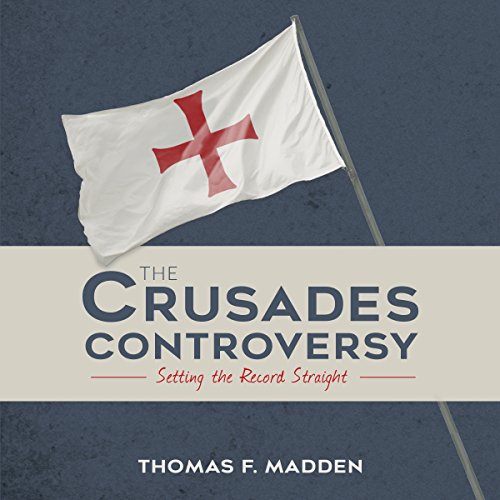
The Crusades Controversy
Summary
This short book written by medieval historian, Thomas Madden, offers a fresh perspective on the Crusades. He refutes the commonly held belief that the Crusades are the reason for the current tensions between Islam and the West and that Catholics are to blame for starting them in the first place. Closing the gap between historical understanding and popular perception, Madden shows that it's not the Crusades that led to the conflict between the Muslim Middle East and the West but the artificial memory passed down by Arab nationalists and Islamists. Today, when the Crusades are used as a justification for recent wars and acts of violence, The Crusades Controversy provides a sane understanding of how these holy wars fit within the context of history and the modern challenges our world faces today.
©2017 Thomas F. Madden (P)2018 Thomas F. Madden

The New Concise History of the Crusades
Summary
How have the crusades contributed to Islamist rage and terrorism today? Were the crusades the Christian equivalent of modern jihad? In this sweeping yet crisp history, Thomas F. Madden offers a brilliant and compelling narrative of the crusades and their contemporary relevance. Placing all the major crusades within their medieval social, economic, religious, and intellectual environments, Madden explores the uniquely medieval world that led untold thousands to leave their homes, family, and friends to march in Christ's name to distant lands. From Palestine and Europe's farthest reaches, each crusade is recounted in clear, concise narrative. The author gives special attention as well to the crusades' effects on the Islamic world and the Christian Byzantine East.
©2006 Rowman & Littlefield Publishers, Inc. (P)2014 Redwood Audiobooks

The Modern Scholar: From Jesus to Christianity: A History of the Early Church
Summary
Entrusting the apostles to continue the work he had started by instructing them to "Go therefore and make disciples of all nations, baptizing them in the name of the Father, the Son and the Holy Spirit . . .," Jesus kindled the fires of a new religion in a world largely dominated by polytheism, cult leader worship, and mysticism. In the first century of its existence, Christianity was both welcomed and vilified throughout the Roman Empire. Many of Christianity's original adherents were martyred - murdered by those who believed it a danger to their authority or, at the very least, the cause of unrest among an otherwise docile populace.Christians themselves practiced their religion with great diversity, linked as much to local influences as theology. Political intrigue, theological beliefs, and simple misunderstandings created a need for dialogue between the many practitioners of the growing faith.Christianity's adoption as the official faith of the Roman state tied it inexorably to the fortunes of the Empire. This also helped to create a gulf between the two main theological branches of the religion, which remain to this day.
©2005 Thomas F. Madden (P)2005 Recorded Books

Istanbul
Summary
The first single-volume history of Istanbul in decades: a biography of the city at the center of civilizations past and present. For more than two millennia, Istanbul has stood at the crossroads of the world, perched at the very tip of Europe, gazing across the shores of Asia. The history of this city - known as Byzantium, then Constantinople, now Istanbul - is at once glorious, outsized, and astounding. Founded by the Greeks, its location blessed it as a center for trade but also made it a target of every empire in history, from Alexander the Great and his Macedonian Empire, to the Romans and later the Ottomans. At its most spectacular, Emperor Constantine I re-founded the city as New Rome, the capital of the eastern Roman Empire, and dramatically expanded the city, filling it with artistic treasures, and adorning the streets with opulent palaces. Around it all, Constantine built new walls, truly impregnable, that preserved power, wealth, and withstood any aggressor - walls that still stand for tourists to visit. From its ancient past to the present, we meet the city through its ordinary citizens - the Jews, Muslims, Italians, Greeks, and Russians who used the famous baths and walked the bazaars - and the rulers who built it up and then destroyed it, including Mustafa Kemal Ataturk, the man who christened the city "Istanbul" in 1930. Thomas Madden's entertaining narrative brings to life the city we see today, including the rich splendor of the churches and monasteries that spread throughout the city. Istanbul draws on a lifetime of study and the latest scholarship, transporting listeners to a city of unparalleled importance and majesty that holds the key to understanding modern civilization. In the words of Napoleon Bonaparte, "If the Earth were a single state, Istanbul would be its capital."
©2016 Thomas F. Madden (P)2016 Recorded Books