Umberto Eco has 11 audiobooks on Listento.it, narrated by 10 narrators, with an average listener rating of 4.3★ across 135 ratings. The most-rated is The Name of the Rose.

The Name of the Rose
Summary
The international best seller! A masterful gothic thriller set against the turbulence of medieval Italy. The year is 1327. Franciscans in a wealthy Italian abbey are suspected of heresy, and Brother William of Baskerville arrives to investigate. But his delicate mission is suddenly overshadowed by seven bizarre deaths that take place in seven days and nights of apocalyptic terror. Brother William turns detective, and a uniquely deft one at that. His tools are the logic of Aristotle, the theology of Aquinas, the empirical insights of Roger Bacon - all sharpened to a glistening edge by his wry humor and ferocious curiosity. He collects evidence, deciphers secret symbols and coded manuscripts, and digs into the eerie labyrinth of the abbey where "the most interesting things happen at night". As Brother William goes about unraveling the mystery of what happens at the abbey by day and by night, listeners step into a brilliant re-creation of the 14th century, with its dark superstitions and wild prejudices, its hidden passions and sordid intrigues. Virtuoso storyteller Umberto Eco conjures up a gloriously rich portrait of this world with such grace, ease, wit, and love that you will become utterly intoxicated with the place and time.
©1980 Gruppo Editoriale Fabbri-Bompiani, Snzogno, Etas S.p.A.; English Translation ©1983 by Harcourt Brace & Company and Martin Secker & Warburg Limited (P)2013 Naxos AudioBooks

Le Nom de la Rose
Summary
Au début du XIVe siècle, une abbaye située aux confins de la Provence et de la Ligurie. Un lieu voué à la prière et à l'étude avec sa bibliothèque qui fait l'admiration de tout l'Occident chrétien, à l'écart des violences et des luttes de pouvoir qui déchirent les royaumes voisins. Jusqu'au jour où un moine est trouvé mort au bas des murailles. C'est le début d'une sanglante série que devra élucider Guillaume de Baskerville. Fascinant roman policier médiéval, Le Nom de la Rose est aussi la preuve éclatante de la virtuosité intellectuelle d'Umberto Eco. Il faut une grande maîtrise pour restituer le foisonnement des tons et des rythmes qui donne au roman d'Umberto Eco toute sa séduction : c'est cette performance que réussit l'interprétation de François d'Aubigny.
©2012, Editions Grasset et Fasquelle pour la traduction française de la version revue et corrigée du " Nom de la Rose". Traduit de l'italien par Jean-Noël Schifano. Edition revue et corrigée par l'auteur et (P)201 1

Foucault's Pendulum
Summary
One Colonel Ardenti, who has unnaturally black, brilliantined hair, a carefully groomed mustache, wears maroon socks, and who once served in the Foreign Legion, starts it all. He tells three Milan book editors that he has discovered a coded message about a Templar Plan, centuries old and involving Stonehenge, a plan to tap a mystic source of power far greater than atomic energy. The editors, who have spent altogether too much time rewriting crackpot manuscripts on the occult by fanatics and dilettante, decide to have a little fun. They'll create a Plan of their own. But how? Randomly they throw together manuscript pages on hermetic thought: The Masters of the World, who live beneath the earth. The Comte de Saint-Germain, who lives forever. They add Satanic initiation rites of the Kings of the Temple, Assassins, Rosicrucians, Brazilian voodoo, the Third Reich. And they feed all this, and much more, into their powerful computer. Abulafia. A terrific joke, they think, until the Plan assumes a life and power of its own, and turns deadly...as people mysteriously begin to disappear, one by one, starting with Colonel Ardenti.
©1988 Gruppo Editoriale Fabbri-Bompiani, Snzogno, Etas S.p.A.; 1989 Harcourt Brace Jovanovich Inc. (P)1995 Audio Renaissance

The Prague Cemetery
Summary
Whether it’s a critically acclaimed novel or provocative collection of essays, every work from best-selling author Umberto Eco is a highly anticipated publishing event. The Prague Cemetery is set amid conspiracy-rich 19th century Europe, where intrigue abounds—and where a lone, evil genius may be pulling all the strings.
©2010 RSC Libri S.p.A. (P)2011 Recorded Books, LLC
![Cover art for El nombre de la rosa [The Name of the Rose]](https://m.media-amazon.com/images/I/51Y-MJniKiL._SL500_.jpg)
El nombre de la rosa [The Name of the Rose]
Summary
La novela emblemática de Umberto Eco ahora en audiolibro Valiéndose de las características propias de la novela gótica, la crónica medieval y la novela policíaca, El nombre de la rosa narra las actividades detectivescas de Guillermo de Baskerville para esclarecer los crímenes cometidos en una abadía benedictina en el año 1327. Le ayudará en su labor el novicio Adso, un hombre joven que se enfrenta por primera vez a las realidades de la vida, más allá de las puertas del convento. En esta brillante incursión en el mundo de la narrativa, el lector disfrutará de una trama apasionante y de una admirable reconstrucción del siglo XVI. Please note: This audiobook is in Spanish.
©1980 Casa Editrice Valentino Bompiani & Co., S.p.A. (P)2015 Penguin Random House Grupo Editorial, S. A. U.

Baudolino
Summary
As Constantinople is being pillaged and burned in April 1204, a young man, Baudolino, manages to save a historian and a high court official from certain death at the hands of crusading warriors. Born a simple peasant, Baudolino has two gifts: his ability to learn languages and to lie. A young man, he is adopted by a foreign commander who sends him to university in Paris. After he allies with a group of fearless and adventurous fellow students, they go in search of a vast kingdom to the East - a kingdom of strange creatures, eunuchs, unicorns and, of course, lovely maidens. Fusing historical events with myths and fables, this is a lighthearted, splendid tale.
©2000 RCS Libri S.p.A (P)2002 Recorded Books
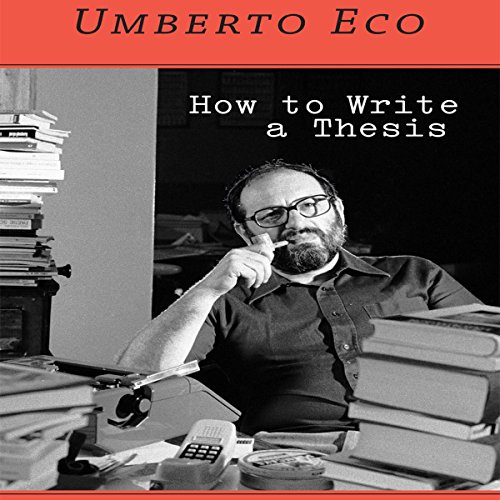
How to Write a Thesis
Summary
By the time Umberto Eco published his best-selling novel The Name of the Rose, he was one of Italy's most celebrated intellectuals, a distinguished academic and the author of influential works on semiotics. Some years before that, in 1977, Eco published a little book for his students, How to Write a Thesis, in which he offered useful advice on all the steps involved in researching and writing a thesis - from choosing a topic to organizing a work schedule to writing the final draft. Now in its 23rd edition in Italy and translated into 17 languages, How to Write a Thesis has become a classic. Remarkably, this is its first, long overdue publication in English. Eco's approach is anything but dry and academic. He not only offers practical advice, but also considers larger questions about the value of the thesis-writing exercise. How to Write a Thesis is unlike any other writing manual. It sounds like a novel. It is opinionated. It is frequently irreverent, sometimes polemical, and often hilarious. Eco advises students how to avoid "thesis neurosis", and he answers the important question "Must You Read Books?" He reminds students "You are not Proust" and "Write everything that comes into your head, but only in the first draft". Of course, there was no Internet in 1977, but Eco's index card research system offers important lessons about critical thinking and information curating for students of today who may be burdened by Big Data.
©2015 Massachusetts Institue of Technology (P)2015 Gildan Media LLC

The Island of the Day Before
Summary
After a violent storm in the South Pacific in the year 1643, Roberto della Griva finds himself shipwrecked. Swept from the Amaryllis, he has managed to pull himself aboard the Daphne, anchored in the bay of a beautiful island surrounded by treacherous coral reefs. The ship is fully provisioned, he discovers, but the crew is missing. As Roberto explores the vessel and descends into madness, he remembers chapters from his youth: Ferrante, his imaginary evil brother; the siege of Casale, that meaningless chess move in the 30 Years' War in which he lost his father and his illusions; the Aristotelian metaphor machine of Padre Emanuele; the salons of Paris; the theory of the Powder of Sympathy; the approach of his unapproachable Lady, then prison; and finally, the summons of Cardinal Mazarin himself. In this fascinating, lyrical tale, Umberto Eco tells of an international race to master the seas by unraveling the mysteries of longitude; of a young dreamer searching for love and meaning; and of a most amazing old Jesuit who, with his clocks and maps, has plumbed the secrets of longitude, the depths of the ocean, and the Biblical Flood.
©1994 R.C.S. Libri & Grandi Opere SpA-Milano; English Translation ©1995 Harcourt, Inc. (P)1995 Macmillan Audio

The Mysterious Flame of Queen Loana
Summary
Internationally best-selling author Umberto Eco is a master stylist whose books, including The Name of the Rose and Baudolino, have been savored by millions around the world. Now, with The Mysterious Flame of Queen Loana, Eco crafts another of the ambitious and breathtaking novels that are his trademark. When book dealer Yambo suffers amnesia, he loses all sense of who he is, but retains memories of all the books, poems, songs, and movies he has ever experienced. To reclaim his identity, he retreats to the family home and rummages through old letters, photographs, and mementos stored in the attic. Yambo's mind swirls with thoughts, and he struggles to retrieve the one memory that may be most sacred, that of Lila Saba, his first love. Steeped in nostalgia and filled with vivid, sometimes wondrous imagery, The Mysterious Flame of Queen Loana is a magnificent addition to Eco's literary legacy.
©2004 RCS Libri S.p.A. (P)2005 Recorded Books, LLC

The Beneficiary
Summary
A New York Times Notable Book of the Year "[A] poignant addition to the literature of moneyed glamour and its inevitable tarnish and decay...like something out of Fitzgerald or Waugh." (The New Yorker) A parable for the new age of inequality: part family history, part detective story, part history of a vanishing class, and a vividly compelling exploration of the degree to which an inheritance - financial, cultural, genetic - conspired in one person's self-destruction. Land, houses, and money tumbled from one generation to the next on the 800-acre estate built by Scott's investment banker great-grandfather on Philadelphia's Main Line. There was an obligation to protect it, a license to enjoy it, a duty to pass it on - but it was impossible to know in advance how all that extraordinary good fortune might influence the choices made over a lifetime. In this warmly felt tale of an American family's fortunes, journalist Janny Scott excavates the rarefied world that shaped her charming, unknowable father, Robert Montgomery Scott, and provides an incisive look at the weight of inheritance, the tenacity of addiction, and the power of buried secrets. Some beneficiaries flourished, like Scott's grandmother, Helen Hope Scott, a socialite and celebrated horsewoman said to have inspired Katherine Hepburn's character in the play and Academy Award-winning film The Philadelphia Story. For others, including the author's father, she concludes, the impact was more complex. Bringing her journalistic talents, light touch, and crystalline prose to this powerful story of a child's search to understand a parent's puzzling end, Scott also raises questions about our new Gilded Age. New fortunes are being amassed, new estates are being born. Does anyone wonder how it will all play out, 100 years hence?
©2019 Janny Scott (P)2019 Penguin Audio

Numero Zero
Summary
Lake Como, 1945. Mussolini and his mistress are captured and shot by local partisans. The precise circumstances of Il Duce's death remain shrouded in confusion and controversy. Milan, 1992. Colonna, a depressed hack writer, is offered a fee he can't refuse to ghostwrite a memoir. His subject: a fledgling newspaper financed by a powerful media magnate. As Colonna gets to know the team, he learns the paranoid theories of Braggadocio, who is convinced that Mussolini's corpse was a body double and part of a wider Fascist plot. It's the scoop he desperately needs. The evidence? He's working on it. Colonna is sceptical. But when a body is found stabbed to death in a back alley and the paper is shut down, even he is jolted out of his complacency. Fuelled by conspiracy theories, Mafiosi, love, corruption and murder, Numero Zero reverberates with the clash of forces that have shaped Italy since the Second World War. This gripping novel from the author of The Name of the Rose is told with all the power of a master storyteller.
©2015 RCS Libri S.p.A (P)2015 Random House AudioBooks