The Africa category has 68 audiobooks on Listento.it, with an average listener rating of 3.7★ across 63 ratings. The most-rated is King Leopold's Ghost.

Foreign Native
Summary
In Foreign Native, RW Johnson looks back with affection and humour on his life in Africa. From schooldays in Durban - fresh off the boat from Merseyside - to later years as an academic, director of the Helen Suzman Foundation and formidable political commentator, he has produced an entertaining and occasionally eye-popping memoir brimming with history, anecdote and insight. Johnson charts his evolution from enthusiastic, left-leaning Africanist to political realist, relating the episodes that influenced his intellectual worldview, including time spent among the exiled liberation movements in London during the 1960s, a sojourn in newly independent Guinea and more recent forays into Zimbabwe. There are wonderful stories, some hilarious, others filled with pathos, about the multitude of characters - Harold Strachan, Tom Sharpe, Ronnie Kasrils, Helen Suzman, Frederik van zyl Slabbert, among many others that he met along the way. Perceptive, critical and full of verve, Foreign Native is leavened with a deep humanity that makes it a pleasure to listen to.
©2020 Jonathan Ball Publishing (P)2020 Audible, Ltd

The Congo Free State
Summary
King Leopold II of Belgium emerges from the pages of history as a curious character. He was a member of a privileged clique of European monarchs, bereft of power but rich, indulgent, and indolent. Leopold certainly availed himself of all the pleasures of court life, but he was also shrewd, astonishingly competent, and avaricious to an almost unimaginable degree. His initial interest in foreign real estate was imperial, insofar as he desired on behalf of Belgium the main accoutrements of a first-rate power, which were, of course, foreign estates and colonies. He was, however, unable to move the Belgian parliament to act in accordance, the conservative belief perhaps being that Belgium could not afford to compete on that level. Belgium was a small European nation, existing between major and, at times, belligerent powers, and as such, it quietly went about its business with a determination not to rock the European boat. Displaying enormous ability and a masterful grasp of diplomatic maneuver, Leopold was able to secure primary rights over the territory of the Congo River catchment, a portion of the globe more than three times the size of France. By any standards, this was a monumental coup, and by the time the other European powers woke up to precisely what was underway, it was too late the arrest the momentum. Of all the issues on the agenda as delegates gathered in Berlin in 1884, foremost was the Congo question. The matter was debated, and although deeply troubled by the potential consequences, recognition was eventually afforded to Leopold's claim to the Congo.
©2017 Charles River Editors (P)2017 Charles River Editors

Cat and Mouse on the Niger
Summary
"They have soldiers. We only have arguments." (French Foreign Minister Théophile Delcassé) Near the end of the 19th century, Otto von Bismarck, the German chancellor, brought the plenipotentiaries of all major powers of Europe together to deal with Africa's colonization in such a manner as to avoid provocation of war. This event, known as the Berlin Conference of 1884-1885, galvanized a phenomenon that came to be known as the Scramble for Africa. The conference established two fundamental rules for European seizure of Africa. The first of these was that no recognition of annexation would be granted without evidence of a practical occupation and the second, that a practical occupation would be deemed unlawful without a formal appeal for protection made on behalf of a territory by its leader - a plea that must be committed to paper in the form of a legal treaty. This began a rush, spearheaded mainly by European commercial interests in the form of chartered companies, to penetrate the African interior and woo its leadership with guns, trinkets, and alcohol, and having thus obtained their marks or seals upon spurious treaties, begin establishing boundaries of future European African colonies. The ease with which this was achieved was due to the fact that, at that point, traditional African leadership was disunited, and the people had just staggered back from centuries of concussion inflicted by the slave trade. Thus, to usurp authority, intimidate an already broken society, and play one leader against the other was a diplomatic task so childishly simple, the matter was wrapped up, for the most part, in less than a decade. Even at that stage, however, the countries would keep jostling for position in Africa against each other, attempting to snap up more land and consolidate it. As such, the scramble kept going at a fevered pitch until the outbreak of World War I. When they entered the negotiations in Berlin in 1884, the French were established in their flagship African territory of Senegal, situated at the westernmost point of continental Africa, which tended to give them an option over the vast reaches of the western continent so far unclaimed by any territory. The history of French engagement in Senegal can be traced back to 1677, with the French acquisition of a slave port on the island of Gorée, today a cantonment of the Senegalese capital of Dakar. From there, the French were apt to gaze across the vast expanse of unclaimed territory to their minor enclave of French Somaliland, founded between 1883 and 1887, and which would, in the post-independence era, become the state of Djibouti. The French imperial vision, therefore, became the establishment of French sovereignty over everything in between these two points, including, if possible, Egypt. That obviously clashed with British objectives. As the British were working to establish a route from Cape Town in South Africa to Cairo in Egypt, the French were seeking to connect Dakar to Djibouti. If lines were drawn on the map to connect those places, the lines would intersect around the Sudanese river port of Kodok, which, during the imperial era, was known as Fashoda. The sequence of events across Africa would lead to a dramatic confrontation between a French expedition and British soldiers at Fashoda in 1898, and what happened there would help determine the boundaries of colonial Africa for the next several decades. Cat and Mouse on the Niger: The History of the Competition Between the British and French for Control of the Niger River chronicles the competition between both nations as they sought to make inroads on the African continent.
©2020 Charles River Editors (P)2020 Charles River Editors

Lost Souls: The Forgotten Heroes of Eshowe
Summary
In January 1879, three columns of British soldiers under the command of Lord Chelmsford, commenced the invasion of the Zulu Kingdom. The southern No. 1 Column led by Colonel Charles Pearson advances on the old mission station at Eshowe. Their intent is to establish a fort and supply depot from which to support the centre No. 3 Column’s advance on the Zulu royal kraal at Ulundi. As the vast column of British soldiers and their African allies slogs its way across the coastal hills, the incessant rain and threat of typhoid promise to be as fearful a nemesis as the lurking armies of Zulu warriors. Unbeknownst to Pearson, calamity struck a hundred miles to the north when nearly half of No. 3 Column is destroyed during a catastrophic battle at a mountain called Isandlwana. Despite the garrison at Rorke’s Drift subsequent repelling of the Zulu onslaught, the entire invasion is left in tatters. Over a thousand imperial soldiers now lie dead, in a war which the Crown never authorised or wanted. Over the coming days, the Zulus surround the fort at Eshowe, cutting off all communications and resupply efforts. With the British Empire now reluctantly committed to war, reinforcements are dispatched from England. In a race against time, Lord Chelmsford rallies the arriving forces into a relief column. Should they fail to break through to Eshowe and relieve the garrison, Colonel Pearson and another thousand British soldiers will suffer the same fate as the poor souls whose bodies still lie unburied along the slopes of Isandlwana.
©2018 James M Mace (P)2018 James M Mace
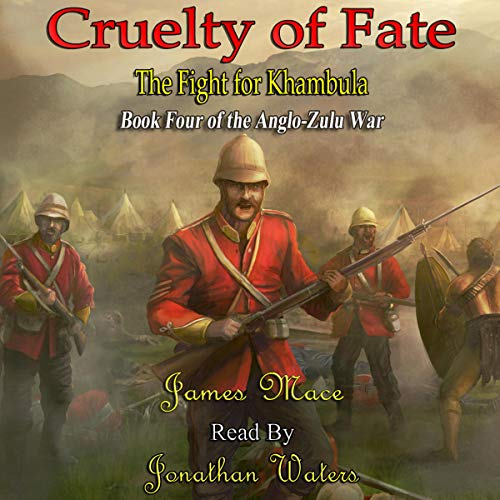
Cruelty of Fate: The Fight for Khambula
Summary
In late January 1879, following news of the terrible disaster to befall British forces at Isandlwana, Colonel Henry Evelyn Wood, commanding officer of the northern No. 4 Column, withdraws his forces to Khambula, near the Natal and Transvaal borders. Adding to their woes, the southern No. 1 Column finds itself trapped under siege at the abandoned mission station of Eshowe. The general officer commanding, Lord Chelmsford, orders Wood to continue harassing the Zulus, keeping the pressure off their central and southern forces while he rallies reinforcements to relieve Eshowe. In light of the disaster at Isandlwana, Wood knows he must temper aggression with caution, as he does not have the numbers necessary to face the entire Zulu amabutho. Facing the British in the north are the semi-autonomous abaQulusi tribe and their venerable ally, an exiled Swazi prince named Mbilini. A master of guerrilla warfare, Mbilini harries the British invaders relentlessly while awaiting reinforcements from the Zulu king, Cetshwayo. Fifty miles to the east, at the royal kraal of Ulundi, Cetshwayo’s triumphant albeit terribly bloodied regiments return home to take in the harvest following their victory at Isandlwana. The king’s subsequent overtures of peace are soundly rebuffed by Lord Chelmsford, and he knows he must soon summon his regiments once again. With shouts of "we are the boys of Isandlwana!" the Zulus turn their attention north, seeking to join with Mbilini and send another British invasion column to oblivion.
©2019 James M Mace (P)2019 James M Mace

Morocco: Essential Travel Tips
Summary
In this Sam's Travel Guide on Morocco, you will find all the information you need to know: Things you must know about Morocco Best places to visit in Morocco Famous architectural wonders to visit in Morocco Best beaches in Morocco Souvenirs you must buy in Morocco Most popular night destinations in Morocco Best restaurants in Morocco Most luxurious hotels in Morocco Local dishes you must try in Morocco Things to avoid in Morocco When you download Morocco: Essential Travel Tips - All You Need to Know, you will be well-prepared to visit the country of your dreams! Buy this audiobook today! Would you like to start today? If you do, just scroll up and hit the "Buy Now" button. Enjoy Sam's Travel Guides!
©2019 Sam's Travel Guide (P)2019 Sam's Travel Guide

Three Days in January: An Anatomy of Rebellion
Summary
On 23 January 1915, a native rebellion broke out in the British Protectorate of Nyasaland, the future nation-state of Malawi. The leader of the uprising was a black Baptist priest by the name of John Chilembwe. The John Chilembwe Uprising has generally been credited with setting in motion the modern African liberation movement. In this edition of the Peter Baxter African History Series, we examine the episode in detail, plotting the genesis of the African liberation movement through the growth of independent, black churches at the turn of the century. This is another fascinating episode of African history, essential listening for the international history enthusiast.
©2019 Peter Baxter (P)2019 Peter Baxter

Before the Revolution
Summary
America began, we are often told, with the Founding Fathers, the men who waged a revolution and created a unique place called the United States. We may acknowledge the early Jamestown and Puritan colonists and mourn the dispossession of Native Americans, but we rarely grapple with the complexity of the nation’s pre-revolutionary past. In this pathbreaking revision, Daniel Richter shows that the United States has a much deeper history than is apparent - that far from beginning with a clean slate, it is a nation with multiple pasts that stretch back as far as the Middle Ages, pasts whose legacies continue to shape the present. Exploring a vast range of original sources, Before the Revolution spans more than seven centuries and ranges across North America, Europe, and Africa. Richter recovers the lives of a stunning array of peoples - Indians, Spaniards, French, Dutch, Africans, English - as they struggled with one another and with their own people for control of land and resources. Their struggles occurred in a global context and built upon the remains of what came before. Gradually and unpredictably, distinctive patterns of North American culture took shape on a continent where no one yet imagined there would be nations called the United States, Canada, or Mexico. By seeing these trajectories on their own dynamic terms, rather than merely as a prelude to independence, Richter’s epic vision reveals the deepest origins of American history.
©2012 Dr. Daniel Richter (P)2012 Gildan Media LLC

Greater Than a Tourist: Livingstone, Zambia, Africa
Summary
Are you excited about planning your next trip? Do you want to try something new? Would you like some guidance from a local? If you answered yes to any of these questions, then this Greater Than a Tourist travel guide is for you. Greater Than a Tourist: Livingstone, Zambia, Africa by Lillian M. Simwanza offers the inside scoop on Livingstone City, in Zambia, Africa. Most travel guides tell you how to travel like a tourist. Although there is nothing wrong with that, as part of the Greater Than a Tourist series, this guide will give you travel tips from someone who has lived at your next travel destination. You will discover advice that will help you throughout your stay. This guide will not tell you exact addresses or store hours but instead will give you excitement and knowledge from a local that you may not find in other travel guides. Travel like a local. Slow down, stay in one place, and get to know the people and the culture. By the time you finish this guide, you will be eager and prepared to travel to your next destination.
©2017 CZYK Publishing LLC (P)2018 CZYK Publishing LLC

Mythology
Summary
Introducing: A mythology trilogy From the creator of the Captivating History Series. This audiobook includes three captivating manuscripts: Greek Mythology: A Fascinating Guide to Understanding the Ancient Greek Religion with Its Gods, Goddesses, Monsters, and Mortals Norse Mythology: A Fascinating Guide to Understanding the Sagas, Gods, Heroes, and Beliefs of the Vikings Egyptian Mythology: A Fascinating Guide to Understanding the Gods, Goddesses, Monsters, and Mortals The first part of this audiobook will explore Greek heroes, what they were like and what they accomplished. Furthermore, the audiobook will tackle Greek religion, and the gods and goddesses which establish the backdrop against which Greek legends were formed. We will also take a close look at the myths of Greek monsters. The second part of this audiobook is jam-packed with fascinating facts and stories of Norse mythology. For instance, part two covers all that you need to know about the nine realms, as well as captivating tales of Odin, Thor, Loki, and Ragnar. In the third part of this audiobook, we will start by looking at the gods and goddesses of Kemet -ancient Egypt. Then, we will turn our attention to the monsters which likely gave them nightmares, and humbled them in their quest to bring order to the world around them. Listen to this audiobook now and discover captivating stories of Gods, Goddesses, Monsters, and Mortals.
©2017 Matt Clayton (P)2017 Matt Clayton

Greater Than a Tourist: Nakuru Kenya
Summary
Are you excited about planning your next trip? Do you want to try something new? Would you like some guidance from a local? If you answered yes to any of these questions, then this Greater Than a Tourist audiobook is for you. Greater Than a Tourist: Nakuru, Kenya by Weldon Ngetich is a handy tool belt for any traveler. It provides listeners with important details of Nakuru, Kenya, a tourist destination from a local’s perspective, and it awakens their senses to the wildness of Africa safari that awaits them. Most travel audiobooks tell you how to travel like a tourist. Although there is nothing wrong with that, as part of the Greater Than a Tourist series, this audiobook will give you travel tips from someone who has lived at your next travel destination. You will discover advice that will help you throughout your stay. This audiobook will not tell you exact addresses or store hours but instead will give you excitement and knowledge from a local that you may not find in other smaller travel audiobooks. Travel like a local. Slow down, stay in one place, and get to know the people and the culture. By the time you finish this audiobook, you will be eager and prepared to travel to your next destination.
©2019 CZYK Publishing (P)2019 CZYK Publishing

Ethiopia and the Origin of Civilization
Summary
The history of Ethiopia could also be called the history of humanity. The question is not if this history is well documented, but why it is not thought widely in schools. The time necessary to study the tomes that refer to the Nubians as the forebearers of our civilization is enormous. The world owes Ethiopia for its history, astronomy, agriculture and all the other sciences, and John G. Jackson gave ample references to validate this claim. Ethiopia’s history is incredible and a treasure to the world and it is a shame that it has been distorted by the persistent Eurocentrism.
©2019 John G. Jackson (P)2019 HN Publishing

Tears of the Dead: Requiem of the Zulu Kingdom
Summary
In the aftermath of the Battles of Khambula and Gingindlovu, a lull fell over the war-torn Zulu Kingdom. Though British forces under Lord Chelmsford emerged victorious during both encounters, earlier defeats, casualties, and supply shortages required them to withdraw back into Natal. Now with waves of long-awaited reinforcements arriving, Chelmsford prepares to launch a second invasion of Zululand. Death and destruction have taken their toll on the Zulu people. Thousands of families mourn for their loved ones, while refugees flee from the devastation of the border regions. Despite the defeats and fearful losses, King Cetshwayo, who never wanted war in the first place, takes heart in knowing that, strategically, his enemies were compelled to retreat from his lands. He hopes this will allow him to come to terms with the British before Chelmsford can renew the war in earnest. Unbeknownst to the king, Lord Chelmsford has received word from London that he is to be replaced by General Sir Garnet Wolseley. His lordship is determined to expedite the invasion and utterly crush Cetshwayo’s forces at any cost, denying Wolseley the chance to usurp him before he can expunge the humiliation that has lingered since the dark days following the defeat at Isandlwana.
©2019 James M. Mace (P)2020 James M. Mace

A Popular Account of Dr. Livingstone to the Zambesi and its Tributaries
Summary
Livingstone's first book revolutionized the way European readers saw Africa and made him a hero in England. He returned again to the Zambesi with his brother Charles and others, this time with more equipment and funds. Again he faced hippopotami, crocodiles, impossible terrain, and disease, but his greatest enemies on this trip prove to be human. The British eventually lost faith in the expedition, but Livingstone proved in the end to have had tremendous foresight. He doesn't romanticize, but he is often poetic in this account.
Public Domain (P)2010 Audible, Inc.

The rise and fall of the Ethiopian Empire
Summary
The founder of Ethiopia (or Abyssinia) and the founder of the Imperial dynasty are held to be Menelik I, son of Solomon, King of Israel, and of Makeda, the Queen of Sheba. According to legend, the brother Kings Ella Abrecha and Ella Asbeha, together with their mother, were converted to Christianity by the Coptic monk Frumentius of Alexandria in 330 AD. Their successor, King Kaleb, considerably expanded the kingdom to include parts of South Arabia. However, the state came under increasing pressure from the expanding Islamic world, gradually being pushed back into the interior of Ethiopia. The Solomonic dynasty lost power to the Zagwe dynasty of Lasta from 1117 until 1268. The former being confined to their traditional fiefs in Showa. According to legend, the Ethiopian Saint Takla Haymanot persuaded Emperor Nakuto Le-Ab to relinquish power in favour of Tasfa Iyasus, a descendant of the Solomonic dynasty.
©2013 Henry Epps (P)2013 Henry Epps

Doctor David Livingstone and Bishop Charles Mackenzie
Summary
This story deals with the first great and documented humanitarian tragedy in African history. The East African slave trade, the lesser known of the two branches of the African slave trade, flourished in virtual anonymity as the attention of the world was focused on the abolition of the Atlantic slave trade and the destruction of slavery in the Western hemisphere. Doctor David Livingstone, the great Victorian missionary explorer, devoted his life to witnessing and publicizing this grotesque African trade. The Universities Mission to Central Africa was the first orchestrated intervention in the South-Central African region, and it is a cautionary tale for centuries of similar efforts to follow.
©2019 Peter Baxter (P)2019 Peter Baxter

Mandela: An Audio History
Summary
Audie Award, Audiobook of the Year, 2015 Recognized as one of the most comprehensive oral histories of apartheid ever broadcast (NPR, BBC, CBC, SABC), Mandela: An Audio History tells the story of the struggle against apartheid through rare sound recordings. The series weaves together more than 50 first-person interviews with an unprecedented collection of archival sound: a rare recording of the 1964 trial that resulted in Mandela's life sentence; a visit between Mandela and his family secretly taped by a prison guard; marching songs of guerilla soldiers; government propaganda films; and pirate radio broadcasts from the African National Congress (ANC). Once thought lost forever, Radio Diaries producer Joe Richman unearthed a treasure trove of these historic recordings in the basement archive of the South African Broadcasting Corporation. Ultimately, over 50 hours of archival recordings and many more hours of contemporary interviews with the living witnesses to South Africa's turbulent history have gone into the creation of one of the most moving audio documentaries ever produced. Includes a commemorative 32-page booklet featuring historic photos and a complete transcript of the audio program.
©2004 Original Material © 2004-2014 Radio Diaries, Inc. Packaging © 2014 HighBridge Company. (P)2014 2014 Radio Diaries, Inc.

Mythology: African Myths, Gods, Heroes, and Legends
Summary
As you study the African myths, legends, and folklore through this guide, you will find that there are so many gods and goddesses, and so many different versions of certain stories, that it will blow your mind. The intricate myths in this book have been lined up and collected to help you understand some of the earliest, most ancient beliefs from those living on the African continent. Some have been influential in our day, and some have been completely forgotten except for vague traditions that have been passed on from one generation to the next. Hear about the creation of the universe, plants, animals, and finally, the woman first and the man second (how ironic). You’ll find out what significance a tortoise made in one particular African myth, why and how the sex goddess was worshipped and feared, which historical and cultural facts helped the Africans believe in these things, and how some of these customs have been introduced in our modern-day culture.Begin today and find out more about these fascinating facts and myths!
©2019 Ron Carver (P)2019 Ron Carver

With Open Arms
Summary
When Matthew had to renew his European visa, his point of exit was obvious: he was going to Morocco. Memories of his previous trip filled him with anxiety. What was he thinking? After everything that had happened, did he really want to go back? Scams. Altercations. Mishaps. But also humor and beauty. His curiosity overcoming his fears, his second trip would prove as unforgettable as the first. "My reflexes belatedly kicking in, I couldn't help but flinch. The children cheered, relishing having reduced me to their plaything." "Our little spectacle having brought the night market to a standstill, we were now surrounded by about 50 men. I was living the chaotic mob scene from so many movies, and it was every bit as nightmarish as it had always looked on-screen." "As I was about to let out a desperate cry that would require no translation, the giant finished...leaving me flinching on the floor like a bug that's been smashed but isn't quite dead." "Amidst astonishingly beautiful, unsullied waves of sand, a lone figure squatted, holding a roll of toilet paper. It was a peculiar, paradoxical sight." An Amazon.com best-selling collection of travel writing as entertaining for the armchair traveler as indispensable for anyone interested in adventure in North Africa.
©2015 Matthew Félix (P)2018 Matthew Félix

The African Rulers of Medieval Yemen
Summary
What is more impressive: to become a king having come from a long lineage of kings, or to become a king having come from a long lineage of the enslaved? In the ninth and 10th centuries, enslaved East Africans were brought to the Ziyadid kingdom of Yemen. By the later 10th century they had become the prime ministers of the kingdom. One of the last such prime ministers formed a dynasty that was to last for almost a 150 years, repeatedly bouncing back from the political intrigue of their Arab neighbours. Zabid was the capital from which they ruled, and is today a UNESCO World Heritage site. They were renowned builders and protectors of the architectural heritage of Yemen. The African Rulers of Medieval Yemen is a book that tells a little known part of the history of Africans in Asia, and of slavery as a whole. While telling this story it also bravely asserts that enslaved foreigners have earned the moral right to rule any land which they have helped to build. It also looks at the various attitudes that Arabs had towards Africans, and how the latter managed to literally rise above them. A must-listen for those interested in an African history that stands tall and bows to none.
©2012 Gert Muller (P)2015 Gert Muller