The Africa category has 68 audiobooks on Listento.it, with an average listener rating of 3.7★ across 63 ratings. The most-rated is King Leopold's Ghost.
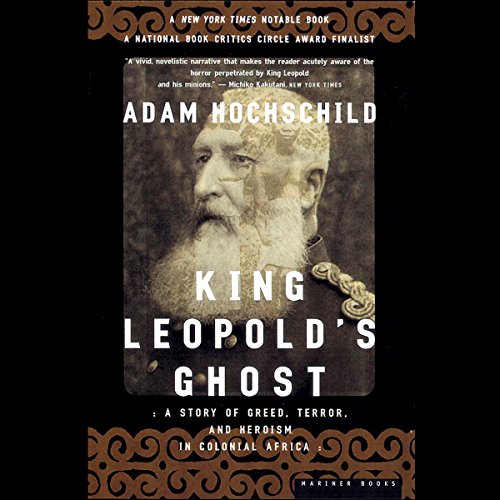
King Leopold's Ghost
Summary
In the late 1890s, Edmund Dene Morel, a young British shipping company agent, noticed something strange about the cargoes of his company's ships as they arrived from and departed for the Congo, Leopold II's vast new African colony. Incoming ships were crammed with valuable ivory and rubber. Outbound ships carried little more than soldiers and firearms. Correctly concluding that only slave labor on a vast scale could account for these cargoes, Morel resigned from his company and almost singlehandedly made Leopold's slave-labor regime the premier human rights story in the world. Thousands of people packed hundreds of meetings throughout the United States and Europe to learn about Congo atrocities. Two courageous black Americans - George Washington Williams and William Sheppard - risked much to bring evidence to the outside world. Roger Casement, later hanged by Britain as a traitor, conducted an eye-opening investigation of the Congo River stations. Sailing into the middle of the story was a young steamboat officer named Joseph Conrad. And looming over all was Leopold II, King of the Belgians, sole owner of the only private colony in the world.
©1998 Adam Hochschild (P)2010 Random House

South Africa: History in an Hour
Summary
With the passing of Nelson Mandela, ‘the father of the nation’, comes the end of an era, and the moment to look back on his remarkable saving, and remaking, of South Africa. After years of oppression and racial inequality, concentrated violence and apartheid, Mandela led the country to unite ‘for the freedom of us all’ as the country’s first black President. South Africa: History in an Hour gives a lively account of the formation of modern South Africa, from the first contact with seventeenth-century European sailors, through the colonial era, the Boer Wars, apartheid and the establishment of a tolerant democracy in the late twentieth century. Here is a clear and fascinating overview of the emergence of the ‘Rainbow Nation’. Know your stuff: read about South African history in just one hour.
©2012 Anthony Holmes (P)2012 HarperCollins Publishers Limited

Brutal Valour: The Tragedy of Isandlwana
Summary
It is December 1878, and war looms on the horizon in South Africa. British high commissioner Sir Henry Bartle-Frere seeks to dismantle the powerful neighboring kingdom of the Zulus and uses an incursion along the disputed border as his justification for war. He issues an impossible ultimatum to the Zulu king, Cetshwayo, demanding he disband his armies and pay massive reparations. With a heavy heart, the king prepares his nation for war against their former allies. Leading the invasion is Lieutenant General Sir Frederic Thesiger, Baron Chelmsford, a highly experienced officer fresh off a decisive triumph over the neighboring Xhosa tribes. He and Frere are convinced that a quick victory over the Zulus will negate any repercussions from the home government for launching what is, in essence, an illegal war. Recently arrived to South Africa are newly recruited privates Arthur Wilkinson and Richard Lowe, members of C Company, 1/24th Regiment of Foot under the venerable Captain Reginald Younghusband. Eager for adventure, they are prepared to do their duty both for the empire and for their friends. As Frere's ultimatum expires, the army of British redcoats and allied African auxiliaries crosses the uMzinyathi River at Rorke's Drift into Zululand. Ten days later the British and Zulus will meet their destiny at the base of a mountain called Isandlwana.
©2016 James M. Mace (P)2017 James M. Mace

White Gold
Summary
In the summer of 1716, a Cornish cabin boy named Thomas Pellow and 52 of his comrades were captured at sea by the Barbary corsairs. Their captors, fanatical Islamic slave traders, had declared war on the whole of Christendom. Thousands of Europeans had been snatched from their homes and taken in chains to the great slave markets of Algiers, Tunis and Sale in Morocco to be sold to the highest bidder. White Gold is an extraordinary and shocking story. Drawn from unpublished letters and manuscripts written by slaves, and by the padres and ambassadors sent to free them, it reveals a disturbing and forgotten chapter of history, told with all the pace and verve of one of our finest historians.
©2004 Giles Milton (P)2005 Hodder & Stoughton Audiobooks

The Slave Ship
Summary
For more than three centuries, slave ships carried millions of people from the coasts of Africa across the Atlantic to the New World. Much is known of the slave trade and the American plantation complex, but little of the ships that made it all possible. In The Slave Ship, award-winning historian Marcus Rediker draws on 30 years of research in maritime archives to create an unprecedented history of these vessels and the human drama acted out on their rolling decks. He reconstructs in chilling detail the lives, deaths, and terrors of captains, sailors, and the enslaved aboard a "floating dungeon" trailed by sharks. From the young African kidnapped from his village and sold to the slavers by a neighboring tribe, to the would-be priest who takes a job as a sailor on a slave ship only to be horrified by the evil he sees, to the captain who relishes having "a hell of my own", Rediker illuminates the lives of people who were thought to have left no trace. This is a tale of tragedy and terror, but also an epic of resilience, survival, and the creation of something entirely new, something that could only be called African American. Rediker restores the slave ship to its rightful place alongside the plantation as a formative institution of slavery, as a place where a profound and still haunting history of race, class, and modern capitalism was made.
©2007 Marcus Rediker (P)2007 Tantor Media Inc.

The Garden of Mars
Summary
A journey - both historical and contemporary - among the fantastical landscapes, beguiling creatures and isolated tribes of the world's fourth island: Madagascar. An improbable world beckons. We think we know Madagascar, but it's too big, too eccentric and too impenetrable to be truly understood. If it was stretched out across Europe, the islands would reach from London to Algiers, and yet its road network is barely bigger than tiny Jamaica's. There is no evidence of any human life until about 10,000 years ago, and, when eventually people settled, it was migrants from Borneo - 3,700 miles away - who came out on top. As well as visiting every corner of Madagascar, John Gimlette journeys deep into its past in order to better understand how Madagascar became what it is today. Along the way, he meets politicians, sorcerers, gem prospectors, militiamen, rioters, lepers and the descendants of 17th-century pirates.
©2021 John Gimlette (P)2020 Head of Zeus Ltd

Rough Crossings
Summary
"The most dramatic account so far of the extraordinary expeience of slaves in and after the American Revolution.... Schama's gift for plunging us into the very center of the action makes reading an exhilarating and often moving experience." (Daily Telegraph) If you were black in America at the start of the Revolutionary War, whom would you want to win? In response to a declaration by the last governor of Virginia that any rebel-owned slave who escaped and served the King would be emancpated, tens of thousands of blacks voted with feet, escaping to fight beside the British. Originally designed to break the plantations of the American South, this military strategy instead unleashed one of the great exoduses in American history. Told in the voices of the slaves and the white abolitionists who aided them, Simon Schama vividly details the odyssey of these escaped blacks, shedding light on an extraordinary chapter in America's birth.
©2006 Simon Schama (P)2006 HarperCollins Publishers, Inc.

The Travels of Reverend Olafur Egilsson
Summary
In the summer of 1627, Barbary corsairs raided Iceland, killing dozens of people and abducting close to 400 to sell into slavery in Algiers. Among those taken was the Lutheran minister Reverend Olafur Egilsson. Reverend Olafur wrote The Travels to chronicle his experiences both as a captive and as a traveler across Europe (he journeyed alone from Algiers to Copenhagen in an attempt to raise funds to ransom the Icelandic captives who remained behind). He was a keen observer, and the narrative is filled with a wealth of detail - social, political, economic, religious - about both the Maghreb and Europe. It is also a moving story on the human level: we witness a man enduring great personal tragedy and struggling to reconcile such calamity with his understanding of God. The Travels is the first-ever English translation of the Icelandic text. Until now, the corsair raid on Iceland has remained largely unknown in the English-speaking world. "It is wonderful that finally two scholars have taken the initiative to translate into English this important text." (Kirsten Wolf, University of Wisconsin-Madison)
©2008 Karl Smari Hreinsson and Adam Nichols (P)2018 Redwood Audiobooks

Apartheid in South Africa: The History and Legacy of the Notorious Segregationist Policies in the 20th Century
Summary
Although apartheid is typically dated from the late 1940s until its dismantling decades later, segregationist policies had been the norm in South Africa from nearly the moment European explorers sailed to the region and began settling there. Whether it was displacing and fighting indigenous groups like the Khoi and San, or fighting other whites like the Boer, separation between ethnicities was the norm in South Africa for centuries before the election of Malan signaled the true rise of the Afrikaner far right. The man most associated with dismantling apartheid, of course, is Nelson Mandela. With the official policy of apartheid instituted in 1948 by an all-white government, Mandela was tried for treason between the years of 1956-61 before being acquitted. He participated in the Defiance Campaign of 1952, and oversaw the 1955 Congress of the People, but when the African National Congress was banned in 1960, he proposed a military wing, despite his initial reluctance toward violent resistance, a reluctance which had its roots in original nonviolent protests through the South African Communist Party. The ANC did not openly discourage such an idea, and the Umkhonto we Sizwe was established. Mandela was again arrested in 1962 and tried for attempts to overthrow the government by violence. The sentence was five years of hard labor, but this was increased to a life sentence in 1964, a sentence handed down to seven of his closest colleagues as well. Mandela would eventually serve 27 years, but his statements made in court received enormous international coverage and acclaim, and his reputation grew during his time in Robben Island Prison of Capetown, the Pollsmoor and Victor Verster Prisons. He was ultimately released in February 1990, in large part as a result of the international campaign generated by his words and the current South African story. Shortly after that, he was elected as the first man of African descent to the presidency of South Africa, which he held from 1994–1999. Most significant was that Mandela was elected from the first multi-factional, multi-racial election ever held in the country, a result of extensive negotiations with then President F.W. Klerk. Apartheid in South Africa: The History and Legacy of the Notorious Segregationist Policies in the 20th Century looks at the controversial policies, the background behind them, and their influence on the country. Along with pictures and a bibliography, you will learn about apartheid in South Africa like never before.
©2019 Charles River Editors (P)2019 Charles River Editors

Crucible of Honour: The Battle of Rorke's Drift
Summary
It is January of 1879. While three columns of British soldiers and their African allies cross the Uminyathi River to commence the invasion of the Zulu Kingdom, a handful of redcoats from B Company, 2/24th Regiment are left to guard the centre column's supply depot at Rorke's Drift. On the morning of 22 January, the main camp at Isandlwana, just 10 miles to the east, comes under attack from the entire Zulu army and is utterly destroyed. Four thousand warriors from King Cetshwayo's elite Undi Corps remained in reserve and were denied any chance to take part in the fighting. Led by Prince Dabulamanzi, they disobey the king's orders and cross into British Natal, seeking their share in triumph and spoils. They soon converge on Rorke's Drift; an easy prize, with its paltry force of 150 redcoats to be readily swept aside. Upon hearing of the disaster at Isandlwana, and with retreat impossible, the tiny British garrison readies to receive the coming onslaught. Leading them is Lieutenant John Chard, a newly-arrived engineer officer with no actual combat experience. Aiding him is B Company's previously undistinguished officer commanding, Lieutenant Gonville Bromhead, along with 24-year old Colour Sergeant Frank Bourne, and a retired soldier-turned civilian volunteer named James Dalton. Unbeknownst to either the British or the Zulus, half of the center column, under Lord Chelmsford's direct command, was not even at Isandlwana, but 15 miles further east, at Mangeni Falls. However, with a huge Zulu force of over 20,000 warriors between them and the drift, their ammunition and ration stores taken or destroyed, and an impossible distance to cover, Chelmsford's battered column cannot possibly come to the depot's aid, and must look to their own survival. The defenders of Rorke's Drift stand alone.
©2017 James Mace (P)2017 James Mace

African Mythology
Summary
If you're looking for a captivating collection of African myths, then pay attention... The continent of Africa is home to 54 countries that together harbor over 3,000 cultures, each with their own ways of life and each with their own stories. Some of these stories have their origins in the folk beliefs of people native to their particular region, while others were imported from or influenced by cultures from elsewhere who settled in Africa. A great number of African folktales have been transmitted orally from person to person down through the ages, but since the 19th century, many stories have been written down and transmitted to audiences beyond the boundaries of the cultures that created them. One important - and tragic - conduit for the transmission of these stories beyond African shores was the European slave trade. Captured Africans who were brought to the Americas and the Caribbean fought to keep alive what they could of their home cultures, and this included their folktale traditions. African folktales come in many different types. Some are myths explaining the origins of things, while others are tales of heroes with supernatural abilities. Animal stories are many and varied, and they usually involve some kind of trickster who uses his wiles to get out of sticky situations and sometimes into them. There are also cautionary tales explaining why it is important to behave well and treat others with respect, while other stories have a style and shape similar to that of a fairy tale. In African Mythology: Captivating Myths of Gods, Goddesses, and Legendary Creatures of Africa, you'll find the following African myths and topics covered Animal tricksters Hero tales Cautionary tales The Influence of Isla And much, much more! So if you want a captivating collection of African myths, buy this audiobook today!
©2019 Matt Clayton (P)2020 Matt Clayton

Africa: African History from Ancient Egypt to Modern South Africa
Summary
What wove the African continent into the rich fabric of cultures and peoples that it is today? Where did ancient culture, trade, and civilization begin? How did the African people survive and thrive despite European colonization and apartheid? These are just some of the questions you’ll find answers to in Africa: African History from Ancient Egypt to Modern South Africa. Africa is a vast continent whose waters, fertile lands, minerals, and diverse wildlife nurtured humankind since ancient times until European colonization and exploitation caused immeasurable suffering and loss. To understand how Africa developed, thrived, suffered, and emerged into the rich tapestry of peoples that it is today, take a trip back to the ancient River Nile and the East African coast. Witness: The development of small settlements into three distinct cultures The Carthaginian Empire grow and flourish as an economic and commercial power The settlement of the Zimbabwe plateau and the construction of enormous stone cities The emergence of the Kingdom of Kongo and its expansion through peaceful trade and alliances The upheaval, atrocities, wars, and eventual stability created by European colonization The founding of the Congo Free State and the growth of forced labor to extract valuable resources from the land The decolonization of Africa and the return of territorial sovereignty and independence The forced racial segregation under apartheid and the birth of a new constitution that ended it The founding of the African Union to establish norms across the continent Start your study of the struggles and triumphs of the African people today with Africa: African History from Ancient Egypt to Modern South Africa.
©2017 Lean Stone Publishing (P)2017 Lean Stone Publishing

Boer War
Summary
This audiobook provides an introduction to one of the most intriguing wars of modern times - a war that saw several innovations, including the use of heliography and indirect fire, and caused the complete overhaul of the great Imperial British fighting machine in its aftermath. It also tells of the first example of the brilliant use of guerrilla warfare by the people who, to this day, have never been outclassed: the Boer commandos. However, the Boer War was also an intensely emotional journey cutting to the very core of the horror of war; leaving women and children in a deliberately destroyed landscape, watching their home and all their possessions burn to the ground. You will learn about the the causes of the war; the commando system; phase one; phase two; phase three; the concentration camps; a gentleman's war; and much more. This audiobook gives a broad overview so that the interested listener will be able to find a point of entry to study the war further. Perhaps studying and understanding this subject is the only way to ask the question: When is a war not a war?
©2018 Hourly History (P)2018 Hourly History

The Portuguese Empire and Africa
Summary
By the mid-15th century, the Byzantine Empire had collapsed and the various Crusades that had taken place in the region had largely disrupted the overland routes of the Silk Road and trade. Compounding the difficulties of trade was the rise of the Ottoman Empire in place of the Byzantines and the outbreak of the Black Death in Europe. Around this time, a period of European exploration began, and major factors that contributed to this period of exploration were introduced by the Chinese, albeit indirectly. The magnetic compass had already been developed and used by the Chinese sailors, the Song Dynasty then began using the device for land navigation in the 11th century. The technology slowly spread west via Arab traders, although a case can be made for the independent European creation for the compass (Southey 1812: 210). Trade was able to increase around the world due to more effective ships being introduced, which were first introduced by the Chinese. The introduction of multiple mast ships and the sternpost rudders allowed the ships to travel quicker and be more maneuverable, with a minimum number of crew aboard. The Portuguese started exploring the west coast of Africa and the Atlantic under orders from Prince Henry the Navigator. At this point, Europeans had not yet been capable of navigating completely around Africa, but the Portuguese continued pushing down the western African coast looking for ways to bypass the Ottomans and Muslims of Africa who had been making overland trade routes difficult. In 1451, Prince Henry the Navigator helped fund and develop a new type of ship, the caravel, that featured triangular lateen sails and would be able to travel in the open ocean and sail against the wind. In 1488, Bartholomew Diaz rounded the southern tip of Africa, named the Cape of Good Hope by King John of Portugal, and entered the Indian Ocean from the Atlantic. When it became clear Christopher Columbus hadn’t landed in Asia, it was understood by everyone that this was not necessarily the route the Europeans were searching for, and the Portuguese continued to send explorers around the Cape of Good Hope in an attempt to reach the East Indies. After a two-year voyage, in 1499, Vasco da Gama had successfully reached India and returned to Portugal. They had found access to the trade regions that they had been searching for, but it would require too many resources to travel with at once; Portugal began establishing a number of forts and trading posts along the route and were able to establish a fort on the west coast of India, Fort Manuel, in 1500, and in 1505 a fort was erected off the coast of Tanzania, thus beginning a trend of European colonization in Africa and Asia that would last for the next 400 years. This audiobook chronicles the early efforts by the Portuguese that helped initiate the Age of Exploration, and the ramifications the colonization had across the world.
©2019 Charles River Editors (P)2019 Charles River Editors

The East African Slave Trade
Summary
"It is certain that large numbers of slaves were exported from eastern Africa; the best evidence for this is the magnitude of the Zanj revolt in Iraq in the 9th century, though not all of the slaves involved were Zanj. There is little evidence of what part of eastern Africa the Zanj came from, for the name is here evidently used in its general sense, rather than to designate the particular stretch of the coast... to which the name was also applied." (Ghada Hashem Talhami, "The Zanj Rebellion Reconsidered", The International Journal of African Historical Studies) It has often been said that the greatest invention of all time was the sail, which facilitated the internationalization of the globe and thus ushered in the modern era. It was the sail that linked the continents of Africa, Asia, and Europe, and thus it was also the sail that facilitated the greatest involuntary human migration of all time. The transatlantic slave trade was founded by the Portuguese in the 15th century for the specific purpose of supplying the New World colonies with African slave labor. It was soon joined by all the major trading powers of Europe, and it reached its peak in the 18th century with the founding and development of plantation economies that ran from the South American mainland through the Caribbean and into the southern states of the United States. The East African Slave Trade, on the other hand, or the Indian Ocean Slave Trade as it was also known, was a far more complex and nuanced phenomenon, far older, significantly more widespread, rooted in ancient traditions, and governed by rules very different to those in the western hemisphere. It is also often referred to as the Arab Slave Trade, although this, specifically, might perhaps be more accurately applied to the more ancient variant of organized African slavery, affecting North Africa, and undertaken prior to the advent of Islam and certainly prior to the spread of the institution south as far as the south/east African coast. It also involved the slavery of non-African races. The African slave trade is a complex and deeply divisive subject that has had a tendency to evolve according the political requirements of any given age, and is often touchable only with the correct distribution of culpability. It has for many years, therefore, been deemed singularly unpalatable to implicate Africans themselves in the perpetration of the institution, and only in recent years has the large-scale African involvement in both the Atlantic and Indian Ocean Slave Trades come to be an accepted fact. There can, however, be no doubt that even though large numbers of indigenous Africans were liable, it was European ingenuity and greed that fundamentally drove the industrialization of the transatlantic slave trade in response to massive new market demands created by their equally ruthless exploitation of the Americas.
©2017 Charles River Editors (P)2017 Charles River Editors

Racism: Does It Still Exist?
Summary
It's not always easy to talk about race, racism, and prejudice. These are subjects that can really make people angry. What we sometimes forget is that we all have opinions. We don't all think alike, no matter what race we are. There are certain words that shouldn't be said aloud and jokes we shouldn't repeat because they can be very hurtful. This book is divided into four parts. The first part will deal with individual, personal stories of racism.
©2017 Marion W. McKenney (P)2017 Marion W. McKenney

The Jew a Negro
Summary
Abernethy’s 1910 book The Jew a Negro has been analyzed by numerous modern authors studying race relations in earlier times in America. Arthur Talmage Abernethy, PH. D., (1872 –1956) was a professor, Methodist pastor in New York and North Carolina, and a Democratic candidate for congress in North Carolina. He was a gifted speaker and author a score of historical books, as well as being the youngest son of the founder of Rutherford College. He was elected to the American Association for the Advancement of Science and became the poet laureate of North Carolina. For example, the 2006 Jewish Roots in Southern Soil: A New History notes: “One southern writer, the North Carolina minister Arthur T. Abernethy, published an entire book arguing that "the Jew of to-day is essentially Negro in habits, physical peculiarities and tendencies". In rare cases...Jews were...grouped with blacks." The 2006 book The Price of Whiteness: Jews, Race, and American Identity states: “Published in 1910 by the North Carolina minister and professor Arthur T. Abernethy, The Jew a Negro argued that ancient Jews had thoroughly mixed with neighboring African peoples, leaving little significant difference between the Jewish and Negro types. As the Jews migrated to more temperate climes, their skin lightened and they became successful, but their essential racial similarity to blacks remained unaltered."
Public Domain (P)2019 BN Publishing

Northern Rhodesia and Southern Rhodesia
Summary
The modern history of Africa was until very recently written on behalf of the indigenous races by the white man, who had forcefully entered the continent during a particularly hubristic and dynamic phase of European history. In 1884, Prince Otto von Bismark, the German chancellor, brought the plenipotentiaries of all major powers of Europe together to deal with Africa's colonization in such a manner as to avoid provocation of war. This event - known as the Berlin Conference of 1884-1885 - galvanized a phenomenon that came to be known as the Scramble for Africa. The conference established two fundamental rules for European seizure of Africa. The first of these was that no recognition of annexation would be granted without evidence of a practical occupation; and second, that a practical occupation would be deemed unlawful without a formal appeal for protection made on behalf of a territory by its leader, a plea that must be committed to paper in the form of a legal treaty. This began a rush, spearheaded mainly by European commercial interests in the form of chartered companies, to penetrate the African interior and woo its leadership with guns, trinkets, and alcohol, and having thus obtained their marks or seals upon spurious treaties, begin establishing boundaries of future European African colonies. The ease with which this was achieved was due to the fact that, at that point, traditional African leadership was disunited, and the people had just staggered back from centuries of concussion inflicted by the slave trade. Thus, to usurp authority, to intimidate an already broken society, and to play one leader against the other was a diplomatic task so childishly simple, the matter was wrapped up, for the most part, in less than a decade. There were some exceptions to this, however, the most notable of which was perhaps the Zulu Nation, a centralized monarchy of enormous military prowess that required a British colonial war, the storied Anglo-Zulu War of 1879, to affect pacification. Another was the amaNdebele, an offshoot of the Zulu, established as early as the 1830s in the southeastern quarter of what would become Rhodesia, and later still Zimbabwe, in the future. Both were powerful, centralized monarchies, fortified by an organized and aggressive professional army, subdivided into regiments, and owing fanatical loyalty to the crown. The Zulu were not dealt with by treaty, and their history is perhaps the subject of another episode of this series, but the amaNdebele were, and early European treaty and concession gatherers were required to tread with great caution as they entered their lands. It would be a long time before the inevitable course of history forced the amaNdebele to submit to European domination. Although treaties and British gunboat diplomacy played a role, it was ultimately war, conquest, and defeat in battle that brought the amaNdebele to heel.
©2020 Charles River Editors (P)2020 Charles River Editors

South Africa
Summary
The Boer War was the defining conflict of South African history and one of the most important conflicts in the history of the British Empire. Naturally, complicated geopolitics underscored it, going back centuries. In fact, the European history of South Africa began with the 1652 arrival of a small Dutch flotilla in Table Bay, at the southern extremity of the African continent, which made landfall with a view to establishing a victualing station to service passing Dutch East India Company (Vereenigde Oost-Indische Compagnie) ships. The Dutch at that point largely dominated the East Indian Trade, and it was their establishment of the settlement of Kaapstad, or Cape Town, that set in motion the lengthy and often turbulent history of South Africa. For over a century, the Cape remained a Dutch East India Company settlement, and in the interests of limiting expenses, strict parameters were established to avoid the development of a colony. As religious intolerance in Europe drove a steady trickle of outward emigration, however, Dutch settlers began to informally expand beyond the Cape, settling the sparsely inhabited hinterland to the north and east of Cape Town. In doing so, they fell increasingly outside the administrative scope of the Company, and they developed an individualistic worldview, characterized by self-dependence and self-reliance. They were also bonded as a society by a rigorous and literal interpretation of the Old Testament. In their wake, towards the end of the 17th century, followed a wave of French Huguenot immigrants, fleeing a renewal of anti-Protestantism in Europe. They were integrated over the succeeding generations, creating a hybridized language and culture that emerged in due course as the Cape Dutch, the Afrikaner or the Boer. South Africa: The History and Legacy of the Nation from European Colonization to the End of the Apartheid Era looks at the controversial history of the country, from the initial European explorers to the successful struggle to dismantle apartheid.
©2019 Charles River Editors (P)2019 Charles River Editors

The Republic of Zimbabwe
Summary
“The only white man you can trust is a dead white man.” (Robert Mugabe) The modern history of Africa was, until very recently, written on behalf of the indigenous races by the white man, who had forcefully entered the continent during a particularly hubristic and dynamic phase of European history. In 1884, Prince Otto von Bismark, the German chancellor, brought the plenipotentiaries of all major powers of Europe together to deal with Africa's colonization in such a manner as to avoid provocation of war. This event - known as the Berlin Conference of 1884-1885 - galvanized a phenomenon that came to be known as the Scramble for Africa. The conference established two fundamental rules for European seizure of Africa. The first of these was that no recognition of annexation would be granted without evidence of a practical occupation, and the second, that a practical occupation would be deemed unlawful without a formal appeal for protection made on behalf of a territory by its leader - a plea that must be committed to paper in the form of a legal treaty. Thus began a rush, spearheaded mainly by European commercial interests in the form of chartered companies, to penetrate the African interior and woo its leadership with guns, trinkets, and alcohol, and having thus obtained their marks or seals upon spurious treaties, begin establishing boundaries of future European African colonies. The ease with which this was achieved was due to the fact that, at that point, traditional African leadership was disunited, and the people had just staggered back from centuries of concussion inflicted by the slave trade. Thus, to usurp authority, to intimidate an already broken society, and to play one leader against the other was a diplomatic task so childishly simple, the matter was wrapped up, for the most part, in less than a decade. There were some exceptions to this, however. The most notable of which was perhaps the Zulu Nation, a centralized monarchy of enormous military prowess that required a British colonial war - the storied Anglo-Zulu War of 1879 - to affect pacification. Another was the amaNdebele, an offshoot of the Zulu, established as early as the 1830s in the southeastern quarter of what would become Rhodesia, and later still Zimbabwe, in the future. Both were powerful, centralized monarchies, fortified by an organized and aggressive professional army, subdivided into regiments and owing fanatical loyalty to the crown. The Zulu were not dealt with by treaty, and their history is, perhaps, the subject of another episode of this series, but the amaNdebele were, and early European treaty and concession gatherers were required to tread with great caution as they entered their lands. It would be a long time before the inevitable course of history forced the amaNdebele to submit to European domination. Although treaties and British gunboat diplomacy played a role, it was ultimately war, conquest, and defeat in battle that brought the amaNdebele to heel. Rumors of gold in the land helped lead Cecil John Rhodes to obtaining a royal charter in October 1889 for a private company to exploit the resources. After tricking the amaNdebele with a dubious agreement, members of Rhodes’ company began to establish a fledgling colony, and after the British defeated the amaNdebele and began driving them away from the land during the First Matabele War, the seeds were sown for two colonies to take root. But little did the British know just how politically turbulent those efforts would be and how much more fighting would have to take place to consolidate their position.
©2020 Charles River Editors (P)2020 Charles River Editors