The Americas category has 777 audiobooks on Listento.it, with an average listener rating of 4.5★ across 2,631 ratings. The most-rated is Endurance.

The Industrial Revolution
Summary
From electric lights to automobiles to the appliances that make our lives easier at work and at home, we owe so much of our world to the Industrial Revolution. In this course, The Great Courses partners with the Smithsonian - one of the world's most storied and exceptional educational institutions - to examine the extraordinary events of this period and uncover the far-reaching impact of this incredible revolution. Over the course of 36 thought-provoking lectures, longtime Great Courses favorite Professor Allitt introduces you to the inventors, businessmen, and workers responsible for transforming virtually every aspect of our lives and fueling one of the greatest periods of innovation in human history. The technological achievements of this era are nothing short of astonishing. Thanks to inventions such as the steam engine and processes such as large-scale iron smelting, industrial entrepreneurs were able to mechanize labor, which allowed for a host of new efficiencies such as division of labor, mass production, and global distribution. You'll discover the science behind some of the most astounding inventions in modern history, including the spinning jenny, the incandescent light bulb, and the computer processor. You'll learn how these inventions came about and consider what effects these technologies had on every aspect of human life. Get an inside look at the history of industrial innovation and explore the lives of engineers, inventors, architects, and designers responsible for changing the world - as well as ordinary workers who lost their livelihoods to new technologies and suffered from unsafe working conditions. The story of the Industrial Revolution is complex, and these lectures will leave you with a new appreciation for the amazing human achievements all around us. PLEASE NOTE: When you purchase this title, the accompanying reference material will be available in your Library section along with the audio.
©2014 The Teaching Company, LLC (P)2014 The Great Courses

Hackers: Heroes of the Computer Revolution
Summary
Steven Levy's classic book traces the exploits of the computer revolution's original hackers - those brilliant and eccentric nerds from the late 1950s through the early '80s who took risks, bent the rules, and pushed the world in a radical new direction. With updated material from noteworthy hackers such as Bill Gates, Mark Zuckerberg, Richard Stallman, and Steve Wozniak, Hackers is a fascinating story that begins in early computer research labs and leads to the first home computers. Levy profiles the imaginative brainiacs who found clever and unorthodox solutions to computer engineering problems. They had a shared sense of values, known as "the hacker ethic" that still thrives today. Hackers captures a seminal period in recent history when underground activities blazed a trail for today's digital world, from MIT students finagling access to clunky computer-card machines to the DIY culture that spawned the Altair and the Apple II.
©2010 O'Reilly Media (P)2015 Audiobooks.com Publishing
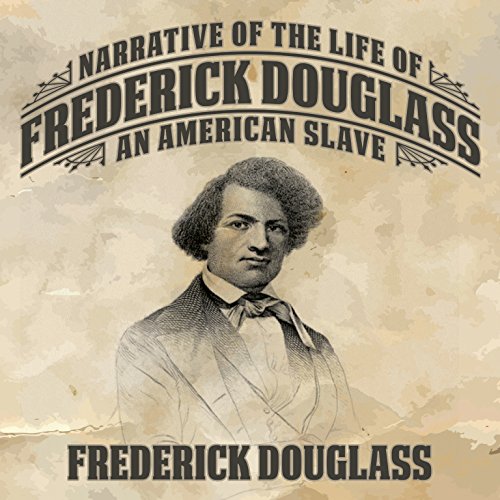
Narrative of the Life of Frederick Douglass
Summary
This classic of American literature, a dramatic autobiography of the early life of an American slave, was first published in 1845, when its author had just achieved his freedom. It is a story that shocked the world with its first-hand account of the horrors of slavery. The book was an incredible success. It sold over 30,000 copies and was an international best seller. His eloquence gives a clear indication of the powerful principles that led Douglas to become the first great African-American leader in the United States.
Public Domain (P)2015 Gildan Media LLC

Twelve Years a Slave
Summary
Twelve Years a Slave is an account of actual events that took place in the life of Solomon Northup, during the pre-Civil War era of the 1840s. It follows the trials and tribulations of an educated African American man that was born into freedom and later kidnapped, taken away from his family, and forced into slavery. His story brings to life a shockingly common practice that took place during those times. In his journey, Northup, who is a native of Saratoga, New York, and has a wife with three kids, gets lured into leaving his home town by two circus promoters who ask him to accompany them to Washington, D.C., while getting paid to perform at a musical gig. This trip, which he thought would only take a few days turned in to an unimaginable voyage of deceit and great misfortune. Those few days turned into 12 long years, in which Northup was placed back into slavery in the isolated plantation country of Louisiana's Bayou Boeuf where he quickly learned that the mere mention of his past freedom would result in severe punishments or possibly his own death. His story takes a drastic turn when a heroic friend risks his own life to help deliver the news of Northup's whereabouts to his wife, in order to help him regain his freedom. This heroic act could ultimately get Northup killed or help return him back home, to his family and freedom.
©2014 A.R.N. Publications (P)2014 A.R.N. Publications

Murdered Midas
Summary
A gold mine. A millionaire. An island paradise. An unsolved murder. A missing fortune. The story of the infamous Sir Harry Oakes as only Charlotte Gray can tell it. On an island paradise in 1943, Sir Harry Oakes, gold-mining tycoon, philanthropist, and "richest man in the Empire", was murdered. The news of his death surged across the English-speaking world, from London, the Imperial center, to the remote Canadian mining town of Kirkland Lake, in the Northern Ontario bush. The murder became celebrated as "the crime of the century". The layers of mystery deepened as the involvement of Oakes' son-in-law, Count Alfred de Marigny, came quickly to be questioned, as did the odd machinations of the governor of the Bahamas, the former King Edward VIII. Despite a sensational trial, no murderer was ever convicted. Rumors were unrelenting about Oakes' missing fortune, and fascination with the Oakes story has persisted for decades. Award-winning biographer and popular historian Charlotte Gray explores, for the first time, the life of the man behind the scandal, a man who was both reviled and admired - from his early, hardscrabble days of mining exploration, to his explosion of wealth, to his grandiose gestures of philanthropy. And Gray brings fresh eyes to the bungled investigation and shocking trial in the remote colonial island streets, proposing an overlooked suspect in this long-cold case. Murdered Midas is the story of the man behind the newspaper headlines, who despite his wealth and position was never able to have justice. PLEASE NOTE: When you purchase this title, the accompanying PDF will be available in your Audible Library along with the audio.
©2019 Charlotte Gray (P)2019 HarperCollins Publishers

Nouvelle-France
Summary
Ce n'est pas d'hier que Gilles Proulx sonne l'alarme : les Québécois sont de plus en plus ignorants de leur histoire, oublieux de leurs ancêtres et inconscients du travail colossal que ceux-ci ont accompli pour poser les fondations du Québec d'aujourd'hui. C'est pour corriger ces tristes lacunes qu'au-delà des faits de guerre et autres dates marquantes, l'auteur de Nouvelle-France raconte avec verve les actes de bravoure de Madeleine de Verchères, qui sauva les habitants de son fort d'une attaque iroquoise, les découvertes de Jean-Baptiste Le Moyne de Bienville, explorateur de la Louisiane et fondateur de La Nouvelle-Orléans, ou la ténacité extraordinaire dont ont fait preuve Louis Hébert et sa famille, premiers colons de Nouvelle-France. Avec l'irrévérence et la passion qu'on lui connaît, Proulx se fait fort de redonner à ses lecteurs, jeunes et moins jeunes, la soif d'apprendre leur histoire.
©2016 Éditions du Journal (P)2020 Vues et Voix

Native Peoples of North America
Summary
History, for all its facts and figures, names and dates, is ultimately subjective. You learn the points of view your teachers provide, the perspectives that books offer, and the conclusions you draw yourself based on the facts you were given. Hearing different angles on historical events gives you a more insightful, accurate, and rewarding understanding of events - especially when a new viewpoint challenges the story you thought you knew. Now the Great Courses has partnered with Smithsonian to bring you a course that will greatly expand your understanding of American history. This course, Native Peoples of North America, pairs the unmatched resources and expertise of the Smithsonian's National Museum of the American Indian with the unparalleled knowledge of Professor Daniel M. Cobb of the University of North Carolina at Chapel Hill to provide a multidisciplinary view of American history, revealing new perspectives on the historical and contemporary experiences of indigenous peoples and their impact on the history of our country. This insightful and unique 24-lecture course helps disprove myths and stereotypes that many people take as fact. Professor Cobb presents a different account of the Seven Years' War, the American Revolution, the War of 1812, the Civil War, the Gold Rush, the Transcontinental Railroad, and beyond, providing the stories of the American Indian people who fought and negotiated to preserve their ancestral lands. Native Peoples of North America recounts an epic story of resistance and accommodation, persistence and adaption, extraordinary hardship and survival across more than 500 years of colonial encounter. As the Smithsonian curators stated, "The past never changes. But the way we understand it, learn about it, and know about it changes all the time." Be prepared - this course is going to change how you understand American history. And no matter how much you know about this subject, you will be surprised. PLEASE NOTE: When you purchase this title, the accompanying reference material will be available in your Library section along with the audio.
©2016 The Great Courses (P)2016 The Teaching Company, LLC

Four Hundred Souls
Summary
A chorus of extraordinary voices comes together to tell one of history’s great epics: the 400-year journey of African Americans from 1619 to the present - edited by Ibram X. Kendi, author of How to Be an Antiracist, and Keisha N. Blain, author of Set the World on Fire. The story begins in 1619 - a year before the Mayflower - when the White Lion disgorges “some 20-and-odd Negroes” onto the shores of Virginia, inaugurating the African presence in what would become the United States. It takes us to the present, when African Americans, descendants of those on the White Lion and a thousand other routes to this country, continue a journey defined by inhuman oppression, visionary struggles, stunning achievements, and millions of ordinary lives passing through extraordinary history. Four Hundred Souls is a unique one-volume “community” history of African Americans. The editors, Ibram X. Kendi and Keisha N. Blain, have assembled 90 brilliant writers, each of whom takes on a five-year period of that 400-year span. The writers explore their periods through a variety of techniques: historical essays, short stories, personal vignettes, and fiery polemics. They approach history from various perspectives: through the eyes of towering historical icons or the untold stories of ordinary people; through places, laws, and objects. While themes of resistance and struggle, of hope and reinvention, course through the book, this collection of diverse pieces from 90 different minds, reflecting 90 different perspectives, fundamentally deconstructs the idea that Africans in America are a monolith - instead it unlocks the startling range of experiences and ideas that have always existed within the community of Blackness. This is a history that illuminates our past and gives us new ways of thinking about our future, written by the most vital and essential voices of our present. Read by a full cast, including: Joniece Abbott-Pratt, Amir Abdullah, Ryan Vincent Anderson, Kristen Ariza, Dashawn Barnes, Joshua Bennett, Quincy Tyler Bernstine, Andre Blake, Torian Brackett, Donte Bonner, Mahogany L. Browne, Ron Butler, Kellie Carter-Jackson, Brianna Collette, Karen Chilton, Sean Crisden, Keith David, Angela Y. Davis, William DeMerrit, Leonard Dozier, Robin Eller, Kevin R. Free, James Fouhey, Alicia Garza, Dion Graham, Danai Gurira, Jerome Harmann-Hardeman, Jamal Henderson, Ethan Herisse, Susan Heyward, Cary Hite, Dominic Hoffman, Sherrilyn Ifill, James Monroe Iglehart, JD Jackson, Zainab Jah, Nikole Hannah-Jones, Sullivan Jones, Peter Francis James, Terrence Kidd, January LaVoy, Adam Lazarre-White, Keylor Leigh, Nicole Lewis, Dennis Logan, Chante McCormick, Desmond Manny, Jesus Martinez, Heather McGhee, Sheryl Mebane, Robin Miles, Karen Murray, Soneela Nankani, Leon Nixon, Soledad O’Brien, Leslie Odom, Jr., Adenrele Ojo, Genesis Oliver, Prentice Onayemi, Tovah Ott, Morgan Parker, Imani Parks, Lisa Renee Pitts, Imani Jade Powers, Rhett Samuel Price, Bill Quinn, Phylicia Rashad, David Sadzin, Joshua David Scarlett, Heather Alicia Simms, Shayna Small, Patricia Smith, Marisha Tapera, Tashi Thomas, Damian Thompson, TL Thompson, Ella Turenne, Bahni Turpin, Anita Welch, Jade Wheeler, Samira Wiley, Zenzi Williams, Mirron Willis, Andia Winslow, Kai Wright, and with co-editors Ibram X. Kendi and Keisha N. Blain
©2021 Respective authors of all material within (P)2021 Random House Audio

The Pioneers
Summary
The number one New York Times best seller by Pulitzer Prize-winning historian David McCullough rediscovers an important chapter in the American story that's "as resonant today as ever" (The Wall Street Journal) - the settling of the Northwest Territory by courageous pioneers who overcame incredible hardships to build a community based on ideals that would define our country. As part of the Treaty of Paris, in which Great Britain recognized the new United States of America, Britain ceded the land that comprised the immense Northwest Territory, a wilderness empire northwest of the Ohio River containing the future states of Ohio, Indiana, Illinois, Michigan, and Wisconsin. A Massachusetts minister named Manasseh Cutler was instrumental in opening this vast territory to veterans of the Revolutionary War and their families for settlement. Included in the Northwest Ordinance were three remarkable conditions: freedom of religion, free universal education, and most importantly, the prohibition of slavery. In 1788 the first band of pioneers set out from New England for the Northwest Territory under the leadership of Revolutionary War veteran General Rufus Putnam. They settled in what is now Marietta on the banks of the Ohio River. McCullough tells the story through five major characters: Cutler and Putnam; Cutler's son Ephraim; and two other men, one a carpenter turned architect, and the other a physician who became a prominent pioneer in American science. "With clarity and incisiveness, [McCullough] details the experience of a brave and broad-minded band of people who crossed raging rivers, chopped down forests, plowed miles of land, suffered incalculable hardships, and braved a lonely frontier to forge a new American ideal" (The Providence Journal). Drawn in great part from a rare and all-but-unknown collection of diaries and letters by the key figures, The Pioneers is a uniquely American story of people whose ambition and courage led them to remarkable accomplishments. "A tale of uplift" (The New York Times Book Review), this is a quintessentially American story, written with David McCullough's signature narrative energy.
©2019 David McCullough (P)2019 Simon & Schuster

36 Books That Changed the World
Summary
Certain works of literature, history, science, philosophy, political theory and religion offer powerful examples of how books can spark revolutions, birth great religions, spur scientific advancements, shape world economies, teach us new ways of thinking, and much more. And with this fascinating collection crafted from our extensive library of courses, you can now get a single course that represents 36 of our best lectures on literary works that changed the world. In the company of an unparalleled roster of award-winning professors from a range of disciplines, you'll get fresh perspectives on books you only thought you knew - and intriguing introductions to some works you may not have known played key roles in getting us to where we are today. These include The Analects, the Liber Abaci, A Dictionary of the English Language, The Jungle, The Feminine Mystique, and more. If you've taken another course with these professors before, get a reminder of just why you enjoyed them. And if you've never heard some of them before, who knows? You may just discover your next favorite Great Courses professor. More than that, you'll rediscover just how powerful the printed word can be. You'll also learn how the mark of a truly great book isn't that it just changes the lives of individual readers-but the lives of entire civilizations.
©2014 The Great Courses (P)2014 The Teaching Company, LLC
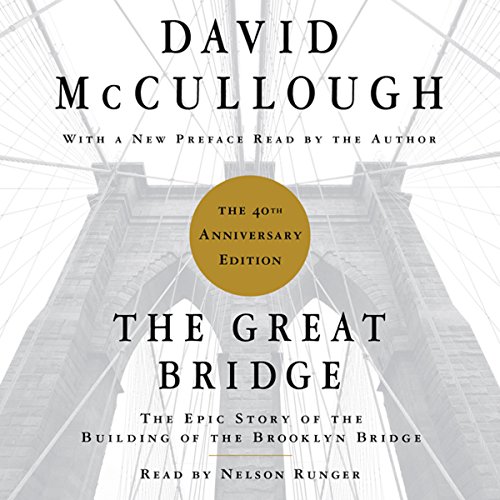
The Great Bridge
Summary
This monumental book tells the enthralling story of one of the greatest accomplishments in our nation's history, the building of what was then the longest suspension bridge in the world. The Brooklyn Bridge rose out of the expansive era following the Civil War, when Americans believed all things were possible. So daring a concept as spanning the East River to join two great cities required vision and dedication of the kind that went into building Europe's great cathedrals. During 14 years of construction, the odds against success seemed overwhelming. Thousands of people were put to work. Bodies were crushed and broken, lives lost, notorious political empires fell, and surges of public doubt constantly threatened the project. But the story of the building of the Brooklyn Bridge is not just the saga of an engineering miracle; it is a sweeping narrative of the social climate of the time, replete with heroes and rascals who helped either to construct or to exploit the great enterprise. The Great Bridge is also the story of a remarkable family, the Roeblings, who conceived and executed the audacious engineering plan at great personal cost. Without John Roebling's vision, his son Washington's skill and courage, and Washington's wife Emily's dedication, the bridge we know and cherish would never have been built. Like the engineering marvel it describes, The Great Bridge, republished on the 40th anniversary of its initial publication, has stood the test of time. Please note: The Great Bridge (Unabridged) is available for just one credit until June 20, 2012, after which point it will be priced at two credits.
©2007 David McCullough (P)2012 Simon & Schuster

Franklin D. Roosevelt
Summary
"Le premier des droits de l'homme est celui de pouvoir manger à sa faim." Franklin D. Roosevelt Qui fut cet homme, hors du commun, élu quatre fois à la tête des États-Unis ? D'où venait-il et quel a été son parcours ? Comment a-t-il fait, malgré son hémiplégie, pour galvaniser une nation ayant sombré dans l'abîme économique de la crise de 1929 ? Qu'est-ce que le New-Deal ? Comment a-t-il pu transformer un pays à la dérive pour en faire la première puissance économique mondiale ? Franklin Delano Roosevelt était un visionnaire. Proche de ses concitoyens il promulgua la majorité des lois sociales américaines pour aider les plus démunis. Il sut aussi brider la puissance de grands groupes industriels et financiers. Quand démarra la seconde guerre mondiale, stupéfait par la défaite française et devant l'avancée des troupes japonaises en Asie, il en anticipa les conséquences. En quelques mois, il fit de l'Amérique l'arsenal du monde libre. Il mourut sans voir sa victoire, quelques jours avant la capitulation allemande et quelques mois avant l'effondrement nippon. Jamais le monde libre ne devra autant qu'à cet homme.
©2015 Editions Tallandier (P)2019 Sixtrid SAS

Where Wizards Stay Up Late
Summary
Twenty-five years ago, it didn't exist. Today, 20 million people worldwide are surfing the Net. Where Wizards Stay Up Late is the exciting story of the pioneers responsible for creating the most talked about, most influential, and most far-reaching communications breakthrough since the invention of the telephone. In the 1960s, when computers where regarded as mere giant calculators, J.C.R. Licklider at MIT saw them as the ultimate communications devices. With Defense Department funds, he and a band of visionary computer whizzes began work on a nationwide, interlocking network of computers. Taking listeners behind the scenes, Where Wizards Stay Up Late captures the hard work, genius, and happy accidents of their daring, stunningly successful venture.
©1996 Katie Hafner (P)2012 Katie Hafner

Hidden History
Summary
Learn about all the secrets our government has kept for the past fifty years. The US government has spent half the time covering up conspiracies as it has spent helping the American people. In Hidden History, you will see the amount of effort over the past fifty years that our government has dedicated to lying and covering up the truth to the world. Starting with the assassination of President John F. Kennedy, Don Jeffries chronicles a wide variety of issues that have plagued our country's history. Whether it's the assassinations of MLK and RFK, Iran-Contra, the Oklahoma City bombing, TWA Flight 800, voting fraud, or 9/11, every major disaster or war that we've witnessed has somehow been distorted by those who are supposed to be protecting us. Jeffries also delves into extensive research on the death of John F. Kennedy Jr., and you'll be shocked by what he finds out. So whether you've only heard bits and pieces of these stories or have read several books on the topics, Hidden History is the book that belongs in every conspiracy theorist's library, as the information included in this encyclopedia has never been collected together in any other published work available. So sit down, strap in, and get ready to be shocked and awed by how much has been hidden from you by our government over the past fifty years. Skyhorse Publishing, as well as our Arcade imprint, are proud to publish a broad range of books for readers interested in history - books about World War II, the Third Reich, Hitler and his henchmen, the JFK assassination, conspiracies, the American Civil War, the American Revolution, gladiators, Vikings, ancient Rome, medieval times, the old West, and much more. While not every title we publish becomes a New York Times bestseller or a national bestseller, we are committed to books on subjects that are sometimes overlooked and to authors whose work might not otherwise find a home.
©2014 Donald Jeffries (P)2017 Brilliance Publishing, Inc., all rights reserved.

The Massey Murder
Summary
In February 1915, a member of one of Canada’s wealthiest families was shot and killed on the front porch of his home in Toronto as he was returning from work. Carrie Davies, an 18-year-old domestic servant, quickly confessed. But who was the victim here? Charles "Bert" Massey, a scion of a famous family, or the frightened, perhaps mentally unstable Carrie, a penniless British immigrant? When the brilliant lawyer Hartley Dewart, QC, took on her case, his grudge against the powerful Masseys would fuel a dramatic trial that pitted the old order against the new, wealth and privilege against virtue and honest hard work. Set against a backdrop of the Great War in Europe and the changing face of a nation, this sensational crime is brought to vivid life for the first time. As in her previous best-selling book, Gold Diggers - now in production as a Discovery Television miniseries - multi-award-winning historian and biographer Charlotte Gray has created a captivating narrative rich in detail and brimming with larger-than-life personalities, as she shines a light on a central moment in our past.
©2013 Chralotte Gray (P)2013 HarperCollins Canada

On the Trail of the Assassins
Summary
Jim Garrison’s classic account of his investigation and prosecution of the murder of JFK. Almost 50 years after the assassination of President John F. Kennedy, his murder continues to haunt the American psyche and stands as a turning point in our nation’s history. The Warren Commission rushed out its report in 1964, but questions continue to linger: Was there a conspiracy? Was there a coup at the highest levels of government? On March 1, 1967, New Orleans district attorney Jim Garrison shocked the world by arresting local businessman Clay Shaw for conspiracy to murder the president. His alleged co-conspirator, David Ferrie, had been found dead a few days before. Garrison charged that elements of the United States government, in particular the CIA, were behind the crime. From the beginning, his probe was virulently attacked in the media and violently denounced from Washington. His office was infiltrated and sabotaged, and witnesses disappeared and died strangely. Eventually, Shaw was acquitted after the briefest of jury deliberation and the only prosecution ever brought for the murder of President Kennedy was over. Returning to audiences for the first time in years, On the Trail of the Assassins - the primary source material for Oliver Stone’s hit film JFK - is Garrison’s own account of his investigations into the background of Lee Harvey Oswald and the assassination of President Kennedy, and his prosecution of Clay Shaw in the trial that followed.
©2012 The Estate of Jim Garrison (P)2013 Audible, Inc.

Richard Nixon
Summary
Brilliantly researched, authoritatively crafted by a prize-winning biographer, this is the Nixon we've been waiting for. Richard Nixon opens with young navy lieutenant "Nick" Nixon returning from the Pacific and setting his cap at Congress, an idealistic dreamer seeking to build a better world. Yet amid the turns of that now legendary 1946 campaign, Nixon's finer attributes quickly gave way to unapologetic ruthlessness. It is a stunning overture to John A. Farrell's magisterial portrait of a man who embodied postwar American cynicism. Within four years of that first win, Nixon would be a US senator, in six the vice president of the United States of America. "Few came so far, so fast, and so alone," Farrell writes. Finally president, Nixon's staff was full of bright young men who devised forward-thinking reforms addressing health care, poverty, civil rights, and protection of the environment. It was a fine legacy, but Nixon cared little for it. He aspired to make his mark on the world stage instead, and his 1972 opening to China was the first great crack in the Cold War. Nixon had another legacy, too: an America divided and polarized. It was Nixon who launched the McCarthy era, who set South against North, and who spurred the silent majority to despise and distrust the country's elites. He persuaded Americans to gnaw, as he did, on grievances - and to look at one another as enemies. Finally, in August 1974, after two years of the mesmerizing intrigue and scandal known as Watergate, Nixon became the only president to resign in disgrace. Richard Nixon is an enthralling tour de force biography of our darkest president, one that reviewers will hail as a defining portrait, and the full life of Nixon listeners have awaited.
©2017 John A. Farrell (P)2017 Random House Audio

The American Revolution
Summary
Why did 13 colonies believe they could defeat the most powerful nation on the planet? And how did they eventually manage such an impressive feat? Get the real story on the battle for American independence with Professor Guelzo's 24 gripping lectures. With a focus on the war's strategy, military tactics, logistics, and most fascinating people, these lectures are a must own for anyone curious about the origins of the greatest nation in modern history. Told from the perspective of both sides in an intense, almost novelistic style that recreates the experience of the war's key battles and decisions, the lectures introduce you to an array of vivid personalities, including George Washington, Lord George Sackville-Germaine, Henry Knox, Sir William Howe, and Thomas Paine. Professor Guelzo's approach gives the forces at work in the palace and in Parliament equal weight with those in play at the Continental Congress and among George Washington's inner circle. It's a perspective that reveals the very different ways in which the two nations saw both their economic relationship and the philosophical underpinnings of a government's relationship to its citizens. You'll learn what it was like to serve on either side of the conflict, how those sides were trained, and about the terrors of the battlefield.Rich in dramatic moments like this, these lectures offer a fresh appraisal of this seminal event in American history, offering the diverging views of two sides whose common heritage had yielded two very different outlooks. PLEASE NOTE: When you purchase this title, the accompanying reference material will be available in your Library section along with the audio.
©2008 The Teaching Company, LLC (P)2008 The Great Courses

Killing Crazy Horse
Summary
This program includes a prologue read by Bill O'Reilly. The latest installment of the multimillion-selling Killing series is a gripping journey through the American West and the historic clashes between Native Americans and settlers. The bloody Battle of Tippecanoe was only the beginning. It’s 1811 and President James Madison has ordered the destruction of Shawnee warrior Chief Tecumseh’s alliance of tribes in the Great Lakes region. But while General William Henry Harrison would win this fight, the armed conflict between Native Americans and the newly formed United States would rage on for decades. In Killing Crazy Horse, best-selling authors Bill O’Reilly and Martin Dugard venture through the fraught history of our country’s founding on already occupied lands, from General Andrew Jackson’s brutal battles with the Creek Nation to President James Monroe’s epic “sea to shining sea” policy, to President Martin Van Buren’s cruel enforcement of a “treaty” that forced the Cherokee Nation out of their homelands along what would be called the Trail of Tears. O’Reilly and Dugard take listeners behind the legends to reveal never-before-told historical moments in the fascinating creation story of America. This fast-paced, wild ride through the American frontier will shock listeners and impart unexpected lessons that reverberate to this day. A Macmillan Audio production from Henry Holt and Company
©2020 Bill O'Reilly and Martin Dugard (P)2020 Macmillan Audio

A Queer History of the United States
Summary
Winner of a 2012 Stonewall Book Award in nonfiction The first book to cover the entirety of lesbian, gay, bisexual, and transgender history, from pre-1492 to the present. In the 1620s, Thomas Morton broke from Plymouth Colony and founded Merrymount, which celebrated same-sex desire, atheism, and interracial marriage. Transgender evangelist Jemima Wilkinson, in the early 1800s, changed her name to “Publick Universal Friend”, refused to use pronouns, fought for gender equality, and led her own congregation in upstate New York. In the mid-19th century, internationally famous Shakespearean actor Charlotte Cushman led an openly lesbian life, including a well-publicized “female marriage.” And in the late 1920s, Augustus Granville Dill was fired by W. E. B. Du Bois from the NAACP’s magazine the Crisis after being arrested for a homosexual encounter. These are just a few moments of queer history that Michael Bronski highlights in this groundbreaking book. Intellectually dynamic and endlessly provocative, A Queer History of the United States is more than a “who’s who” of queer history: it is a book that radically challenges how we understand American history. Drawing upon primary documents, literature, and cultural histories, noted scholar and activist Michael Bronski charts the breadth of lesbian, gay, bisexual, and transgender history, from 1492 to the 1990s, and has written a testament to how the LGBT experience has profoundly shaped our country, culture, and history. A Queer History of the United States abounds with startling examples of unknown or often ignored aspects of American history - the ineffectiveness of sodomy laws in the colonies, the prevalence of cross-dressing women soldiers in the Civil War, the impact of new technologies on LGBT life in the 19th century, and how rock music and popular culture were, in large part, responsible for the devastating backlash against gay rights in the late 1970s. Most striking, Bronski documents how, over centuries, various incarnations of social purity movements have consistently attempted to regulate all sexuality, including fantasies, masturbation, and queer sex. Resisting these efforts, same-sex desire flourished and helped make America what it is today. At heart, A Queer History of the United States is simply about American history. It is a book that will matter both to LGBT people and heterosexuals. This engrossing and revelatory history will make listeners appreciate just how queer America really is.
©2011 Michael Bronski (P)2018 Random House Audio