The Asia category has 136 audiobooks on Listento.it, with an average listener rating of 4.1★ across 115 ratings. The most-rated is Two Trees Make a Forest.

Rainbow's End
Summary
This searingly honest memoir describes growing up on an African farm during the Rhodesian Bush War and the twilight years of white colonialism in the 1970s. It also explores the shock and euphoria of Zimbabwean independence in the 1980s as St John navigates her way through the immense personal and political changes. The abundance and beauty of Africa and its people, as well as childhood innocence, are superbly contrasted with the insidiousness of racism, war and nationalist propaganda to create an unforgettable listen - eloquent, affecting, and utterly spellbinding.
©2006 Lauren St. John (P)2007 W F Howes Ltd.

The Origins of the Modern World
Summary
This clearly written and engrossing book presents a global narrative of the origins of the modern world from 1400 to the present. Unlike most studies, which assume that the "rise of the West" is the story of the coming of the modern world, this history, drawing upon new scholarship on Asia, Africa, and the New World, constructs a story in which those parts of the world play major roles. Robert B. Marks defines the modern world as one marked by industry, the nation state, interstate warfare, a large and growing gap between the wealthiest and poorest parts of the world, and an escape from "the biological old regime." He explains its origins by emphasizing contingencies (such as the conquest of the New World); the broad comparability of the most advanced regions in China, India, and Europe; the reasons why England was able to escape from common ecological constraints facing all of those regions by the 18th century; and a conjuncture of human and natural forces that solidified a gap between the industrialized and non-industrialized parts of the world. Now in a new edition that brings the saga of the modern world to the present, the book considers how and why the United States emerged as a world power in the twentieth century and became the sole superpower by the twenty-first century. Once again arguing that the rise of the United States to global hegemon was contingent, not inevitable, Marks also points to the resurgence of Asia and the vastly changed relationship of humans to the environment that may, in the long run, overshadow any political and economic milestones of the past hundred years.
©2007 Rowman and Littlefield Publishers, Inc. (P)2014 Redwood Audiobooks

Finding George Orwell in Burma
Summary
Over the years the American writer Emma Larkin has spent traveling in Burma, she has come to know all too well the many ways this police state can be described as "Orwellian". The life of the mind exists in a state of siege in Burma, and it long has. The connection between George Orwell and Burma is not simply metaphorical, of course; Orwell's mother was born in Burma, and he was shaped by his experiences there as a young man working for the British Imperial Police. Both his first novel, Burmese Days, and the novel he left unfinished upon his death were set in Burma. And then there is the place of Orwell's work in Burma today: Larkin found it a commonplace observation in Burma that Orwell did not write one book about the country but three - the other two being Animal Farm and Nineteen Eighty-Four. When Larkin quietly asked one Burmeseman if he knew the work of George Orwell, he stared blankly for a moment and then said, "Ah, you mean the prophet."Finding George Orwell in Burma is the story of the year Larkin spent traveling across this shuttered police state, using the life and work of Orwell as her guide. Traveling from Mandalay and Rangoon to poor delta backwaters and up to the old hill-station towns in the mountains of Burma's far north, Larkin visits the places Orwell worked and lived and the places his books live still. She brings to vivid life a country and a people cut off from the rest of the world, and from one another, by the ruling military junta and its network of spies and informers.
©2010 Emma Larkin (P)2010 Tantor

The Road to Sleeping Dragon
Summary
In 1995, at the age of 23, Michael Meyer joined the Peace Corps and, after rejecting offers to go to seven other countries, was sent to a tiny town in Sichuan. Knowing nothing about China, or even how to use chopsticks, Meyer wrote Chinese words up and down his arms so he could hold conversations, and, per a Communist dean's orders, jumped into teaching his students about the Enlightenment, the stock market, and Beatles lyrics. Soon he realized his Chinese counterparts were just as bewildered by China's changes as he was. Thus began an impassioned immersion into Chinese life. With humor and insight, Meyer puts listeners in his novice shoes, winding across the length and breadth of his adopted country - from a terrifying bus attack on arrival, to remote Xinjiang and Tibet, into Beijing's backstreets and his future wife's Manchurian family, and headlong into efforts to protect China's vanishing heritage at places like "Sleeping Dragon", the world's largest panda preserve. Both funny and relatable, The Road to Sleeping Dragon is essential listening for anyone interested in China's history, and how daily life plays out there today.
©2017 Michael Meyer (P)2017 Tantor

Why I Am an Atheist and Other Works
Summary
Bhagat Singh is a name that became synonymous with revolution in India’s struggle for Independence. This young boy brought about a change in the way people thought about freedom. He was well read and fought extensively for rights – his own, his comrades’ and his countrymen’s. A discussion with a friend soon turned into a matter of self-assessment for Bhagat Singh, leading to a discourse on why he chose to be an atheist. Even in the face of death at a very young age, his uncanny observation leads to his putting forth some pertinent questions. On another occasion, he was disappointed with his father’s plea in court for his innocence and chose to write a letter to him. This book is a collection of 18 of his valued writings from within the walls of prison and outside it, which show us the resolve in his words, and the bravery in his acts subsequently.
©2020 Srishti Publishers (P)2020 Audible, Inc.

Stranger in the Shogun's City
Summary
A vivid, deeply researched work of history that explores the life of an unconventional woman during the first half of the 19th century in Edo - the city that would become Tokyo - and a portrait of a great city on the brink of a momentous encounter with the West. The daughter of a Buddhist priest, Tsuneno was born in a rural Japanese village and was expected to live a traditional life much like her mother’s. But after three divorces - and a temperament much too strong-willed for her family’s approval - she ran away to make a life for herself in one of the largest cities in the world: Edo, a bustling metropolis at its peak. With Tsuneno as our guide, we experience the drama and excitement of Edo just prior to the arrival of American Commodore Perry’s fleet, which transformed Japan. During this pivotal moment in Japanese history, Tsuneno bounces from tenement to tenement, marries a masterless samurai, and eventually enters the service of a famous city magistrate. Tsuneno’s life provides a window into 19th-century Japanese culture - and a rare view of an extraordinary woman who sacrificed her family and her reputation to make a new life for herself, in defiance of social conventions. Immersive and fascinating, Stranger in the Shogun’s City is a revelatory work of history, layered with rich detail and delivered with beautiful prose, about the life of a woman, a city, and a culture.
©2020 Amy Stanley. All rights reserved. (P)2020 Simon & Schuster, Inc. All rights reserved.

The Uighurs
Summary
Most today are all too familiar with the unimaginable horrors, hardship, and heartache suffered by millions of North Koreans each passing day, as well as the unspeakable circumstances in Syria, Afghanistan, Yemen, and other war zones, as they very well should be. Average consumers of international news, however, are completely ignorant of the hideous plight and even the existence of the Uighurs themselves, a unique, multi-faceted people paddling strenuously in similarly dire straits.
For the most part, the Uighurs are based in East Turkestan, more commonly referred to as the Xinjiang Uighur Autonomous Region of the People's Republic of China. This prodigious plot of land boasts a total land area of over 1.665 million km², or 640,000 mi², and is, as China puts it, the largest administrative division in the country. The pro-independence inhabitants of East Turkestan, on the other hand, have been fighting for decades to regain sole control of their motherland - as of now, to no avail.
The Uighurs' active pursuit for independence is not an isolated phenomenon. It is reminiscent of the ongoing friction between Taiwan and China, as well as Hong Kong and China, the independence-seekers of the former states struggling to sever its ties with the Red Dragon. That being said, unlike Taiwan, which is managed by an entirely separate constitutional democratic government, and Hong Kong, classified as a special administrative region run by a Chief Executive and Executive Council with its own judicial system, Xinjiang, though technically autonomous, is still very much under the Chinese yoke.
Xinjiang is overseen by its own Communist Party Secretary and Chairman, who are reviled as “puppets of Beijing” behind closed doors. In 2012, Uighurs discreetly disseminated a poem about a former Xinjiang Chairman entitled “Salaam, Nur Bekri”, which skewered Bekri for his ineffective leadership; among their concerns were the climbing unemployment rates within the Uighur community, and the overtly preferential treatment the Han Chinese received. “Closed doors” and “discreet” are key words here. See, while China has been known to breach its agreements with Taiwan and Hong Kong regarding non-intervention on judicial cases and their rights to self-govern, the residents of these states possess the power to exercise freedom of speech, and are granted unfettered access to the internet. This concept, regrettably, has been forgotten by the Uighurs and the country's majority Han Chinese population.
Even more alarming, insiders say its people are imperiled, and this once thriving culture itself is no longer inching, but hurtling towards extinction. An untold number of Uighurs have, and continue to vanish without a trace. The Chinese government claims that the 13,000 or so imprisoned (and executed) since 2014 were radical separatists and “murderous devils” with poisonous vendettas.
A fraction of the Uighurs have been connected to violent acts of terrorism, but the often flimsy and incomplete evidence presented to defense teams certainly warrants some pause for thought. On top of the countless others supposedly snatched off the streets for speaking their minds, fostering their customs, or simply being kin to Uighurs who fled and turned refugee, over a million have been bussed to so-called “re-education camps” or “vocational training centers”. These are no different from “boarding schools”, Xinjiang officials insist, yet survivors have likened these detention centers to inescapable concentration camps.
The Uighurs: The History and Legacy of the Turkic Muslim Minority Group in Asia examines the origins of the Uighurs, their long history, and the notorious current events involving the Uighurs in China.
©2019 Charles River Editors (P)2019 Charles River Editors

Oriental Mythology
Summary
Explore the power of myth as it flowered in Asia
In this second volume of The Masks of God - Joseph Campbell’s major work of comparative mythology - the preeminent mythologist looks at Asian mythology as it developed over the course of five thousand years into the distinctive religions of Egypt, Mesopotamia, India, China, and Japan.
The Masks of God is a four-volume study of world religion and myth that stands as one of Joseph Campbell’s masterworks. On completing it, he wrote: “Its main result for me has been the confirmation of a thought I have long and faithfully entertained: of the unity of the race of man, not only in its biology, but also in its spiritual history, which has everywhere unfolded in the manner of a single symphony, with its themes announced, developed, amplified and turned about, distorted, reasserted, and today, in a grand fortissimo of all sections sounding together, irrestibly advancing to some kind of mighty climax, out of which the next great movement will emerge.”
©1963 Joseph Campbell. Digital Edition © 2014, Joseph Campbell Foundation (JCF) (P)2018 Brilliance Publishing, Inc., all rights reserved.
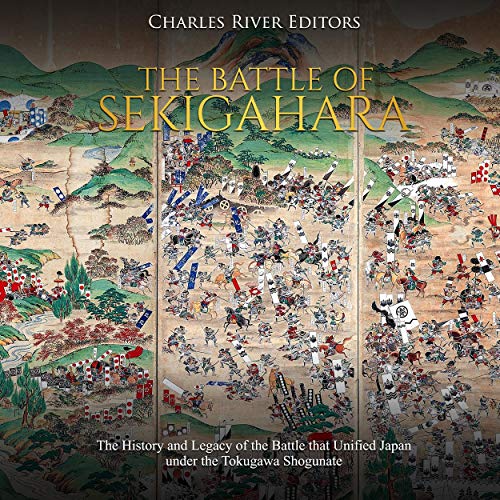
The Battle of Sekigahara
Summary
On October 21, 1600, two massive Japanese armies, totaling an estimated 200,000 soldiers armed to the teeth with swords, yari (spears), arrows, muskets, and cannons, faced off on a battlefield near the town of Sekigahara. A bitter fight to the death ensued, and the results would determine the course of Japanese history for the next 250 years. On the battlefield was the warlord Leyasu Tokugawa, a man desiring domain over the entire island of Japan, but standing in his way was Ishida Mitsunari, a warlord controlling vast swaths of western Japan. Moving with his armies from the east, Ieyasu maneuvered into a position at Sekigahara. Leyasu was relying heavily on the legendary Japanese samurai, but contrary to popular belief, the samurai warriors of that era were avid firearm users, and this battle would be no exception, as both armies bristled with muskets and cannons. Leyasu was outnumbered, but he had a trump card: Traitors placed in the enemy army. These treacherous warlords would join Leyasu in the midst of the battle, turning it in his favor. When Leyasu became shogun (military dictator) of Japan, he presided over the beginning of the Tokugawa shogunate, which brought peace and stability to all of Japan if only by ending the constant civil wars. Many changes took place, most notably in the capabilities of the samurai, Japan’s ruling military class, who were no longer active combat participants. Instead, most of these warriors were fighters in name only, ruling, instead, as privileged bureaucrats. They served the Tokugawa Shogunate, a military government that moved to isolate Japan from the rest of the world, for more than two centuries, and military service became the exclusive domain of a privileged warrior class that combined the military with an intricate network of social status and vassalage to feudal lords. As a feudal government, the Tokugawa shogunate split control of state domains under feudal lords known as daimyo. Although given a high degree of autonomy, the daimyo were responsible to the shogun to provide “maintenance of armed forces, the protection of the coastline, and attendance on the shogun at appointed times”. The maintenance of these functions required a large amount of support from society in general, including merchants, peasants, and artisans, but this system of military governance ensured that the warriors’ social status was elevated to a position of high prestige. Thus, samurai held a virtual monopoly not only on military positions, but also administrative positions at both the central and regional levels, and as a symbol of their status, samurais were the only class allowed to carry weapons - a longsword and shortsword - in public. The blissful isolation changed with the arrival of American Commodore Matthew Perry in 1853. In awe of the American weapons and ships, the Tokugawa shogunate quickly realized that they needed to evolve and modernize their military to survive, and a time of rapid change descended on Japan. As it turned out, however, the shogunate would not have a chance to modernize the nation, because the Meiji Restoration supplanted the shogunate with a new dynasty, and within a mere 30 years, the Tokugawa shogunate and its samurai caste would be relics of the past. The Battle of Sekigahara: The History and Legacy of the Battle that Unified Japan under the Tokugawa Shogunate chronicles the events that led to one of the most important conflicts in Japanese history. You will learn about the Battle of Sekigahara like never before.
©2020 Charles River Editors (P)2020 Charles River Editors

Around the World in 80 Trains
Summary
Bloomsbury presents Around the World in 80 Trains by Monisha Rajesh, read by Monisha Rajesh. Winner of the National Geographic Traveller Award for Best Travel Book. Shortlisted for the Stanford Dolman Travel Book of the Year Award. When Monisha Rajesh announced plans to circumnavigate the globe in 80 train journeys, she was met with wide-eyed disbelief. But it wasn’t long before she was carefully plotting a route that would cover 45,000 miles - almost twice the circumference of the earth - coasting along the world’s most remarkable railways; from the cloud-skimming heights of Tibet’s Qinghai railway to silk-sheeted splendour on the Venice Simplon-Orient-Express. Packing up her rucksack - and her fiancé, Jem, Monisha embarks on an unforgettable adventure that will take her from London’s St Pancras station to the vast expanses of Russia and Mongolia, North Korea, Canada, Kazakhstan and beyond. The ensuing journey is one of constant movement and mayhem, as the pair strikes up friendships and swaps stories with the hilarious, irksome and ultimately endearing travellers they meet on board, all while taking in some of the earth’s most breathtaking views. From the author of Around India in 80 Trains comes another witty and irreverent look at the world and a celebration of the glory of train travel. Rajesh offers a wonderfully vivid account of life, history and culture in an audiobook that will make you laugh out loud - and reflect on what it means to be a global citizen - as you whirl around the world listening to it.
©2019 Monisha Rajesh (P)2020 Bloomsbury Publishing Plc

In the Dragon's Shadow
Summary
A timely look at the impact of China's booming emergence on the countries of Southeast Asia. Today, Southeast Asia stands uniquely exposed to the waxing power of the new China. Three of its nations border China, and five are directly impacted by its claims over the South China Sea. All dwell in the lengthening shadow of its influence: economic, political, military, and cultural. As China seeks to restore its former status as Asia's preeminent power, the countries of Southeast Asia face an increasingly stark choice: flourish within Beijing's orbit or languish outside of it. Meanwhile, as rival powers including the United States take concerted action to curb Chinese ambitions, the region has emerged as an arena of heated strategic competition. Drawing on more than a decade of on-the-ground experience, Sebastian Strangio explores the impacts of China's rise on Southeast Asia, the varied ways in which the countries of the region are responding, and what it might mean for the future balance of power in the Indo-Pacific.
©2020 Sebastian Strangio (P)2020 Tantor

The First Sino-Japanese War
Summary
Completing the Meiji Restoration that heralded the dawn of a new era for both Japan and Asia, the island nation found itself thrust into the modern world, a world of industry and conquest. Flexing its new muscles, the burgeoning power soon came to blows with the regional power that for centuries dominated the area politically and culturally: China. Also seeking to modernize in the wake of Western exploitation, China struggled to adapt to the changing times, doing everything it could to maintain a balance between modernity and tradition. Japan found that balance, and, with its new industry desperate for raw materials, looked to the peninsula of Korea for new markets and resources. China, in contrast, refused to strike such a balance, adopting a veneer of modernity while maintaining the status quo, both domestically and with regards to Korea. For decades Korea existed as a protectorate of China, paying homage to the mighty Chinese dynasties while minding its own business as best it could. However, sensing weakness in the former regional power after being defeated by the Europeans during the Second Opium War, escalating tensions over Korea between the old power of China and the new power of Japan led to the First Sino-Japanese War. In its first modern war, the modernized Japanese empire went to war against the dominant power in the region, and though interested Western powers favored China, Japan won the day, claiming Korea as their conquest and permanently upsetting the balance of power in the region. The conflict paved the way for the future Empire of Japan and the collapse of the Qing Dynasty. Though both nations modernized, and China far outweighed Japan in terms of men and materiel potential, the island nation handily won its first modern war.
©2018 Charles River Editors (P)2018 Charles River Editors

On the Trail of Genghis Khan
Summary
Guided by a Kazakh aphorism - "To understand the wolf, you must put the skin of a wolf on and look through its eyes" - adventurer Tim Cope undertook a journey not successfully completed since the days of Genghis Khan: He traveled by horseback across the entire length of the Eurasian steppe, from the ancient capital of Mongolia to the Danube River in Hungary. It was an incredible six-thousand-mile, three-year-long trip across formidable landscape - and into the heart of the nomadic way of life that dominated this region for thousands of years, transforming Western Europe through its conquering armies. Cope’s trek takes him through wolf-infested plateaus, over glaciers and the subzero “starving steppe,” the scorching Kazakh desert, and the deep forests and treacherous mountains of the Carpathians. Alone except for a trusty dog (and a succession of thirteen horses, many stolen from him along the way), he encounters incredible hospitality from those who welcome him along the way, a tradition that is the linchpin of human survival on the steppe. Immersed in the land and its people, Cope is witness to the rich past and often painful complexities of the present still recovering from Soviet rule. On the Trail of Genghis Khan is a celebration and an elegy for the nomadic way of life - its freedom, its closeness to the land, its animals, and moods - and a narrative full of romance, intelligence, and drama.
©2013 Tim Cope (P)2013 Audible, Inc.

Karachi Vice
Summary
Karachi. Pakistan's largest city is a sprawling metropolis of 20 million people. It is a place of political turbulence in which those who have power wield it with brutal and partisan force, a place in which it pays to have friends in the right places and to avoid making deadly enemies. It is a society where lavish wealth and absolute poverty live side by side, and where the lines between idealism and corruption can quickly blur. It takes an insider to know where is safe, who to trust, and what makes Karachi tick, and in this powerful debut, Samira Shackle explores the city of her mother's birth in the company of a handful of Karachiites. Among them is Safdar the ambulance driver, who knows the city's streets and shortcuts intimately and will stop at nothing to help his fellow citizens. There is Parveen, the activist whose outspoken views on injustice corruption repeatedly lead her towards danger. And there is Zille, the hardened journalist whose commitment to getting the best scoops puts him at increasing risk. As their individual experiences unfold, so Shackle tells the bigger story of Karachi over the past decade: a period in which the Taliban arrive in Pakistan, adding to the daily perils for its residents and pushing their city into the international spotlight. Writing with intimate local knowledge and a global perspective, Shackle paints a nuanced and vivid portrait of one of the most complex, most compelling cities in the world.
©2021 Samira Shackle (P)2021 Samira Shackle

Mohenjo-daro
Summary
What is a city? A simple definition is a "largely constructed landscape", and through inferences and comparisons with modern states, a successful ancient city is generally said to have a number of defining characteristics: evidence of political hierarchies; a centralized authority that is simultaneously dependent on the accumulation of resources and the suppression of competitors; the maintenance of continuous negotiation, alliance building, and occasionally costly and risky investments such as warfare; specialized crafts; a hinterland supplying food; and monumental statements of central planning and communal effort, such as the Mesopotamian ziggurats. Mohenjo-daro was the largest city of the Indus Valley civilization, one of the most advanced civilizations ever to have existed, and the best-known and most ancient prehistoric urban site on the Indian subcontinent. It was a metropolis of great cultural, economic, and political importance that dates from the beginning of the 3rd millennium BCE. Although it primarily flourished between approximately 2500 and 1500 BCE, the city had longer-lasting influences on the urbanization of the Indian subcontinent for centuries after its abandonment. It is believed to have been one of two capital cities of the Indus Civilization, its twin being Harappa located further north in Punjab, Pakistan. Mohenjo-daro is an enigmatic settlement, which confuses simple definitions of what a city consists of. It has revealed little evidence of palaces, contains few definite religious buildings, and appears to have never been involved in any external or internal military conflict. The inhabitants' writing has not been deciphered, and little is known about their religious and post-mortuary beliefs. Nonetheless, the city's importance is epitomized by its monumental buildings and walls, enormous manmade platforms, innovative architectural techniques, and evidence that they engaged in trade over vast distances, with high-quality artifacts sent from the Indus Valley as far as Mesopotamia and even Africa. Of particular note was their ingenious drainage system – one of the earliest means by which sewage was drained out of the city. No other urban site of similar size had a hydraulic network as complex and effective as that of Mohenjo-daro, and it would only be surpassed thousands of years later by the network of aqueducts in Rome during the third century CE. For centuries this city was believed to have sprung into existence suddenly and without precedent, with a highly standardized system of urban development, art, and architecture that is emulated in contemporary settlements across the Indus River Valley in a phenomenon known as the "Pan-Indus system". Although this view has changed over the last few decades, there exists no definitive hypothesis as to how they grew such a complex urban society so quickly. Fittingly, the city has an equally intriguing and mysterious narrative that explains its decline and eventual disappearance, a tale that gives the site its name: the "Hill of the Dead". The Indus Valley Civilization was forgotten for millennia, until 20th century archaeologists rediscovered and began excavations at Mohenjo-daro and Harappa. Today only foundations remain, but the site's importance is represented by its UNESCO World Heritage status, awarded in 1980 for being a site of outstanding cultural importance to the common heritage of humanity.
©2016 Charles River Editors (P)2017 Charles River Editors

History of India
Summary
India is the home of ancient religions and practices. It is a nation whose fascinating history teaches us about tolerance, diversity, and unity. This far-reaching subcontinent has been the place where great empires have developed, the place of monumental battles, the place of foreign invaders and the place of birth of cultures and religions. This book represents a compelling illustration of one of the world’s oldest civilizations: the road it followed to reach the place where it is today, and the primary elements that shaped its culture. It is a narrative that takes you from the ancient beginnings of the nation to modern-day India. Here is a brief insight into the content of the book: Ancient India: its most significant empires and the coming of Islam Medieval India: the primary events that shaped its culture British colonization: how did it settle in India and what impact did it have on its culture? India from 1949 until today: the primary changes that shaped the largest democracy in the world Indian culture and religion: the main elements that distinguish the Hindu way of life from other philosophies and ethics Things to see in India: a few guidelines for eager tourists who want to discover India and its majestic beauty If you want to discover the uniqueness of India, then you must definitely listen to this book. Learning more about its history will make you convey it from a different point of view. There is something about India that makes it unique. It is the combination of cultures and its impressive history that makes one feel attracted to this ancient country, which is often referred to as Mother India. Start your journey today and get your copy of this audiobook!
©2017 Lean Stone Publishing (P)2018 Lean Stone Publishing

An Autobiography or the Story of My Experiments with Truth
Summary
Mohandas Karamchand Gandhi, one of the greatest men to walk this earth, begins the story of his life with descriptions of his childhood in Porbandar and Rajkot in Gujarat, his schooldays, his early marriage, the lessons he learnt when he tried stealing, told lies and smoked cigarettes, and his unshakable devotion to his parents. He then tells us of his journeys abroad, first to England and then to south Africa, and narrates in simple, lucid language his transformation from a shy, diffident young man with a chronic fear of public speaking to a fearless lawyer and leader of men who took on the might of the British empire.
©2010 Tridip Suhrud (P)2019 Random House Audio

Mao Zedong (Spanish edition)
Summary
Explore la cautivadora vida de Mao Zedong Mao Zedong es reconocido, junto con Chiang Kai-Shek y Sun Yat-Sen, como una de las figuras más influyentes de la historia China moderna. Su control político de la nación declinó durante sus últimos años, pero permaneció como el presidente del Partido Comunista de China desde su fundación en 1949 hasta el día en que murió (9 de septiembre de 1976). Como el padre fundador de la República Popular China y el eje central de uno de los cultos de personalidad más intensos del mundo, el alcance de su influencia no se puede subestimar. Hoy, el legado de Mao puede inspirar tanto una devoción servil, como una condena abierta o cierto temor a mirar muy de cerca los aspectos negativos de su legado. El hecho de que su influencia se haya extendido durante casi tres décadas también hace difícil llegar a una comprensión holística de su impacto en China. El punto de vista oficial del Partido Comunista de China, popularizado por Deng Xiaoping, es que Mao estuvo un “70% correcto y un 30% equivocado”. Esta biografía detallará el extraordinario viaje de Mao, de ser el hijo de un campesino a ser uno de los más grandes - y altamente polarizadores - líderes de la historia moderna. Su objetivo es proporcionar una mejor comprensión de quién fue Mao como persona y tratar de desentrañar los rasgos de su personalidad y las experiencias personales que formaron su visión del mundo y determinaron sus acciones. Algunos de los temas abordados en este libro son: Primeros años Despertar político Pekín Cuatro de mayo y el Movimiento de la Nueva Cultura Los dolores de crecimiento del Partido Comunista de China La Expedición del Norte Crecimiento de su popularidad y apoyo de las masas La Gran Marcha La República Popular China El Gran Salto Adelante La Revolución Cultural ¿Qué representó el maoísmo? ¡Y mucho más! Please note: This audiobook is in Spanish.
©2018 Captivating History (P)2018 Captivating History

The Silk Road
Summary
If you want to discover the captivating history of the Silk Road, then pay attention.... The Silk Road, which has been understood as a generalized route of trade between the East and the West, is different from European, North African, and Near Eastern trade routes because until recently, it has been understood as solely being a land route; in fact, it was believed to be the longest overland trade route in human history. The history of the Silk Road is extremely complex. It cannot be told as a singular chronological narrative. Different cultures and societies rose and vanished along the Silk Road, and peoples migrated from one region to another. In short, for most of its history, there was fluidity as to the dominant cultures along the route or routes. Explaining the rise and fall or disappearance of these cultures involves stopping along the way to consider the chronology of their histories. In The Silk Road: A Captivating Guide to the Ancient Network of Trade Routes Established During the Han Dynasty of China and How It Connected the East and West, you will discover topics such as: Rome, silk, and ancient geography Han silk production and trade The Kingdom of Loulan Buddhists along the Silk Road Turfan: An oasis on the Silk Road The legend of Prester John Genghis Khan, ruler of the whole world The Lord of Xanadu, Kublai Khan: The Emperor of China Marco Polo visits Kublai Khan’s China The final years of Kublai Khan And much, much more! So if you want to learn more about the Silk Road scroll up and click the "add to cart" button!
©2020 Captivating History (P)2020 Captivating History

The History of China in 50 Events
Summary
As one of the oldest civilizations in the world, China has a vast, rich history. In order to assist with the study of Chinese history, this audiobook has been broken down into a series of straightforward, easy-to-follow vignettes. Inside you will hear about.... The Great Flood The Great Wall is begun The Terra Cotta Army is created Gunpowder is invented Great anti-Buddhist persecution Marco Polo travels to China The Forbidden City is completed First Opium War SARS outbreak And much more! This audiobook will provide in-depth insights into some of the most important events in Chinese history while providing an overall context within which these events took place. Designed as an introductory overview of Chinese history, this audiobook is the perfect resource for those who are seeking to expand their knowledge of China and world history.
©2016 Henry Freeman (P)2018 Henry Freeman