Bill Hare has narrated 40 audiobooks on Listento.it by 2 authors, with an average listener rating of 3.8★ across 12 ratings. The most-rated is Mysterious Canada: A Collection of Hauntings, Mysteries, and Strange Creatures Across the Canadian Nation.

Mysterious Canada: A Collection of Hauntings, Mysteries, and Strange Creatures Across the Canadian Nation
Summary
Canada has the reputation of being a boring place. More tranquil than its southern neighbor, it goes along in its quiet way sustaining one of the most stable and prosperous democracies in the world, and does so with little fuss or drama. It doesn't get in the news much, which considering the content of most news stories is a good thing. People get along, the economy is expanding, and there are no regular disasters. While all this makes Canada a pleasant place to live, it does not make it particularly interesting. But dig a little below the surface, and you'll find a different Canada, a stranger Canada, one of murder, mystery, and paranormal experiences. The stories that follow will show that Canada, far from being a dull, staid nation where nothing much happens, is an epicenter of the mysterious. Mysterious Canada: A Collection of Hauntings, Mysteries, and Strange Creatures Across the Canadian Nation offers a sampling of the many strange stories and unexplained phenomena that make Canada such an intriguing place. It is part of an ongoing series by Sean McLachlan and Charles River Editors that covers the mysteries and oddities of various places across the world, including The Weird Wild West, Weird West Coast, Mysteries of the South, Mysterious New England, and Weird Ireland. You will learn about the weird legends and mysteries of Canada like never before.
©2017 Charles River Editors (P)2017 Charles River Editors

The Amber Road
Summary
“Pytheas says that the Gutones, a people of Germany, inhabit the shores of an estuary of the Ocean called Mentonomon, their territory extending a distance of six thousand stadia; that, at one day's sail from this territory, is the Isle of Abalus, upon the shores of which, amber is thrown up by the waves in spring, it being an excretion of the sea in a concrete form; as, also, that the inhabitants use this amber by way of fuel, and sell it to their neighbors, the Teutones...” (Pliny the Elder)
The story of the Silk Road has been a popular topic among tourists, academics, economists, state parties, and daydreaming children for many centuries. In many ways the Silk Road can be seen everywhere, and it has existed for as long as people have traveled across Eurasia. Its impact is widely felt among the diverse peoples that live on the continent, through the unique regional art and architectural styles, as well as in countless films, books, academic studies, and organized tours devoted to the ancient trade routes.
At the same time, however, the Silk Road is an entirely abstract invention, first coined by the 19th century German geographer Ferdinand von Richthofen. There has never existed a single route - let alone a road - that was used to transfer goods, nor was silk the primary commodity traded across Eurasia. Instead, the Silk Road is more a multi-layered narrative about the rise and fall of nomadic confederations and sedentary societies, the consolidation and dissolution of kingdoms and empires, the exchange of commodities and fine crafts, and the transfer and mixture of ideas, religions, technology, science, art, architecture, myths, and legends. It is a story that is relevant for the present-day countries through which this exchange once took place, as they lay claim to the artifacts, heritage sites, and symbolic meaning of the Silk Road for political and economic purposes and to build their national identity.
In fact, international trade in the ancient world was a more intricate and far-reaching system than many have been led to believe. The Silk Road and the Incense Trade Route have been heavily investigated in recent decades, but the Amber Road trade network dominating northern Europe has been given far less attention. Amber, the hardened sap of prehistoric trees, has washed up on Baltic shores for generations, and though it had little value to the locals beyond religious symbolism and aesthetic beauty, they learned that foreign civilizations would pay massive sums for the beautiful substance.
Though written sources are scattered and tend to come and go depending on the civilization involved, much has been written by ancient authors, particularly of Greek and Roman origins. More importantly, archeologists have traced the spread of amber through the discovery of pieces with specific chemical construction, linking it back to the Baltic region. Once thought to have mainly been exported to Rome, Baltic amber has also been found in Mycenaean Greece, Egypt and Syria, though perhaps not surprisingly, it was Roman demand that formed the height of the amber exchange.
Perhaps even more interesting than the movement of the amber is regarding shifting trade operations from government controlled systems to private merchant enterprises to monopolies of guilds and orders, a return to government control, and finally, the selling of the trade to individual countries. It is a fascinating microcosm of changing political and governmental landscapes through millennia of change and development in northern Europe and the wider ancient Mediterranean world.
The Amber Road: The History and Legacy of the Ancient Trade Network that Moved Amber across Europe looks at the development of this crucial trade, and its impact on antiquity.
©2019 Charles River Editors (P)2019 Charles River Editors

The Roma
Summary
“We are all wanderers on this earth. Our hearts are full of wonder, and our souls are deep with dreams.” (Old Romani proverb) In the 21st century, cultural differences and individuality are often celebrated and protected across much of the world, and given society's conscientious awareness of such phenomena, it is, therefore, all the more surprising when considering the ignorance or indifference that the world, at large, exhibits toward the Romani people. Otherwise known as the “Roma” or by their popular misnomer “the gypsies”, the members of this highly undervalued and grossly misrepresented community have long been considered outcasts. More often than not, the Romani are branded by even those who fancy themselves liberals as “pikeys”, “gyppos”, and “gips”. There's also a regrettably common term “gypped” meaning “to cheat, or swindle” which perpetuates the damaging stereotype that the Roma are dishonest nuisances and societal pests. Even well-intentioned attempts to shine the spotlight on the community have sometimes been counterproductive, for they are often reduced to no more than exotic, whimsical entertainers for the privileged. According to a shocking email authored by an anonymous whistleblower in 2012, the staff at the Laurieston Job Center in Glasgow's Southside regularly referred to their Romani customers as “gypos, scum, beggars, suicide bombers, thieves, and pedophiles”. The whistleblower cited the staff's disturbing comments regarding an unnamed Romani woman who had brought her two children along to the job center: “The staff were all joking and saying they should sanction her for claiming whilst pimping out her kids. They then went on to make horrible remarks about the children, saying they were "mongs". On August 5th of the same year, over 700 far-right “activists” stormed the heavily Romani-populated Hungarian village of Devescer. “Gypsy criminals,” the mob chanted as they hurled rocks, paving stones, and other projectiles at the homes of their prey. “We will set your homes on fire. You will burn inside your homes!” The police, who were called to the scene, supposedly stood on the sidelines with their arms crossed, unwilling to intervene. The dangerous blanket statements issued by various European politicians in the past and recent years are also a cause for concern. In 1992, Bert Karlsson, a prominent member of the Swedish New Democracy Party, claimed that “Gypsies [were] responsible for 90 percent of crime against senior citizens”. In June 2008, the conservative Italian Prime Minister Silvio Berlusconi ordered the fingerprinting of the 150,000 Romani, children included, as a way to crack down on street crime. In France, political parties from either end of the spectrum have blamed the Romani for the nation's problems, economic and otherwise. The gypsies, asserted one interior minister, were responsible for one in every 10 crimes. It’s fair to wonder why the abhorrent treatment of the Romani continues to slip below the radar of many social justice warriors, particularly in this age of globalization. This is all the more confounding given that many are aware of the ways the Roma have been persecuted over several centuries, most notoriously during the holocaust.
©2019 Charles River Editors (P)2019 Charles River Editors
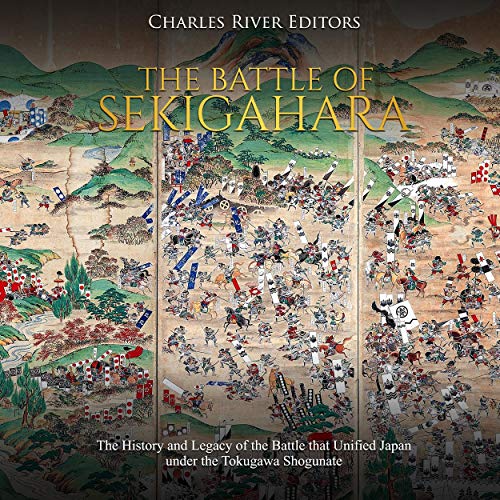
The Battle of Sekigahara
Summary
On October 21, 1600, two massive Japanese armies, totaling an estimated 200,000 soldiers armed to the teeth with swords, yari (spears), arrows, muskets, and cannons, faced off on a battlefield near the town of Sekigahara. A bitter fight to the death ensued, and the results would determine the course of Japanese history for the next 250 years. On the battlefield was the warlord Leyasu Tokugawa, a man desiring domain over the entire island of Japan, but standing in his way was Ishida Mitsunari, a warlord controlling vast swaths of western Japan. Moving with his armies from the east, Ieyasu maneuvered into a position at Sekigahara. Leyasu was relying heavily on the legendary Japanese samurai, but contrary to popular belief, the samurai warriors of that era were avid firearm users, and this battle would be no exception, as both armies bristled with muskets and cannons. Leyasu was outnumbered, but he had a trump card: Traitors placed in the enemy army. These treacherous warlords would join Leyasu in the midst of the battle, turning it in his favor. When Leyasu became shogun (military dictator) of Japan, he presided over the beginning of the Tokugawa shogunate, which brought peace and stability to all of Japan if only by ending the constant civil wars. Many changes took place, most notably in the capabilities of the samurai, Japan’s ruling military class, who were no longer active combat participants. Instead, most of these warriors were fighters in name only, ruling, instead, as privileged bureaucrats. They served the Tokugawa Shogunate, a military government that moved to isolate Japan from the rest of the world, for more than two centuries, and military service became the exclusive domain of a privileged warrior class that combined the military with an intricate network of social status and vassalage to feudal lords. As a feudal government, the Tokugawa shogunate split control of state domains under feudal lords known as daimyo. Although given a high degree of autonomy, the daimyo were responsible to the shogun to provide “maintenance of armed forces, the protection of the coastline, and attendance on the shogun at appointed times”. The maintenance of these functions required a large amount of support from society in general, including merchants, peasants, and artisans, but this system of military governance ensured that the warriors’ social status was elevated to a position of high prestige. Thus, samurai held a virtual monopoly not only on military positions, but also administrative positions at both the central and regional levels, and as a symbol of their status, samurais were the only class allowed to carry weapons - a longsword and shortsword - in public. The blissful isolation changed with the arrival of American Commodore Matthew Perry in 1853. In awe of the American weapons and ships, the Tokugawa shogunate quickly realized that they needed to evolve and modernize their military to survive, and a time of rapid change descended on Japan. As it turned out, however, the shogunate would not have a chance to modernize the nation, because the Meiji Restoration supplanted the shogunate with a new dynasty, and within a mere 30 years, the Tokugawa shogunate and its samurai caste would be relics of the past. The Battle of Sekigahara: The History and Legacy of the Battle that Unified Japan under the Tokugawa Shogunate chronicles the events that led to one of the most important conflicts in Japanese history. You will learn about the Battle of Sekigahara like never before.
©2020 Charles River Editors (P)2020 Charles River Editors

The CIA
Summary
Though it might be hard to believe, the Americans did not have a covert operations organization when they joined the war, and like the British, it took them some time to realize it could be a powerful tool. As a result, the Office of Strategic Services (OSS) was not established until June 13, 1942, six months after the attack on Pearl Harbor. Voices within the Pentagon, State Department, and White House all opposed the establishment of this new and untested organization that would carry out activities normally considered unacceptable, so officials within the OSS had to fight for the very existence of the organization, battling through layers of bureaucracy to get the resources he needed and ensure its independence of action. They also worked hard to justify the use of covert tactics in warfare, to the extent that its leader, William “Wild Bill” Donovan, cited precedents that stretched back to the Bible. In time, all the hard work led to the growth of the OSS into an organization with over 13,000 staff and 40 offices scattered across the world. Its purposes were initially similar to that of Britain’s Special Operations Executive, including espionage, sabotage, and intelligence assessments, but with time and experience, it expanded to include economic, psychological, and guerrilla warfare, as well as counter-intelligence work. And of course, it would all chart a path for the early days of America’s most famous intelligence agency, the CIA. The 28-year period from 1933-1961, bracketed on one end by Hitler’s rise to power in Germany and on the other by the very height of the Cold War, was marked by a remarkably stable succession of American presidents. In fact, only three men held office in this period, and that predictability led to a general stability among government agencies. The CIA had five different directors in its first 15 years, from 1946-1961, but nine different directors in the next 20, with four of those directors serving less than a year. Although plagued by its own share of problems in its early existence during World War II and the early Cold War years, the agency’s early problems, smoothed over by a string of tenured presidents, paled in comparison to those it would face in the coming decades. The presidency became much more tumultuous and plagued by scandal and tragedy in the following decades. Beginning with Kennedy, the country had five presidents in the span of less than 20 years, and none of them completed two full terms, so it is perhaps not surprising that the CIA felt its way through its own tough days during this period. To place the agency’s blame for its own very real mistakes at the feet of the ever-churning office of the presidency is not entirely fair, because in many cases the CIA made its own bed and was forced to lie in it, but the continuously changing executive landscape and the subsequent jerky and often haphazard changes of directions certainly played a part in the agency’s troubles of this period. Through the 1980s and 1990s, presidential terms regained a measure of predictability, but the agency continued to struggle through the traps it had set for itself in the prior decades while trying to find its place in the new world of computers, 24 hour news coverage, and the sheer avalanche of information that came with technological advancements. When the Soviet Union collapsed in 1991, it appeared the CIA might no longer have an adversary formidable enough to keep the agency funded and staffed, but 9/11 ended that fairy tale and brought the CIA’s next era into sharp focus. A war on terrorism replaced the Soviet Union as the spy service’s primary foil, and the years following the 9/11 attacks were dire for the agency, but the misguided invasion of Iraq and persistent claims of detainee torture and murder sullied the spy agency’s reputation right from the start of the 21st century.
©2019 Charles River Editors (P)2019 Charles River Editors

The Franco-Prussian War: The History of the War that Established the German Empire
Summary
After Prussia was victorious in the Austro-Prussian War, Bismarck played a waiting game where the unification of Germany was concerned, as the joining of the southern states - initially resistant to Prussian rule, friendly with Austria, and bent on independence - would have to be overcome. What was needed was “a clear case of French aggression” toward either Prussia or the southern states. Not only would such a move by Emperor Napoleon III trigger the terms of the treaty between the German states, but it would keep the remaining world powers out of the conflict. The Franco-Prussian War started in August 1870, and a number of victories followed for the Prussians in battles in northeast France. By September, the strategic city of Metz was under siege, and forces fought a major battle at Sedan. Led by Field Marshal Helmuth von Moltke, the Prussians forced the French to surrender at Metz, and then at Sedan. Emperor Napoleon III, commanding his country’s forces at Sedan, was taken prisoner, humiliating France and its impetuous leader. The Prussians immediately marched on Paris, but the capital refused to submit, and a separate siege was mounted that ended up lasting 130 days. Obviously, French society was in tumult, but a Third Republic and Government of National Defence was pronounced in place of the French Empire. An uprising subsequently took place in the stricken city, dubbed the "Paris Commune", which sought to establish a radical alternative to the status quo and was itself put down by French troops. Prussian forces besieged Paris starting in September 1870, and although French units attempted to make inroads at battles in the north and east of the country, the Prussians were in comfortable control of the conflict. Food was becoming scarce, and an armistice was signed on January 26, 1871 with Paris on the brink of starvation. The Prussians lost 45,000 men during the conflict, while France suffered almost three times as many dead and wounded. On January 18, 1871, King Wilhelm I was crowned Kaiser of the German Empire, and though the Franco-Prussian War was still taking place, this moment was essentially the point at which Germany was unified. German unification was the territorial expansion of Prussia by another name, but Berlin demonstrated it could protect the interests, or at least the safety, of German-speakers under their watch. Despite the campaigns of nationalists and liberals over the previous decades, it was ultimately a victory on the battlefield that united the German states. This was the real-world application of Bismarck’s "Blood and Iron" concept. From this position of strength during war, Prussia achieved an unassailable position. During the relatively short wars of 1864, 1866, and 1870-71, Bismarck roused nationalist sentiment, and in so doing, he achieved the long awaited goal of German unification.
©2018 Charles River Editors (P)2018 Charles River Editors

The Portuguese Empire and Africa
Summary
By the mid-15th century, the Byzantine Empire had collapsed and the various Crusades that had taken place in the region had largely disrupted the overland routes of the Silk Road and trade. Compounding the difficulties of trade was the rise of the Ottoman Empire in place of the Byzantines and the outbreak of the Black Death in Europe. Around this time, a period of European exploration began, and major factors that contributed to this period of exploration were introduced by the Chinese, albeit indirectly. The magnetic compass had already been developed and used by the Chinese sailors, the Song Dynasty then began using the device for land navigation in the 11th century. The technology slowly spread west via Arab traders, although a case can be made for the independent European creation for the compass (Southey 1812: 210). Trade was able to increase around the world due to more effective ships being introduced, which were first introduced by the Chinese. The introduction of multiple mast ships and the sternpost rudders allowed the ships to travel quicker and be more maneuverable, with a minimum number of crew aboard. The Portuguese started exploring the west coast of Africa and the Atlantic under orders from Prince Henry the Navigator. At this point, Europeans had not yet been capable of navigating completely around Africa, but the Portuguese continued pushing down the western African coast looking for ways to bypass the Ottomans and Muslims of Africa who had been making overland trade routes difficult. In 1451, Prince Henry the Navigator helped fund and develop a new type of ship, the caravel, that featured triangular lateen sails and would be able to travel in the open ocean and sail against the wind. In 1488, Bartholomew Diaz rounded the southern tip of Africa, named the Cape of Good Hope by King John of Portugal, and entered the Indian Ocean from the Atlantic. When it became clear Christopher Columbus hadn’t landed in Asia, it was understood by everyone that this was not necessarily the route the Europeans were searching for, and the Portuguese continued to send explorers around the Cape of Good Hope in an attempt to reach the East Indies. After a two-year voyage, in 1499, Vasco da Gama had successfully reached India and returned to Portugal. They had found access to the trade regions that they had been searching for, but it would require too many resources to travel with at once; Portugal began establishing a number of forts and trading posts along the route and were able to establish a fort on the west coast of India, Fort Manuel, in 1500, and in 1505 a fort was erected off the coast of Tanzania, thus beginning a trend of European colonization in Africa and Asia that would last for the next 400 years. This audiobook chronicles the early efforts by the Portuguese that helped initiate the Age of Exploration, and the ramifications the colonization had across the world.
©2019 Charles River Editors (P)2019 Charles River Editors

Gnosticism
Summary
Gnosticism is one of the great mysteries in the history of Western religion. At its core is an ancient Greek word, gnosis, a word prominent in the writings of Plato, which refers to a deep personal knowledge or understanding that often transcends the physical world. The Gnostics painted a picture of a fallen, broken world in which physicality was a product of a lesser deity. This deity was created in defiance of the One and in order to trap humans and blind them to the truths of their predicament and divine origins. By acquiring insight, or gnosis, in this secret nature of the world, humans might escape their prison. Only through knowledge can people be set free. As that makes clear, Gnosticism as a belief system is difficult to define since it is not a well-organized or uniform doctrine like Christianity or Judaism, but at one time there was some synchronization with Christianity that nurtured both movements. As a religion and philosophy, Gnosticism flourished alongside Christianity, and it is not easy to say which one came first, but it is certain that both movements influenced each other. To paraphrase John Dominic Crossan, it is unclear whether Gnosticism was a Christian heresy, a Jewish heresy, or an original religion that powerfully merged with both. Gnosticism borrowed elements from Christians, just as the whole of Christianity took a certain Gnostic flavor, to the point that some books of the New Testament, especially the Gospel of John, could easily pass as a proto-Gnostic document. At the risk of oversimplifying, Gnosticism was the belief that the souls are divine sparks imprisoned in imperfect physical bodies, due to the machinations of a lesser and evil god who created the world. This evil god is identified with the creator of the Genesis and the Hebrew Bible. The material world and the body are prisons separated from the divine realm, from which humans must escape through the ascent of various levels. This is possible through the acquisition of secret knowledge reserved for the elect. This special revelation or gnosis (knowledge) was supposedly disclosed by Jesus to his dearest disciples, and it can be found in the Gnostic books, deliberately written in cryptic language. The acquisition of the secrets necessary for the salvation of the soul in many cases implied a radical asceticism and corporal sacrifice.
©2019 Charles River Editors (P)2019 Charles River Editors

The Maccabean Revolt
Summary
In 722 BCE, the Neo-Assyrian Empire destroyed the kingdom of Israel, and after a siege of three years, the city of Samaria fell to the troops of Sargon II. As was a common practice in the ancient world, the victor uprooted the inhabitants and forced them into exile, scattering the refugees throughout Asia Minor and possibly Africa to destroy them as a cohesive group and prevent them from possibly revolting. That exile brought about the end of the 10 lost tribes of Israel. Only the much smaller and less important kingdom of Judah, nestled in the arid lands of the south, survived the campaign of the king of Assyria in 701 BCE, which the Bible attributed to the intervention of angels. Modern historians believe that the failure of an army as powerful as Sennacherib's to finish the job was due to a plague or a disease spreading among the ranks and forcing them to withdraw. However it happened, for a few more decades, the kingdom of Judah survived, at the southern tip of the ancient Promised Land, along the western shore of the Dead Sea. It was subjected first to the empire that had tried to destroy it, and then to the Neo-Babylonians. Finally, King Nebuchadnezzar II razed Jerusalem. Jerusalem was uninhabited for much of the 6th century BCE. This period is known as the exile to Babylon, and Bible scholars believe that it was during those years that the Jewish people came into contact with several stories and legends that would later be incorporated into their sacred writings. A generation later, Achaemenid Persian Emperor Cyrus the Great allowed the Jews who so wished to return to Jerusalem to rebuild the temple and reestablish their nation. The reborn country, settled in the province called Yehud Medinata, survived semi-independently, although to a lesser extent than before, until it was again absorbed by the Greek kingdoms that arose after the conquests of Alexander the Great. After that, the Jews remained under the rule of the Hellenistic Seleucids, who ruled their Near Eastern kingdom from Mesopotamia, and occasionally under the rule of the Ptolemies, who reigned from Alexandria, Egypt. For nearly two centuries, the Jews and Greeks of the region were able to live in relative peace. The Seleucid rulers allowed the Jews to practice their religion unmolested, and many of the Jews adopted aspects of Hellenism in order to ingratiate themselves with the rulers. Eventually, though, a number of factors led to a Jewish revolt against Seleucid rule that started in 167 BCE and came to be known as the Maccabean Revolt. The uprising came about as the result of a growing sense of Jewish identity and a sort of proto-nationalism that viewed the Seleucids as enemy occupiers of the Holy Land. On the other side, the Seleucid King Antiochus IV (r. 175-164 BCE) viewed the Jews with suspicion due to their often insular nature and unwillingness to accept Hellenism. These attitudes collided, leading to the Maccabean Revolt. The Maccabean Revolt never clearly ended, so historians continue to debate the timeline, but as it dragged on for some time, it evolved from an independence movement into a war of Jewish conquest. Judea’s sovereignty and temple worship were restored in Jerusalem, but as their luck would have it, the Jewish nation wouldn’t last long due to the rise of Rome. Nevertheless, the revolt had permanent effects on Jewish culture and identity, the Bible, the celebration of Hanukkah, and the geopolitical situation in the ancient Near East.
©2020 Charles River Editors (P)2020 Charles River Editors

Emperor Hirohito
Summary
“It was not clear to me that our course was unjustified. Even now I am not sure how historians will allocate the responsibility for the war.” (Emperor Hirohito) The man known to most of the world as Emperor Hirohito ruled during some of the most tumultuous years in Japanese history. When he came to the throne in 1926, he inherited control of a country which had only recently emerged as a major industrial and world power. Through the aggressive expansion and wars of the 1930s, Hirohito was at the head of one of the world’s foremost powers. Throughout the maelstrom of World War II, he remained in power, a distant and, to most outsiders, inscrutable factor in the rise of the Japanese Empire. Before and during the war, many people in America and elsewhere believed that Emperor Hirohito was at least partly responsible for both the confrontational Japanese approach to foreign affairs and for the often brutal conduct of the Japanese armed forces during the wars which followed. As such, when the war ended, there were plenty of calls for the emperor to be indicted for war crimes along with other senior figures in Japan. However, a new feeling emerged at that time, suggesting that, in reality, Hirohito had been little more than a figurehead taken along by a tide of militarism, helpless to intervene or influence the course of events. Modern scholarship suggests that neither of these views of Hirohito is entirely true. At the time he came to the throne, the emperor was revered as a semi-divine figure, and his influence on every level of Japanese political and military life was undeniable and considerable. Although the emperor generally did not express his will through the issuance of direct orders, the displeasure of the emperor was something which every senior member of the military and political sphere sought strenuously to avoid. In this context, to imagine Hirohito as a helpless puppet, a purely constitutional monarch manipulated by ruthless politicians and generals, is an error. Indeed, he was always an active participant in the most important events before and during Japan’s war against the Allies. In hindsight, it’s clear that the image of Hirohito as a powerless figurehead emerged as part of a legend deliberately created by America and its allies, following the war to help maintain a peaceful occupation of Japan. With the dawn of the Cold War, Japan was needed as an ally, allowing it to serve as a potential bulwark against Soviet expansion in Southeast Asia. Rebuilding Japan into a strong and stable power became a priority, and for this, Hirohito was needed to provide continuity and a form of rule to which the Japanese people were accustomed. Thus, Hirohito went on to rule throughout the astonishing Japanese economic recovery in the 1950s and 1960s, all the way until his death in 1989. The new constitution imposed by America after the war was framed around the monarchy, and to justify keeping Hirohito in power, it was necessary to demonstrate that he had not been personally culpable for Japanese aggression or military brutality. This was so successful that for many years, few historians disputed this version of history. It was only relatively recently that new works have concluded that the personality and influence of the Japanese emperor were far greater than this post-war invention suggested. Today, most modern historians agree that Hirohito was neither a helpless dupe nor an aggressive hawk who drove Japan into war - his role was more complex, and his personality played a far more significant role than either of these simplified views would suggest. This book looks at the role of the enigmatic leader in the rise, fall and rebirth of modern Japan.
©2020 Charles River Editors (P)2020 Charles River Editors

The FBI and J. Edgar Hoover: The History and Legacy of the Federal Bureau of Investigation Under Its First Director
Summary
"We are a fact-gathering organization only. We don’t clear anybody. We don’t condemn anybody.” (J. Edgar Hoover) No single figure in 20th century American history inspires such opposing opinions as J. Edgar Hoover, the iconic first Director of the Federal Bureau of Investigation. In his time, he was arguably the most powerful non-elected figure in the federal government. Serving under eight presidents (and outliving two of them), he remains the longest-serving head of a major government office, and Hoover died as he began: a civil servant, having been appointed by the Attorney General and serving at the pleasure of the president. That said, no civil servant had ever accrued to themselves the power and public attention that Hoover did. To many Americans in the 1930s, ‘40s, and ‘50s, Hoover was a real American hero. In a country suffering from the Great Depression and the crime wave of the early 1930s, Hoover was the symbol of law and order as his “G-Men” used the newest in scientific crime solving methods to bring gangsters like John Dillinger, Pretty Boy Floyd, and Baby Face Nelson to justice. In the 1940s, he protected a country at war from German and Japanese spies and saboteurs. In the 1950s, he led the charge against Soviet spies and domestic communists who he saw as undermining the institutions of the country. Every boy in the country wanted to be a G-Man, helping Mr. Hoover ferret out anyone who would harm the United States. However, by the 1960s and 1970s, Hoover the hero had become Hoover the villain. Various exposes and investigations revealed a darker side to the legend, one that included serious violations of the civil liberties of individuals. Hoover’s G-Men, it was discovered, engaged in illegal break-ins and wiretaps of suspected subversives, wrote fake letters that undermined the reputations of public individuals, paid informants for information, and pushed the groups they belonged to into committing illegal acts. It was alleged that Hoover led a personal vendetta against Martin Luther King, Jr. and the entire Civil Rights Movement. Hoover, it was said, had stayed in office so long by gathering secret files of damaging information about politicians (including presidents) that shortly after his death in 1972, the Hoover legend was in tatters, replaced by a caricature of a vain, vindictive, power-mad petty dictator who was a closet cross-dresser. As with most larger-than-life figures, the truth lies somewhere between two myths. Views of Hoover as hero and Hoover as villain contain elements of truth. The same man who took a small insignificant office of the Justice Department and transformed it into the premier national law enforcement agency in the world was the same man who approved (or at least had knowledge of) actions that violated the Constitution he was sworn to uphold. The director who ordered his agents in the 1960s to destroy the Ku Klux Klan when they were engaging in violent acts against Civil Rights protesters also surveyed the leading figure of the Civil Rights Movement. J. Edgar Hoover was in many ways a walking contradiction, but his apparent contradictions embodied the issues at the heart of 20th century America. The FBI and J. Edgar Hoover: The History and Legacy of the Federal Bureau of Investigation Under Its First Director examines the events that led to the formation of the FBI, the most important cases it was involved in, and the controversies surrounding Hoover’s methods. You will learn about the FBI under Hoover like never before.
©2019 Charles River Editors (P)2020 Charles River Editors

The Constitutional Convention of 1787
Summary
By 1787, it became evident that the Articles of Confederation were inadequate for the new nation. With these problems hampering the national government under the Articles of Confederation and the threat of default on the nation's massive war debt looming, plans began being made to fix the problems of the Articles of Confederation. Thus, that summer, a Constitutional convention was called, and each state sent delegates to Philadelphia. Among the delegates were prominent patriots and former members of the Continental Congress, including George Washington and Benjamin Franklin. However, while most of the delegates came to Philadelphia virtually starting with nothing, Alexander Hamilton and James Madison arrived in Philadelphia well-prepared and well-studied. Hamilton had been a leader in calling for a Constitutional Convention to restructure the nation's government at the convention in Annapolis a year earlier. At that convention, Hamilton had been elected to draft a document describing the reasons for a stronger national government. The letter was sent to each of the 13 states, and it was instrumental in leading to the opening of the Constitutional Convention in 1787. Meanwhile, Madison had been brushing up on his political theory and actually prepared extensively for the Convention. Madison used his extensive knowledge of ancient and foreign languages to study Constitutions from across the world, which he had done this prior to helping craft the Virginia Constitution. Thus, he was already considered something of an expert on Constitutionalism. Given that background, and the fact that he had done more legwork than anybody else at the Convention, delegates looked to him as a leader on the subject. The Constitution was a decisive move away from the Articles of Confederation, which the proponents of the Constitution claimed promoted dissonance by giving the States too much autonomy. They argued that a strong federal government ought to be empowered to maintain standing armies, provide for a national militia, and be able to levy direct taxes to support its common defense and provide for economic prosperity. Certain fears about the federal government becoming omnipotent and abusing its military authority or right to tax, they argued, should be assuaged by understanding the role of legislature, or the representatives of the people, in determining the central government's authority to raise an army and levy taxes. This was a democratic experiment that had never been embarked upon before. The Constitutional Convention of 1787: The History and Legacy of the Drafting of the US Constitution looks at how America’s governing document came to be. You will learn about the Constitutional Convention like never before.
©2018 Charles River Editors (P)2018 Charles River Editors

Robert Frost: The Life and Legacy of the Famous 20th Century American Poet
Summary
“I'd like to get away from earth awhile And then come back to it and begin over. May no fate willfully misunderstand me And half grant what I wish and snatch me away Not to return. Earth's the right place for love: I don't know where it's likely to go better. I'd like to go by climbing a birch tree, And climb black branches up a snow-white trunk Toward heaven, till the tree could bear no more, But dipped its top and set me down again. That would be good both going and coming back. One could do worse than be a swinger of birches.” (Robert Frost, Birches) Of all the authors and poets American schoolchildren may be exposed to over the course of their education, Robert Frost is often one of the first, and on rare occasions that he is not, it is still a near certainty that some of his most famous poems will be discussed at some point. Many will have memorized Stopping by Woods on a Snowy Evening before finishing grade school or will instantly recall the end of The Road Not Taken. Frost may not be as remembered or influential as other American literary giants, or even poets such as Emily Dickinson and Walt Whitman, but his career was historic in terms of its length and breadth of accomplishments. Over the course of several decades, Frost became the first to win four Pulitzer Prizes for Poetry, and he also earned such recognitions as a Congressional Medal of Honor before being made the poet laureate of Vermont shortly before the end of his life. The many works he put out and the various styles of prose all greatly influenced his contemporaries and future generations of writers, even as he ably described a rural America of a seemingly bygone era and managed to instill universal ideas and teachings therein. Poet Amy Lowell may have described his abilities best early on in Frost’s career, writing of him, “He tells you what he has seen exactly as he has seen it. And in the word exactly lies the half of his talent. The other half is a great and beautiful simplicity of phrase, the inheritance of a race brought up on the English Bible. Mr. Frost's work is not in the least objective. He is not writing of people whom he has met in summer vacations, who strike him as interesting, and whose life he thinks worthy of perpetuation. Mr. Frost writes as a man under the spell of a fixed idea. He is as racial as his own puppets. One of the great interests of the book is the uncompromising New Englander it reveals...Art is rooted in the soil, and only the very greatest men can be both cosmopolitan and great. Mr. Frost is as New England as Burns is Scotch, Synge Irish, or Mistral Provençal”. Robert Frost: The Life and Legacy of the Famous 20th Century American Poet looks at his remarkable life and work. You will learn about Robert Frost like never before.
©2019 Charles River Editors (P)2019 Charles River Editors

The Santa Fe Trail
Summary
The Lewis and Clark Expedition, notwithstanding its merits as a feat of exploration, was also the first tentative claim on the vast interior and the western seaboard of North America by the United States. It set in motion the great movement west that began almost immediately with the first commercial overland expedition funded by John Jacob Astor’s Pacific Fur Company and would continue with the establishment of the Oregon Trail and California Trail. The westward movement of Americans in the 19th century was one of the largest and most consequential migrations in history, and as it so happened, the paths were being formalized and coming into use right around the time gold was discovered in the lands that became California in January 1848. Located thousands of miles away from the country’s power centers on the East Coast at the time, the announcement came a month before the Mexican-American War had ended, and among the very few Americans who were near the region at the time, many of them were army soldiers who were participating in the war and garrisoned there. San Francisco was still best known for being a Spanish military and missionary outpost during the colonial era, and only a few hundred called it home. Mexico’s independence, and its possession of those lands, had come only a generation earlier. Everything changed almost literally overnight. While the Mexican-American War technically concluded with a treaty in February 1848, the announcement brought an influx of an estimated 90,000 “Forty-Niners” to the region in 1849, hailing from other parts of America and even as far away as Asia. All told, an estimated 300,000 people would come to California over the next few years, as men dangerously trekked thousands of miles in hopes of making a fortune, and in a span of months, San Francisco’s population exploded, making it one of the first "mining boom" towns to truly spring up in the West. This was a pattern that would repeat itself across the West anytime a mineral discovery was made, from the Southwest and Tombstone to the Dakotas and Deadwood. At the same time, the journey itself was fraught with risk. It’s easy for people with modern transportation to comfortably reminisce about the West, but many pioneers discovered that the traveling came with various kinds of obstacles and danger, including bitter weather, potentially deadly illnesses, and hostile Native Americans, not to mention an unforgiving landscape that famous American explorer Stephen Long deemed “unfit for human habitation.” Nineteenth century Americans were all too happy and eager for the transcontinental railroad to help speed their passage west and render overland paths obsolete. One early trail got its start in Independence, Missouri, one of many cities marked as starting points for pioneers, settlers, or traders. From there, the trail went all the way to Santa Fe, which at that time was part of the newly independent country of Mexico. As Americans pushed steadily west along the frontier and the Mexican-American War was fought, both ends of the trail became part of the United States as well as the Santa Fe Trail that connected with other trails that continued on to Mexico. From 1822 to 1880, the trail remained the prominent method of transportation until the railroads reached Santa Fe, ending the widespread use of a route that once connected two countries. The Santa Fe Trail: The History and Legacy of 19th Century America’s Most Popular Overland Route to the Southwest examines how the path was forged, the people most responsible for it, and the most famous events associated with the trail’s history.
©2019 Charles River Editors (P)2019 Charles River Editors

Ty Cobb
Summary
"I had to fight all my life to survive. They were all against me, but I beat the bastards and left them in the ditch." (Ty Cobb) "Cobb is a prick. But he sure can hit. God Almighty, that man can hit." (Babe Ruth) As one of America's oldest and most beloved sports, baseball has long been touted as the national pastime, but of all the millions of people who have played it over the last few centuries, few have influenced Major League Baseball like Ty Cobb, whose career spanned over 20 seasons. The Georgia Peach overcame early hardships to set nearly 100 MLB records in his time as a player and player-manager for the Detroit Tigers and Philadelphia Athletics. With an MVP and Triple Crown under his belt by the age of 25, Cobb went on to produce statistics that still lead MLB in several categories, including 4,065 combined runs scored and RBIs, a career batting average over .365, and at least 11 batting titles. In cases where he's no longer the record holder, it would take decades for players like Pete Rose to play in more games and collect more at bats and hits, for Rickey Henderson to score as many runs, and for Lou Brock to steal more bases. Even Americans who are relatively unfamiliar with baseball's storied history have likely heard of Ty Cobb and can recognize him as one of the sport's all time greats, but today his legacy is better known for controversy. In his day, Cobb was cast as a villain by fans of teams he played against, but he was portrayed in flattering manners shortly after his death. Things changed when other contemporary accounts came out and cast him as a vile racist, among other personal failings, much of which can be credited to the writing of sportswriter Al Stump and the modern biopic Cobb, released in 1994. It has only been recently that modern historians have pushed back a bit on those portrayals of Cobb and attempted to depict him in a more balanced light, and even then some of them have struggled. For example, in The Journal of American Culture, writer Hunter M. Hampton noted that biographer Charles Leerhsen's Ty Cobb: A Terrible Beauty, released in 2015, "succeeds in debunking the myth of Cobb that Stump created, but...spawned a new myth by conflating Stump's shortcomings to depict Cobb as an egalitarian". Ty Cobb: The Life and Legacy of the Player Who Set the Most Major League Baseball Records profiles the controversial legend, both on the field and off it. You will learn about Ty Cobb like never before."
©2019 Charles River Editors (P)2020 Charles River Editors

Babe Ruth: The Life and Legacy of Major League Baseball's Most Famous Player
Summary
“I only have one superstition: I make sure to touch all the bases when I hit a home run.” (Babe Ruth) As one of America’s oldest and most beloved sports, baseball has long been touted as the national pastime, but of all the millions of people who have played it over the last few centuries, the first name that many associate with Major League Baseball is Babe Ruth, whose career spanned over 20 years on the way to becoming the sport’s biggest legend. The Bambino came onto the scene as a pitcher for the Boston Red Sox, only to be infamously sold to the rival New York Yankees, where he went on to set records for most home runs (714), runs batted in (2,213), walks (2,062), slugging percentage (.690), and on-base plus slugging (1.164). The Sultan of Swat’s records would take decades to be surpassed, but he also managed to win more than 20 games as a pitcher for Boston, along with three World Series before heading to New York. Boston wouldn’t win another championship for over 80 years after Ruth’s departure, a drought famously referred to as “The Curse of the Bambino.” As if he wasn’t accomplished enough in Boston, Ruth went on to become a pop culture fixture in New York while playing 15 years for the Yankees on some of the sport’s most legendary teams. In addition to leading the Bronx Bombers to four World Series during his time there, Ruth set several single season and career records, elevating the team and MLB itself in ways that athletes could hardly dream of today. Ruth’s impact could be keenly felt in a 1922 article authored by Heywood Broun, "Cutting the Heart of the Plate,” which said of him, “No one ever requires more than one glance to identify Babe Ruth. Even a wholly ignorant person who had never heard of him would probably stop in wonder at the sight of Babe waddling by. It must be clear to all beholders that here is some great, primitive force harking back to the dim days of the race. William Jennings Bryan might well look upon the Babe and recant. To be sure, a certain ingenuity was required to fit just the proper name upon this personality. As George Herman Ruth he might have gone far but he could hardly have reached the heights. The man who made him by the gift of ‘Babe’ ought to draw a substantial royalty from Ruth's mighty income. But probably no single individual hit upon the happy thought. Undoubtably a mass movement was required. Babe Ruth has all the vigor and vitality of a piece of folk literature.” Over a century after his MLB debut, Ruth remains as well known as ever, and people continue to discuss his exploits both on and off the field. Ruth used to wink at his reputation, joking, "I learned early to drink beer, wine, and whiskey. And I think I was about five when I first chewed tobacco.” Biographer Leigh Montville described a typical scene after a game: “The outrageous life fascinated [pitcher Waite] Hoyt, the...freedom of it, the nonstop, pell-mell charge into excess. How did a man drink so much and never get drunk?.... The puzzle of Babe Ruth never was dull, no matter how many times Hoyt picked up the pieces and stared at them. After games he would follow the crowd to the Babe's suite. No matter what the town, the beer would be iced and the bottles would fill the bathtub.” Given the passage of time, people tend to debate how good Ruth would be today, including most recently a current MLB reliver, Adam Ottavino, who claimed he would strike out Ruth every time. That claim became even more controversial when Ottavino joined none other than the Yankees ahead of the 2019 season, which led to the reliever walking back some of the comments. But even as far back as 1929, Bucky Harris may have foreseen debates of this kind by pointing out, “These other home run hitters are neck and neck. When the Babe was doing his stuff, he was miles ahead of his field."
©2019 Charles River Editors (P)2019 Charles River Editors

The Chisholm Trail
Summary
The Lewis and Clark Expedition, notwithstanding its merits as a feat of exploration, was also the first tentative claim on the vast interior and the western seaboard of North America by the United States. It set in motion the great movement west that began almost immediately with the first commercial overland expedition funded by John Jacob Astor's Pacific Fur Company and would continue with the establishment of the Oregon Trail and California Trail. The westward movement of Americans in the 19th century was one of the largest and most consequential migrations in history, but the journey itself was fraught with risk. It's easy for people with modern transportation to comfortably reminisce about the West, but many pioneers discovered that the traveling came with various kinds of obstacles and danger, including bitter weather, potentially deadly illnesses, and hostile Native Americans, not to mention an unforgiving landscape that famous American explorer Stephen Long deemed "unfit for human habitation". Ninteenth century Americans were all too happy and eager for the transcontinental railroad to help speed their passage west and render overland paths obsolete. Around the time that the Civil War ended in 1865, the open ranges of south Texas were full of the cattle known as longhorns. Hundreds of thousands of the distinctive steer, with their horns spanning as much as seven feet from tip to tip, roamed free on the range, so cattle ranchers took advantage of the bounty and claimed the wild longhorns as their own. With a beef shortage on the East Coast, the demand for cattle was high, so the ranchers just needed to get the cattle north from Texas to the nearest railroad. Tennessee native Jesse Chisholm was a trader, not a cattleman, but the trail he blazed from his trading post in Wichita, Kansas, to the Red River in Texas became crucial to cattle drivers. The trail was straight, with few river crossing and no large hills to navigate, and in some spots it was over 400 yards wide. This made the Chisholm Trail ideal for both trade wagons and driving cattle. Between 1867 and 1872, over one million head of cattle were herded from Texas to Kansas, where they were then loaded onto a train and shipped east. In due time, cattle drives became a hallmark sight of the West, and they've frequently been depicted in modern media alongside typical Western images such as cowboys, saloons, mining towns, and Native Americans. Thus, even as the existence of paths like the Chisholm Trail proved brief, the Chisholm Trail provided a vital link in the cattle industry in a pivotal point in American history, ensuring it remains intimately associated with the legends of the Old West. The Chisholm Trail: The History and Legacy of 19th Century America's Most Famous Cattle Drive Route examines how the various paths were forged, the people most responsible for them, and the most famous events associated with the trail's history. You will learn about the Chisholm Trail like never before.
©2019 Charles River Editors (P)2020 Charles River Editors

Fritz Lang
Summary
“I was something that is always hated in Hollywood - a perfectionist; nobody likes a perfectionist, you know.” (Fritz Lang) While it’s easily forgotten today, during the early 20th century, various European countries had vibrant film industries, and even though Hollywood had already staked its claim as the forerunner of the international cinematic landscape by the 1920s, national cinemas in Sweden, Germany, and elsewhere throughout Western Europe enjoyed great power during this period. In the early 20th century, Germany's most renowned film directors were pioneering the genre known as "expressionism", and within it, Fritz Lang was known as the "Master of Darkness". Together with his eventual wife Thea von Harbou, Lang wrote a number of acclaimed movies. Some of his well-known films include Dr. Mabuse the Gambler (1922), Die Nibelungen (1924), Metropolis (1927), and Woman in the Moon (1929). Eventually, a number of Europe’s biggest movie stars and directors came to Hollywood, such as Greta Garbo, Ingrid Bergman, and Alfred Hitchcock, but Lang’s course to America came under far different circumstances. As Adolf Hitler rose to power and strengthened the Nazis’ grip over Germany, the party’s coarse antisemitism took root across all segments of society. As Jews were further persecuted, German Jews from all walks of life went into exile, and the loss of so many bright minds has led historians to the conclusion that the exodus could have made the difference in World War II. As scientists like Albert Einstein made their way out of the country to safety, they served as further proof that in addition to being dogmatically racist, the Nazis were also incompetent and self-defeating. Coinciding with Hitler’s rise, Lang was filming The Testament of Dr. Mabuse, and it was quickly viewed as a biting commentary on the Nazi Party. On March 30, 1933, the Nazi regime banned it, and Lang later claimed that propaganda minister Joseph Goebbels confided to him that he loved the movie. By then, Lang was known for noir films, especially M, a dark movie about a child murderer. Compelled to leave Germany, Lang made his way to Hollywood and quickly established himself there, leading to a career spanning 20 years. Continuing with the same themes as the ones he used in Germany, Lang helped establish noir as one of the most popular film genres of the 1950s in America, with influential works like Scarlett Street, and his most famous film, The Big Heat (1953). By 1960, however, his health began to decline, and thus so did his output, which was somewhat ironic because he brought the Mabuse series of films full circle with 1960’s The Thousand Eyes of Dr. Mabuse, which revived interest in Mabuse and led to more films being made for the series. As fate would have it, though, those films would be produced by German producer Artur Brauner, not Lang himself. Fritz Lang: The Life and Legacy of the Influential German-American Film Legend chronicles his career in front of the camera and behind it.
©2020 Charles River Editors (P)2020 Charles River Editors

Tom Horn
Summary
“You're the sickest looking lot of sheriffs I ever seen.” (Tom Horn) The exploration of the early American West, beginning with Lewis and Clark’s transcontinental trek at the behest of President Thomas Jefferson, was not accomplished by standing armies, the era’s new steam train technology, or by way of land grabs. These came later, but not until pathways known only to a few of the land’s indigenous people were discovered, carved out, and charted in an area stretching from the eastern Rocky Mountains to the Pacific Ocean, and the present-day borders of Mexico and Canada. Even the great survey parties, such as Colonel William Powell’s exploration of the Colorado River, came decades later. The first views of the West’s enormity by white Americans were seen by individuals of an entirely different personality, in an era that could only exist apart from its home civilization. In the span of scarcely more than a half century, the West developed from a handful of scattered fur-trapping enterprises - predominantly inhabited by males - to a region full of burgeoning rustic communities, and before the government’s official “closure” of the frontier as a lawless expanse, Western societies were essentially living apart from traditional American rule of law. What judicial structures were at work across the West were erratic, often willing to exercise extremes without evidential justification, and manipulated by major corporate interests of the day, most notably cattle. The latter 19th century brought about both the heyday and decline of that industry, but the modernized and increasingly technology-oriented societies began to bloom while many of the legendary frontier figures were still alive. In some cases, the old and new worlds were able to coexist as the lone wolves and lawmen of the frontier became obsolete as an archetype, but still a part of folklore. Wyatt Earp was the subject of several early motion pictures and lived long enough to consult on their productions and meet actors. Iconic rodeo stars, lawmen, and notorious outlaws who made themselves famous on horseback witnessed the beginnings of the age of flight. However, the transition from a mostly lawless region to an ordered society that more closely mirrored the East Coast could be rough for some, and, perhaps, nobody struggled to adapt to societal progress more than the infamous Tom Horn. At the close of the 19th century, Horn undertook virtually every form of employment available on the frontier before ending his career as a paid assassin for the cattle industry, anonymously ambushing cattle rustlers. According to an ongoing debate, he was either the perpetrator or scapegoat in the murder of a young boy in Iron Mountain, Wyoming, an ambush execution that occurred in the context of a raging feud between the cattle and sheep industries that broke all borders of rationality. With a raft of unanswered questions, Horn remains among the most prominent and controversial figures in the annals of frontier America, a reputation due in large part to the sensationalistic autobiography he wrote in prison: Life of Tom Horn, Government Scout and Interpreter. Tom Horn: The Controversial Life and Legacy of One of the Wild West’s Most Famous Gunslingers chronicles Horn’s time as a scout, cowboy, Pinkerton agent, and writer, and how he became one of the most famous folk legends.
©2020 Charles River Editors (P)2020 Charles River Editors

Charles Ponzi and the Ponzi Scheme
Summary
“I went looking for trouble, and I found it.” (Charles Ponzi) Though few people are familiar with the story of his life, Charles Ponzi’s name is almost instantly recognizable thanks to the famous financial scandal named after him. This is somewhat ironic because, while his last name has become synonymous with financial scandal and many recognize how a Ponzi scheme works, some have argued that Ponzi really did not know what he was doing while it was taking place. When reading many of the books and articles written about him, it does seem as though Ponzi believed he would be able to pay back his investors at one point or another. In fact, the scheme that Ponzi created was not a new one - it was historically known as “robbing Peter to pay Paul” - but Ponzi became famous for it because he was able to create a scam in this way on a massive scale. When he was finally caught, it led to the investigation and collapse of several estates and banks, and Massachusetts subsequently found itself in a banking crisis. Moreover, one of the most interesting aspects of the affair is that people from many different social backgrounds and classes were affected by Ponzi’s scandal. He took money from teenagers who had savings as low as $20, and he also took millions from New York City’s elite. Ponzi’s scheme involved scamming investors by promising them a bigger return on their investments than was actually possible. Every investor’s money would just be put into a large pool to pay back past investors, and while Ponzi was hardly the first person to engage in such a scheme, the 1920s were ripe for this kind of financial conning. The Roaring Twenties became famous for frivolity, flappers, and Prohibition. Famously depicted in F. Scott Fitzgerald’s The Great Gatsby, life after World War I in America was a time of great spending, and people believed that it as possible for them to make great fortunes, no matter what their social background was. The rich wanted to be richer, and the poor believed that they could also attain a quick rags-to-riches story. This kind of climate was ripe for individuals such as Ponzi to make their mark on history, for better and worse. Charles Ponzi and the Ponzi Scheme: The History and Legacy of 20th Century America’s Most Famous Con Artist looks at the elaborate fraud designed by one of America’s most notorious criminals. You will learn about Ponzi like never before.
©2019 Charles River Editors (P)2019 Charles River Editors