Colin Fluxman has narrated 107 audiobooks on Listento.it by 7 authors, with an average listener rating of 3.9★ across 23 ratings. The most-rated is Yugoslavia: The History of the Eastern European Nation from Its Founding to Its Breakup.

Yugoslavia: The History of the Eastern European Nation from Its Founding to Its Breakup
Summary
Yugoslavia was arguably one of the most unusual geopolitical creations of the 20th century. The Yugoslav state had never existed in any historical sense, and the ties that bound together its constituent peoples were tenuous at best. Although nominally all “Slavs,” the country was an amalgamation of languages, alphabets, cultures, religions, and traditions, which ensured its short existence was littered with splits, conflicts, and shocking violence. In a sense, it’s somewhat surprising that it lasted as long as it did. In the wake of World War I, as the political boundaries of Europe and the Middle East were redrawn, the Kingdom of Yugoslavia, initially known as the Kingdom of Serbs, Croats and Slovenes, came into existence with a monarch as its head of state. Confirmed at the 1919 Versailles Conference, the “first” Yugoslavia was a particularly fragile enterprise, and there was almost constant tension between the majority Serbs and the other Yugoslav nationalities, especially the Croats. As a result, the Kingdom was a land of political assassinations, underground terrorist organizations, and ethnic animosities. In 1929, King Alexander I suspended democracy and ruled as a dictator until he himself was assassinated in 1934. The Kingdom of Yugoslavia was particularly vulnerable to the forces that engulfed the rest of Europe at the end of the 1930s, including fascism and communism. When the Axis forces attacked in 1941, the country quickly capitulated and was dismembered by the Nazis and their allies. A separate Croatian state was formed, led by Ante Paveli, who committed some of the worst crimes and human rights abuses of the war. The Balkan region was virtually emptied of its Jewish population, victims of the Nazi Holocaust. During his reign, Tito managed to quash the intense national feelings of the diverse groups making up the Yugoslavian population, and he did so through several methods. He managed to successfully play the two superpower rivals, the United States and Soviet Union, off against each other during the Cold War, and in doing so, he maintained a considerable amount of independence from both, even as he additionally received foreign aid to keep his regime afloat. All the while he remained defiant, once penning a legendary letter to Joseph Stalin warning the Soviet dictator, “To Joseph Stalin: Stop sending people to kill me! We've already captured five of them, one of them with a bomb and another with a rifle... If you don't stop sending killers, I'll send a very fast working one to Moscow and I certainly won't have to send another.” Internal issues plagued the country in its final years and Tito had tinkered with Yugoslavia’s constitution on several occasions. His final attempt, in 1974, saw the partial separation of Kosovo - crucial in the Serb national story - from the rest of Serbia.
©2018 Charles River Editors (P)2018 Charles River Editors

The Partition of Ireland and the Troubles: The History of Northern Ireland from the Irish Civil War to the Good Friday Agreement
Summary
“The Honorable Member must remember that in the South they boasted of a Catholic State. They still boast of Southern Ireland being a Catholic State. All I boast of is that we are a Protestant Parliament and a Protestant State. It would be rather interesting for historians of the future to compare a Catholic State launched in the South with a Protestant State launched in the North and to see which gets on the better and prospers the more.” (Sir James Craig) One of the most bitter and divisive struggles in the history of the British Isles, and in the history of the British Empire, played out over the question of Home Rule and Irish independence, and then later still as the British province of Northern Ireland grappled within itself for the right to secede from the United Kingdom or the right to remain. What is it within this complicated relationship that has kept this strange duality of mutual love and hate at play? A rendition of “Danny Boy” has the power to reduce both Irishmen and Englishmen to tears, and yet they have torn at one another in a violent conflict that can be traced to the very dawn of their contact. This history of the British Isles themselves is in part responsible. The fraternal difficulties of two neighbors so closely aligned, but so unequally endowed, can be blamed for much of the trouble. The imperialist tendencies of the English themselves, tendencies that created an empire that embodied the best and worst of humanity, alienated them from not only the Irish, but the Scots and Welsh too. However, the British also extended that colonial duality to other great societies of the world, India not least among them, without the same enduring suspicion and hostility. There is certainly something much more than the sum of its parts in this curious combination of love and loathing that characterizes the Anglo-Irish relationship. The Partition of Ireland and the Troubles: The History of Northern Ireland from the Irish Civil War to the Good Friday Agreement analyzes the tumultuous events that marked the creation of Northern Ireland, and the conflicts fueled by the partition. Along with pictures of important people, places, and events, you will learn about Northern Ireland like never before.
©2018 Charles River Editors (P)2018 Charles River Editors

The Greek Dark Ages
Summary
When people think of ancient Greece, images of philosophers such as Plato or Socrates often come to mind, as do great warriors like Pericles and Alexander the Great. But hundreds of years before Athens became a city, a Greek culture flourished and spread its tentacles throughout the Western Mediterranean region via trade and warfare. Scholars have termed this pre-Classical Greek culture the Mycenaean culture, which existed from about 2000 to 1200 BCE, when Greece, along with much of the Eastern Mediterranean, was thrust into a centuries-long Dark Ages. Before the Mycenaean culture collapsed, it was a vital part of the late Bronze Age Mediterranean system and stood on equal footing with some of the great powers of the region, such as the Egyptians and Hittites. Despite being ethnic Greeks and speaking a language that was the direct predecessor of classical Greek, the Mycenaeans had more in common with their neighbors from the island of Crete, who are known today as the Minoans. Due to their cultural affinities with the Minoans and the fact that they conquered Crete yet still carried on many Minoan traditions, the Mycenaeans are viewed by some scholars as the later torchbearers of a greater Aegean civilization, much the way the Romans carried on Hellenic civilization after the Greeks. Given that the Mycenaeans played such a vital role on the history in the late Bronze Age, it would be natural to assume there are countless studies and accurate chronologies on the subject, but the opposite is true. Although the Mycenaeans were literate, the corpus of written texts from the period is minimal, so modern scholars are left to use a variety of methods in order to reconstruct a proper history of Mycenaean culture, and what came after. The Greek Dark Ages, sometimes referred to as the Homeric Age or the Geometric Period, spans the era of Greek history from the end of the Mycenaean civilization around 1100 BCE and the emergence of the Greek poleis in the ninth century BCE. It is an era that has provided little in terms of extant archaeological evidence, which in part explains the name “Dark Ages”, but this lack of evidence has led some archaeologists and historians to make the very great assumption that little of any real significance occurred during these 200 years. Instead, they view it as a sort of hiatus between the collapse of the Mycenaean culture and the emergence of Archaic Greece. As with other so-called “Dark Ages”, this assessment is simplified, and an absence of evidence should never be assumed as evidence of absence. While these two centuries were, indeed, a period of transition, they included events and developments that were specific to the time, most notably the development of iron for weaponry, and many of these developments were highly significant in the subsequent evolution of Archaic Greece. After all, it’s crucial to keep in mind that places like Athens and Sparta were inhabited throughout this time, and the impact of the Minoans, Mycenaeans, and others shaped their futures. The Greek Dark Ages: The History and Legacy of the Era Between the Fall of the Mycenaeans and the Rise of the City-States examines the overlooked time period, what life was like during it, and how it facilitated the rise of the famous poleis.
©2020 Charles River Editors (P)2020 Charles River Editors

The Maurya Empire
Summary
During the last centuries of the first millennium BCE, most of the Mediterranean basin and the Near East were either directly or indirectly under the influence of Hellenism. The Greeks spread their ideas to Egypt, Mesopotamia, and Persia and attempted to unify all of the peoples of those regions under one government. Although some of the Hellenistic kingdoms proved to be powerful in their own rights -- especially Ptolemaic Egypt and the Seleucid Empire, which encompassed all of Mesopotamia, most of the Levant, and much of Persia during its height -- no single kingdom ever proved to be dominant. The Hellenic kingdoms battled each other for supremacy and even attempted to claim new lands, especially to the east, past the Indus River in lands that the Greeks referred to generally as India. But as the Hellenistic Greeks turned their eyes to the riches of India, a dynasty came to power that put most of the Indian subcontinent under the rule of one king.
©2017 Charles River Editors (P)2017 Charles River Editors

Armenian Myths and Legends
Summary
Armenia is considered to be one of the oldest cradles of civilization, with the area of historical Armenia roughly extending to the area stretching from the Euphrates River in the west, the region of Artsakh, parts of Caucasian Albania to the east, parts of the modern state of Georgia to the north, and its southern boundary abutting the northern tip of Mesopotamia. Armenia is a landlocked mountainous plateau that rises to an average of over 6,000 feet above sea level, and for this reason, the territory was commonly referred to as the Armenian Highlands. In these highlands, Armenian culture, as well as its language, started to develop. Rich cultural material, mythological and legendary tales, toponyms and names, as well as historical sources serve as evidence the Armenian Highlands have been inhabited by Armenians since the dawn of time. Like many other people all over the world, Armenian people also created their own mythology and heroes. The first pantheon of the Armenian pagan gods had gone through its formation parallel to the development of the Armenian people as a consequence of the religious beliefs the people bore. Before being the first kingdom to convert to and accept Christianity as its religion in the year of AD 301, Armenians were pagan and believed in a multitude of gods and goddesses. These were attributed with many natural elements. The main sources that have conveyed the Armenian pagan myths and legends to the following generations are the Armenian historians of the fourth to seventh centuries, such as Agathangelos, Faustus the Byzantine, Movses Khorenatsi, and Sebeos. Another prime source containing many clues that helps us grasp and comprehend these myths and legends is the Armenian national heroic epic Daredevils of Sassoun. Armenian Myths and Legends: The History of the Mythology and Folk Tales from Armenia looks at the stories that came from Armenia in ancient times, including their influences from other cultures. You will learn about Armenian mythology like never before.
©2018 Charles River Editors (P)2018 Charles River Editors
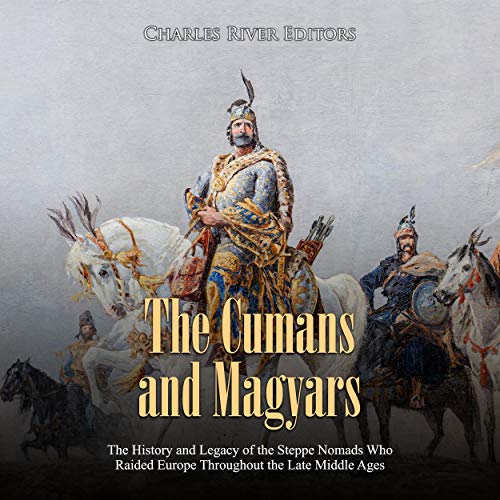
The Cumans and Magyars
Summary
Of all the steppe peoples in the medieval period, perhaps none were more important to European history than the Magyars. Like the Huns and Avars before them and the Cumans and Mongols after them, the Magyars burst into Europe as a destructive, unstoppable horde, taking whatever they wanted and leaving a steady stream of misery in their wake. They used much of the same tactics as the other steppe peoples and lived a similar, nomadic lifestyle. The Magyars also had many early cultural affinities with other steppe peoples, following a similar religion and ideas of kingship and nobility, among other things. That said, as similar as the Magyars may have been to other steppe nomads before and after them, they were noticeably different in one way: The Magyars settled down and became a part of Europe and Western Civilization in the Middle Ages. The Magyars exploded onto the European cultural scene in the late ninth century as foreign marauders, but they made alliances with many important kingdoms in less than a century and established their own dynasty in the area, roughly equivalent to the modern nation-state of Hungary. After establishing themselves as a legitimate dynasty among their European peers, the Magyars formed a sort of cultural bridge between the Roman Catholic kingdoms of Western Europe and the Orthodox Christian kingdoms of Eastern Europe. Ultimately, the Magyars chose the Roman Catholic Church, thereby becoming a part of the West and tying their fate to it for the remainder of the Middle Ages.
©2020 Charles River Editors (P)2020 Charles River Editors

The Cumans
Summary
Let us begin this narration, brethren, from the old times of Vladimir to this present time of Igor, who, strengthened his mind with courage, who quickened his heart with valor and, thus imbued with martial spirit, led his valiant regiments against the Kuman land in defense of the Russian land.” (The Tale of Igor’s Campaign) Before the Mongols rode across the steppes of Asia and Eastern Europe, the Cumans were a major military and cultural force that monarchs from China to Hungary and from Russia to the Byzantine Empire faced, often losing armies and cities in the process. The Cumans were a tribe of Turkic nomads who rode the steppes looking for plunder and riches, but they rarely stayed long after they got what they wanted. From the late 9th century until the arrival of the Mongols in 1223, there was virtually nothing that could be done to stop the Cumans. Old Russian chronicles, Byzantine texts, Western European chronicles, and travel diaries of Islamic scholars all reveal that the Cumans were a threat to any kingdom in their path. Some kingdoms chose to fight the Cumans and often suffered heavy destruction, while others believed buying them off was the more reasonable course of action. The latter course often brought them into intimate contact with the most powerful kingdoms of medieval Eastern Europe before the Cumans were eventually replaced by the Mongols, with the remaining Cumans dispersing and integrating into various European and central Asian kingdoms in the 13th century. Many Cumans joined the Mongol Golden Horde and later became Muslims, while some helped found dynasties in Bulgaria, Hungary, and Romania. The Cumans came from somewhat mysterious origins before they became the western vanguard of a massive nomadic horde that grew in ferocity and effectiveness as the centuries passed, but they were far more than mindless barbarians interested in violence alone. Although violence did play a major role in early Cuman culture, sources reveal they were also interested in diplomacy and eventually integrated with their sedentary neighbors. Archaeological discoveries further indicate that their culture was unique, complete with mythology and some art, but in the end, the Cumans disappeared as quickly as they appeared on the historical scene, much like other nomadic peoples before and after them. The Cumans: The History of the Medieval Turkic Nomads Who Fought the Mongols and Rus’ in Eastern Europe examines how the Cumans became a major fighting force in the region, and the influence they had. You will learn about the Cumans.
©2020 Charles River Editors (P)2020 Charles River Editors

Apartheid in South Africa: The History and Legacy of the Notorious Segregationist Policies in the 20th Century
Summary
Although apartheid is typically dated from the late 1940s until its dismantling decades later, segregationist policies had been the norm in South Africa from nearly the moment European explorers sailed to the region and began settling there. Whether it was displacing and fighting indigenous groups like the Khoi and San, or fighting other whites like the Boer, separation between ethnicities was the norm in South Africa for centuries before the election of Malan signaled the true rise of the Afrikaner far right. The man most associated with dismantling apartheid, of course, is Nelson Mandela. With the official policy of apartheid instituted in 1948 by an all-white government, Mandela was tried for treason between the years of 1956-61 before being acquitted. He participated in the Defiance Campaign of 1952, and oversaw the 1955 Congress of the People, but when the African National Congress was banned in 1960, he proposed a military wing, despite his initial reluctance toward violent resistance, a reluctance which had its roots in original nonviolent protests through the South African Communist Party. The ANC did not openly discourage such an idea, and the Umkhonto we Sizwe was established. Mandela was again arrested in 1962 and tried for attempts to overthrow the government by violence. The sentence was five years of hard labor, but this was increased to a life sentence in 1964, a sentence handed down to seven of his closest colleagues as well. Mandela would eventually serve 27 years, but his statements made in court received enormous international coverage and acclaim, and his reputation grew during his time in Robben Island Prison of Capetown, the Pollsmoor and Victor Verster Prisons. He was ultimately released in February 1990, in large part as a result of the international campaign generated by his words and the current South African story. Shortly after that, he was elected as the first man of African descent to the presidency of South Africa, which he held from 1994–1999. Most significant was that Mandela was elected from the first multi-factional, multi-racial election ever held in the country, a result of extensive negotiations with then President F.W. Klerk. Apartheid in South Africa: The History and Legacy of the Notorious Segregationist Policies in the 20th Century looks at the controversial policies, the background behind them, and their influence on the country. Along with pictures and a bibliography, you will learn about apartheid in South Africa like never before.
©2019 Charles River Editors (P)2019 Charles River Editors

The Uighurs
Summary
Most today are all too familiar with the unimaginable horrors, hardship, and heartache suffered by millions of North Koreans each passing day, as well as the unspeakable circumstances in Syria, Afghanistan, Yemen, and other war zones, as they very well should be. Average consumers of international news, however, are completely ignorant of the hideous plight and even the existence of the Uighurs themselves, a unique, multi-faceted people paddling strenuously in similarly dire straits.
For the most part, the Uighurs are based in East Turkestan, more commonly referred to as the Xinjiang Uighur Autonomous Region of the People's Republic of China. This prodigious plot of land boasts a total land area of over 1.665 million km², or 640,000 mi², and is, as China puts it, the largest administrative division in the country. The pro-independence inhabitants of East Turkestan, on the other hand, have been fighting for decades to regain sole control of their motherland - as of now, to no avail.
The Uighurs' active pursuit for independence is not an isolated phenomenon. It is reminiscent of the ongoing friction between Taiwan and China, as well as Hong Kong and China, the independence-seekers of the former states struggling to sever its ties with the Red Dragon. That being said, unlike Taiwan, which is managed by an entirely separate constitutional democratic government, and Hong Kong, classified as a special administrative region run by a Chief Executive and Executive Council with its own judicial system, Xinjiang, though technically autonomous, is still very much under the Chinese yoke.
Xinjiang is overseen by its own Communist Party Secretary and Chairman, who are reviled as “puppets of Beijing” behind closed doors. In 2012, Uighurs discreetly disseminated a poem about a former Xinjiang Chairman entitled “Salaam, Nur Bekri”, which skewered Bekri for his ineffective leadership; among their concerns were the climbing unemployment rates within the Uighur community, and the overtly preferential treatment the Han Chinese received. “Closed doors” and “discreet” are key words here. See, while China has been known to breach its agreements with Taiwan and Hong Kong regarding non-intervention on judicial cases and their rights to self-govern, the residents of these states possess the power to exercise freedom of speech, and are granted unfettered access to the internet. This concept, regrettably, has been forgotten by the Uighurs and the country's majority Han Chinese population.
Even more alarming, insiders say its people are imperiled, and this once thriving culture itself is no longer inching, but hurtling towards extinction. An untold number of Uighurs have, and continue to vanish without a trace. The Chinese government claims that the 13,000 or so imprisoned (and executed) since 2014 were radical separatists and “murderous devils” with poisonous vendettas.
A fraction of the Uighurs have been connected to violent acts of terrorism, but the often flimsy and incomplete evidence presented to defense teams certainly warrants some pause for thought. On top of the countless others supposedly snatched off the streets for speaking their minds, fostering their customs, or simply being kin to Uighurs who fled and turned refugee, over a million have been bussed to so-called “re-education camps” or “vocational training centers”. These are no different from “boarding schools”, Xinjiang officials insist, yet survivors have likened these detention centers to inescapable concentration camps.
The Uighurs: The History and Legacy of the Turkic Muslim Minority Group in Asia examines the origins of the Uighurs, their long history, and the notorious current events involving the Uighurs in China.
©2019 Charles River Editors (P)2019 Charles River Editors

The Magyars
Summary
"Having crossed the Danube, they encamped beside the Danube as far as Budafelhévíz. Hearing this, all the Romans living throughout the land of Pannonia, saved their lives by flight. Next day, Prince Árpád and all his leading men with all the warriors of Hungary entered the city of King Attila and they saw all the royal palaces, some ruined to the foundations, others not, and they admired beyond measure the stone buildings and were happier than can be told that they had deserved to take without fighting the city of King Attila, of whose line Prince Árpád descended. They feasted every day with great joy in the palace of King Attila, sitting alongside one another, and all the melodies and sweet sounds of zithers and pipes along with all the songs of minstrels were presented to them.... Prince Árpád gave great lands and properties to the guests staying with them, and, when they heard this, many guests thronged to him and gladly stayed with him.” (An excerpt from Gesta Hungarorum) Of all the steppe peoples in the medieval period, perhaps none were more important to European history than the Magyars. Like the Huns and Avars before them and the Cumans and Mongols after them, the Magyars burst into Europe as a destructive, unstoppable horde, taking whatever they wanted and leaving a steady stream of misery in their wake. They used much of the same tactics as the other steppe peoples and lived a similar, nomadic lifestyle. The Magyars also had many early cultural affinities with other steppe peoples, following a similar religion and ideas of kingship and nobility, among other things. That said, as similar as the Magyars may have been to other steppe nomads before and after them, they were noticeably different in one way: The Magyars settled down and became a part of Europe and Western civilization in the Middle Ages. The Magyars exploded onto the European cultural scene in the late ninth century as foreign marauders, but they made alliances with many important kingdoms in less than a century and established their own dynasty in the area, roughly equivalent to the modern nation-state of Hungary. After establishing themselves as a legitimate dynasty among their European peers, the Magyars formed a sort of cultural bridge between the Roman Catholic kingdoms of Western Europe and the Orthodox Christian kingdoms of Eastern Europe. Ultimately, the Magyars chose the Roman Catholic Church, thereby becoming a part of the West and tying their fate to it for the remainder of the Middle Ages. The Magyars: The History and Legacy of the Medieval Tribes That Established the Kingdom of Hungary examines the Magyars and their culture, from their origins through the Arpad Dynasty to their raids on Europe, the establishment of a royal dynasty, and their integration into Western civilization, marking the transition from the Magyars to Hungarians. You will learn about the Magyars like never before. Please note: The audio references supplemental material that is not included with the purchase of this audiobook.
©2020 Charles River Editors (P)2020 Charles River Editors

Loki: The Origins and History of the Famous Norse Trickster God
Summary
Much of what is known of the Norse myths comes from the 10th century onwards. Until this time and, indeed, for centuries afterwards, Norse culture (particularly that of Iceland, where the myths were eventually transcribed) was an oral culture. In fact, in all Scandinavian countries well into the 13th century laws were memorized by officials known as "Lawspeakers" who recited them at the "Thing." The Thing was the legislative assembly in Scandinavia "held for judicial purposes". One of the most famous of these Lawspeakers was the Icelander Snorri Sturluson, a masterful writer who wrote the Prose Edda in the 13th century. There are other sources for the Norse myths, namely the later "Poetic Edda", a collection of poems and prose work, and other sagas but the Snorri's Prose Edda is the most complete work whose attribution is known to modern scholars. It is believed that Snorri, a Christian, recorded these pagan beliefs so as to preserve and explain the stylistic poetry of Iceland, particularly the popular descriptive devices known as kennings. A kenning is made up of a base word and a modifying word that is used to describe a separate object. For example, "Gold" had a great many kennings, one of which was "Sif's Hair". If, however, the memory of Loki cutting off Sif's hair and replacing it with gold were lost, then this kenning would make no sense to later generations. There are many of these allusions to the myths and it is thanks to them that the myths have survived.
©2017 Charles River Editors (P)2017 Charles River Editors

Homo Erectus: The History of the Archaic Humans Who Left Africa and Formed the First Hunter-Gatherer Societies
Summary
Most scientists believe the evolution of humans has a history as long as life itself. Anatomically modern humans and all other life that has existed on the planet first came about from the single-celled microorganisms that emerged approximately 4 billion years ago. Through the processes of mutation and natural selection, all forms of life developed, and this continuous lineage of life makes it difficult to say precisely when one species completely separates from another. In other words, scientists still debate when a human became a human rather than the ancestor species that came before. Around 1.8 million years ago, a third species of Homo appeared in the fossil record. H. erectus would have shared the landscape for a time with H. habilis and H. rudolfensis, but the fossils of H. erectus are not limited to eastern and southern Africa. Instead, they are found across Africa and parts of mainland and insular Asia. This is the first species of Homo to be found outside Africa (Rightmire 1993). Features of H. erectus suggest an evolution toward modern humans, and the features that separate H. erectus from the other Homo species are found in the skull. The size of the brain was approximately 900 cc, making it larger than the brain size of H. habilis. H. erectus would not have the largest brain capacity of the Homo genus during its existence, with the emergence of H. heidelbergensis approximately 800,000 years ago. The larger brain size may not matter much when the size of the brain is considered with the size of the body, which also increased. While the facial features of H. erectus would have made them noticeably different if they were alive today, their postcranial morphology may have been similar to modern humans. A key difference is the density or thickness of the bones; in H. erectus the limb bones are more robust, but otherwise they appear very similar to modern humans. The length of the hindlimbs in relation to the arms is similar to modern humans, which means that H. erectus may have been able to walk in a similar way. (Richtmire 1993: 57–84). This may or may not be linked with the widespread distribution of H. erectus. Perhaps more important for H. erectus than simply being able to walk out of Africa would have been the ability to adapt to changing climates and essentially modify the environment around them. Most notably, the major advantage that H. erectus would have had is the ability to control fire. This skill, which no other animal has mastered, helped H. erectus travel across the world, and it may date as far back as 1.7 million years ago to as recently as 200,000 years ago. Most scientists agree that H. erectus was able to control fire by at least 600,000 years ago. Homo Erectus: The History of the Archaic Humans Who Left Africa and Formed the First Hunter-Gatherer Societies examines how H. erectus evolved, and what their lives were like.
©2018 Charles River Editors (P)2018 Charles River Editors

The First Sino-Japanese War
Summary
Completing the Meiji Restoration that heralded the dawn of a new era for both Japan and Asia, the island nation found itself thrust into the modern world, a world of industry and conquest. Flexing its new muscles, the burgeoning power soon came to blows with the regional power that for centuries dominated the area politically and culturally: China. Also seeking to modernize in the wake of Western exploitation, China struggled to adapt to the changing times, doing everything it could to maintain a balance between modernity and tradition. Japan found that balance, and, with its new industry desperate for raw materials, looked to the peninsula of Korea for new markets and resources. China, in contrast, refused to strike such a balance, adopting a veneer of modernity while maintaining the status quo, both domestically and with regards to Korea. For decades Korea existed as a protectorate of China, paying homage to the mighty Chinese dynasties while minding its own business as best it could. However, sensing weakness in the former regional power after being defeated by the Europeans during the Second Opium War, escalating tensions over Korea between the old power of China and the new power of Japan led to the First Sino-Japanese War. In its first modern war, the modernized Japanese empire went to war against the dominant power in the region, and though interested Western powers favored China, Japan won the day, claiming Korea as their conquest and permanently upsetting the balance of power in the region. The conflict paved the way for the future Empire of Japan and the collapse of the Qing Dynasty. Though both nations modernized, and China far outweighed Japan in terms of men and materiel potential, the island nation handily won its first modern war.
©2018 Charles River Editors (P)2018 Charles River Editors

The French Revolution: A Captivating Guide to the Ten-Year Revolution in France and the Impact Made by Napoleon Bonaparte
Summary
Explore the captivating history of the French Revolution. Few historical events are as greatly revered and entirely misunderstood as the French Revolution that began in 1789. The memory of this complicated and lengthy political, violent uprising has been generally painted in broad - and oversimplified - strokes. While the French Revolution was certainly centered around two lavish monarchs and an enlightened common class, there was so much more going on behind the scenes. In The French Revolution: A Captivating Guide to the Ten-Year Revolution in France and the Impact Made by Napoleon Bonaparte, you will discover topics such as: A brief history of the French Monarchy Philosophies of the times France in the 18th century Marie Antoinette, Madame Deficit Taxes, famine, and the Enlightenment Sieyes’ “What Is the Third Estate?” The National Assembly Death of the Dauphin Bastille Day The first mayor of Paris Declaration of the Rights of Man...and the Women’s March France at war The Flight to Varennes Storming the Tuileries The monarchy is outlawed The fate of the colonies The Louisiana Purchase The Reign of Terror The new French calendar Emperor Napoleon Bonaparte In the days and years afterward And much, much more! So, if you want to learn more about the French Revolution, then listen to this audiobook now!
©2018 Captivating History (P)2019 Captivating History

Baldr: The Origins and History of the Famous Norse God Whose Death Leads to Ragnarok
Summary
One of the most influential and famous of the Norse Gods, Baldr "the Bright", Odin’s second son, occupies a place in Norse mythology like no other. His fate was either that of the harbinger of doom or of salvation, depending on the interpretation of his myths. His story is one of the few that plays a pivotal role in the early days of the gods, as well as in their cataclysmic end?-?Ragnarök?-?and was even one of the very few to return to the light after the devastation. Baldr was not just a key figure in Norse mythology, however, features of his story?-?his apparent resurrection being one?-?are central to some of the most pivotal myths to emerge from Indo-European traditions and they make for fascinating learning to anybody with an interest in the movement and development of Scandinavian culture as well as that of Christianity. Featuring miracles and magic, descents into the underworld and the destruction of the gods, Baldr’s story remains one of the most beloved in all world mythology. Baldr: The Origins and History of the Famous Norse God Whose Death Leads to Ragnarok looks at the story and the legendary Norse deity. You will learn about Baldr like never before.
©2017 Charles River Editors (P)2018 Charles River Editors

Boudica: The Life and Legacy of the Celtic Queen Who Rebelled Against the Romans in Britain
Summary
The famous conqueror from the European continent came ashore with thousands of men, ready to set up a new kingdom in England. The Britons had resisted the amphibious invasion from the moment his forces landed, but he was able to push forward. In a large winter battle, the Britons’ large army attacked the invaders but was eventually routed, and the conqueror was able to set up a new kingdom. Over 1,100 years before William the Conqueror became the king of England after the Battle of Hastings, Julius Caesar came, saw, and conquered part of “Britannia”, setting up a Roman province with a puppet king in 54 BCE. In the new province, the Romans eventually constructed a military outpost overlooking a bridge across the River Thames. The new outpost was named Londinium, and it covered just over two dozen acres. Londinium had become the largest city in Britannia shortly before being burned down in a native revolt led by an infamous Celtic Iceni queen named Boudica. With a name meaning “Victory”, Boudica was a charismatic woman who commanded nearly 100,000 Celts and led them on a campaign to expel the Roman overlords from Britain around the year 61 CE. Often called the “Celtic Queen”, she wore a warrior’s necklace around her delicate neck and rode upon a sturdy steed. According to the ancient historian Cassius Dio, “In stature, she was very tall, in appearance most terrifying, in the glance of her eye most fierce, and her voice was harsh.” It is said she had a piercing glare that could shrink her people’s enemies, which in this case were the Roman legionnaires under the vengeful general Suetonius. Boudica was not only a woman of high intelligence but also a Druid priestess of great repute, which caused the Romans a unique kind of concern. The Celts have fascinated people for centuries, and the biggest fascination of all has been over the Druids, a religious class at the heart of Celtic society that wielded great power. Naturally, people have been interested in Druids for centuries mostly because they don’t understand much about the Druids or their practices. The word comes from the Romans, who labeled them "Druidae" in reference to the white robed order of Celtic priests living in Gaul, Britain, and Ireland. They were a well-organized, secretive group who kept no written records and performed their rituals - allegedly including human sacrifice - in oaken groves, all of which interested and horrified Roman writers.
©2019 Charles River Editors (P)2019 Charles River Editors

British Legends: The Life and Legacy of Margaret Thatcher
Summary
A lot of ink has been spilled covering the lives of history's most influential figures, but how much of the forest is lost for the trees? In Charles River Editors' British Legends series, listeners can get caught up to speed on the lives of Great Britain's most important men and women in the time it takes to finish a commute, while learning interesting facts long forgotten or never known. Sir Winston Churchill is often cited as Britain's greatest prime minister for leading the United Kingdom against Hitler's Nazi war machine during World War II, and indeed he was the idol of the one person who many think might have surpassed him: Margaret Thatcher. Thatcher not only became Britain's first female prime minister; she also became its longest serving prime minister. The political precedents Thatcher set as a woman would be enough of a legacy in their own right, but Thatcher effectively wielded her power in a way that made a lasting contribution to both geopolitics and the perception of female politicians in general. Thatcher is widely credited, along with Ronald Reagan, as one of the principal Cold Warriors who brought about the demise of the Soviet Union, whose leaders gave her the famous nickname "Iron Lady". And, of course, Thatcher was recently in the spotlight again with the release of the critically acclaimed movie The Iron Lady, starring Meryl Streep. With the success of that movie, Thatcher has undergone a cultural revival and reiconization in many quarters for her political stances and political achievements. At the same time, however, the role she played as a woman is now often overlooked out of the expedience of political correctness, and it is considered uncivil to analyze Thatcher's political rise through the prism of sex. In fact at times the former prime minister claimed to understand an issue better due to her sex and sometimes used her sex more subliminally. British Legends: The Life and Legacy of Margaret Thatcher details the Iron Lady's life and career, but it also humanizes her and explores the role gender played in her rise to power and ultimately her legacy.
©2012 Charles River Editors (P)2015 Charles River Editors

The First Italian War
Summary
In 1494, there were five sovereign regional powers in Italy: Milan, Venice, Florence, the Papal States, and Naples. In 1536, only one remained - Venice. These decades of conflict precipitated great anxiety among Western thinkers. Italians responded to the fragmentation, forevermore, of Latin Christendom, the end of self-governance for Italians, and the beginning of the early modern era in a myriad of ways. They were always heavily influenced by the lived experience of warfare between large Christian armies on the peninsula. Most historians credit the city-state of Florence as the place that started and developed the Italian Renaissance, a process carried out through the patronage and commission of artists during the late 12th century. If Florence is receiving its due credit, much of it belongs to the Medicis, the family dynasty of Florence that ruled at the height of the Renaissance. The dynasty held such influence that some of its family members were even ordained as pope. Among all of the Medicis, its most famous member ruled during the Golden Age of Florence, at the apex of the Renaissance’s artistic achievements. Lorenzo de Medici, commonly referred to as Lorenzo the Magnificent, was groomed both intellectually and politically to rule, and he took the reins of power at the age of 20. Lorenzo de Medici may have not been a king, prince, or duke, but he nevertheless held significant influence over all of the noble houses of the region, from Milan and Naples to the King of France. Between 1482 and 1484, Lorenzo’s influence prevented a close alliance between King Louis IX of France and the city of Venice, which was at war with Ferrara. Lorenzo’s personal influence helped reduce Venice’s power in the region. During the Baron’s War of 1485 and 1486, while Florence sided with the pope, Lorenzo favored Ferdinando of Aragon, who had close ties with Naples, giving Lorenzo the chance to attempt to negotiate an improvement in relations between the pope and Naples. While the two had once been allied against Florence, their alliance had ended with the war. Lorenzo proposed a new agreement between the two, largely centered around financial obligations, in 1489. It was accepted in 1492, creating an enduring peace for some time. Perhaps fittingly, once Lorenzo the Magnificent died, the tenuous peace would go with him, touching off the Italian Wars. The First Italian War: The History and Legacy of the Italian Wars’ Initial Conflict at the Height of the Renaissance chronicles the various nations and city-states that jousted for power throughout the peninsula during the late 15th century. The audiobook presents places and events that'll help you learn about the First Italian War like never before.
©2019 Charles River Editors (P)2019 Charles River Editors

Lagash
Summary
In southern Iraq, a crushing silence hangs over the dunes. For nearly 5,000 years, the sands of the Iraqi desert have held the remains of the oldest known civilization: the Sumerians. When American archaeologists discovered a collection of cuneiform tablets in Iraq in the late 19th century, they were confronted with a language and a people who were at the time only scarcely known to even the most knowledgeable scholars of ancient Mesopotamia. The exploits and achievements of other Mesopotamian peoples, such as the Assyrians and Babylonians, were already known to a large segment of the population through the Old Testament and the nascent field of Near Eastern studies had unraveled the enigma of the Akkadian language that was widely used throughout the region in ancient times, but the discovery of the Sumerian tablets brought to light the existence of the Sumerian culture, which was the oldest of all the Mesopotamian cultures. For a people so great it is unfortunate that their accomplishments and contributions, not only to Mesopotamian civilization but to civilization in general, largely go unnoticed by the majority of the public. Perhaps the Sumerians were victims of their own success; they gradually entered the historical record, established a fine civilization, and then slowly submerged into the cultural patchwork of their surroundings. They also never suffered a great and sudden collapse like other peoples of the ancient Near East, such as the Hittites, Assyrians and Neo-Babylonians did. A close examination of Sumerian culture and chronology reveals that the Sumerians set the cultural tone in Mesopotamia for several centuries in the realms of politics/governments, arts, literature, and religion. The Sumerians were truly a great people whose legacy continued long after they were gone.
©2017 Charles River Editors (P)2017 Charles River Editors

Northern Rhodesia and Southern Rhodesia
Summary
The modern history of Africa was until very recently written on behalf of the indigenous races by the white man, who had forcefully entered the continent during a particularly hubristic and dynamic phase of European history. In 1884, Prince Otto von Bismark, the German chancellor, brought the plenipotentiaries of all major powers of Europe together to deal with Africa's colonization in such a manner as to avoid provocation of war. This event - known as the Berlin Conference of 1884-1885 - galvanized a phenomenon that came to be known as the Scramble for Africa. The conference established two fundamental rules for European seizure of Africa. The first of these was that no recognition of annexation would be granted without evidence of a practical occupation; and second, that a practical occupation would be deemed unlawful without a formal appeal for protection made on behalf of a territory by its leader, a plea that must be committed to paper in the form of a legal treaty. This began a rush, spearheaded mainly by European commercial interests in the form of chartered companies, to penetrate the African interior and woo its leadership with guns, trinkets, and alcohol, and having thus obtained their marks or seals upon spurious treaties, begin establishing boundaries of future European African colonies. The ease with which this was achieved was due to the fact that, at that point, traditional African leadership was disunited, and the people had just staggered back from centuries of concussion inflicted by the slave trade. Thus, to usurp authority, to intimidate an already broken society, and to play one leader against the other was a diplomatic task so childishly simple, the matter was wrapped up, for the most part, in less than a decade. There were some exceptions to this, however, the most notable of which was perhaps the Zulu Nation, a centralized monarchy of enormous military prowess that required a British colonial war, the storied Anglo-Zulu War of 1879, to affect pacification. Another was the amaNdebele, an offshoot of the Zulu, established as early as the 1830s in the southeastern quarter of what would become Rhodesia, and later still Zimbabwe, in the future. Both were powerful, centralized monarchies, fortified by an organized and aggressive professional army, subdivided into regiments, and owing fanatical loyalty to the crown. The Zulu were not dealt with by treaty, and their history is perhaps the subject of another episode of this series, but the amaNdebele were, and early European treaty and concession gatherers were required to tread with great caution as they entered their lands. It would be a long time before the inevitable course of history forced the amaNdebele to submit to European domination. Although treaties and British gunboat diplomacy played a role, it was ultimately war, conquest, and defeat in battle that brought the amaNdebele to heel.
©2020 Charles River Editors (P)2020 Charles River Editors