The Computer Science category has 133 audiobooks on Listento.it, with an average listener rating of 4★ across 570 ratings. The most-rated is Life 3.0.

Life 3.0
Summary
How will artificial intelligence affect crime, war, justice, jobs, society, and our very sense of being human? The rise of AI has the potential to transform our future more than any other technology - and there's nobody better qualified or situated to explore that future than Max Tegmark, an MIT professor who's helped mainstream research on how to keep AI beneficial. How can we grow our prosperity through automation without leaving people lacking income or purpose? What career advice should we give today's kids? How can we make future AI systems more robust so that they do what we want without crashing, malfunctioning, or getting hacked? Should we fear an arms race in lethal autonomous weapons? Will machines eventually outsmart us at all tasks, replacing humans on the job market and perhaps altogether? Will AI help life flourish like never before or give us more power than we can handle? What sort of future do you want? This book empowers you to join what may be the most important conversation of our time. It doesn't shy away from the full range of viewpoints or from the most controversial issues - from superintelligence to meaning, consciousness, and the ultimate physical limits on life in the cosmos.
©2017 Max Tegmark (P)2017 Random House Audio
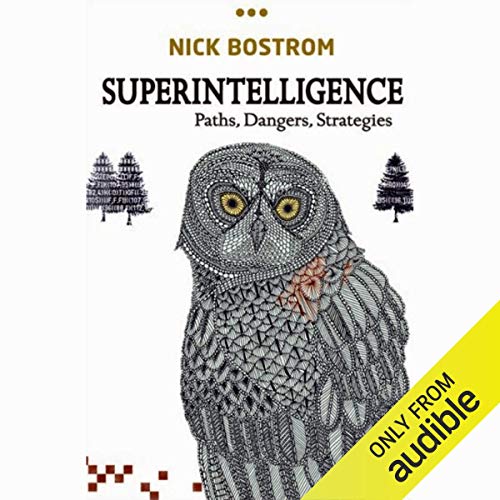
Superintelligence
Summary
Superintelligence asks the questions: What happens when machines surpass humans in general intelligence? Will artificial agents save or destroy us? Nick Bostrom lays the foundation for understanding the future of humanity and intelligent life. The human brain has some capabilities that the brains of other animals lack. It is to these distinctive capabilities that our species owes its dominant position. If machine brains surpassed human brains in general intelligence, then this new superintelligence could become extremely powerful - possibly beyond our control. As the fate of the gorillas now depends more on humans than on the species itself, so would the fate of humankind depend on the actions of the machine superintelligence. But we have one advantage: We get to make the first move. Will it be possible to construct a seed Artificial Intelligence, to engineer initial conditions so as to make an intelligence explosion survivable? How could one achieve a controlled detonation? This profoundly ambitious and original book breaks down a vast track of difficult intellectual terrain. After an utterly engrossing journey that takes us to the frontiers of thinking about the human condition and the future of intelligent life, we find in Nick Bostrom's work nothing less than a reconceptualization of the essential task of our time. PLEASE NOTE: When you purchase this title, the accompanying reference material will be available in your Library section along with the audio.
©2014 Nick Bostrom (P)2014 Audible Inc.

The Big Nine
Summary
A call-to-arms about the broken nature of artificial intelligence, and the powerful corporations that are turning the human-machine relationship on its head. We like to think that we are in control of the future of "artificial" intelligence. The reality, though, is that we - the everyday people whose data powers AI - aren't actually in control of anything. When, for example, we speak with Alexa, we contribute that data to a system we can't see and have no input into - one largely free from regulation or oversight. The big nine corporations - Amazon, Google, Facebook, Tencent, Baidu, Alibaba, Microsoft, IBM and Apple - are the new gods of AI and are short-changing our futures to reap immediate financial gain. In this book, Amy Webb reveals the pervasive, invisible ways in which the foundations of AI - the people working on the system, their motivations, the technology itself - is broken. Within our lifetimes, AI will, by design, begin to behave unpredictably, thinking and acting in ways which defy human logic. The big nine corporations may be inadvertently building and enabling vast arrays of intelligent systems that don't share our motivations, desires, or hopes for the future of humanity. Much more than a passionate, human-centered call-to-arms, this book delivers a strategy for changing course, and provides a path for liberating us from algorithmic decision-makers and powerful corporations.
©2019 Amy Webb (P)2019 Hachette Audio

The History of the Future
Summary
The dramatic, larger-than-life true story behind the founding of Oculus and its quest for virtual reality, by the best-selling author of Console Wars. From iconic books like Neuromancer to blockbuster films like The Matrix, virtual reality has long been hailed as the ultimate technology. But outside of a few research labs and military training facilities, this tantalizing vision of the future was nothing but science fiction. Until 2012, when Oculus founder Palmer Luckey - then just a rebellious teenage dreamer living alone in a camper trailer - invents a device that has the potential to change everything. With the help of a video game legend, a serial entrepreneur, and many other colorful characters, Luckey’s scrappy start-up kick-starts a revolution and sets out to bring VR to the masses. As with most underdog stories, things don’t quite go according to plan. But what happens next turns out to be the ultimate entrepreneurial journey: a tale of battles won and lost, lessons learned, and never-ending twists and turns - including an unlikely multibillion-dollar acquisition by Facebook’s Mark Zuckerberg that shakes up the landscape in Silicon Valley and gives Oculus the chance to forever change our reality. Drawing on more than 100 interviews with the key players driving this revolution, The History of the Future weaves together a rich, cinematic narrative that captures the breakthroughs, breakdowns, and human drama of trying to change the world. The result is a super accessible and supremely entertaining look at the birth of a game-changing new industry. PLEASE NOTE: When you purchase this title, the accompanying PDF will be available in your Audible Library along with the audio.
©2019 Blake J. Harris (P)2019 HarperCollins Publishers
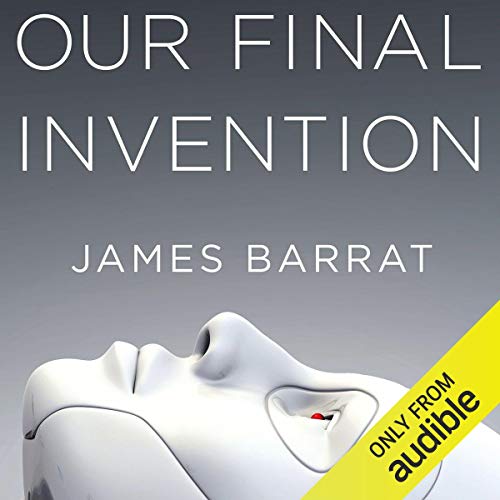
Our Final Invention
Summary
A Huffington Post Definitive Tech Book of 2013 Artificial Intelligence helps choose what books you buy, what movies you see, and even who you date. It puts the "smart" in your smartphone and soon it will drive your car. It makes most of the trades on Wall Street, and controls vital energy, water, and transportation infrastructure. But Artificial Intelligence can also threaten our existence. In as little as a decade, AI could match and then surpass human intelligence. Corporations and government agencies are pouring billions into achieving AI’s Holy Grail - human-level intelligence. Once AI has attained it, scientists argue, it will have survival drives much like our own. We may be forced to compete with a rival more cunning, more powerful, and more alien than we can imagine. Through profiles of tech visionaries, industry watchdogs, and groundbreaking AI systems, Our Final Invention explores the perils of the heedless pursuit of advanced AI. Until now, human intelligence has had no rival. Can we coexist with beings whose intelligence dwarfs our own? And will they allow us to?
©2013 James Barrat (P)2014 Audible Inc.

Deep Thinking
Summary
Garry Kasparov's 1997 chess match against the IBM supercomputer Deep Blue was a watershed moment in the history of technology. It was the dawn of a new era in artificial intelligence: a machine capable of beating the reigning human champion at this most cerebral game. That moment was more than a century in the making, and in this breakthrough book, Kasparov reveals his astonishing side of the story for the first time. He describes how it felt to strategize against an implacable, untiring opponent with the whole world watching, and recounts the history of machine intelligence through the microcosm of chess, considered by generations of scientific pioneers to be a key to unlocking the secrets of human and machine cognition. Kasparov uses his unrivaled experience to look into the future of intelligent machines and sees it bright with possibility. As many critics decry artificial intelligence as a menace, particularly to human jobs, Kasparov shows how humanity can rise to new heights with the help of our most extraordinary creations, rather than fear them. Deep Thinking is a tightly argued case for technological progress, from the man who stood at its precipice with his own career at stake.
©2017 Garry Kasparov (P)2017 Hachette Audio

The Simulation Hypothesis: An MIT Computer Scientist Shows Why AI, Quantum Physics, and Eastern Mystics All Agree We Are in a Video Game
Summary
The Simulation Hypothesis, by best-selling author, renowned MIT computer scientist, and Silicon Valley video game designer Rizwan Virk, explains one of the most daring and consequential theories of our time. Drawing from research and concepts from computer science, artificial intelligence, video games, quantum physics, and referencing both speculative fiction and ancient eastern spiritual texts, Virk shows how all of these traditions come together to point to the idea that we may be inside a simulated reality like the Matrix. The Simulation Hypothesis is the idea that our physical reality, far from being a solid physical universe, is part of an increasingly sophisticated video game-like simulation, where we all have multiple lives, consisting of pixels with its own internal clock run by some giant Artificial Intelligence. Simulation theory explains some of the biggest mysteries of quantum and relativistic physics, such as quantum indeterminacy, parallel universes, and the integral nature of the speed of light. “There’s a one in a billion chance we are not living in a simulation.” (Elon Musk) “I find it hard to argue we are not in a simulation.” (Neil deGrasse Tyson) “We are living in computer generated reality.” (Philip K. Dick) Video game designer Riz Virk shows how the history and evolution of our video games, including virtual reality, augmented reality, artificial intelligence, and quantum computing could lead us to the point of being able to develop all encompassing virtual worlds like the Oasis in Ready Player One, or the simulated reality in The Matrix. While the idea sounds like science fiction, many scientists, engineers, and professors have given the simulation hypothesis serious consideration. But the simulation hypothesis is not just a modern idea. Philosophers and mystics of all traditions have long contended that we are living in some kind of “illusion“ and that there are other realities which we can access with our minds. Whether you are a computer scientist, a fan of science fiction like The Matrix movies, a video game enthusiast, or a spiritual seeker, The Simulation Hypothesis touches on all these areas, and you will never look at the world the same way again!
©2019 Rizwan Virk (P)2019 Rizwan Virk

Human Compatible
Summary
"The most important book on AI this year." (The Guardian) "Mr. Russell's exciting book goes deep, while sparkling with dry witticisms." (The Wall Street Journal) "The most important book I have read in quite some time" (Daniel Kahneman) "A must-read" (Max Tegmark) "The book we've all been waiting for" (Sam Harris) A leading artificial intelligence researcher lays out a new approach to AI that will enable us to coexist successfully with increasingly intelligent machines. In the popular imagination, superhuman artificial intelligence is an approaching tidal wave that threatens not just jobs and human relationships, but civilization itself. Conflict between humans and machines is seen as inevitable and its outcome all too predictable. In this groundbreaking audiobook, distinguished AI researcher Stuart Russell argues that this scenario can be avoided, but only if we rethink AI from the ground up. Russell begins by exploring the idea of intelligence in humans and in machines. He describes the near-term benefits we can expect, from intelligent personal assistants to vastly accelerated scientific research, and outlines the AI breakthroughs that still have to happen before we reach superhuman AI. He also spells out the ways humans are already finding to misuse AI, from lethal autonomous weapons to viral sabotage. If the predicted breakthroughs occur and superhuman AI emerges, we will have created entities far more powerful than ourselves. How can we ensure they never, ever, have power over us? Russell suggests that we can rebuild AI on a new foundation, according to which machines are designed to be inherently uncertain about the human preferences they are required to satisfy. Such machines would be humble, altruistic, and committed to pursue our objectives, not theirs. This new foundation would allow us to create machines that are provably deferential and provably beneficial.
©2019 Stuart Russell (P)2019 Penguin Audio

On the Future
Summary
A provocative and inspiring look at the future of humanity and science from world-renowned scientist and best-selling author Martin Rees Humanity has reached a critical moment. Our world is unsettled and rapidly changing, and we face existential risks over the next century. Various outcomes - good and bad - are possible. Yet our approach to the future is characterized by short-term thinking, polarizing debates, alarmist rhetoric, and pessimism. In this short, exhilarating book, renowned scientist and best-selling author Martin Rees argues that humanity’s prospects depend on our taking a very different approach to planning for tomorrow. The future of humanity is bound to the future of science and hinges on how successfully we harness technological advances to address our challenges. If we are to use science to solve our problems while avoiding its dystopian risks, we must think rationally, globally, collectively, and optimistically about the long term. Advances in biotechnology, cybertechnology, robotics, and artificial intelligence - if pursued and applied wisely - could empower us to boost the developing and developed world and overcome the threats humanity faces on Earth, from climate change to nuclear war. At the same time, further advances in space science will allow humans to explore the solar system and beyond with robots and AI. But there is no “Plan B” for Earth - no viable alternative within reach if we do not care for our home planet. Rich with fascinating insights into cutting-edge science and technology, this accessible book will captivate anyone who wants to understand the critical issues that will define the future of humanity on Earth and beyond.
©2018 Martin Rees (P)2018 Princeton University Press

Possible Minds
Summary
Science-world luminary John Brockman assembles 25 of the most important scientific minds, people who have been thinking about the field of artificial intelligence for most of their careers, for an unparalleled roundtable examination about mind, thinking, intelligence, and what it means to be human. "Artificial intelligence is today's story - the story behind all other stories. It is the Second Coming and the Apocalypse at the same time: Good AI versus evil AI." (John Brockman) More than 60 years ago, mathematician-philosopher Norbert Wiener published a book on the place of machines in society that ended with a warning: "We shall never receive the right answers to our questions unless we ask the right questions.... The hour is very late, and the choice of good and evil knocks at our door." In the wake of advances in unsupervised, self-improving machine learning, a small but influential community of thinkers is considering Wiener's words again. In Possible Minds, John Brockman gathers their disparate visions of where AI might be taking us. The fruit of the long history of Brockman's profound engagement with the most important scientific minds who have been thinking about AI - from Alison Gopnik and David Deutsch to Frank Wilczek and Stephen Wolfram - Possible Minds is an ideal introduction to the landscape of crucial issues AI presents. The collision between opposing perspectives is salutary and exhilarating; some of these figures, such as computer scientist Stuart Russell, Skype cofounder Jaan Tallinn, and physicist Max Tegmark, are deeply concerned with the threat of AI, including the existential one, while others, notably robotics entrepreneur Rodney Brooks, philosopher Daniel Dennett, and best-selling author Steven Pinker, have a very different view. Serious, searching, and authoritative, Possible Minds lays out the intellectual landscape of one of the most important topics of our time. Read by Jason Culp, Rob Shapiro, Vikas Adam, Will Damron, and Kathleen McInerney.
©2019 John Brockman (P)2019 Penguin Audio

Digital Transformation
Summary
From visionary Silicon Valley entrepreneur Tom Siebel comes a penetrating examination of the new technologies that are disrupting business and government - and how organizations can harness them to transform into digital enterprises. The confluence of four technologies - elastic cloud computing, big data, artificial intelligence, and the internet of things - writes Siebel, is fundamentally changing how business and government will operate in the 21st century. Siebel masterfully guides listeners through a fascinating discussion of the game-changing technologies driving digital transformation and provides a roadmap to seize them as a strategic opportunity. He shows how leading enterprises such as Enel, 3M, Royal Dutch Shell, the US Department of Defense, and others are applying AI and IoT with stunning results. Digital Transformation is the guidebook every business and government leader needs to survive and thrive in the new digital age. Image credited to Regan McCamey PLEASE NOTE: When you purchase this title, the accompanying PDF will be available in your Audible Library along with the audio.
©2019 Thomas M. Siebel (P)2019 Audible, Inc.

The Alignment Problem
Summary
A jaw-dropping exploration of everything that goes wrong when we build AI systems and the movement to fix them. Today’s “machine-learning” systems, trained by data, are so effective that we’ve invited them to see and hear for us - and to make decisions on our behalf. But alarm bells are ringing. Recent years have seen an eruption of concern as the field of machine learning advances. When the systems we attempt to teach will not, in the end, do what we want or what we expect, ethical and potentially existential risks emerge. Researchers call this the alignment problem. Systems cull résumés until, years later, we discover that they have inherent gender biases. Algorithms decide bail and parole - and appear to assess Black and White defendants differently. We can no longer assume that our mortgage application, or even our medical tests, will be seen by human eyes. And as autonomous vehicles share our streets, we are increasingly putting our lives in their hands. The mathematical and computational models driving these changes range in complexity from something that can fit on a spreadsheet to a complex system that might credibly be called “artificial intelligence.” They are steadily replacing both human judgment and explicitly programmed software. In best-selling author Brian Christian’s riveting account, we meet the alignment problem’s “first-responders,” and learn their ambitious plan to solve it before our hands are completely off the wheel. In a masterful blend of history and on-the-ground reporting, Christian traces the explosive growth in the field of machine learning and surveys its current, sprawling frontier. Listeners encounter a discipline finding its legs amid exhilarating and sometimes terrifying progress. Whether they - and we - succeed or fail in solving the alignment problem will be a defining human story. The Alignment Problem offers an unflinching reckoning with humanity’s biases and blind spots, our own unstated assumptions and often contradictory goals. A dazzlingly interdisciplinary work, it takes a hard look not only at our technology but at our culture - and finds a story by turns harrowing and hopeful.
©2020 Brian Christian (P)2020 Brilliance Publishing, Inc., all rights reserved.

Rebooting AI
Summary
Two leaders in the field offer a compelling analysis of the current state of the art and reveal the steps we must take to achieve a truly robust artificial intelligence. Despite the hype surrounding AI, creating an intelligence that rivals or exceeds human levels is far more complicated than we have been led to believe. Professors Gary Marcus and Ernest Davis have spent their careers at the forefront of AI research and have witnessed some of the greatest milestones in the field, but they argue that a computer beating a human in Jeopardy! does not signal that we are on the doorstep of fully autonomous cars or superintelligent machines. The achievements in the field thus far have occurred in closed systems with fixed sets of rules, and these approaches are too narrow to achieve genuine intelligence. The real world, in contrast, is wildly complex and open-ended. How can we bridge this gap? What will the consequences be when we do? Taking inspiration from the human mind, Marcus and Davis explain what we need to advance AI to the next level, and suggest that if we are wise along the way, we won't need to worry about a future of machine overlords. If we focus on endowing machines with common sense and deep understanding, rather than simply focusing on statistical analysis and gathering ever-larger collections of data, we will be able to create an AI we can trust - in our homes, our cars, and our doctors' offices. Rebooting AI provides a lucid, clear-eyed assessment of the current science and offers an inspiring vision of how a new generation of AI can make our lives better.
©2019 Gary Marcus (P)2019 Random House Audio

Stay Awhile and Listen
Summary
Two companies. Two opposing cultures. One multi-billion-dollar video game empire. Stay Awhile and Listen: How Two Blizzards Unleashed Diablo and Forged a Video Game Empire invites listeners to discover the origin of Blizzard North, a studio built by gamers, for gamers, and Blizzard Entertainment, a convergence of designers driven to rule their industry. Composed from exhaustive research and hundreds of personal interviews, the Stay Awhile and Listen series divulges the fated meeting that brought the two Blizzards together, the clashes that tore them apart, and their transformation from grassroots democracy to corporate empire. At the center of it all - Diablo, a hack-and-slash adventure through the darkest recesses of Hell that changed online gaming forever.
©2015 David Craddock (P)2015 Audiobooks.com

To Be a Machine
Summary
Meet the visionaries, billionaires, professors, and programmers who are using groundbreaking technology to push the limits of the human body - our senses, our intelligence, and our lifespans Once relegated to the fringes of society, transhumanism (the use of technology to enhance human intellectual and physical capability) is now poised to enter our cultural mainstream. It has found adherents in Silicon Valley billionaires Ray Kurzweil and Peter Diamandis. Google has entered the picture, establishing a biotech subsidiary aimed at solving the problem of aging. In To Be a Machine, journalist Mark O'Connell takes a headlong dive into this burgeoning movement. He travels to the laboratories, conferences, and basements of today's foremost transhumanists, where he's presented with the staggering possibilities and moral quandaries of new technologies like mind uploading, artificial superintelligence, cryonics, and device implants. A contributor to Slate, The New Yorker, and The New York Times Magazine, O'Connell serves as a sharp and lively guide to the outer limits of technology in the 21st century. In investigating what it means to be a machine, he offers a surprising, singular meditation on what it means to be human.
©2017 Mark O'Connell (P)2017 Random House Audio

The Deep Learning Revolution
Summary
How deep learning - from Google Translate to driverless cars to personal cognitive assistants - is changing our lives and transforming every sector of the economy. The deep-learning revolution has brought us driverless cars, the greatly improved Google Translate, fluent conversations with Siri and Alexa, and enormous profits from automated trading on the New York Stock Exchange. Deep-learning networks can play poker better than professional poker players and defeat a world champion at Go. In this book, Terry Sejnowski explains how deep learning went from being an arcane academic field to a disruptive technology in the information economy. Sejnowski played an important role in the founding of deep learning, as one of a small group of researchers in the 1980s who challenged the prevailing logic-and-symbol based version of AI. The new version of AI Sejnowski and others developed, which became deep learning, is fueled instead by data. Deep networks learn from data in the same way that babies experience the world, starting with fresh eyes and gradually acquiring the skills needed to navigate novel environments. It took nature many millions of years to evolve human intelligence; AI is on a trajectory measured in decades. Sejnowski prepares us for a deep learning future.
©2018 Massachusetts Institute of Technology (P)2019 Tantor

Cybersecurity
Summary
If you want to avoid getting hacked, having your information spread, and risking financial loss, then pay attention.... Do you create tons of accounts you will never again visit? Does your password contain a sequence of numbers, such as “123456”? Do you automatically click all links and download all email attachments coming from your friends? This audiobook will show you just how incredibly lucky you are that nobody's hacked you before. With this handy little book as your starting point, you can finally go from a starry-eyed internet user to a paranoid cybersecurity geek. With plenty of examples, this audiobook will show you that the internet is not merely a way to watch cute cat videos; it's a battlefield, a military invention that was accidentally found to be capable of overpowering any threat economically, digitally and politically. From the crudest forums to the most sophisticated online services, there is a war going on, and, whether you want it or not, you're involved by the very fact you're here, so better arm yourself with knowledge. Here’s just a tiny fraction of what you’ll discover: How the internet is held together with a pinky swear How hackers use raunchy photos to eke out private information Examples of preposterous social engineering attacks Equally preposterous defense from those attacks How people in charge don't even realize what hacking means How there's only one surefire way to protect against hacking Research on past, present, and future hacking methods Difference between good and bad hackers How to lower your exposure to hacking Why companies pester you to attach a phone number to an account Why social media is the most insecure way to spend your afternoon And much, much more....
©2018 Lester Evans (P)2019 Lester Evans

The Emperor's New Mind
Summary
For decades, proponents of artificial intelligence have argued that computers will soon be doing everything that a human mind can do. Admittedly, computers now play chess at the grandmaster level, but do they understand the game as we do? Can a computer eventually do everything a human mind can do? In this absorbing and frequently contentious book, Roger Penrose puts forward his view that there are some facets of human thinking that can never be emulated by a machine. The book's central concern is what philosophers call the "mind-body problem". Penrose examines what physics and mathematics can tell us about how the mind works, what they can't, and what we need to know to understand the physical processes of consciousness. He is among a growing number of physicists who think Einstein wasn't being stubborn when he said his "little finger" told him that quantum mechanics is incomplete, and he concludes that laws even deeper than quantum mechanics are essential for the operation of a mind. To support this contention, Penrose takes the listener on a dazzling tour that covers such topics as complex numbers, Turing machines, complexity theory, quantum mechanics, formal systems, Godel undecidability, phase spaces, Hilbert spaces, black holes, white holes, Hawking radiation, entropy, quasicrystals, and the structure of the brain.
©1989 Oxford University Press; Preface copyright 1999, 2016 by Roger Penrose (P)2019 Tantor

Surviving AI: The Promise and Peril of Artificial Intelligence
Summary
Artificial intelligence is our most powerful technology and, in the coming decades, it'll change everything in our lives. If we get it right, it'll make humans almost godlike. If we get it wrong...well, extinction is not the worst possible outcome. Surviving AI is a concise, easy guide to what's coming, taking you through technological unemployment (the economic singularity) and the possible creation of a superintelligence (the technological singularity).
©2015 Calum Chace (P)2015 Calum Chace

Machine Learning: The New AI
Summary
Today, machine learning underlies a range of applications we use every day, from product recommendations to voice recognition - as well as some we don't yet use every day, including driverless cars. It is the basis of the new approach in computing where we do not write programs but collect data; the idea is to learn the algorithms for the tasks automatically from data. As computing devices grow more ubiquitous, a larger part of our lives and work is recorded digitally, and as "Big Data" has gotten bigger, the theory of machine learning - the foundation of efforts to process that data into knowledge - has also advanced. In this audiobook, machine learning expert Ethem Alpaydin offers a concise overview of the subject for the general listener, describing its evolution, explaining important learning algorithms, and presenting example applications. Alpaydin offers an account of how digital technology advanced from number-crunching mainframes to mobile devices, putting today's machine learning boom in context. He describes the basics of machine learning and some applications; the use of machine learning algorithms for pattern recognition; artificial neural networks inspired by the human brain; algorithms that learn associations between instances, with such applications as customer segmentation and learning recommendations; and reinforcement learning, when an autonomous agent learns act so as to maximize reward and minimize penalty. Alpaydin then considers some future directions for machine learning and the new field of "data science," and discusses the ethical and legal implications for data privacy and security.
©2016 Massachusetts Institute of Technology (P)2016 Gildan Media LLC