The Europe category has 561 audiobooks on Listento.it, with an average listener rating of 4.3★ across 1,762 ratings. The most-rated is Clanlands.

In the Reign of King John
Summary
Weakened by the loss of Normandy, King John faced insurrection by his disgruntled barons. With the assistance of the archbishop of Canterbury, they drew up a list of their demands. Dan Jones' vivid account of the vicissitudes of feudal power politics and the workings of 13th-century government is interwoven with an exploration of the lives of ordinary people: how and where they worked, what they wore, what they ate and what role the church played in their lives.
©2015 Dan Jones (P)2016 W F Howes

The Development of European Civilization
Summary
In almost every way that matters, historical Europe was the laboratory in which the world you now live in was conceived and tested. And you'll be living with the consequences for the rest of your life. These 48 lectures lead you through the doors of that laboratory and guide you through the development of Europe from the late Middle Ages through the eve of World War II. As you follow Professor Bartlett through the dramatic story of European history, you'll learn about the major ideologies and "isms" that bubbled forth from Europe's constantly fermenting cauldron of debate and conflict, including absolutism, scientism, rationalism, capitalism, nationalism, liberalism, and totalitarianism. You'll investigate the forces that intermingled to create the Industrial Revolution and the accompanying economic and social upheavals that would, in turn, create so many more. You'll also make sense of the European ideologies of government, including the rule of law, the concept of "the consent of the governed," taxation, an independent judiciary, and other concepts. You'll explore the new roles for religion in European life, from the end of the traditional union of altar and throne to great upheavals such as the Protestant Reformation and the Great Schism. And you'll witness the evolution of the European class system, which influenced the social forces that swirled around it just as much as it was influenced by them. Rather than offering a laundry list of dates, events, and famous individuals, Professor Bartlett leaves you instead with an understanding of historical and social causality. More important: He offers you the chance to experience Europe's development from a European perspective. PLEASE NOTE: When you purchase this title, the accompanying reference material will be available in your Library section along with the audio.
©2011 The Teaching Company, LLC (P)2011 The Great Courses

The Irish Identity: Independence, History, and Literature
Summary
Many political and cultural events sent shock waves through the Irish world in the 19th and early 20th centuries as Ireland gradually shook off the shackles of British rule. Alongside a long and painful political process arose one of the greatest flourishings of literature in modern times - a spirited discourse among those who sought to shape their nation's future, finding the significance of their bloody present intimately entwined with their legendary past. As nationalists including Charles Stewart Parnell, Patrick Pearse, and Michael Collins studied their political situation and sought a road to independence, writers such as W. B. Yeats, James Joyce, J. M. Synge, Lady Gregory, and many others examined the emerging Irish identity and captured the spirit of the nation's ongoing history in their works. Delve into this remarkable period with The Irish Identity: Independence, History, and Literature. After laying the groundwork of ancient Irish history and centuries of British rule - from the Norman invasion in the 12th century through the brutal Penal Laws and the Great Famine - Professor Conner brings you inside the Irish Renaissance, also called the Irish Revival. Around the turn of the 20th century, a group of writers began taking a keen interest in the uniquely Irish culture, from its language to its art to its mythology. This fascination fed into the growing demand for Irish nationhood, and the arts, culture, and politics of the time are inextricable. The Irish Renaissance fused and elevated aesthetic and civic ambitions, fueling a cultural climate of masterful artistic creation and resolute political self-determination reminiscent of the Italian Renaissance. Over the course of 36 enthralling lectures, Professor Conner reveals the multifaceted story of the Irish Renaissance through an exploration of its complex history and remarkable literature. PLEASE NOTE: When you purchase this title, the accompanying reference material will be available in your Library section along with the audio.
©2016 The Teaching Company, LLC (P)2016 The Great Courses

A Short History of Europe
Summary
Penguin presents the audiobook edition of A Short History of Europe written and read by Simon Jenkins. Europe is an astonishingly successful place. In this dazzling new history, best-selling author Simon Jenkins grippingly tells the story of its evolution from warring peoples to peace, wealth and freedom - a story that twists and turns from Greece and Rome, through the Dark Ages, the Reformation and the French Revolution, to the Second World War and up to the present day. Jenkins takes in leaders from Julius Caesar and Joan of Arc to Wellington and Angela Merkel as well as cultural figures from Aristotle to Shakespeare and Picasso. He brings together the transformative forces and dominant eras into one chronological tale - all with his usual insight, colour and authority. Despite the importance of Europe's politics, economy and culture, there has not been - until now - a concise book to tell this story. Covering the key events, themes and individuals, Jenkins' portrait of the continent could not be more timely - or masterful.
©2018 Simon Jenkins (P)2018 Penguin Books Ltd

Shadow of the Titanic
Summary
Although we think we know the story of the Titanic - the famously unsinkable ship that hit an iceberg on its maiden voyage from Britain to America in April 1912 - little has been written about what happened to the survivors after the tragedy. How did the loss of the ship shape the lives of the people who survived? How did those who were saved feel about those who perished? And how did they remember that terrible night? Shadow of the Titanic will shed new light on this unforgettable event by showing how the disaster continued to shape the lives of those passengers who escaped the sinking ship.
©2011 Andrew Wilson (P)2014 Audible, Inc.

Germania
Summary
Sitting on a bench at a communal table in a restaurant in Regensburg, his plate loaded with disturbing amounts of bratwurst and sauerkraut made golden by candlelight shining through a massive glass of beer, Simon Winder was happily swinging his legs when a couple from Rottweil politely but awkwardly asked, "So, why are you here"? This audiobook is an attempt to answer that question. Why spend time wandering around a country that remains a sort of dead zone for many foreigners, surrounded as it is by a force field of historical, linguistic, climatic, and gastronomic barriers? Winder's audiobook is propelled by a wish to reclaim the brilliant, chaotic, endlessly varied German civilization that the Nazis buried and ruined, and that, since 1945, so many Germans have worked to rebuild. Germania is a very funny audiobook on serious topics: how we are misled by history, how we twist history, and how sometimes it is best to know no history at all. It is a audiobook full of curiosities, odd food, castles, mad princes, fairy tales, and horse-mating videos. It is about the limits of language, the meaning of culture, and the pleasure of townscape.
©2010 Simon Winder (P)2018 Tantor

Des Gaulois aux Carolingiens
Summary
Pour la première fois, l'éditeur des savoirs, les Presses Universitaires de France, et la maison de disques culturels de référence Frémeaux & Associés, s'associent pour proposer des cours particuliers sur l'histoire de France, racontée, expliquée et analysée par les plus grands universitaires. En près de cinq heures, cet audio retrace l'histoire de France depuis les Gaulois jusqu'à la fin de l'empire carolingien, incarnée par Bruno Dumézil, spécialiste d'histoire médiévale. Claude Colombini-Frémeaux
(p) 2012 Groupe Frémeaux Colombini SAS© 2012 Frémeaux & Associés / PUF

A Journey
Summary
Tony Blair is a politician who defines our times. His emergence as Labour Party leader in 1994 marked a seismic shift in British politics. Within a few short years, he had transformed his party and rallied the country behind him, becoming prime minister in 1997 with the biggest victory in Labour’s history, and bringing to an end 18 years of Conservative government. He took Labour to a historic three terms in office as Britain’s dominant political figure of the last two decades.
A Journey is Tony Blair’s firsthand account of his years in office and beyond. Here he describes for the first time his role in shaping our recent history, from the aftermath of Princess Diana’s death to the war on terror. He reveals the leadership decisions that were necessary to reinvent his party, the relationships with colleagues including Gordon Brown, the grueling negotiations for peace in Northern Ireland, the implementation of the biggest reforms to public services in Britain since 1945, and his relationships with leaders on the world stage - Nelson Mandela, Bill Clinton, Vladimir Putin, George W. Bush.. He analyzes the belief in ethical intervention that led to his decisions to go to war in Kosovo, Sierra Leone, Afghanistan, and, most controversially of all, in Iraq.
A Journey is a book about the nature and uses of political power. In frank, unflinching, often wry detail, Tony Blair charts the ups and downs of his career to provide insight into the man as well as the politician and statesman. He explores the challenges of leadership, and the ramifications of standing up, clearly and forcefully, for what one believes in. He also looks ahead, to emerging power relationships and economies, addressing the vital issues and complexities of our global world.
Few British prime ministers have shaped the nation’s course as profoundly as Tony Blair, and his achievements and his legacy will be debated for years to come. Here, uniquely, we have his own journey, in his own words.
©2010 Tony Blair (P)2010 Random House Audio

Bury the Chains
Summary
From the author of the widely acclaimed King Leopold's Ghost comes the taut, gripping account of one of the most brilliantly organized social justice campaigns in history - the fight to free the slaves of the British Empire. In early 1787, 12 men - a printer, a lawyer, a clergyman, and others united by their hatred of slavery - came together in a London printing shop and began a remarkable grass-roots movement, battling for the rights of people on another continent. Masterfully stoking public opinion, the movement's leaders pioneered a variety of techniques that have been adopted by citizens' movements ever since, from consumer boycotts to wall posters and lapel buttons to celebrity endorsements. A deft chronicle of this groundbreaking antislavery crusade and its powerful enemies, Bury the Chains gives a little-celebrated human rights watershed its due at last.
©2005 Adam Hochschild (P)2018 Tantor

The Time Traveller's Guide to Elizabethan England
Summary
What was it actually like to live in Elizabethan England? If you could travel to the past and walk the streets of London in the 1590s, where would you stay? What would you eat? What would you wear? Would you really have a sense of it being a glorious age? And if so, how would that glory sit alongside the vagrants, diseases, violence, sexism and famine of the time? In this book Ian Mortimer answers the key questions that a visitor to late 16th-century England would ask.
©2012 Ian Mortimer (P)2012 W F Howes Ltd

My Twenty-Five Years in Provence
Summary
From the moment Peter Mayle and his wife, Jennie, uprooted their lives in England and crossed the Channel permanently, they never looked back. Here the beloved author of A Year in Provence pays tribute to the most endearing and enduring aspects of his life in France - the charming and indelible parade of village life, the sheer beauty, the ancient history. He celebrates the café and lists some of his favorites; identifies his favorite villages, restaurants, and open-air markets; and recounts his most memorable meals. A celebration of 25 years of Provençal living - of lessons learned and changes observed - with his final book, Mayle has crafted a lasting love letter to his adopted home, marked by his signature warmth, wit, and humor.
©2018 Peter Mayle (P)2018 Random House Audio

Full Steam Ahead
Summary
The Age of Railways was an era of extraordinary change which utterly transformed every aspect of British life - from trade and transportation to health and recreation. Full Steam Ahead reveals how the world we live in today was entirely shaped by the rail network, charting the glorious evolution of rail transportation and how it left its mark on every aspect of life, landscape and culture. Peter Ginn and Ruth Goodman brilliantly bring this revolution to life in their trademark style, which engages and captivates. They explore the everyday lives and the intangible ephemeral history that makes up the stories of the people who built, worked and were affected by the railways. From the very first steam railways to the infrastructure that is still used in part today, they look at the men, women and children who lived and sometimes died constructing Britain's railway heritage. Immersing themselves in the story of how the railways made us what we are today, the authors uncover compelling social history along the way, exploring the railway's impact on everything from food and medicine to warfare and the class system. They tell the stories of the historic characters whose lives were changed by this radical mode of transport, describing the wider social history and geography of each particular region of Britain. As they trace the emergence of the Industrial Revolution across the country, the authors discover a hidden layer of social history, using rail transportation as a backdrop to reveal Britain's radical change in social attitudes and culture across the 19th and early 20th centuries, including the rise of the working class, women's rights, industrial growth, economic decline, warfare and the birth of the great British holiday. Full Steam Ahead is a passionate, charming and insightful look at Britain through the lens of one of its most momentous eras.
©2016 Lion Television Limited (P)2016 HarperCollins Publishers

How to Behave Badly in Elizabethan England
Summary
Every age and social strata has its bad eggs, rule-breakers, and nose-thumbers. As acclaimed popular historian and author of How to Be a Victorian Ruth Goodman reveals in her madcap chronicle, Elizabethan England was particularly rank with troublemakers, from snooty needlers who took aim with a cutting "thee" to lowbrow drunkards with revolting table manners. Goodman draws on advice manuals, court cases, and sermons to offer this colorfully crude portrait of offenses most foul. Mischievous listeners will delight in learning how to time your impressions for the biggest laugh, why quoting Shakespeare was poor form, and why curses hurled at women were almost always about sex (and why we shouldn't be surprised). Bringing her signature "exhilarating and contagious" enthusiasm (Boston Globe), this is a celebration of one of history's naughtiest periods, when derision was an art form.
©2018 Ruth Goodman (P)2019 HighBridge, a division of Recorded Books

The Age of Revolution
Summary
This is the third volume in Churchill's famous account. During the long period of 1688 to 1815, three revolutions took place, and all led to war between the British and the French.
© and (P)2014 Audible, Inc.
Medieval Heroines in History and Legend
Summary
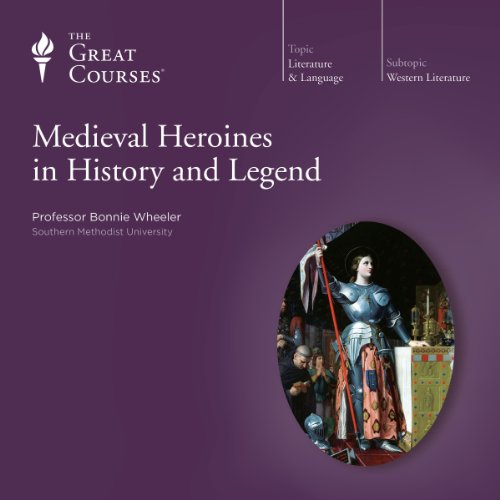
This series of 24 fascinating lectures draws on the latest modern scholarship to explore the lives of four medieval women who still shimmer in the modern imagination: Heloise, the abbess and mistress of Abelard; the prophet Hildegard of Bingen; Queen Eleanor of Aquitaine; and Joan of Arc. These lectures exemplify today's golden age of medieval scholarship, in which the role women played in medieval life is being clarified for the first time. You examine both old legends and new facts to address several provocative questions, such as: Were Hildegard's visions the result of migraines? How did Joan conduct herself in battle and react to its bloody reality? What does Eleanor's life tell us about a woman's role in the Crusades? As you journey through a past we are only now beginning to understand fully, you learn how these remarkable heroines have been both understood and misunderstood throughout history, and you'll better understand how history passes judgment on both women and the Middle Ages. PLEASE NOTE: When you purchase this title, the accompanying reference material will be available in your Library section along with the audio.
©2002 The Teaching Company, LLC (P)2002 The Great Courses

Iberia
Summary
Spain is an immemorial land like no other, one that James A. Michener, the Pulitzer Prize-winning author and celebrated citizen of the world, came to love as his own. Iberia is Michener's enduring nonfiction tribute to his cherished second home. In the fresh and vivid prose that is his trademark, he not only reveals the celebrated history of bullfighters and warrior kings, painters and processions, cathedrals and olive orchards; he also shares the intimate, often hidden country he came to know, where the congeniality of living souls is thrust against the dark weight of history. Wild, contradictory, passionately beautiful, this is Spain as experienced by a master writer.
©2015 James A. Michener (P)2015 Random House Audio

Crown and Country
Summary
From one of our finest historians comes an outstanding exploration of the British monarchy from the retreat of the Romans up until the modern day.
The monarchy is one of Britain’s longest surviving institutions – as well as one of its most tumultuous and revered. In this masterful book, David Starkey looks at the monarchy as a whole, charting its history from Roman times, to the Wars of the Roses, the chaos of the Civil War, the fall of Charles I and Cromwell's emergence as Lord Protector – all the way up until the Victorian era when Britain’s monarchs came face-to-face with modernity.
This brilliant collection of biographies of Britain’s kings and queens provides an in-depth examination of what the British monarchy has meant, what it means now and what it will continue to mean. Bringing to life a cast of colourful characters, Starkey’s trademark energy and authority make him the perfect guide on this epic, accessible and compelling journey, as he offers us a vivid portrait of British culture, politics and nationhood through an institution that has defined the realm for nearly two thousand years.
©2010 David Starkey (P)2010 HarperCollins Publishers Limited
A History of England, Volume 2: The Tudors and the Stuarts: 1485 - 1688
Summary
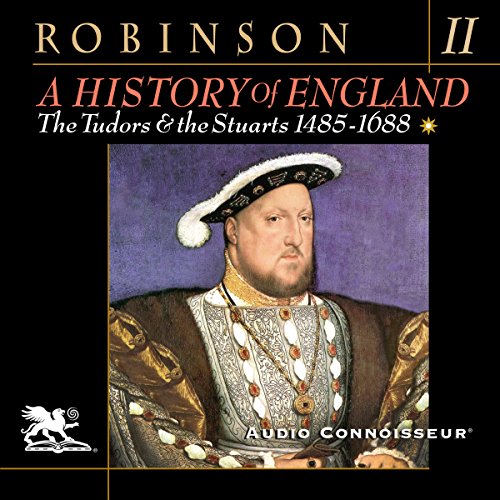
Cyril Robinson's magnificent history continues with volume two in this four-part series. We now follow the fortunes of two great royal dynasties: Tudor and Stuart. Great names from England's past tumble out one after the other. Henry VIII takes the English out of the Catholic fold. His daughter, Elizabeth, defeats the Spanish Armada of 1588. The arrogance of Charles I leads him to the scaffold. Civil War and Puritanism follow, led by the intrepid Oliver Cromwell. Charles II returns triumphantly in 1661 and leads England into the Restoration period. But the feckless James II manages to get himself chased out of England. The volume ends with the accession of William of Orange and the resurgence of Protestant representative government. Democracy finally gains a permanent foothold in England. PLEASE NOTE: When you purchase this title, the accompanying reference material will be available in your My Library section along with the audio.
Public Domain (P)2015 Audio Connoisseur

A History of England, Volume 3: William III to Waterloo: 1689-1815
Summary
In volume three of Cyril Robinson's famous history of England, we now enter a crucial phase in which political and economic power both change hands. Parliament now dominates the nation's political discourse, and, led by its brilliant Whig leader, Robert Walpole, this party maintains itself in power for a century. It is a stagnant century of corrupt politics and even more corrupt government magistrates and bureaucrats. But it is also the century that will usher in the greatest change humankind has ever seen. The Industrial Revolution completely alters every aspect of society. And, meanwhile, war is the motive power behind everything, as England pits itself against the mightiest and most feared power in Europe, the France of the Bourbons and, later, Napoleon. In a tumultuous 125-year period, the English fight and win three out of four great wars, losing their American colonies but gaining a worldwide trading empire. Follow along in this exciting third volume of a four-part series as England's greatest heroes confront and bring down the greatest military genius of the era, Napoleon Bonaparte. Often going it alone, Britannia places her fate in the hands of two men...Nelson and Wellington. PLEASE NOTE: When you purchase this title, the accompanying reference material will be available in your Library section along with the audio.
Public Domain (P)2015 Audio Connoisseur

Ivar the Boneless: Myths Legends & History
Summary
This book will explore the life and exploits of one of the most fearsome Vikings who has ever walked the earth - Ivar the Boneless. The records that talk about him are quite conflicting, as they often are with mythical and historical figures. This book will do its best and take a closer look to his origins, family, and notable exploits. We will also catch a glimpse into the possibilities of his demeanor and behavior without moving away from the fact that he is one of the most ruthless men to ever invade England in the ninth century. It is our hope that you'll enjoy this book and learn many new and exciting things about Ivar the Boneless!
©2018 KIV Books (P)2018 KIV Books