The Middle East category has 186 audiobooks on Listento.it, with an average listener rating of 4.3★ across 560 ratings. The most-rated is The Crusades.

Parthian Empire
Summary
Explore the most enduring empire of the ancient Near East. Few nations were able to not only parry but also defeat the mighty Roman Empire, rivaling it in almost all segments. One of those was the Parthian empire, cultural and traditional successor of the more famous Achaemenid Persian empire that was brought down by the Alexander the Great. Indeed, the Parthians are recognized as one of the toughest enemies the Romans ever fought, and rightfully so. Parthian soldiers put the Roman legions to the test, making them prove their worth. Yet by looking at the Parthian empire solely as the "great enemies of Rome", it is easy to overlook other important parts of Parthian history. Simply by changing our perspective, we are able to see that the Parthians were not only warriors but also artists, builders, and traders; they did much more than just challenge the might of the Roman steel. By listening to Parthian Empire: A Captivating Guide to the Enemy of the Roman Republic and Roman Empire, you will: Learn about the origins of the Parthian empire Discover the rise of the Parthian empire Gain startling knowledge about the Roman-Parthian Wars Be able to visualize the powerful military tactics that the Parthians used - tactics that gradually became the standard method of warfare in the Roman empire, as well Explore the remarkable art and culture of the Parthians Go on a discovery to get a sense of the life in the Parthian empire And much, much more! So if you want to learn about the Parthian Empire without having to go through boring textbooks, listen to this audiobook now!
©2018 Captivating History (P)2018 Captivating History

Hammurabi
Summary
Explore the captivating history of Hammurabi. The story of Hammurabi is the story of 43 years jam-packed with conquest, temple- and wall-building, irrigation efforts, and lawmaking, but it’s also a story of broken relations and rising and falling empires. It’s a story of betrayal and shifting alliances, a story where even the gods take a backseat to the matters of common men. It’s a tale that’s both thousands of years old and, interestingly enough, just as contemporary as it was when Hammurabi still drew breath. And like all great tales of history, it’s a yarn that teaches the common man that no feat of greatness comes without a price and that human nature is just as complex as it was when Babylonians praised Marduk and hailed Hammurabi as a god in his own right. In Hammurabi: A Captivating Guide to the Sixth King of the First Babylonian Dynasty, Including the Code of Hammurabi, you will discover topics such as: Babylon before Hammurabi: Position of the city in Mesopotamia, early rulers Rise of Hammurabi: Wars and achievements chronology of Hammurabi Reign of Hammurabi: Babylon during his reign, relations to other cities. Hammurabi’s Babylon Hammurabi’s character: physical appearance, relations with other rulers, glimpses of his personality The Code of Hammurabi and early Mesopotamian law Dissecting the code Hammurabi’s legacy And much, much more!
©2018 Captivating History (P)2019 Captivating History

Blood, Metal and Dust
Summary
Bloomsbury presents Blood, Metal and Dust by Ben Barry, read by Christopher Ragland. From the high-ranking officer who wrote the still-classified British military analysis of the war in Iraq comes the authoritative history of two conflicts which have overshadowed the beginning of the 21st century. Inextricably linked to the ongoing ‘War on Terror’, the wars in Iraq and Afghanistan dominated more than a decade of international politics and their influence is felt to this day. Blood, Metal and Dust is the first military history to offer a comprehensive overview of the wars in Afghanistan and Iraq, providing in-depth accounts of the operations undertaken by both US and UK forces. Brigadier Ben Barry explores the wars which shaped the modern Middle East, providing a detailed narrative of operations as they unfolded. With unparalleled access to official military accounts and extensive contacts in both the UK and the US militaries, Brigadier Barry is uniquely placed to tell the story of these controversial conflicts and offers a rounded account of the international campaigns which irrevocably changed the global geopolitical landscape.
©2020 Ben Barry (P)2020 Bloomsbury Publishing Plc
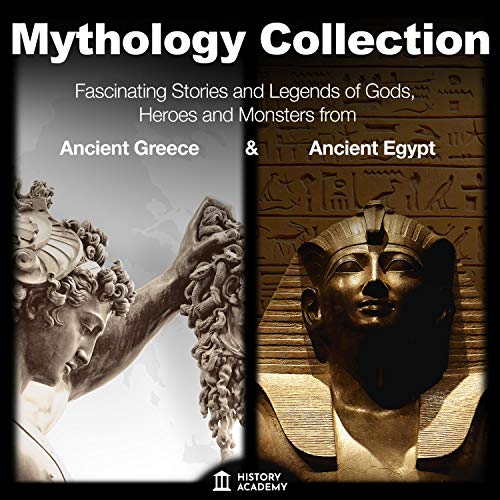
Mythology Collection: Greek Mythology and Egyptian Mythology
Summary
Before science, there were myths. Today we see them as fiction, but in the past myths were a way to explain all the natural phenomena that surrounded mankind. History Academy’s brand-new book will tell you all about ancient Greek and ancient Egypt mythologies. Greek mythology: Let yourselves be amazed by the wonderful stories about gods and goddesses like Zeus and Athena, heroes like Perseus and monsters like Medusa. Every myth present in the book is supported by additional material regarding ancient Greeks’ history and culture to help our readers understand the cultural background of the time. The book also includes a genealogical tree to clarify the relationships between the different characters. “Greek Mythology” is a modern collection of ancient Greek myths gathered by History Academy to let the new generations enjoy these ancient immortal tales. Every myth is full of adventures that will amaze both experienced readers and occasional ones. This book is perfect for anyone who’s passionate about mythology and art and wishes to know more about myths like Pandora’s box or Prometheus’ theft of fire. Egyptian mythology: History Academy’s brand-new book about Egyptian mythology will tell you all about ancient Egyptian divinities, pharaohs and legendary creatures. The book includes detailed descriptions about ancient Egypt’s historical and cultural background and maps to help you findwhere the events took place. Ancient Egypt’s myths still influence our modern collective culture with its stories about powerful gods and pharaohs, curses, mummies and Pyramids. History Academy offers you a complete volume meant to reveal the mysteries of Ancient Egypt.
©2020 History Academy (P)2020 History Academy

Ancient Near East
Summary
If you want to discover the captivating history of the ancient Near East, then pay attention.... Where did the first signs of civilization appear in the ancient world? When did people start to transition from the nomadic life of hunters and gatherers to living in the first urbanized settlements? Who was the first emperor in history? Which empire was the strongest and mightiest, and for how long? Where did the title “King of the Universe” come from, and who was the “True King?” All these answers are hidden in the ancient history of the Fertile Crescent, and now, they are unveiled to you in our comprehensive and captivating guide to the ancient civilizations of the Near East. In Ancient Near East: A Captivating Guide to Ancient Civilizations of the Middle East, Including Regions Such as Mesopotamia, Ancient Iran, Egypt, Anatolia, and the Levant, you will discover topics such as: Mesopotamia: The Birth of the First Civilization Egypt: The Unification of Upper and Lower Egypt and the Birth of the Pharaohs Ancient Iran: From Early Urban Settlements to the Rise of the Elamites Anatolia: The Bridge Between Asia and Europe and the Rise of the Hittite Old Kingdom The Levant: The Kingdom of Ebla and the Cultures of the Ancient Levant The Rise of the Assyrian Empire and Babylon from the Ashes of Akkad The Old and New Kingdom of Egypt: Dynastic Egypt and the Rise of Power in the Banks of Nile The Middle and New Kingdoms of the Hittite: The Dark Ages and the Glory of the Hittite Empire Beyond the Wars and Thrones: The Everyday Life of Common People in the Ancient Near East The Birth of Religions in the Ancient Near East: The Cradle of Civilization and the Gods And much, much more! So if you want to learn more about the ancient Near East, scroll up and click "Buy Now"!
©2020 Captivating History (P)2020 Captivating History

Egypt: Essential Travel Tips - All You NEED to Know
Summary
In this Sam's Travel Guide on Egypt, you will find all the information you NEED to know about: Things you MUST know about Egypt Best places to visit in Egypt Best cities to visit in Egypt Best beaches in Egypt Souvenirs you must buy in Egypt Most popular night destinations in Egypt Best restaurants in Egypt Most luxurious hotels in Egypt Local dishes you must try in Egypt Things to avoid in Egypt When you download Egypt: Essential Travel Tips - All You NEED to Know you will be well prepared to visit the country of your dreams ! Buy this book today! Would you like to start today? If you do, just scroll up and hit the buy button. Enjoy Sam's Travel Guides!
©2018 Sam's Travel Guide (P)2018 Sam's Travel Guide

The Dynasties of Ancient Egypt
Summary
Africa may have given rise to the first human beings, and Egypt probably gave rise to the first great civilizations, which continue to fascinate modern societies across the globe nearly 5,000 years later. From the Library and Lighthouse of Alexandria to the Great Pyramid at Giza, the Ancient Egyptians produced several wonders of the world, revolutionized architecture and construction, created some of the world’s first systems of mathematics and medicine, and established language and art that spread across the known world. With world-famous leaders like King Tut and Cleopatra, it’s no wonder that today’s world has so many Egyptologists. What makes the accomplishments of the Ancient Egyptians all the more remarkable is that Egypt was historically a place of great political turbulence. Its position made it both valuable and vulnerable to tribes across the Mediterranean and the Middle East, and Ancient Egypt had no shortage of its own internecine warfare. Its most famous conquerors would come from Europe, with Alexander the Great laying the groundwork for the Hellenic Ptolemy line and the Romans extinguishing that line after defeating Cleopatra and driving her to suicide. Perhaps the most intriguing aspect of ancient Egyptian civilization was its inception from the ground up, as the ancient Egyptians had no prior civilization which they could use as a template. In fact, ancient Egypt itself became a template for the civilizations that followed. The Greeks and the Romans were so impressed with Egyptian culture that they often attributed many attributes of their own culture (usually erroneously) to the Egyptians. With that said, some minor elements of ancient Egyptian culture were, indeed, passed on to later civilizations. Egyptian statuary appears to have had an initial influence on the Greek version, and the ancient Egyptian language continued long after the pharaonic period in the form of the Coptic language. The Dynasties of Ancient Egypt: The History and Legacy of the Pharaohs from the Beginning of Egyptian Civilization to the Rise of Rome chronicles the tumultuous history of Ancient Egypt.
©2017 Charles River Editors (P)2017 Charles River Editors

Super Cheap Doha: 2021 Travel Guide
Summary
Get this guide to tick Doha off your bucket list for under $250. Lonely Planet advises "budget" travellers to pay $140 Per day to visit Doha. This guide will show you how to comfortably enjoy the Qatari capital for $50 a day. Super Cheap Doha is a travel guide for people seeking cold-hard facts to enjoy the biggest Doha adventure on the smallest budget. Choose from city adventures or mix it up with our desert suggestions. Either way, our plans and Doha’s fascinating history and jaw-dropping desert landscapes will blow your mind, not your budget. Instantly discover everything you need for a luxurious trip to Doha on a backpackers budget. Hundreds of historical, cultural, and money-saving local insights Cheapest flight routes to Doha Insider Tips on planning your trip on a budget including the most fascinating souks and free museums How to get 25 percent off your Doha Airbnb How to stay in five-star Doha hotels for two-star prices The cheapest place to stay (this may surprise you) Must-see and cheap hacks to see and do all the sights including an amazing value Falconry The cheapest route form the airport to the city Advice on getting around cheaply Must-try street foods and the best place to try them including mouth-watering local desserts Tons of cheap delicious local eats Practical tips and insights Detailed broken down checklist of things to remember to save money Discount markets you must visit Cheapest onwards destinations Bonus: Thousands of general travel hacks to save you money before travelling Save yourself the time and hassle. Enjoy everything Doha has to offer without the ascribed $140 a day tourist budget. Super Cheap Insider Guides (dot) com Spend a little and enjoy a lot with Super Cheap Insider Guides written by real travellers in collaboration with thrifty locals. Spend $5 on this audiobook to save hundreds in Doha When you buy and review this book you’ll have free access to our Super Cheap Accommodation Finder Service, normally $50 (a team of highly skilled Accommodation Hackers will find you three of the best price-performance accommodation options for your specific needs). You can also use our flight hacking service (our skilled flight hackers will take hundreds of dollars off your flight). We’ve designed this hands-on guidebook to save you time, hassle, and money. Leave the crowds behind Get Super Cheap Doha to save hundreds on your Doha trip with real insights Google can’t and won’t reveal.
©2019 Phil G Tang (P)2021 Super Cheap Insider Guides

The Nile: Travelling Downriver Through Egypt's Past and Present
Summary
The Nile, like all of Egypt, is both timeless and ever-changing. In this audio, renowned Egyptologist Toby Wilkinson takes us on a journey downriver that is both history and travelogue. We begin at the First Nile Cataract, close to the modern city of Aswan. From there, Wilkinson guides us through the illustrious nation birthed by this great river.
We see Thebes, with its Valley of the Kings, Valley of the Queens, and Luxor Temple. We visit the fertile Fayum, the Great Pyramid of Giza, and finally, the pulsing city of Cairo, where the Arab Spring erupted on the bridges over the water. Along the way, Wilkinson introduces us to the gods, pharaohs, and emperors who joined their fate to the Nile and gained immortality; and to the adventurers, archaeologists, and historians who have all fallen under its spell. Peerlessly erudite, vividly told, The Nile brings the course of this enduring river into stunning view.
©2014 Toby Wilkinson (P)2020 Blackstone Publishing

Love and Ruin
Summary
Nothing about the romance between Nancy Hatch Dupree and Louis Dupree was what you'd call typical. For starters, there were the lovers themselves. Louis was a foul-mouthed paratrooper turned swashbuckling archaeologist. Nancy was a witty travel writer and the wife of a CIA station chief on the ragged frontier of the Cold War. Then there was the place and time: Kabul, Afghanistan in the 1960s, a heady and short-lived milieu of conniving spies, future mujahideen, and cocktail-swilling cosmopolitans. It was there that Nancy and Louis fell in love not only with each other, but also with Afghanistan itself. The country was as exceptional and difficult as they were - and when it descended into chaos, they had no choice but to follow it. In Love and Ruin, journalist James Verini travels to Afghanistan in search of the Duprees' story, an exhilarating and heartbreaking tale of lives lived to the fullest in one of the world's most fascinating and forbidding places.
©2014 James Verini, The Atavist (P)2014 James Verini, The Atavist

A Year Under Sharia Law
Summary
Three years into a financial crisis that shows no sign of loosening its grip, a young couple make the unpopular decision to teach English in Saudi Arabia. The choice of Saudi Arabia is based primarily on the best salary offer and an all-expenses-paid round-trip flight. Secondarily, it is to satiate a desire to explore a country steeped in mystery and taboo. Little do they know that the experience will come with a price and change their lives in a profound way, witnessing human rights violations that go unchecked even up to today and an ultra-conservative culture wrestling with tradition and modernity. A Year Under Sharia Law is written as a travel memoir with vignettes of daily life and interactions with the community at large. It was also written to shine a spotlight on the plight of impoverished ladies who come to Saudi Arabia in the hopes of earning a salary to send money back to their family. They find work as nannies and house maids, primarily. These ladies are often stripped of their rights in a patriarchy that makes them prime targets for unspeakable abuses. Their passports are held by their Saudi employees, and they essentially become prisoners. This memoir is not only dedicated to them and their plight, but also the tireless and dangerous work done by journalists who are critical of Saudi Arabia’s human rights record. Some have paid the ultimate price.
©2019 Alex Fletcher (P)2020 Alex Fletcher

Hunting the Caliphate
Summary
In this vivid first-person narrative, a Special Operations Joint Terminal Attack Controller (JTAC) and his commanding general give fascinating and detailed accounts of America's fight against one of the most barbaric insurgencies the world has ever seen. In the summer of 2014, three years after America's full troop withdrawal from the Iraq War, President Barack Obama authorized a small task force to push back into Baghdad. Their mission: protect the Iraqi capital and US embassy from a rapidly emerging terrorist threat. A plague of brutality, that would come to be known as ISIS, had created a foothold in northwest Iraq and northeast Syria. It had declared itself a Caliphate - an independent nation-state administered by an extreme and cruel form of Islamic law - and was spreading like a newly evolved virus. Soon, a massive and devastating US military response had unfolded. Hear the ground truth on the senior military and political interactions that shaped America's war against ISIS, a war unprecedented in both its methodology and its application of modern military technology.
©2019 Dana J. H. Pittard and Wes J. Bryant (P)2019 Tantor

Cleopatra
Summary
Il mondo di oggi non sarebbe lo stesso senza Cleopatra, una sovrana colta, intelligente e dotata di una straordinaria abilità sia sul tavolo delle trattative che nelle guerre. Una donna di potere incredibilmente moderna per il passato e allo stesso tempo capace di provare grandi passioni amorose. Ma chi era veramente l'ultima regina d'Egitto? Lei, infatti, è nell'immaginario di tutti, però la sua figura storica è ancora in parte poco conosciuta e non priva di aspetti enigmatici a causa dei pochi dati certi che la riguardano. Alberto Angela ha deciso di ricostruire la vita e le abilissime mosse sullo scacchiere internazionale, ma anche gli amori e le passioni della regina che in un certo senso ha conquistato Roma, rintracciando le fonti storiche e consultando gli studi moderni, e accompagnandoci per mano tra le caotiche strade della capitale del mondo antico, sulle banchine dell'esotico porto di Alessandria d'Egitto e sui sanguinosi campi di battaglia, alla scoperta di persone, storie, usi e costumi. Alberto Angela è in grado di farci rivivere in prima persona il periodo che ha segnato un cambio epocale nella storia romana, dal racconto minuto per minuto dell'uccisione di Giulio Cesare che decreta la fine della Repubblica alla morte di Antonio e Cleopatra (la cui tomba non è ancora stata ritrovata!) fino alla nascita dell'Impero con Augusto al potere. "Cleopatra. La regina che sfidò Roma e conquistò l'eternità" è un viaggio nel tempo tra Occidente e Oriente, per riscoprire con uno sguardo nuovo una donna carismatica e intelligente e un periodo storico affascinante e convulso, ricco di contraddizioni, intrighi, passioni e guerre che hanno segnato il nostro presente e contribuito a rendere il mondo il luogo che oggi tutti noi conosciamo.
©2019 HarperCollins Italia S.p.A (P)2020 Audible Studios

The Wisdom of the Egyptians
Summary
The story of the Egyptians, the religion of the ancient Egyptians, the Ptah-Hotep and the Ke'gemini, the Book of the Dead, the wisdom of Hermes Trismegistus, Egyptian magic, the Book of Thoth.
©2019 Majestic (P)2019 Majestic

Sumerios [Sumerians]
Summary
Explora la fascinante historia de los sumerios La gran importancia de la cultura sumeria en toda la cultura mundial es evidente y crucial. Esta civilización es la única responsable de algunas de las innovaciones más importantes en prácticamente todos los aspectos básicos para mantener una sociedad civilizada: incluyendo la religión, la legislación, la arquitectura, la educación, el arte, la literatura y hasta el entretenimiento. Naturalmente, la mayoría de lo que vemos actualmente como aspectos negativos de la sociedad también se estableció en la antigua Sumeria. No hubo un aspecto de la vida sumeria que no estuviera plagado de corrupción o devastación de una u otra forma. En otras palabras, los sumerios nos dieron la sublimidad de la fe y la rigidez del pensamiento religioso junto con el deseo de supremacía política. Nos dieron tanto a los monarcas benévolos y afectuosos como a los tiranos crueles y castigadores; el niño educado y el niño mimado; el agrario trabajador y el fiestero borracho; y los imperios épicos, así como también los restos patéticos de ellos. Los sumerios lo hicieron todo, y lo hicieron ellos primero. Algunos de los temas y preguntas que se encuentran en este libro incluyen: Un resumen de los antiguos sumerios. La estructura social de los antiguos sumerios. La religión y la mitología de los antiguos sumerios. La cronología de los reinos sumerios. La vida cotidiana de los antiguos sumerios. Las innovaciones sumerias. La cultura sumeria. La política exterior de Sumeria: las relaciones con otras naciones. ¡Y una gran oferta que no querrá perderse! ¡Obtenga el libro ahora para aprender más acerca de los sumerios! Please note: This audiobook is in Spanish.
©2018 Captivating History (P)2018 Captivating History

Nimrud: The History and Legacy of the Ancient Assyrian City
Summary
When scholars study the history of the ancient Near East, several wars that had extremely brutal consequences (at least by modern standards) often stand out. Forced removal of entire populations, sieges that decimated entire cities, and wanton destruction of property were all tactics used by the various peoples of the ancient Near East against each other, but the Assyrians were the first people to make war a science. When the Assyrians are mentioned, images of war and brutality are among the first that come to mind, despite the fact that their culture prospered for nearly 2,000 years. Like a number of ancient individuals and empires in that region, the negative perception of ancient Assyrian culture was passed down through Biblical accounts, and regardless of the accuracy of the Bible’s depiction of certain events, the Assyrians clearly played the role of adversary for the Israelites. Indeed, Assyria (Biblical Shinar) and the Assyrian people played an important role in many books of the Old Testament and are first mentioned in the book of Genesis: “And the beginning of his kingdom was Babel and Erech, and Akkad, and Calneh, in the land of Shinar. Out of that land went forth Ashur and built Nineveh and the city Rehoboth and Kallah.” (Gen. 10:10-11). Although the Biblical accounts of the Assyrians are among the most interesting and are often corroborated with other historical sources, the Assyrians were much more than just the enemies of the Israelites and brutal thugs. A historical survey of ancient Assyrian culture reveals that although they were the supreme warriors of their time, they were also excellent merchants, diplomats, and highly literate people who recorded their history and religious rituals and ideology in great detail. The Assyrians, like their other neighbors in Mesopotamia, were literate and developed their own dialect of the Akkadian language that they used to write tens of thousands of documents in the cuneiform script (Kuhrt 2010, 1:84). Furthermore, the Assyrians prospered for so long that their culture is often broken down by historians into the “Old”, “Middle”, and “Neo” Assyrian periods, even though the Assyrians themselves viewed their history as a long succession of rulers from an archaic period until the collapse of the neo-Assyrian Empire in the 7th century BCE. In fact, the current divisions have been made by modern scholars based on linguistic changes, not on political dynasties (van de Mieroop 2007, 179). The city of Nimrud was one of the Assyrians’ most important cities, and it has been known by many different names throughout its history. In ancient Assyrian, the city was called Kal?u, a name first attested to in texts dating back to the 13th century BCE. In the Bible, it is known as Calah, and the city is now called Nimrud from an association with the Biblical figure Nimrod. Nimrud is located in northern Iraq on the east bank of the Tigris River, about 20 miles south of modern Mosul and ancient Nineveh. An ancient Assyrian capital during the Neo-Assyrian period, the city has produced many glorious artifacts and provided countless insights into this ancient civilization, but the history of the city after the fall of the Assyrians has proven just as turbulent and interesting. Nimrud: The History and Legacy of the Ancient Assyrian City chronicles the origins of the city, how it became a power center in antiquity, and its controversial fate.
©2019 Charles River Editors (P)2019 Charles River Editors

The Kingdom of Kush
Summary
If you want to discover the captivating history of the kingdom of Kush, then pay attention... The kingdom of Kush was completely forgotten once it met its end. The stories of its might didn’t survive in the cultures of its successor kingdoms, possibly because Christianization soon followed, which required the people of the Nubian region to turn toward the East and the myths of the Christian messiah. There was no more room for the divine rulers, Amun and Re, or a place for their sons, the kings of Kush. The kingdom continued to exist in the stories of some classical writers, but it was often considered as nothing more than a distant, probably even imaginary, kingdom, where the uncivilized savages lived. It was not until the early 20th century that the kingdom of Kush received its rightful place in history. When the first archaeological survey of Nubia took place between 1907 and 1911, the distinctive cultural aspects of the Kingdom of Kush emerged, and it was finally seen as a separate entity from Egypt. In The Kingdom of Kush: A Captivating Guide to an Ancient African Kingdom in Nubia That Once Ruled Egypt, you will discover topics such as: Nubia and the Emergence of the Kingdom of Kush From Alara to the Twenty-Fifth Dynasty The Rulers of the Twenty-Fifth Dynasty Relations Between Kush and Egypt Continue Kush Between the 6th and 3rd Centuries The Meroitic Dynasty The Last Centuries of the Kingdom of Kush The Society of Kush And much, much more! So, if you want to learn more about the kingdom of Kush, scroll up and click the "add to cart" button!
©2020 Captivating History (P)2020 Captivating History

The Ancient Black Hebrews Vol II
Summary
The author takes you through what forensic anthropologists look for to determine racial ancestry in a skeleton. He then uses this information to show black traits in the ancient biblical period skeletons that have been dug up in Israel. He finishes the book with accounts of Christian-period Judeans who show these same features. Wonderfully and simply written. This settles the issue once and for all!
©2014 Gert Muller (P)2015 Gert Muller

The Marsh Arabs
Summary
For a period of seven years, Wilfred Thesiger canoed through the marshes at the confluence of Iraq's Tigris and Euphrates rivers, living among the native Madan tribes and their islands made of reeds. Now extinct, their ancient way of life is speculated to have existed for 5,000 years, going back to the days of ancient Sumer, and possessed a unique culture found nowhere else in the Middle East. Thesiger documents the tribes' conflicts, traditions, cuisine, relationships, justice systems, and art, and reveals how they built their unique water-borne society, with its beautiful canoes (taradas) and stately guest houses (mudhifs) - it is a remarkable familiarity gained through Thesiger's innate understanding of tribal ritual and etiquette, and the trust he earned through the use of a basic medical supply kit that he brought along with him. Poetic and immersing, The Marsh Arabs brings alive the sights, sounds, and smells of the marshes, and a culture that has now vanished forever. PLEASE NOTE: When you purchase this title, the accompanying PDF will be available in your Audible Library along with the audio.
©1964 Wilfred Thesiger (P)2019 Naxos Audiobooks

The Ottoman-Russian Wars of the 18th Century
Summary
In terms of geopolitics, perhaps the most seminal event of the Middle Ages was the successful Ottoman siege of Constantinople in 1453. The city had been an imperial capital as far back as the fourth century, when Constantine the Great shifted the power center of the Roman Empire there, effectively establishing two almost equally powerful halves of antiquity’s greatest empire. Constantinople would continue to serve as the capital of the Byzantine Empire even after the Western half of the Roman Empire collapsed in the late fifth century. Naturally, the Ottoman Empire would also use Constantinople as the capital of its empire after their conquest effectively ended the Byzantine Empire, and thanks to its strategic location, it has been a trading center for years and remains one today under the Turkish name of Istanbul. In the wake of taking Constantinople, the Ottoman Empire would spend the next few centuries expanding its size, power, and influence, bumping up against Eastern Europe and becoming one of the world’s most important geopolitical players. It was a rise that would not truly start to wane until the 19th century, and in the centuries before the decline of the “sick man of Europe", the Ottomans frequently tried to push further into Europe. Some of those forays were memorably countered by Western Europeans and the Holy League, but the Ottomans’ most frequent foe was the Russian Empire, which opposed them for both geopolitical and religious reasons. From negotiations to battles, the two sides jockeyed for position over the course of hundreds of years, and the start of the fighting may have represented the Ottomans’ best chance to conquer Moscow and change the course of history. For anyone trying to understand the origins of modern Russia and the start of the Russo-Turkish Wars, the search should begin with Tsar Peter I (1672-1725), who titled himself Peter the Great during his lifetime. The moniker is fitting, considering the manner in which Peter brought Russia out of the Middle Ages and into the 18th century. Through a series of campaigns, Peter turned Russia into a formidable empire that would subsequently become a major force on the European continent, while also emulating Western Europe and turning Russia into an international state that interacted with the other continental powers. By revolutionizing and modernizing Russian arms, including the creation of Russia’s first naval force, Peter was able to pursue an aggressive and expansionist foreign policy that set the stage for the way the European map would be redrawn again and again over the coming centuries. In the late 17th century, Peter the Great launched an attack on Azov, an Ottoman fortress near the mouth of the Dnieper as it flows into the Sea of Azov. Conquest of the stronghold would provide Muscovy with a port and the ability to attack Crimea from sea, but even after the Russians accomplished this, the ultimate prize - free access to the Black Sea - remained out of Russia’s reach on account of the strength of the Ottoman fleet in the Black Sea and the logistical challenges of conquering the Crimean Peninsula. Furthermore, soon after the conquest of Azov Peter engaged in a much costlier war in the north against Sweden for the conquest of ports on the Baltic Sea. The Ottoman Empire, which had just signed a humiliating treaty with Austria, Poland and Venice which gave up Hungary and other conquests, was pleased with the respite, but it came unto conflict with Russia again over Peter’s enemy King Charles XII of Sweden, who had taken refuge in Ottoman Moldavia after his defeat at the Battle of Poltava in July 1709.
©2020 Charles River Editors (P)2020 Charles River Editors