The Military category has 1,612 audiobooks on Listento.it, with an average listener rating of 4.6★ across 5,283 ratings. The most-rated is The Rise and Fall of the Third Reich.

The Landry Family Series, Part 1
Summary
The Landry Family Series is a feel-good, heart-warming series featuring strong alpha males and smart, capable heroines. Sweet and steamy, the Landry family enjoys favorite tropes such as second-chance romance, surprise babies, office lovers, sports and military romances, and more. Fall madly in love with this relatable, unforgettable family by USA Today best-selling author Adriana Locke. This set includes three full novels - Sway, Swing, and Switch.
©2016, 2017 Adriana Locke (P)2019 Adriana Locke

Killing the Bismarck
Summary
In May 1941 the German battleship Bismarck, accompanied by heavy cruiser Prinz Eugen, broke out into the Atlantic to attack Allied shipping. The Royal Navy's pursuit and subsequent destruction of the Bismarck was an epic of naval warfare. In this new account of those dramatic events at the height of the Second World War, Iain Ballantyne draws extensively on the graphic eyewitness testimony of veterans to construct a thrilling story, mainly from the point of view of the British battleships, cruisers, and destroyers involved. He describes the tense atmosphere as cruisers play a lethal cat-and-mouse game, shadowing the Bismarck in the icy Denmark Strait. We witness the shocking destruction of the British battle cruiser HMS Hood, in which all but three of her ship's complement were killed, an event that fueled pursuing Royal Navy warships, including the battered battleship Prince of Wales, with a thirst for revenge. While Swordfish torpedo bombers try desperately to cripple the Bismarck, we sail in destroyers on their own daring torpedo attacks, battling mountainous seas. Finally the author takes us into the last showdown, as battleships Rodney and King George V, supported by cruisers Norfolk and Dorsetshire, destroy the pride of Hitler's fleet. This vivid, superbly researched account portrays this epic saga through the eyes of so-called ordinary sailors caught up in extraordinary events. Killing the Bismarck is an outstanding book, conveying the horror and majesty of war at sea in all its cold brutality and awesome power.
©2010 Iain Ballantyne (P)2017 Blackstone Audio, Inc.

Last Stand at Khe Sanh
Summary
The vivid, fast-paced account of the siege of Khe Sanh told through the eyes of the men who lived it. For seventy-seven days in 1968, amid fears that America faced its own disastrous Dien Bien Phu, six thousand US Marines held off thirty thousand North Vietnamese Army regulars at the remote mountain stronghold called Khe Sanh. It was the biggest battle of the Vietnam War, with sharp ground engagements, devastating artillery duels, and massive US air strikes. After several weeks of heroic defense, the besieged Americans struck back in a series of bold assaults, and the North Vietnamese withdrew with heavy losses. Last Stand at Khe Sanh is the vivid, fast-paced account of the dramatic confrontation as experienced by the men who were there: Marine riflemen and grenadiers, artillery and air observers, platoon leaders and company commanders, Navy corpsmen and helicopter pilots, and a plucky band of US Army Special Forces. Based on extensive archival research and more than one hundred interviews with participants, Last Stand at Khe Sanh captures the courage and camaraderie of the defenders and delivers the fullest account yet of this epic battle.
©2014 Gregg Jones (P)2014 Blackstone Audio, Inc.

The Flame of Islam
Summary
"The year 1169 dawned upon a quiet East. Along this frontier of Christianity, nothing unusual was taking place. Nothing ominous, that is. And in that part of the East known as the Holy Land, the crusaders went about their affairs without misgivings." So opens Harold Lamb's magnificent history. However, out of the chaos of Muslim tribal warfare and regional animosity arose a military genius such as Islam had never known: Saladin. Uniting the sultanates of Cairo and Damascus, Saladin created a single powerful state. Luring the crusaders into an ill-considered confrontation, he destroyed their army at the Battle of Hattin in 1187, leaving the few remaining crusaders clinging perilously to a series of towns and forts along the Levantine coast. Into this desperate situation stepped the most formidable warrior of the age, Richard the Lion-Hearted. Hear the incredible tales of valor and futility as King Richard attempts to retake Jerusalem. And after him, many other kings would come forward....
©1930 Estate of Harold Lamb (P)2012 Audio Connoisseur

Hitler's Children
Summary
Göring. Hess. Mengele. Dönitz. Names that conjure up dark memories of Nazi Germany and the Holocaust. They were the architects of the Third Reich. And they were fathers. Gerald Posner convinced 11 sons and daughters of Hitler's inner circle to break their silence. This second generation of perpetrators in Hitler's Children struggle with their Third Reich inheritance. In grappling with memories of good and loving fathers who were later charged with war crimes, these heirs to the Nazi legacy add a fresh and important perspective to understanding the complexity of what historian, Hannah Arendt, dubbed "the banality of evil". Hitler's Children is much more, however, than a series of startling family interviews. It is also a spellbinding insider's look at some of the men whose names have become synonymous with terror. This is a classic book about the second generation of Nazi perpetrators (the only one ever to have family interviews with Hess, Mengele, Donitz, and Göring.) No other book author or documentarian ever got those children to talk again. And Norman Frank, the eldest son of war criminal Hans Frank, also never spoke to anyone but Posner.
©2017 Gerald Posner (P)2017 Tantor
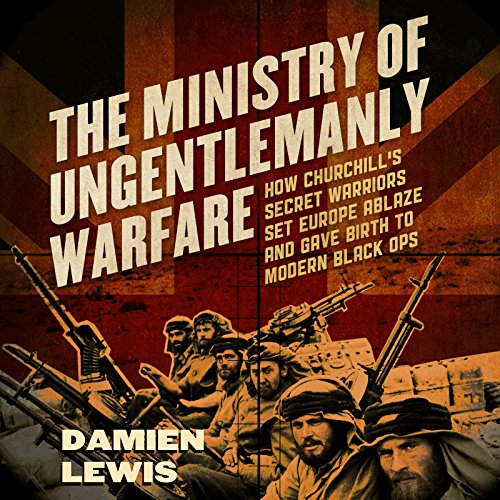
The Ministry of Ungentlemanly Warfare
Summary
From award-winning historian, war reporter, and author Damien Lewis (Zero Six Bravo, Judy) comes the incredible true story of the top-secret "butcher-and-bolt" black ops units Prime Minister Winston Churchill assigned the task of stopping the unstoppable German war machine. Criminals, rogues, and survivalists, the brutal tactics and grit of these "deniables" would define a military unit the likes of which the world had never seen. When France fell to the Nazis in spring 1940, Churchill declared that Britain would resist the advance of the German army - alone if necessary. Churchill commanded the Special Operations Executive to secretly develop a very special kind of military unit that would operate on their own initiative deep behind enemy lines. The units would be licensed to kill, fully deniable by the British government, and a ruthless force to meet the advancing Germans. The very first of these butcher-and-bolt units - the innocuously named Maid Honour Force - was led by Gus March-Phillipps, a wild British eccentric of high birth; and an aristocratic, handsome, and bloodthirsty young Danish warrior, Anders Lassen. Amped up on amphetamines, these assorted renegades and sociopaths undertook the very first of Churchill's special operations - a top-secret, high-stakes mission to seize Nazi shipping in the far-distant port of Fernando Po in West Africa. Though few of these early desperadoes survived WWII, they took part in a series of fascinating, daring missions that changed the course of the war. It was the first stirrings of the modern special ops team, and all of the men involved would be declared war heroes when it was all over. The Ministry of Ungentlemanly Warfare focuses on a dozen of these extraordinary men, weaving their stories of brotherhood and comradely and elite soldiering into a gripping narrative yarn, from the earliest missions to Anders Lassen's tragic death just weeks before the end of the war.
©2015 Damien Lewis (P)2016 Hachette Audio

Tanks in Hell
Summary
In May 1943, a self-described "really young, green, ignorant lieutenant" assumed command of a new US Marine Corps company. His even younger enlisted Marines were learning to use an untested weapon, the M4A2 "Sherman" medium tank. His sole combat veteran was the company bugler, who had salvaged his dress cap and battered horn from a sinking aircraft carrier. Just six months later, the company would be thrown into one of the ghastliest battles of World War II. On November 20, 1943, the 2nd Marine Division launched the first amphibious assault of the Pacific War, directly into the teeth of powerful Japanese defenses on Tarawa. In that blood-soaked invasion, a single company of Sherman tanks, of which only two survived, played a pivotal role in turning the tide from looming disaster to legendary victory. In this unique study, Oscar E. Gilbert and Romain V. Cansiere use official documents, memoirs, and interviews with veterans to follow Charlie Company from its formation, and trace the movement, action - and loss - of individual tanks in this horrific four-day struggle. The authors follow the company from training through the brutal 76-hour struggle for Tarawa. Survivor accounts and air-photo analyses document the movements - and destruction - of the company's individual tanks. It is a story of escapes from drowning tanks, and even more harrowing extrications from tanks knocked out behind Japanese lines. It is a story of men doing whatever needed to be done, from burying the dead to hand-carrying heavy cannon ammunition forward under fire. It is the story of how the two surviving tanks and their crews expanded a perilously thin beachhead and cleared the way for critical reinforcements to come ashore. But most of all, it is a story of how a few unsung Marines helped turn near disaster into epic victory.
©2015 Oscar E. Gilbert and Romain Cansiere (P)2018 Tantor

Travesty of Justice
Summary
On the morning of July 2, 2012, in the most dangerous warzone in the world, Lieutenant Clint Lorance took command of his small band of American paratroopers at the spearhead of the American War in Afghanistan. Intelligence reports that morning warned of a Taliban ambush against Lorance’s platoon. Fifteen minutes into their patrol, three military-age Afghan males crowded on a motorcycle and sped aggressively down a Taliban-controlled dirt road toward Lorance’s men. Three weeks earlier, outside the massive American Kandahar Airfield, Taliban terrorists struck by motorcycle, riding into a crowded area, detonating body-bombs and killing 22 people. Sixty-three days before that, three Ohio National Guard soldiers were murdered in another motorcycle-suicide bombing. Suicide-by-motorcycle had become a common Taliban murder-tactic against Americans. Lorance had seconds to react. Either open fire and protect his men, or ignore the speeding motorcycle and pray like hell that his men weren’t about to get blown the hell up. In a split-second decision, Lorance ordered his men to fire. When no weapons were found on the Afghan bodies, the Army betrayed one of its finest young officers and prosecuted Lorance for “murder.” Hiding crucial evidence from the military jury, and ordering his own men to testify against him or face murder charges themselves, they railroaded Lorance into a 20-year prison sentence at Fort Leavenworth, where he remains today. Travesty of Justice chronicles the true story of the most despicable political prosecution in American military history. Don Brown is an American author of 11 published novels and two significant military works of non-fiction. His book Last Fighter Pilot was endorsed by the Ronald Reagan Presidential Foundation, and spent several weeks on the Conservative Book Club's national best seller list.
©2019 Don Brown (P)2019 WildBlue Press

The Easy Day Was Yesterday
Summary
From his cage in a putrid, overcrowded Indian jail, Paul Jordan reflects on a life lived on the edge and curses the miscalculation that robbed him of his freedom. His childhood, marred by the loss of his father and brother, produces a young man hell-bent on being the best of the best - an ambition he achieves by being selected to join the elite SAS. He survives the gut-wrenching training regime, deployment to the jungles of Asia and the horrors of genocide in Rwanda before leaving the army to embark on a career as a security adviser. His new life sees him pursuing criminals and gun-toting bandits in Papua New Guinea and the Solomons, protecting CNN newsmen as the US 7th Cavalry storms into Baghdad with the outbreak of the Iraq War and facing death on a massive scale as he accompanies reporters into the devastated Indonesian town of Banda Ache, flattened by the Boxing Day tsunami. During his 24 days in an Indian gaol, Paul Jordan discovers that friendship and human dignity somehow survive the filth and deprivation. The Easy Day Was Yesterday is fast paced, brutally honest, raw and laced with dark humour. The core of Paul Jordan's eventful life, it shows the ability of the human spirit to survive even in the direst adversity.
©2013 Paul Jordan (P)2017 Audible, Ltd

Duty
Summary
From the former secretary of defense, a strikingly candid, vivid account of serving Presidents George W. Bush and Barack Obama during the wars in Iraq and Afghanistan. When Robert M. Gates received a call from the White House, he thought he'd long left Washington politics behind: After working for six presidents in both the CIA and the National Security Council, he was happily serving as president of Texas A&M University. But when he was asked to help a nation mired in two wars and to aid the troops doing the fighting, he answered what he felt was the call of duty.
©2014 Robert M. Gates (P)2014 Random House Audio

Trail of Hope
Summary
Following the conquest of Poland by Nazi Germany and the Soviet Union in 1939, hundreds of thousands of Polish families were torn from their homes and sent eastward to the arctic wastes of Siberia. Prisoners of war, refugees, those regarded as "social criminals" by Stalin's regime, and those rounded up by sheer chance were all sent "to see the Great White Bear". However, with Hitler's invasion of the Soviet Union in Operation Barbarossa just two years later, Russia and the Allied powers found themselves on the same side once more. Turning to those that it had previously deemed "undesirable", Russia sought to raise a Polish army from the men, women, and children that it had imprisoned within its labor camps. In this remarkable work, renowned historian Professor Norman Davies draws from years of meticulous research to recount the compelling story of this unit, the Polish II Corps or "Anders Army", and their exceptional journey from the Gulag of Siberia through Iran, the Middle East, and North Africa to the battlefields of Italy to fight shoulder-to-shoulder with Allied forces. Complete with firsthand accounts from the men and women who lived through it, this is a unique record of one of the most fascinating episodes of World War II.
©2015 Norman Davies (P)2018 Tantor

Warlords of Ancient Mexico
Summary
Learn the unbelievable true history of the great warrior tribes of Mexico. More than 13 centuries of incredible spellbinding history are detailed in this intriguing study of the rulers and warriors of Mexico. Dozens of these charismatic leaders of nations and armies are brought to life by the deep research and entertaining storytelling of Peter Tsouras. Tsouras introduces the reader to the colossal personalities of the period: Smoking Frog, the Mexican Machiavelli, the Poet Warlord, the Lion of Anahuac, and others... all of them warlords who shaped one of the most significant regions in world history, men who influenced the civilization of half a continent. The warlords of Mexico, for all their fascinating lives and momentous acts, have been largely ignored by writers and historians, but here that disappointing record is put right by a range of detailed biographies that entertain as they inform. Students of the area, historians working in American history, and long-term visitors and tourists to the region will gain a much clearer understanding of the background history of these territories and the men who formed and reformed them.
©1996, 2014 Peter G. Tsouras (P)2014 Audible Inc.

The Vanquished
Summary
In The Vanquished, a highly original and gripping work of history, Robert Gerwarth asks us to think again about the true legacy of the First World War. In large part it was not the fighting on the Western Front that proved so ruinous to Europe's future but the devastating aftermath, as countries on both sides of the original conflict were savaged by revolutions, pogroms, mass expulsions, and further major military clashes. If the war itself had in most places been a struggle mainly between state-backed soldiers, these new conflicts were predominantly perpetrated by civilians and paramilitaries and driven by a murderous sense of injustice projected onto enemies real and imaginary. In the years immediately after the armistice, millions would die across central, Eastern, and Southeastern Europe before the Soviet Union and a series of rickety and exhausted small new states would come into being. It was here, in the ruins of Europe, that extreme ideologies such as fascism would take shape. As absorbing in its drama as it is unsettling in its analysis, The Vanquished is destined to transform our understanding of not just the First World War but the 20th century as a whole.
©2016 Robert Gerwarth (P)2016 Tantor

The Napoleonic Wars
Summary
The Napoleonic Wars saw fighting on an unprecedented scale in Europe and the Americas. It took the wealth of the British Empire, combined with the might of the continental armies, almost two decades to bring down one of the world's greatest military leaders and the empire that he had created. Napoleon's ultimate defeat was to determine the history of Europe for almost 100 years. From the frozen wastelands of Russia, through the brutal fighting in the Peninsula to the blood-soaked battlefield of Waterloo, this book tells the story of the dramatic rise and fall of the Napoleonic Empire.
©2020 Alexander Mikaberidze (P)2020 Recorded Books

SAS Great Escapes
Summary
No food. No water. Out of ammo. Safety is south. But between there and here is 150 miles of barren desert – freezing at night, boiling in the day – populated solely by Ernst Rommel’s fearsome and deadly Afrika Corps. What would you do? Give up? Or get on with it? For the seven SAS supermen in Damien Lewis’s explosive new audio exclusive, the answer was simple: Escape. Evade. Survive. From the mountains of Italy, to the deserts of Africa, these heroes epitomise the bravery, esprit de corps and daring do of Britain’s finest elite fighting force. Fans of Ant Middleton’s First Man In and Ben MacIntyre’s SAS: Rogue Heroes are in for a treat, as the SAS’s master chronicler, Damien Lewis, has produced a gripping, heart-in-the-mouth, real-life thriller. A Sunday Times number one best-selling author, this fresh look at the most audacious escapes the SAS made in the Second World War is white-knuckle listening of the highest calibre. Because if you put a fence in front of these men...they’ll climb it.
©2020 Damien Lewis (P)2020 Audible, Ltd

The Rise and Fall of Adolf Hitler
Summary
American journalist and author William L. Shirer was a war correspondent for six years in Nazi Germany, having a front-row seat to Hitler’s rise in influence and power. His most definitive work on the subject, The Rise and Fall of the Third Reich, is a riveting account of life in the tyrannical state, a country transformed by war and dictatorship. The author was originally commissioned to write The Rise and Fall of Adolf Hitler for a young adult audience. This account loses none of the immediacy of The Rise and Fall of the Third Reich - capturing Hitler’s prominence in public cognizance, the horror of mass killings, and the paranoia and insanity that marked the führer’s downfall. This book is by no means simplified - and is sure to appeal to anybody with an interest in World War II history.
©1961, 1989 by William L. Shirer (P)2020 by Blackstone Publishing

Hiroshima Nagasaki
Summary
"Nobody is more disturbed," said President Truman, three days after the destruction of Nagasaki in 1945, "over the use of the atomic bombs than I am, but I was greatly disturbed over the unwarranted attack by the Japanese on Pearl Harbor and their murder of our prisoners of war. The only language [the Japanese] seem to understand is the one we have been using to bombard them. When you have to deal with a beast you have to treat him as a beast. It is most regrettable but nevertheless true." The atomic bombs dropped on Hiroshima and Nagasaki killed more than 100,000 instantly, mostly women, children, and the elderly. Many hundreds of thousands more succumbed to their horrific injuries later, or slowly perished of radiation-related sickness. Yet the bombs were "our least abhorrent choice", American leaders claimed at the time - and still today most people believe they ended the Pacific War and saved millions of American and Japanese lives. Ham challenges this view, arguing that the bombings, when Japan was on its knees, were the culmination of a strategic Allied air war on enemy civilians that began in Germany and had till then exacted its most horrific death tolls in Dresden and Tokyo. The war in Europe may have ended but it continued in the Pacific against a regime still looking to save face. Ham describes the political manoeuvring and the scientific race to build the new atomic weapon. He also gives powerful witness to its destruction through the eyes of 80 survivors, from 12-year-olds forced to work in war factories to wives and children who faced it alone, reminding us that these two cities were full of ordinary people who suddenly, out of a clear blue summer's sky, felt the sun fall on their heads.
©2011 Paul Ham (P)2012 Bolinda Publishing Pty Ltd

Bunker Hill
Summary
Nathaniel Philbrick, the bestselling author of In the Heart of the Sea and Mayflower, brings his prodigious talents to the story of the Boston battle that ignited the American Revolution. Boston in 1775 is an island city occupied by British troops after a series of incendiary incidents by patriots who range from sober citizens to thuggish vigilantes. After the Boston Tea Party, British and American soldiers and Massachusetts residents have warily maneuvered around each other until April 19, when violence finally erupts at Lexington and Concord. In June, however, with the city cut off from supplies by a British blockade and Patriot militia poised in siege, skirmishes give way to outright war in the Battle of Bunker Hill. It would be the bloodiest battle of the Revolution to come, and the point of no return for the rebellious colonists. Philbrick brings a fresh perspective to every aspect of the story. He finds new characters, and new facets to familiar ones. The real work of choreographing rebellion falls to a thirty-three year old physician named Joseph Warren who emerges as the on-the-ground leader of the Patriot cause and is fated to die at Bunker Hill. Others in the cast include Paul Revere, Warren's fiancee, the poet Mercy Scollay, a newly recruited George Washington, the reluctant British combatant General Thomas Gage and his more bellicose successor William Howe, who leads the three charges at Bunker Hill and presides over the claustrophobic cauldron of a city under siege as both sides play a nervy game of brinkmanship for control. With passion and insight, Philbrick reconstructs the revolutionary landscape - geographic and ideological - in a mesmerizing narrative of the robust, messy, blisteringly real origins of America.
©2013 Nathaniel Philbrick (P)2013 Penguin Audio

Mr. Lincoln's Army
Summary
A magnificent history of the opening years of the Civil War by Pulitzer Prize-winning author Bruce Catton. The first book in Bruce Catton's Pulitzer Prize-winning Army of the Potomac Trilogy, Mr. Lincoln's Army is a riveting history of the early years of the Civil War, when a fledgling Union Army took its stumbling first steps under the command of the controversial general George McClellan. Following the secession of the Southern states, a beleaguered President Abraham Lincoln entrusted the dashing, charismatic McClellan with the creation of the Union's Army of the Potomac and the responsibility of leading it to a swift and decisive victory against Robert E. Lee's Army of Northern Virginia. Although a brilliant tactician who was beloved by his troops and embraced by the hero-hungry North, McClellan's ego and ambition ultimately put him at loggerheads with his commander in chief - a man McClellan considered unworthy of the presidency. McClellan's weaknesses were exposed during the Battle of Antietam, the bloodiest day in American military history, which ended in a stalemate even though the Confederate troops were greatly outnumbered. After Antietam, Lincoln ordered McClellan's removal from command, and the Union entered the war's next chapter having suffered thousands of casualties and with great uncertainty ahead. America's premier chronicler of the nation's brutal internecine conflict, Bruce Catton is renowned for his unparalleled ability to bring a detailed and vivid immediacy to Civil War battlefields and military strategy sessions. With tremendous depth and insight, he presents legendary commanders and common soldiers in all their complex and heartbreaking humanity.
©1951, 1962 Bruce Catton (P)2016 Audible, Inc.

A Game of Birds and Wolves
Summary
As heard on the New Yorker Radio Hour: The triumphant and "engaging history" (The New Yorker) of the young women who devised a winning strategy that defeated Nazi U-boats and delivered a decisive victory in the Battle of the Atlantic. By 1941, Winston Churchill had come to believe that the outcome of World War II rested on the battle for the Atlantic. A grand strategy game was devised by Captain Gilbert Roberts and a group of 10 Wrens (members of the Women's Royal Naval Service) assigned to his team in an attempt to reveal the tactics behind the vicious success of the German U-boats. Played on a linoleum floor divided into painted squares, it required model ships to be moved across a make-believe ocean in a manner reminiscent of the childhood game Battleship. Through play, the designers developed "Operation Raspberry", a counter-maneuver that helped turn the tide of World War II. Combining vibrant novelistic storytelling with extensive research, interviews, and previously unpublished accounts, Simon Parkin describes for the first time the role that women played in developing the Allied strategy that, in the words of one admiral, "contributed in no small measure to the final defeat of Germany". Rich with unforgettable cinematic detail and larger-than-life characters, A Game of Birds and Wolves is a heart-wrenching tale of ingenuity, dedication, perseverance, and love, bringing to life the imagination and sacrifice required to defeat the Nazis at sea.
©2020 Simon Parkin (P)2020 Little, Brown & Company