William Hughes has narrated 48 audiobooks on Listento.it by 51 authors, with an average listener rating of 4.4★ across 322 ratings. The most-rated is NeuroTribes.

NeuroTribes
Summary
What is autism: a lifelong disability or a naturally occurring form of cognitive difference akin to certain forms of genius? In truth it is both of these things and more - and the future of our society depends on our understanding it. Wired reporter Steve Silberman unearths the secret history of autism, long suppressed by the same clinicians who became famous for discovering it, and finds surprising answers to the crucial question of why the number of diagnoses has soared in recent years. Going back to the earliest days of autism research and chronicling the brave and lonely journey of autistic people and their families through the decades, Silberman provides long-sought solutions to the autism puzzle while mapping out a path for our society toward a more humane world in which people with learning differences and those who love them have access to the resources they need to live happier, healthier, more secure, and more meaningful lives. Along the way he reveals the untold story of Hans Asperger, the father of Asperger's syndrome, whose "little professors" were targeted by the darkest social-engineering experiment in human history; exposes the covert campaign by child psychiatrist Leo Kanner to suppress knowledge of the autism spectrum for 50 years; and casts light on the growing movement of "neurodiversity" activists seeking respect, support, technological innovation, accommodations in the workplace and in education, and the right to self-determination for those with cognitive differences.
©2015 Steve Silberman (P)2015 Blackstone Audio, Inc.

Unacknowledged
Summary
The biggest lie in history is about to be shattered. UFOs are real. In late June of 1947, three extraterrestrial craft were downed outside Roswell Air Force Base. Many more followed, revealing dozens of ET species and a Rosetta Stone to a new physics, an energy generation and propulsion system responsible for interstellar space travel. This new system could have easily replaced oil, gas, coal, and nuclear plants - and with them, the entire geopolitical and economic order on our planet. But a cabal of bankers, the military-industrial complex, and Big Oil stopped it. We have been lied to. And now, 70 years after Roswell, the witnesses to that lie have come forward to testify in a must-listen book that will shock the world. PLEASE NOTE: When you purchase this title, the accompanying reference material will be available in your Library section along with the audio.
©2017 Blackstone Audio, Inc. (P)2017 Blackstone Audio, Inc.

The Road to Serfdom, the Definitive Edition
Summary
An unimpeachable classic work in political philosophy, intellectual and cultural history, and economics, The Road to Serfdom has inspired and infuriated politicians, scholars, and the public for half a century. Originally published in 1944 - when Eleanor Roosevelt supported the efforts of Stalin, and Albert Einstein subscribed lock, stock, and barrel to the socialist program - The Road to Serfdom was seen as heretical for its passionate warning against the dangers of state control over the means of production. For F. A. Hayek, the collectivist idea of empowering government with increasing economic control would lead not to a utopia but to the horrors of Nazi Germany and Fascist Italy. First published by the University of Chicago Press on September 18, 1944, The Road to Serfdom garnered immediate, widespread attention. The first printing of 2,000 copies was exhausted instantly, and within six months more than 30,000 books were sold. In April 1945, Reader's Digest published a condensed version of the book, and soon thereafter the Book-of-the-Month Club distributed this edition to more than 600,000 readers. A perennial best seller, the book has sold 400,000 copies in the United States alone and has been translated into more than 20 languages, along the way becoming one of the most important and influential books of the century. With this new edition, The Road to Serfdom takes its place in the series the Collected Works of F. A. Hayek. The volume includes a foreword by series editor and leading Hayek scholar Bruce Caldwell explaining the book's origins and publishing history and assessing common misinterpretations of Hayek's thought. Caldwell has also standardized and corrected Hayek's references and added helpful new explanatory notes. Supplemented with an appendix of related materials ranging from prepublication reports on the initial manuscript to forewords to earlier editions by John Chamberlain, Milton Friedman, and Hayek himself, this new edition of The Road to Serfdom is the definitive version of Hayek's enduring masterwork.
©2007 Estate of F. A. Hayek (P)2017 Blackstone Audio, Inc.

Too Big to Fail
Summary
The Inside Story of How Wall Street and Washington Fought to Save the Financial System - and Themselves A real-life thriller about the most tumultuous period in America's financial history by an acclaimed New York Times reporter. Andrew Ross Sorkin delivers the first true, behind-the-scenes, moment-by-moment account of how the greatest financial crisis since the Great Depression developed into a global tsunami. From inside the corner office at Lehman Brothers to secret meetings in South Korea and the corridors of Washington, Too Big to Fail is the definitive story of the most powerful men and women in finance and politics grappling with success and failure, ego and greed, and, ultimately, the fate of the world's economy. "We've got to get some foam down on the runway!" a sleepless Timothy Geithner, the then-president of the Federal Reserve of New York, would tell Henry M. Paulson, the Treasury secretary, about the catastrophic crash the world's financial system would experience. Through unprecedented access to the players involved, Too Big to Fail re-creates all the drama and turmoil, revealing neverdisclosed details and elucidating how decisions made on Wall Street over the past decade sowed the seeds of the debacle. This true story is not just a look at banks that were "too big to fail"; it is a real-life thriller with a cast of bold-faced names who themselves thought they were too big to fail.
©2009 Andrew Ross Sorkin (P)2009 Penguin Audiobooks

Citizen Coke
Summary
Coke's insatiable thirst for resources shapes the company and reshapes the globe in this absorbing history. Coca-Cola's success in building a global empire out of sugary water drew on more than a secret formula and brilliant advertising. The real secret to Coke's success was its strategy, from the beginning, to offload production costs and risks onto suppliers and franchisees. Outsourcing and a trim corporate profile enabled Coke to scale up production of a low-price beverage and realize huge profits. But the costs shed by Coke have fallen on the public at large. Coke now uses an annual 79 billion gallons of water, an increasingly precious global resource, and its reliance on corn syrup has helped fuel our obesity crisis. Bartow J. Elmore explores Coke through its ingredients, showing how the company secured massive quantities of coca leaf, caffeine, sugar, and other inputs. Citizen Coke became a giant in a world of abundance; in a world of scarcity, it is a strain on resources and all who depend on them.
©2014, 2015 Bartow J. Elmore (P)2014 Blackstone Audio, Inc.

The Next 100 Years
Summary
George Friedman, founder of Stratfor, has become a leading expert in geopolitical forecasting, sought after for his thoughtful assessments of current trends and near-future events. In The Next 100 Years, Friedman turns his eye on the future. Drawing on a profound understanding of history and geopolitical patterns dating back to the Roman Empire, he shows that we are now, for the first time in half a millennium, experiencing the dawn of a new historical cycle.
©2009 George Friedman (P)2009 Blackstone Audio, Inc.
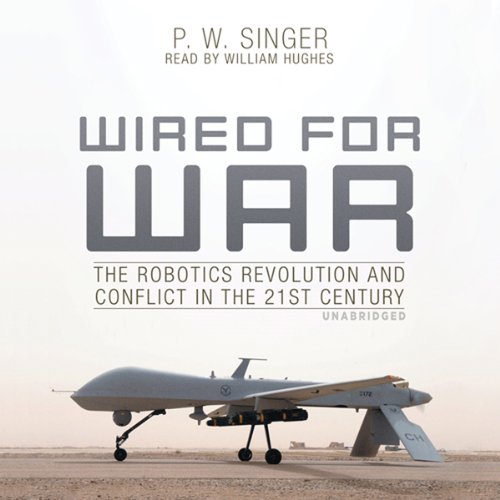
Wired for War
Summary
A military expert reveals how science fiction is fast becoming reality on the battlefield, changing not just how wars are fought, but also the politics, economics, laws, and ethics that surround war itself. Singer’s previous books foretold the rise of private military contractors and the advent of child soldiers - predictions that have proved all too accurate. Now he explores the greatest revolution in military affairs since the atom bomb: robotic warfare. We are now seeing a massive shift in military technology that threatens to make the stuff of I, Robot and The Terminator a reality. Over seven thousand robotic systems are now in Iraq; pilots in Nevada are remotely killing terrorists in Afghanistan; scientists are debating just how smart - and lethal - to make their current prototypes; and many renowned science fiction authors are secretly consulting for the Pentagon. Blending historic evidence with interviews from the field, Singer vividly shows that as these technologies multiply, they will have profound effects on both the front lines and the politics back home. Replacing men with machines may save some lives but will lower morale and psychological barriers to killing. The “warrior ethos,” which has long defined soldiers’ identity, will erode, as will the laws of war that have governed military conflict for generations. Paradoxically, the new technology will also bring war to our doorstep. As other nations and terrorist organizations obtain their own robotic weapons, the robot revolution could undermine America’s military preeminence. While his analysis is unnerving, there’s an irresistible gee-whiz quality to the innovations Singer uncovers.
©2009 P. W. Singer (P)2010 Blackstone Audio, Inc.

The Rise and Fall of Nations
Summary
This pioneering work demystifies the drivers behind political, economic, and social change. Shaped by his 25 years traveling the world and enlivened by encounters with tycoons, presidents, and villagers from Rio to Beijing, Ruchir Sharma's The Rise and Fall of Nations rethinks the "dismal science" of economics as a practical art. Narrowing the thousands of factors that can shape a country's fortunes to 10 clear rules, Sharma explains how to spot political, economic, and social changes in real time. He shows how to read political headlines, black markets, the price of onions, and billionaire rankings as signals of booms, busts, and protests. Set in a postcrisis age that has turned the world upside down, replacing fast growth with low growth and political calm with revolt, Sharma's pioneering book is an entertaining field guide to understanding change in this era or any era.
©2016 Ruchir Sharma (P)2016 Blackstone Audio, Inc.

Solid State
Summary
In Solid State, Kenneth Womack offers the most definitive account of the conception, recording, mixing, and reception of Abbey Road. In February 1969, the Beatles began working on what became their final album together. Abbey Road introduced a number of new techniques and technologies to the Beatles' sound and included "Come Together", "Something", and "Here Comes the Sun", which all emerged as classics. Womack's colorful retelling of how this landmark album was written and recorded is a treat for fans of the Beatles. Solid State takes listeners back to 1969 and into EMI's Abbey Road Studios, which boasted an advanced solid state transistor mixing desk. Womack focuses on the dynamics between John, Paul, George, and Ringo and producer George Martin and his team of engineers, who for the most part set aside the tensions and conflicts that had arisen on previous albums to create a work with an innovative (and among some fans and critics, controversial) studio-bound sound that prominently included the new Moog synthesizer, among other novelties. As Womack shows, Abbey Road was the culmination of the instrumental skills, recording equipment, and artistic vision that the band and George Martin had developed since their early days in the same studio seven years before. A testament to the group's creativity and their producer's ingenuity, Solid State is required listening for all fans of the Beatles and the rock 'n' roll.
©2019 Kenneth Womack (P)2019 Blackstone Publishing

The Management Myth
Summary
Alongside his devastating critique of management "philosophy" from Frederick Taylor to Tom Peters, Stewart provides a bitingly funny account of his own days in a management consulting firm. Combining hands-on experience with the theoretical underpinnings of contemporary fads in efficiency improvement, empowerment, and strategy, Stewart knows his stuff, and thus he lays bare how consultants really have done very little for the business of others - while making a killing for themselves.
©2009 Matthew Stewart (P)2009 Blackstone Audio, Inc.

Republican Gomorrah
Summary
Republican Gomorrah is a bestiary of dysfunction, scandal, and sordidness from the dark heart of the theocratic forces that now have a leash on the party. It shows how those forces are the ones that establishment Republicans, like John McCain, have to bow to if they have any hope of running for president. More that just an exposé, Republican Gomorrah shows that many of the movement's leading figures are stained by crisis and scandal: depression, mental illness, extramarital affairs, struggles with homosexual urges, heavy medication, pornography addiction, serial domestic abuse, and even murder. Inspired by the work of psychologist Erich Fromm, who asserted that the fear of freedom propels anxiety-ridden people into authoritarian settings, Blumenthal explains in a compelling narrative how a culture of personal crises has defined the radical right, transforming the Republican party for the next generation and setting the stage for the future of American politics.
©2009 Max Blumenthal (P)2009 Blackstone Audio, Inc.

Power, Inc.
Summary
The world’s largest company, WalMart Stores, has revenues higher than the gross domestic product of all but 25 of the world’s countries. Its employees outnumber the populations of almost one hundred nations. The world’s largest asset manager, a New York company called BlackRock, controls assets greater than the national reserves of any country on the planet. A private philanthropy, the Gates Foundation, spends as much worldwide on health care as the World Health Organization.
The rise of private power may be the most important and least understood trend of our time. Power, Inc. provides a fresh, timely look at how we have reached a point where thousands of companies have greater power than all but a handful of states.
Beginning with the story of an inquisitive Swedish goat wandering off from his master and inadvertently triggering the birth of the oldest company still in existence, Power, Inc. follows the rise and fall of kings and empires, the making of great fortunes, and the chaos of bloody revolutions. A fastpaced tale in which champions of liberty are revealed to be paid pamphleteers of moneyed interests and greedy scoundrels trigger changes that have lifted billions from deprivation, Power, Inc. traces the bruising jockeying for influence right up to today’s financial crises, growing inequality, broken international system, and battles over the proper role of government and markets.
Rothkopf argues that these recent developments, coupled with the rise of powers like China and India, may not lead to the triumph of American capitalism that was celebrated just a few years ago. Instead, he considers an unexpected scenario, a contest among competing capitalisms offering different visions for how the world should work, a global ideological struggle in which European and Asian models may have important advantages. An important look at the power struggle that is defining our times, Power, Inc. also offers critical insights into how to succeed in the years ahead.
©2012 David Rothkopf (P)2012 Blackstone Audio, Inc.

Last Stand at Khe Sanh
Summary
The vivid, fast-paced account of the siege of Khe Sanh told through the eyes of the men who lived it. For seventy-seven days in 1968, amid fears that America faced its own disastrous Dien Bien Phu, six thousand US Marines held off thirty thousand North Vietnamese Army regulars at the remote mountain stronghold called Khe Sanh. It was the biggest battle of the Vietnam War, with sharp ground engagements, devastating artillery duels, and massive US air strikes. After several weeks of heroic defense, the besieged Americans struck back in a series of bold assaults, and the North Vietnamese withdrew with heavy losses. Last Stand at Khe Sanh is the vivid, fast-paced account of the dramatic confrontation as experienced by the men who were there: Marine riflemen and grenadiers, artillery and air observers, platoon leaders and company commanders, Navy corpsmen and helicopter pilots, and a plucky band of US Army Special Forces. Based on extensive archival research and more than one hundred interviews with participants, Last Stand at Khe Sanh captures the courage and camaraderie of the defenders and delivers the fullest account yet of this epic battle.
©2014 Gregg Jones (P)2014 Blackstone Audio, Inc.

FDR's Folly
Summary
Think FDR was a great president? Think again. In the minds of historians and the American public alike, Franklin Delano Roosevelt was one of our greatest presidents, not least because he supposedly saved America from the Great Depression. But as historian Jim Powell reveals in this groundbreaking book, Roosevelt's New Deal policies actually prolonged and exacerbated the economic disaster, swelled the federal government, and prevented the country from turning around quickly. In today's turbulent domestic and global environment, eerily similar to that of the 1930s, it's more important than ever before to uncover and understand the truth of our history, lest we be doomed to repeat it. You'll never look at FDR in the same way again.
©2003 Jim Powell (P)2008 Blackstone Audio, Inc.

We the Corporations
Summary
In this groundbreaking portrait of corporate seizure of political power, We the Corporations reveals how American businesses won equal rights and transformed the Constitution to serve the ends of capital. Corporations - like minorities and women - have had a civil rights movement of their own and now possess nearly all the same rights as ordinary people. Uncovering the deep historical roots of Citizens United, Adam Winkler shows how that controversial 2010 Supreme Court decision was the capstone of a 200-year battle over corporate personhood and constitutional protections for business. Bringing to resounding life the legendary lawyers and justices involved in the corporate rights movement - among them Daniel Webster, Roger Taney, Lewis Powell, and even Thurgood Marshall - Winkler's tour de force exposes how the nation's most powerful corporations gained our most fundamental rights and turned the Constitution into a bulwark against the regulation of big business.
©2018 Adam Winkler (P)2018 Blackstone Audio, Inc.

The Generals: American Military Command from World War II to Today
Summary
History has been kinder to the American generals of World War II—Marshall, Eisenhower, Patton, and Bradley—than to the generals of the wars that followed. Is this merely nostalgia? Here, Thomas E. Ricks answers the question definitively: No, it is not, in no small part because of a widening gulf between performance and accountability. During World War II, scores of American generals were relieved of command simply for not being good enough. In The Generals we meet great leaders and suspect ones, generals who rose to the occasion and those who failed themselves and their soldiers. Marshall and Eisenhower cast long shadows over this story, but no single figure is more inspiring than Marine General O. P. Smith, whose fighting retreat from the Chinese onslaught into Korea in 1950 snatched a kind of victory from the jaws of annihilation. But Smith’s courage and genius in the face of one of the grimmest scenarios the marines have ever faced only cast the shortcomings of the people who put him there in sharper relief. If Korea showed the first signs of a culture that neither punished mediocrity nor particularly rewarded daring, the Vietnam War saw American military leadership bottom out. In the wake of Vietnam, a battle for the soul of the US Army was waged with impressive success. It became a transformed institution, reinvigorated from the bottom up. But if the body was highly toned, its head still suffered from familiar problems, resulting in tactically savvy but strategically obtuse leadership that would win battles but end wars badly. Ricks has made a close study of America’s military leaders for three decades, and in his hands this story resounds with larger meaning: the transmission of values, strategic thinking, the difference between an organization that learns and one that fails. Military history of the highest quality, The Generals is also essential reading for anyone with an interest in the difference between good leaders and bad ones.
©2012 Thomas E. Ricks (P)2012 Blackstone Audio, Inc

The Teapot Dome Scandal
Summary
The Teapot Dome scandal of the early 1920s was all about oil - hundreds of millions of dollars' worth of petroleum. When the scandal finally broke, the consequences were tremendous. President Harding's legacy was forever tarnished, while "Oil Cabinet" member Albert Fall was forced to resign and was imprisoned for a year. Others implicated in the affair suffered prison terms, commitment to mental hospitals, suicide, and even murder. The Republican Party and the oil-company CEOs scrambled to cover their tracks and were mostly successful. Key documents mysteriously disappeared; important witnesses suffered sudden losses of memory. Though a special investigation was authorized, the scope of the wrongdoing was contained by administration stonewalling. But newly surfaced information indicates that the scandal was even bigger than originally thought.
©2008 Laton McCartney (P)2008 Blackstone Audio, Inc.

It's Even Worse Than It Looks
Summary
Acrimony and hyperpartisanship have seeped into every part of the political process. Congress is deadlocked, and its approval ratings are at record lows. America’s two main political parties have given up their traditions of compromise, endangering our very system of constitutional democracy. And one of these parties has taken on the role of insurgent outlier; the Republicans have become ideologically extreme, scornful of compromise, and ardently opposed to the established social and economic policy regime. Here, congressional scholars Thomas Mann and Norman Ornstein identify two overriding problems that have led Congress—and the United States—to the brink of institutional collapse. The first is the serious mismatch between our political parties, which have become as vehemently adversarial as parliamentary parties, with a governance system that, unlike a parliamentary democracy, makes it extremely difficult for majorities to act. Second, while both parties participate in tribal warfare, both sides are not equally culpable. The political system faces what the authors call "asymmetric polarization", with the Republican Party implacably refusing to allow anything that might help the Democrats politically, no matter the cost. With dysfunction rooted in long-term political trends, a coarsened political culture, and a new partisan media, the authors conclude that there is no silver bullet that can solve everything. But they offer a panoply of useful ideas and reforms, endorsing some solutions, like greater public participation and institutional restructuring of the House and Senate, while debunking others, like independent or third-party candidates. Above all, they call on the media as well as the public at large to focus on the true causes of dysfunction rather than just throwing the bums out every election cycle. Until voters learn to act strategically to reward problem solving and punish obstruction, American democracy will remain in serious danger.
©2012 Thomas E. Mann and Norman J. Ornstein (P)2012 Blackstone Audio, Inc.

The Great Deformation
Summary
A coruscating, brilliantly insightful exegesis of where capitalism went wrong, how it was corrupted, and how it might be restored, by outspoken former Reagan budget director and best-selling author David Stockman. David Stockman was the architect of the Reagan Revolution that was meant to restore sound money principles to the United States government. It failed, derailed by politics, special interests, welfare, and warfare. In The Great Deformation, Stockman describes how the working of free markets and democracy has long been under threat in America and provides a surprising, nonpartisan catalog of the corrupters and defenders. His analysis overturns the assumptions of Keynesians and monetarists alike, showing how both liberal and neoconservative interference in markets has proved damaging and often dangerous. Over time, crony capitalism has made fools of us all, transforming Republican treasury secretaries into big-government interventionists and populist Democrat presidents into industry-wrecking internationalists. Today’s national debt stands at nearly $16 trillion. Divided equally among taxpayers, each of us is $52,000 in debt. This book explains how we got here—and why this warped crony capitalism has betrayed so many of our hopes and dreams.
©2013 David A. Stockman (P)2013 Blackstone Audio, Inc

Brain Bugs
Summary
A lively, surprising tour of our mental glitches and how they arise. With its trillions of connections, the human brain is more beautiful and complex than anything we could ever build, but it’s far from perfect: our memory is unreliable; we can’t multiply large sums in our heads; advertising manipulates our judgment; we tend to distrust people who are different from us; supernatural beliefs and superstitions are hard to shake; we prefer instant gratification to long-term gain; and what we presume to be rational decisions are often anything but. Drawing on striking examples and fascinating studies, neuroscientist Dean Buonomano illuminates the causes and consequences of these “bugs” in terms of the brain’s innermost workings and their evolutionary purposes. He then goes one step further, examining how our brains function—and malfunction—in the digital, predator-free, information-saturated, special-effects-addled world that we have built for ourselves. Along the way, Brain Bugs gives us the tools to hone our cognitive strengths while recognizing our inherent weaknesses.
©2011 Dean Buonomano (P)2011 Blackstone Audio, Inc.