The Military category has 1,612 audiobooks on Listento.it, with an average listener rating of 4.6★ across 5,283 ratings. The most-rated is The Rise and Fall of the Third Reich.
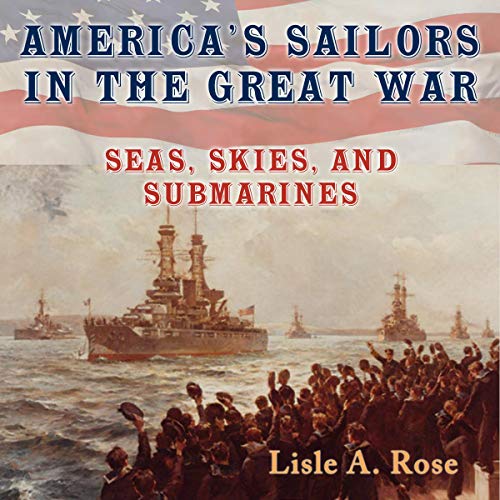
America's Sailors in the Great War: Seas, Skies, and Submarines (American Military Experience)
Summary
This audiobook is a thrillingly-told story of naval planes, boats, and submarines during World War I.
When the US entered World War I in April 1917, America’s sailors were immediately forced to engage in the utterly new realm of anti-submarine warfare waged on, below and above the seas by a variety of small ships and the new technology of air power. The US Navy substantially contributed to the safe trans-Atlantic passage of a two million man Army that decisively turned the tide of battle on the Western Front even as its battleship division helped the Royal Navy dominate the North Sea. Thoroughly professionalized, the Navy of 1917-18 laid the foundations for victory at sea 25 years later.
The book is published by University of Missouri Press. The audiobook is published by University Press Audiobooks.
©2017 The Curators of the University of Missouri (P)2019 Redwood Audiobooks

Lincoln as He Really Was
Summary
"Lincoln as He Really Was, by Charles T. Pace, is a refreshingly truthful antidote to the standard Lincoln mythology. It is refreshing because it is so fact-based and well-documented and devoted to historical truth. Lincoln as He Really Was is not your typical boring, voluminous biography filled with thousands of disconnected (and often irrelevant) facts dug up by a dozen graduate research assistants and published by a card-carrying member of the Ivy League Lincoln cult. It is the first work since Edgar Lee Masters’ 1931 classic Lincoln the Man to attempt to reveal the truth about what kind of man Abraham Lincoln really was." (Dr. Thomas J. DiLorenzo, author of The Real Lincoln; Lincoln Unmasked; Hamilton’s Curse; and The Problem with Socialism)
©2018 Charles T. Pace (P)2018 Shotwell Publishing LLC

Recollections of a Private Soldier in the Army of the Potomac
Summary
Who beside the enlisted men can tell how the fierce Confederates looked and fought behind their earthworks and in the open; how the heroic soldiers of the impoverished South were clothed, armed, and fed? The memoirs of Grant, Lee, Hood, Gordon, Johnston, and other Civil War generals are some of our most common sources that we look at when learning about this tumultuous conflict. But what about the voices of the common soldier? Frank Wilkeson, when he wrote his account of the Civil War, aimed to rectify this and reassert the importance of looking at the accounts of the men who carried the muskets, served the guns, and rode their saddles into the heat of battle. As he states in his preface, "The epauleted history has been largely inspired by vanity or jealousy, saving and excepting forever the immortal record." Wilkeson and his fellow comrades who lived on the frontlines of the conflict had no need to rescue their reputations or assert their actions and thus their accounts provide a brilliant and unbiased alternative view of this bloody war. After lying about his age Frank Wilkeson was just 16 when he joined the Union Army in 1864. Through the course of the next year he saw some of the ferocious battles of Grant's Overland Campaign. Recollections of a Private Soldier in the Army of the Potomac is a wonderfully refreshing account of the American Civil War that takes listeners to the heart of what it would have been like to have served in the front ranks.
Public Domain (P)2019 Blackstone Audio, Inc.

Boned 3
Summary
Are YOU ready to be BONED - FOR THE LAST TIME? Hoo boy! Am I ever in BIG trouble! Why? Because my trio of beloved stepbrothers are a bunch of lying bastards! Oh, sure, they are sexy, alpha males, and will make any woman alive salivate with want, with just a glance at their beautiful, muscled bodies and dreamy eyes. They, and their SEAL team, military, and security force compatriots are eye candy, for sure! And, they are always on the go, men of action who fight danger, and uncover hidden perils. They aren't beyond sharing their conquests, either, with their wives and girlfriends eager to join in the fun! But, they've all hidden secrets from me, and I don't know who to trust anymore! My soul-mate is Drake 'Bone' Jaeger. He got his nickname when a sports magazine featured the famous 'profile' of his spandex swimsuit on its cover. I love Bone with all my heart, but now I'm involved with his brother, Karl! Karl, a man of action with huge passions and insatiable hungers, sails us around the world on his luxurious yacht, the "Miss T". His crew, Dean, Julie, and Tanya are more than just mates - they are our friends and lovers. The voyages on this love boat spin me around, with sensual pleasures beyond compare! Stephan, the eldest Jaeger brother, holds an unconditional love for me. And, to my chagrin, my own feelings are growing stronger for him with each passing day! After an attack on our family and friends by the Mandarin Connection's evil operatives leaves me forever altered, I don't know which of these men will win my love. Or, if I deserve any of them at all! BONED3 is the action-packed sequel to Stephanie Brother's novels BONED, and BONED2! You won't be able to put it down!
©2017 Stephanie Brother (P)2018 Stephanie Brother

Blood Moon
Summary
This sweeping American epic reveals one of the greatest untold stories of the 19th century: the fierce rivalry between two great Cherokee chiefs that led to war, forced migration, and the devastation of a once-proud nation. Blood Moon is the story of the century-long blood feud between two rival Cherokee chiefs from the early years of the United States through the infamous Trail of Tears and into the Civil War. While little remembered today, their mutual hatred shaped the tragic history of the tribe far more than anyone, even the reviled President Andrew Jackson, ever did. In this epic saga, John Sedgwick brings to life an untold chapter of American history through the relationship between one chief called The Ridge, a fearsome warrior who spoke no English but whose exploits on the battlefield were legendary, and John Ross, who was the Cherokees’ primary chief for nearly 40 years, yet displayed the Scottish side of his mixed-blood heritage and spoke not a word of Cherokee. To protect their sacred landholdings from American encroachment, these two men negotiated with almost every American president from George Washington through Abraham Lincoln. At first friends and allies, they broke on the subject of Removal, breeding an enmity that led to a bloody civil war within Cherokee Nation that culminated in the two factions battling each other in the War Between the States. Dramatic, far-reaching, and unforgettable, Blood Moon paints a portrait of these two inspirational leaders who worked together to lift their people to the height of culture and learning as the most civilized tribe in the nation and then drop them to the depths of ruin and despair as they turned against each other. Theirs is a story of land, pride, honor, and loss that forms much of the country’s mythic past today.
©2018 John Sedgwick (P)2018 Simon & Schuster

Picasso's War
Summary
From best selling author Russell Martin comes a stirring account of the town that inspired one of the world's most celebrated and controversial works of art, the painting Guernica's profound impact on the politics and culture of the 20th century, and the artist whose passion and artistic vision are unequaled in modern history. On April 26, 1937 the German Luftwaffe began relentless bombing and machine-gunning of businesses, homes and villages to test a new type of warfare waged from the air, at the request of General Francisco Franco and his rebel forces. Three and a half hours later, the village lay in ruins, its population decimated. This act of terror and unspeakable cruelty - the first intentional, large-scale attack against a nonmilitary target in modern warfare - outraged the world, and compelled a Spanish painter to respond with artistic fury. Pablo Picasso, an expatriate living in Paris, reacted immediately to the devastation in his homeland by beginning work on the canvas that would become his testament against the horrors of war. Weaving themes of conflict and redemption, doom and transcendence, and featuring some of the century's most memorable and infamous figures, Martin follows this renowned masterwork from its creation through its journey across decades, from many countries of Europe to America and finally and triumphantly to Spain. Picasso's War is a book that vividly demonstrates how vital art is to human lives and how sometimes it even transfigures tragedy, a story that delivers an unforgettable portrait of an artistic genius whose visionary rendering of the terrible wounds of war still resonates profoundly today.
©2002 Russell Martin (P)2002 HighBridge Compnay

Operazione Dynamo
Summary
In questo breve viaggio nella storia, andremo alla scoperta di uno degli eventi più significativi della Seconda Guerra Mondiale, uno di quelli che avrebbe potuto indubbiamente cambiarne l'esito. È la storia delle centinaia di migliaia di soldati, soprattutto britannici e francesi, ma anche belgi, olandesi, cechi e polacchi, intrappolati nella zona del porto francese di Dunkerque dall'allora inarrestabile esercito tedesco. Nel corso dell'Operazione Dynamo, migliaia di civili britannici usarono le loro imbarcazioni per trasportare in Inghilterra i militari, unendo i loro sforzi alle forze navali britannica e francese. Dal canto suo, l'aviazione inglese fece il possibile per proteggere la flotta e le barche dalle incursioni dei bombardieri e dei caccia tedeschi. Ascolterai poi l'audio di un documentario sulla battaglia di Dunkerque e una breve scheda del film di Christopher Nolan basato su questa storia.
©2017 Area51 Publishing (P)2017 Area51 Publishing

Petersburg
Summary
Travel through a pivotal time in American history....Discover what happened, why it matters, and what to see. Jeff Shaara, America's premier Civil War novelist, gives a remarkable guided tour of one of the Civil War battlefields every American should visit. He captures the true meaning and magnitude of the conflict.
©2007 Jeff Shaara (P)2007 Random House, Inc.

Verdun
Summary
Alongside Waterloo and Gettysburg, the Battle of Verdun during World War I stands as one of history’s greatest clashes. Yet it is also one of the most complex and misunderstood. Conventional wisdom holds that the battle began in February 1916 and lasted until December, when the victorious French wrested all the territory they had lost back from the Germans. In fact, says historian John Mosier, from the very beginning of the war until the armistice in 1918, no fewer than eight distinct battles were waged for the possession of Verdun. These conflicts are largely unknown, even in France, owing to the obsessive secrecy of the French high command and its energetic propaganda campaign to fool the world into thinking that the war on the Western Front was a steady series of German checks and defeats. Although British historians have always seen Verdun as a one-year battle designed by the German chief of staff to bleed France white, Mosier’s careful analysis of the German plans reveals a much more abstract and theoretical approach.Our understanding of Verdun has long been mired in myths, false assumptions, propaganda, and distortions. Now, using numerous accounts of military analysts, serving officers, and eyewitnesses, including French sources that have never been translated, Mosier offers a compelling reassessment of the Great War’s most important battle.
©2013 John Mosier (P)2013 Gildan Media LLC

The War with Hannibal
Summary
Hannibal’s military campaign against Rome inspired its citizens with the same panic that would later terrify Europeans beset by Mongol invaders from the East. A sworn enemy of Rome, Hannibal succeeded as leader of the Carthaginian forces at the age of 26, following the death of his brother-in-law Hasdrubal. On joining his troops, Hannibal launched an attack on the Roman-held city of Saguntum, beginning the Second Punic War and a process that seemed almost predestined as his army swept like a scourge round the Mediterranean shores. Though credit is due to the wisdom of Carthage’s leaders and the loyalty and efficiency of its troops, the larger share must be given to Hannibal, a leader and strategist equal to any the world has known.
Public Domain (P)1993 Recorded Books, LLC

Dunkirk
Summary
Penguin presents the unabridged downloadable audiobook edition of Dunkirk by Hugh Sebag-Montefiore, read by Roy McMillan. Hugh Sebag-Montefiore's Dunkirk: Fight to the Last Man tells the story of the rescue in May 1940 of British soldiers fleeing capture and defeat by the Nazis at Dunkirk. Dunkirk was not just about what happened at sea and on the beaches. The evacuation would never have succeeded had it not been for the tenacity of the British soldiers who stayed behind to ensure they got away. Men like Sergeant Major Gus Jennings, who died smothering a German stick bomb in the church at Esquelbecq in an effort to save his comrades, and Captain Marcus Ervine-Andrews VC, who single-handedly held back a German attack on the Dunkirk perimeter, thereby allowing the British line to form up behind him. Told to stand and fight to the last man, these brave few battalions fought in whatever manner they could to buy precious time for the evacuation. Outnumbered and outgunned, they launched spectacular and heroic attacks time and again, despite ferocious fighting and the knowledge that for many only capture or death would end their struggle. Hugh Sebag-Montefiore was a barrister before becoming a journalist and then an author. He wrote the best-selling Enigma: The Battle for the Code. One of his ancestors was evacuated from Dunkirk.
©2007 Hugh Sebag-Montefiore (P)2017 Penguin Random House UK

Marching Orders
Summary
A stunning account of how the American military's breaking of the Japanese diplomatic Purple codes led to the defeat of Nazi Germany. Bruce Lee, having had access to more than one million pages of US Army documents and thousands of pages of daily top-secret messages dispatched to Tokyo from the Japanese embassy in Berlin, assembles fascinating revelations about pivotal moments in the war, including the reason Eisenhower stopped his army at the Elbe and let the Russians capture Berlin, the invasion of Europe, and the battles on the African and Eastern fronts. This groundbreaking book clearly demonstrates how the success of the American code breakers led to so many favorable military and strategic outcomes for the Allies and hastened the end of this devastating war.
©2015 Bruce Lee (P)2016 Dreamscape Media, LLC

The Ring
Summary
A story of love, loss, and hope. Amanda knows three things about her life - she loves living in Tacoma, she wants to be a teacher, and she will never marry a man in the military. Yet, when Lucas drops by the coffee shop where she works in a flight suit, he starts to change her mind about her future. While she is determined to just be his friend, the chemistry between them is undeniable. Their relationship survives two deployments and Lucas' hectic business travel thereafter. After they get married, they move across the country to Charleston, SC, and Amanda finds a job - which helps somewhat with the loneliness. But while she thought she was prepared for this life, she soon finds out the true sacrifices military families make.
©2019, 2020 BLKDOG Publishing (P)2020 Sarah Anne Carter

Saipan
Summary
The story of the Battle of Saipan has it all. Marines at war: on Pacific beaches, in hellish volcanic landscapes in places like Purple Heart Ridge, Death Valley, and Hell's Pocket, under a commander known as "Howlin' Mad." Naval combat: carriers battling carriers from afar, fighters downing Japanese aircraft, submarines sinking carriers. Marine-army rivalry. Fanatical Japanese defense and resistance. A turning point of the Pacific War. James Hallas reconstructs the full panorama of Saipan in a way that no recent chronicler of the battle has done. In its comprehensiveness, attention to detail, scope of research, and ultimate focus on the men who fought and won the battle on the beaches and at and above the sea, it rivals Richard Frank's modern classic Guadalcanal. This is the definitive military history of the Battle of Saipan.
©2019 Rowman & Littlefield (P)2019 Rowman & Littlefield

The Finest Hours of the Second World War: WWII
Summary
“Each war entails the destruction of the human soul.” (Henry Miller). Humanity should not lose its memory, even if some may try to conceal it. From the hindsight afforded by the passing of 75 years from the events narrated, with freedom of thought and a totally independent standpoint, Pacific Media have undertaken an arduous research which has resulted in the series: The Finest Hours of WWII. From the atrocious moment in which Hitler ordered the invasion of Polish territory to the day in which Emperor Hirohito “had to accept the unacceptable”, all is encompassed in this audiobook over its 21 programs. 1. Hitler, the Wolf 2. The Onset; The German-Soviet Expansion 3. The Fürher’s Revenge 4. The Battle of Britain 5. The Battle of the Atlantic 6. The Desert Fox 7. The Invasion of The Soviet Union 8. Mr. President, What About the Japanese? 9. Midway: Change of Course 10. Stalingrad 11. The Desert Rats 12. The Decline of Fascism 13. The Slow Italian Campaign 14. The Road to Tokio 15. The Pacific in Flames 16. D Day 17. The Battle of Kursk 18. The Battle for Germany 19. The Agony of The Third Reich 20. Leyte, Imperial Destiny 21. "The Peace" of the Atomic Bomb
©2010 Pacific Media, S.L. (P)2020 Pacific Media, S.L.

Valley of the Shadow
Summary
Struggling to reassert control over their Indochinese colonies after World War II, the French established a huge air-land base in the valley of Dien Bien Phu. But when the opposing Vietnamese People's Army (VPA) began massing its forces against the base in late 1953, French commanders seized the opportunity to draw their elusive enemy into a decisive set-piece battle. Defending a series of fortified positions which were reliant upon a single airstrip - and later, risky and inaccurate airdrops - for reinforcement and resupply, the French troops quickly discovered that they had underestimated their enemy. In 56 days of costly close-quarters fighting, the VPA slowly dislodged the French from one strongpoint after another by developing novel tactics and accomplishing incredible feats of engineering. Drawing upon Vietnamese-language sources never previously employed in Western accounts of the siege, Valley of the Shadow is a dramatic re-telling of the climactic battle of the First Indochina War, the conflict that saw the French expelled from their former colony and set the stage for the "American War" in Vietnam.
©2018 Kevin Boylan and Luc Olivier (P)2019 Tantor

Wet
Summary
T-Bomb, Tait Bommer's call-sign, has never described him more accurately. A loose cannon with a penchant for pissing people off, he's now responsible for a major screw-up during the First Special Forces Group's most recent mission. His mess has earned him two weeks of mandated R&R on the shores of Kauai, where the ultimatum is clear - straighten up and fly right, or don't return to active duty. But he's such a train wreck that even his best friend, Kellan Rush, isn't happy about having to pull babysitting duty. When their "vacation" is interrupted by a stranger bearing nothing but a glare, a Bowie knife, and a lot of curves in a tiny bikini, they wonder if the trip hasn't been hijacked by island spirits. Surely they've found a goddess in this dark-haired beauty who not only sees their emotional scars but opens their spirits by exposing her own soul. "Therapy" takes on new meaning when illicit desires become explosive passion...and their goddess's sweet submission. Neither man wants to leave the island paradise, a torment that's intensified when an old adversary threatens to steal their goddess - and rip their friendship apart. Will Tait and Kellan let jealousy triumph? Or will they unite as brothers at arms for the most important mission of their lives in the name of the greatest cause of all - saving the woman they love?
©2018 Waterhouse Press, LLC (P)2018 Brilliance Publishing, Inc., all rights reserved

The Gulf War: The History and Legacy of Operation Desert Shield and Operation Desert Storm
Summary
It was one of the 20th century’s most decisive wars, but also one of its most influential. In the wake of Saddam Hussein’s invasion of Kuwait, America led a coalition of dozens of nations that repelled the Iraqi attack and smashed Iraqi forces, much of which was captured on live television as global networks broadcast the images back home. On the now ironic date of September 11, 1990, President Bush addressed a joint session of Congress to explain why he was assembling a coalition of nations to intervene against Saddam Hussein’s invasion of Kuwait. Bush stated, “Out of these troubled times, our fifth objective -- a new world order -- can emerge…A new era, freer from the threat of terror, stronger in the pursuit of justice and more secure in the quest for peace.” As his son would later attempt over a decade later in another war against Iraq, President Bush sought to present the coalition of nearly 40 nations as indicative of multilateralism, even though it was dominated by American forces. At the time, the Soviet Union was less than a year away from collapsing, leaving the United States as the sole superpower. In fact, the “new world order” that Bill Clinton and future presidents stepped into was one that allowed for American unilateralism. Since World War II, the United States had protected the West during the Cold War, and President Kennedy had coined the term “Pax Americana” to describe his hope of peace for the world. 30 years later, American presidents now seemingly had the opportunity to use America’s unchecked power to instill and preserve peace across the world. As events have proved, the attempt to forge Pax Americana would be much easier said than done, and American involvement in the Middle East has been directly tied to the First Gulf War.
©2018 Charles River Editors (P)2018 Charles River Editors

The Brave
Summary
Twenty-one riveting stories from the battlefield about how India's highest military honor was won The Brave takes you to the hearts and minds of India's bravest soldiers, all of whom won the Param Vir Chakra, India's greatest military honor. With access to the Army, families, and comrades-in-arms of the soldiers, Rachna Bisht Rawat paints the most vivid portrait of these men and their extraordinary deeds. How hard is it to fight at 20,000 feet in sub-zero temperatures? Why did Captain Vikram Batra say, "Yeh dil maange more"? How do wives and girlfriends of soldiers who don't return cope? What happens when the enemy is someone that you have trained? How did the Charlie Company push back the marauding Chinese? How did a villager from Uttar Pradesh become a specialist in destroying tanks? Both gripping and inspiring, The Brave is the ultimate audiobook on the Param Vir Chakra.
©2019 Rachna Bisht (P)2019 Random House Audio

A Thousand May Fall
Summary
The Civil War ended more than 150 years ago, yet our nation remains fiercely divided over its enduring legacies. In A Thousand May Fall, Pulitzer Prize finalist Brian Matthew Jordan returns us to the war itself. Creating an intimate, absorbing chronicle from the ordinary soldier's perspective, he allows us to see the Civil War anew - and through unexpected eyes. At the heart of Jordan's vital account is the 107th Ohio Volunteer Infantry, which was at once representative and exceptional. Its ranks weathered the human ordeal of war in painstakingly routine ways, fighting in two defining battles, Chancellorsville and Gettysburg, each time in the thick of the killing. But the men of the 107th were not lauded as heroes. Most of them were ethnic Germans, set apart by language and identity, and their loyalties were regularly questioned by a nativist Northern press. In the course of its service, the 107th Ohio was decimated five times over, and although one of its members earned the Medal of Honor, few others achieved any lasting distinction. Reclaiming these men for posterity, Jordan reveals that even as they endured the horrible extremes of war, the Ohioans contemplated the deeper meanings of the conflict at every turn - from personal questions of citizenship and belonging to the overriding matter of slavery and emancipation.
©2021 Brian Matthew Jordan (P)2021 HighBridge, a division of Recorded Books