The World category has 419 audiobooks on Listento.it, with an average listener rating of 4.5★ across 2,940 ratings. The most-rated is A Short History of Nearly Everything.

River of Darkness
Summary
From the acclaimed author of Conquistador comes this thrilling account of one of history's greatest adventures of discovery. With cinematic immediacy and meticulous attention to historical detail, here is the true story of a legendary 16th-century explorer and his death-defying navigation of the Amazon - river of darkness, pathway to gold. In 1541, the brutal conquistador Gonzalo Pizarro and his well-born lieutenant Francisco Orellana set off from Quito in search of La Canela, South America's rumored Land of Cinnamon, and the fabled El Dorado, "the golden man". Driving an enormous retinue of mercenaries, enslaved natives, horses, hunting dogs, and other animals across the Andes, they watched their proud expedition begin to disintegrate even before they descended into the nightmarish jungle, following the course of a powerful river. Soon hopelessly lost in the swampy labyrinth, their numbers diminishing daily through disease, starvation, and Indian attacks, Pizarro and Orellana made a fateful decision to separate. While Pizarro eventually returned home barefoot and in rags, Orellana and 57 men, in a few fragile craft, continued downriver into the unknown reaches of the mighty Amazon, serenaded by native war drums and the eerie cries of exotic predators. Theirs would be the greater glory.
©2011 Buddy Levy (P)2017 Tantor

Turning Points in Middle Eastern History
Summary
The Middle East is a critically important area of our world. And, with its current prominence in international affairs, media images of the Middle East reach us on a daily basis. Much media coverage, however, is incomplete at best, failing to take account of either the complexities or the historical background of this pivotal region. For most of us, the real story of the Middle East remains untold. What made this crucial geopolitical area what it is today? In coming to terms with the present and future of the Middle East, an understanding of its history is not only highly valuable but essential. Now, the 36 lectures of Turning Points in Middle Eastern History unfurl a breathtaking panorama of history, exploring a 1,300-year window from the rise of the warrior prophet Muhammad to the fall of the Ottoman Empire after World War I. Each lecture focuses on a specific moment that changed the direction of events or the narrative of history. You'll witness the Battle of Karbala, where Muhammad's heirs - the Sunni and Shia - split once and for all. You'll discover the wonders of the Islamic Golden Age and marvel at the superlative advances in astronomy, mathematics, medicine, and literature - and the preservation of classical Greek and Roman wisdom - that unfolded in global centers of learning such as Baghdad, Cairo, and Cordoba. You'll follow the empire building of the Persian Safavids, the Egyptian Mamluks, and the Ottomans, among others. The breakup of the Ottoman Empire yielded most of the modern states of the Middle East. The far-reaching impacts of its rise and fall, plus the long-lasting influence of the 18th-century Saud-Wahhab Pact between a desert ruler and a religious reformer, creating today's Kingdom of Saudi Arabia, are two more expressions of how the past suffuses the present. The stories you'll discover here are as dazzling as anything in the Arabian Nights and are all the more astonishing for being true. PLEASE NOTE: When you purchase this title, the accompanying reference material will be available in your My Library section along with the audio.
©2016 The Great Courses (P)2016 The Teaching Company, LLC

Apollo 8
Summary
This program includes a bonus conversation with Commander Frank Borman plus archival audio from Apollo 8's lunar orbit and from the cockpit during the mission. The untold story of the historic voyage to the moon that closed out one of our blackest, bloodiest years with a nearly unimaginable triumph In August 1968 NASA made a bold decision: In just 16 weeks, the United States would launch humankind's first flight to the moon. Only the year before, three astronauts had burned to death in their spacecraft, and since then the Apollo program had suffered one setback after another. Meanwhile, the Russians were winning the space race, the Cold War was getting hotter by the month, and President Kennedy's promise to put a man on the moon by the end of the decade seemed sure to be broken. But when Frank Borman, Jim Lovell, and Bill Anders were summoned to a secret meeting and told of the dangerous mission, they instantly signed on. Written with all the color and verve of the best narrative nonfiction, Apollo 8 takes us from Mission Control to the astronauts' homes, from the test labs to the launchpad. The race to prepare an untested rocket for an unprecedented journey paves the way for the hair-raising trip to the moon. Then, on Christmas Day, a nation that has suffered a horrendous year of assassinations and war is heartened by an inspiring message from the trio of astronauts in lunar orbit. And when the mission is over - after the first view of the far side of the moon, the first Earth-rise, and the first reentry through the Earth's atmosphere following a flight to deep space - the impossible dream of walking on the moon suddenly seems within reach. The full story of Apollo 8 has never been told, and only Jeffrey Kluger - Jim Lovell's coauthor on their best-selling book about Apollo 13 - can do it justice. Here is the tale of a mission that was both a calculated risk and a wild crapshoot, a stirring account of how three American heroes forever changed our view of the home planet.
©2017 Jeffrey Kluger (P)2017 Macmillan Audio

Energy
Summary
Pulitzer Prize- and National Book Award-winning author Richard Rhodes reveals the fascinating history behind energy transitions over time - wood to coal to oil to electricity and beyond. People have lived and died, businesses have prospered and failed, and nations have risen to world power and declined, all over energy challenges. Ultimately, the history of these challenges tells the story of humanity itself. Through an unforgettable cast of characters, Pulitzer Prize-winning author Richard Rhodes explains how wood gave way to coal and coal made room for oil, as we now turn to natural gas, nuclear power, and renewable energy. Rhodes looks back on five centuries of progress, through such influential figures as Queen Elizabeth I, King James I, Benjamin Franklin, Herman Melville, John D. Rockefeller, and Henry Ford. In Energy, Rhodes highlights the successes and failures that led to each breakthrough in energy production, from animal and water power to the steam engine, from internal combustion to the electric motor. He addresses how we learned from such challenges, mastered their transitions, and capitalized on their opportunities. Rhodes also looks at the current energy landscape, with a focus on how wind energy is competing for dominance with cast supplies of coal and natural gas. He also addresses the specter of global warming and a population hurtling toward 10 billion by 2100. Human beings have confronted the problem of how to draw life from raw material since the beginning of time. Each invention, each discovery, each adaptation brought further challenges, and through such transformations we arrived at where we are today. In Rhodes’ singular style, Energy details how this knowledge of our history can inform our way tomorrow.
©2018 Richard Rhodes (P)2018 Simon & Schuster Audio

Amazing Grace
Summary
Amazing Grace tells the story of the remarkable life of the British abolitionist William Wilberforce (1759-1833). This accessible biography chronicles Wilberforce's extraordinary role as a human rights activist, cultural reformer, and member of Parliament. At the center of this heroic life was a passionate 20-year fight to abolish the British slave trade, a battle Wilberforce won in 1807, as well as efforts to abolish slavery itself in the British colonies, a victory achieved just three days before his death in 1833. Metaxas discovers in this unsung hero a man of whom it can truly be said, "He changed the world." Before Wilberforce, few thought slavery was wrong. After Wilberforce, most societies in the world came to see it as a great moral wrong. This account of Wilberforce's life will help many to become acquainted with an exceptional man who was a hero to Abraham Lincoln and an inspiration to the anti-slavery movement in America.
©2007 Eric Metaxas (P)2007 Tantor Media Inc.

A History of the World
Summary
From the earliest civilizations to the 21st century: a global journey through human history, published alongside a landmark BBC One television series. Our understanding of world history is changing, as new discoveries are made on all the continents and old prejudices are being challenged. In this truly global journey, Andrew Marr revisits some of the traditional epic stories, from classical Greece and Rome to the rise of Napoleon, but surrounds them with less familiar material, from Peru to the Ukraine, China to the Caribbean. He looks at cultures that have failed and vanished, as well as the origins of today’s superpowers, and finds surprising echoes and parallels across vast distances and epochs. This is a book about the great change-makers of history and their times, people such as Cleopatra, Genghis Khan, Galileo, and Mao, but it is also a book about us. For 'The better we understand how rulers lose touch with reality, or why revolutions produce dictators more often than they produce happiness, or why some parts of the world are richer than others, the easier it is to understand our own times.' Fresh, exciting and vividly listenable, this is popular history at its very best.
©2012 Andrew Marr (P)2012 Macmillan Digital Audio

The Old Ways
Summary
From the acclaimed author of The Wild Places comes an engrossing exploration of walking and thinking. In this exquisitely written book, Robert Macfarlane sets off from his Cambridge, England, home to follow the ancient tracks, holloways, drove roads, and sea paths that crisscross both the British landscape and its waters and territories beyond. The result is an immersive, enthralling exploration of the ghosts and voices that haunt old paths, of the stories our tracks keep and tell, and of pilgrimage and ritual. Told in Macfarlane’s distinctive voice, The Old Ways folds together natural history, cartography, geology, archaeology, and literature. His walks take him from the chalk downs of England to the bird islands of the Scottish northwest, from Palestine to the sacred landscapes of Spain and the Himalayas. Along the way he crosses paths with walkers of many kinds - wanderers, pilgrims, guides, and artists. Above all this is a book about walking as a journey inward and the subtle ways we are shaped by the landscapes through which we move. Macfarlane discovers that paths offer not just a means of traversing space but of feeling, knowing, and thinking. Robert Macfarlane is the author of the prize-winning Mountains of the Mind and The Wild Places, both of which were New York Times Notable Books. He has contributed to Harper’s, Granta, the Observer, Times Literary Supplement, and London Review of Books. He is a fellow of Emmanuel College, Cambridge.
©2012 Robert Macfarlane (P)2012 Blackstone Audio, Inc.

Secret Treasure of Oak Island
Summary
It started on a summer afternoon in 1795 when a young man named Daniel McGinnis found what appeared to be an old site on an island off the Acadian coast, a coastline fabled for the skullduggery of pirates. The notorious Captain Kidd was rumored to have left part of his treasure somewhere along here, and as McGinnis and two friends started to dig, they found what turned out to be an elaborately engineered shaft constructed of oak logs, nonindigenous coconut mats, and landfill that came to be known as the Money Pit. Ever since that summer day in 1795, the possibility of what might be hidden in the depths of a small island off the south coast of Nova Scotia, Canada, has made it the site of the world's longest, most expensive, and most perplexing treasure hunt. Author D'Arcy O'Connor recounts the fascinating stories and amazing discoveries of past and current treasure seekers who have sought Oak Island's fabled treasure for over 200 years. It has baffled scientists and madmen, scholars and idiots, millionaires and get-rich-quick schemers, psychics, engineers, charlatans, and even a former president of the United States. The island has consumed the fortunes - and in some cases, the lives - of those who have obsessively set out to unlock its secret. Despite all their efforts, the mystery remains unsolved, and not a single dime of treasure has ever been recovered. The present-day search is an archaeological dig exceeding anything ever done anywhere for similar purposes, and it may well result in the discovery of one of the world's richest and most historically significant treasures. But this is also the story of individuals who have dedicated years of their lives to discover what was buried long ago beneath this strange island. They are driven by a lust for gold, by archaeological curiosity, and by their determination to outwit the engineer who was responsible for the Oak Island enigma.
©2018 D'Arcy O'Connor (P)2018 Tantor

The Last Days of the Incas
Summary
In 1532, the 54-year-old Spanish conquistador Francisco Pizarro led a force of 167 men, including his four brothers, to the shores of Peru. Unbeknownst to the Spaniards, the Inca rulers of Peru had just fought a bloody civil war in which the emperor Atahualpa had defeated his brother, Huascar. Pizarro and his men soon clashed with Atahualpa and a huge force of Inca warriors at the Battle of Cajamarca. Despite being outnumbered by more than 200 to one, the Spaniards prevailed - due largely to their horses, their steel armor and swords, and their tactic of surprise. They captured and imprisoned Atahualpa. Although the Inca emperor paid an enormous ransom in gold, the Spaniards executed him anyway. The following year, the Spaniards seized the Inca capital of Cuzco, completing their conquest of the largest native empire the New World has ever known. Peru was now a Spanish colony, and the conquistadors were wealthy beyond their wildest dreams. But the Incas did not submit willingly. A young Inca emperor, the brother of Atahualpa, soon led a massive rebellion against the Spaniards, inflicting heavy casualties and nearly wiping out the conquerors. Eventually, however, Pizarro and his men forced the emperor to abandon the Andes and flee to the Amazon. There, he established a hidden capital, called Vilcabamba. Although the Incas fought a deadly, 36-year-long guerrilla war, the Spanish ultimately captured the last Inca emperor and vanquished the native resistance. Kim MacQuarrie lived in Peru for five years and became fascinated by the Incas and the history of the Spanish conquest. Drawing on both native and Spanish chronicles, he vividly describes the dramatic story of the conquest, with all its savagery and suspense.
©2007 Kim MacQuarrie (P)2007 Tantor Media Inc.

The Wisdom of History
Summary
Do the lessons passed down to us by history, lessons whose origins may lie hundreds, even thousands of years in the past, still have value for us today? Is Santayana's oft-repeated saying, "Those who cannot remember the past are condemned to repeat it", merely a way to offer lip service to history as a teacher - or can we indeed learn from it? And if we can, what is it that we should be learning? In this unflinching series of 36 lectures, a world-renowned scholar makes the case that we not only can learn from history, but must. Drawing on decades of experience as a classical historian, Professor Fears explores history's patterns to conclude that ignoring them - whether by choice or because we've never learned to see them - is to risk becoming their prisoner, repeating the mistakes that have toppled leaders, nations, and empires throughout time. In this personal reflection on history, Professor Fears has taken on the challenge of extracting the past's lessons in ways that speak to us today, showing us how the experience of ancient empires such as those of Rome and Persia have much to teach us about the risks and responsibilities of being a superpower. He shows how the study of those who left their impact on an earlier world - Caesar Augustus or Genghis Khan, George Washington or Adolf Hitler, Mahatma Gandhi or Josef Stalin - can equip us to make responsible choices as nations, citizens, or individuals in a post-9/11 world where those choices are more crucial than ever. PLEASE NOTE: When you purchase this title, the accompanying reference material will be available in your Library section along with the audio.
©2007 The Teaching Company, LLC (P)2007 The Great Courses

The Golden Thread
Summary
From the mummies of Ancient Egypt, via the silken dragon robes of Imperial China and the woollen sails of Viking longboats to the Indian calicoes and chintzes that powered the Industrial Revolution (and sparked more than one war), arriving finally at the lab-blended fibres that have allowed astronauts to moonwalk - fabrics, man-made and natural, have changed and shaped the world we live in. In 12 fascinating chapters, Kassia St Clair lays out an alternative history of civilisation and human creativity. Wittily written and compellingly argued, this book will change the way you see the world.
©2018 Kassia St Clair (P)2018 Hodder & Stoughton Limited

How the Scots Invented the Modern World
Summary
Who formed the first literate society? Who invented our modern ideas of democracy and free market capitalism? The Scots. As historian and author Arthur Herman reveals, in the 18th and 19th centuries Scotland made crucial contributions to science, philosophy, literature, education, medicine, commerce, and politics - contributions that have formed and nurtured the modern West ever since. This book is not just about Scotland: it is an exciting account of the origins of the modern world. No one who takes this incredible historical trek will ever view the Scots - or the modern West - in the same way again.
©2001 Arthur Herman (P)2016 Recorded Books

The Path Between the Seas
Summary
Winner of the National Book Award for history, The Path Between the Seas tells the story of the men and women who fought against all odds to fulfill the 400-year-old dream of constructing an aquatic passageway between the Atlantic and Pacific oceans. It is a story of astonishing engineering feats, tremendous medical accomplishments, political power plays, heroic successes, and tragic failures. McCullough expertly weaves the many strands of this momentous event into a captivating tale. Like his masterful, Pulitzer Prize-winning biography John Adams, David McCullough's The Path Between the Seas has the sweep and vitality of a great novel. This audiobook is a must-listen for anyone interested in American history, international intrigue, and human drama.
©2001 David McCullough (P)2011 Simon & Schuster

The American Story
Summary
In revealing conversations with our greatest historians, co-founder of the Carlyle Group and patriotic philanthropist David M. Rubenstein takes listeners on a sweeping journey across the grand arc of the American story. These lively dialogues present some of the biggest names in American history exploring the subjects they intimately know and understand. You’ll hear live recordings of: David McCullough on John Adams Ron Chernow on Alexander Hamilton Walter Isaacson on Benjamin Franklin Cokie Roberts on Founding Mothers Doris Kearns Goodwin on Abraham Lincoln A. Scott Berg on Charles Lindbergh Jay Winik on Franklin D. Roosevelt and 1944 Jean Edward Smith on Dwight D. Eisenhower Taylor Branch on Martin Luther King Bob Woodward on Richard Nixon H.W. Brands on Ronald Reagan And a special conversation with Chief Justice John Roberts Through his popular program The David Rubenstein Show, David Rubenstein has established himself as one of today’s most thoughtful interviewers. Now, in The American Story, David shares almost a dozen interviews that capture the brilliance of today’s most esteemed historians, as well as the souls of their subjects. The audiobook presents archival recordings of these interviews and features new introductions by Rubenstein as well as a foreword by Librarian of Congress Carla Hayden, the first woman and the first African American to lead our national library. Through these captivating exchanges, these best-selling and Pulitzer Prize-winning authors offer fresh insight on pivotal moments from the Founding Era to the late 20th century.
©2019 David M. Rubenstein (P)2019 Simon & Schuster

The Adventures of the Mountain Men
Summary
Experience the true “great outdoors” through the stories of the men who lived it. The “mountain men” were the hunters and trappers who fiercely strode the Rocky Mountains in the early to mid-1800s. They braved the elements in search of the skins of beavers and other wild animals, to sell or barter for goods. The lifestyle of the mountain men could be harsh, existing as they did among animals, and spending most of their days and nights living and camping out in the great unexplored wilds of the Rockies. Life outdoors presented many threats, not least among them Native Americans, who were hostile to the mountain men encroaching on the area for their own purposes. For a certain kind of pioneer, this risk and more were outweighed by the benefits of living free, without the restrictions and boundaries of “civilized” settlements. In The Adventures of the Mountain Men, editor Stephen Brennan has compiled many of the best stories about the mountain men - the most daring exploits, the death-defying chances taken to hunt big game, the clashes with the arrows of Native Americans, and also the moments when the men were struck by the incomparable beauty of the unsullied, majestic Rocky Mountains.
©2013 Stephen Brennan (P)2013 Audible, Inc.

Winston S. Churchill: The History of the Second World War, Volume 1 - The Gathering Storm
Summary
In the Second World War, every bond between man and man was to perish. Crimes were committed by the Hitler regime that find no equal in scale and wickedness with any that have darkened the human record. It was a simple policy to keep Germany disarmed after the struggle of the First World War and the Victors adequately armed in vigilance. But errors were soon made. The tragedy of America’s failure to enter the League of Nations; the weakness and lack of resolution of the democracies to confront the growing strength, reach, and ambition of the fascist dictators in Germany, Italy, and Japan; the economic turmoil that allowed these events to spark and build. In this first volume it is all too easy to see and understand how this immense tragedy could have been avoided, how the malice of the wicked was reinforced by the weakness of the virtuous. We shall hear how the counsels of prudence and restraint became the prime agents of mortal danger in this Gathering Storm. The overview is read by Winston S Churchill, MP, and the volume narrated by Michael Jayston.
©2011 Word Of Mouth (P)2011 Copyright Group

The History and Achievements of the Islamic Golden Age
Summary
The study of Western Civilization traditionally follows a well-known but incomplete arc: the grand achievements of Greece and Rome, several hundred years of the Dark Ages, and then the bright emergence of the European Renaissance. But amid the "dark" Middle Ages, the Abbasid Empire, which ruled the Middle East as well as much of Northern Africa and Central Asia from 750 to 1258, serves as a vitally important but often overlooked bridge between the ancient and modern worlds. The History and Achievements of the Islamic Golden Age is your opportunity to get to know the story and the accomplishments of this great period in human civilization. Taught by acclaimed lecturer Eamonn Gearon, these 24 remarkable lectures offer brilliant insights into an era too often overlooked by traditional history textbooks. You'll meet a wealth of scholars, scientists, poets, and philosophers who paved the way for the Renaissance and continue to affect our world in surprising ways. For instance, gain insights into: The origins of the scientific method, along with the development of algebra, chemistry, physics, and astronomy as discrete fields of inquiry The invention of the modern "teaching hospital" and a medical encyclopedia that served Europe for the next 600 years The preservation and translation of the world's great literature, from the Hadith (or sayings of Muhammad) to the master works of Greece and Rome Ontological philosophy that served future Jewish, Christian, and Muslim theologians concerned with the nature of God and the relationship between faith and reason It is nearly impossible to overstate the power and importance of this crucial 500-year history, headquartered in Baghdad but stretching around the world. While much of Europe was quietly passing the time, the Abbasid Empire was an international, multicultural hub of trade, travel, education, art, science, and much more. PLEASE NOTE: When you purchase this title, the accompanying reference material will be available in your Library section along with the audio.
©2017 The Teaching Company, LLC (P)2017 The Great Courses

In the Heart of the Sea
Summary
National Book Award, Nonfiction, 2000 The ordeal of the whaleship Essex was an event as mythic in the nineteenth century as the sinking of the Titanic was in the twentieth. In 1819 the Essex left Nantucket for the South Pacific with 20 crew members aboard. In the middle of the South Pacific, the ship was rammed and sunk by an angry sperm whale. The crew drifted for more than 90 days in three tiny whaleboats, succumbing to weather, hunger, and disease and ultimately turning to drastic measures in the fight for survival. Nathaniel Philbrick uses little-known documents, including a long-lost account written by the ship's cabin boy, and penetrating details about whaling and the Nantucket community to reveal the chilling events surrounding this epic maritime disaster. An intense and mesmerizing read, In the Heart of the Sea is a monumental work of history forever placing the Essex tragedy in the American historical canon.
©2000 Nathaniel Philbrick (P)2000 Penguin Audiobooks

The World Was Never the Same: Events That Changed History
Summary
History is made and defined by landmark events - moments that irrevocably changed the course of human civilization. They have given us spiritual and political ideas; catastrophic battles and wars; scientific and technological advances; world leaders both influential and monstrous; and cultural works of unparalleled beauty. Now a series of 36 captivating lectures explores some of the most important and definitive events in the history of the world - events after which our world would never be the same. Taught by a remarkably gifted teacher with more than 25 teaching awards to his credit, these lectures form an intriguing and engaging tour of thousands of years of human history, from the creation of the Code of Hammurabi to the Battle of Lexington to Dr. Martin Luther King Jr.'s "I Have a Dream" speech and beyond. It's a chance for you to gain new insights about world history from a truly riveting historian. Using his expert knowledge and impressive ability to draw out invaluable lessons from the past, Professor Fears has chosen the events he discusses based on three criteria: how the event in itself fundamentally changed history, how the aftermath of the event changed history, and how the event and its impact still resonate with us today. The result is a comprehensive and authoritative selection of subjects, each of which played a crucial role in transforming human civilization. Whether the event is an obvious or not-so-obvious choice, Professor Fears takes great care to tie each to the 21st century, pointing out just how influential these and other moments were in shaping who we are and how we live. PLEASE NOTE: When you purchase this title, the accompanying reference material will be available in your Library section along with the audio.
©2010 The Teaching Company, LLC (P)2010 The Great Courses
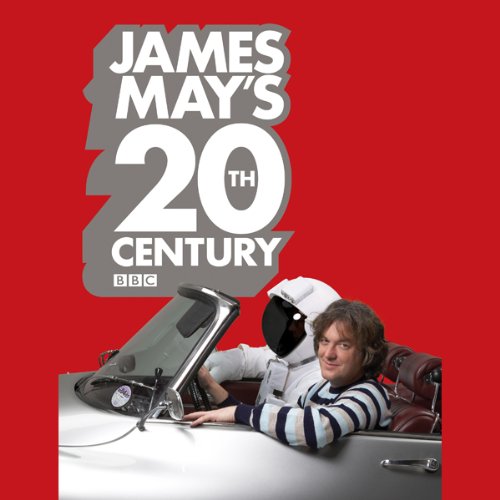
James May's 20th Century
Summary
Longlisted for the Audiobook Download of the Year, 2007. How much should you pay for a return trip to the moon? How are Winnie the Pooh and the artificial heart related? Did teenagers exist before 1950? If not, who invented them? James May's 20th Century answers all these questions and more. In this exclusive download released to tie-in with the BBC TV series, James May explores the iconic themes of the century: flight, space travel, television, mechanised war, medicine, computers, electronic music, skyscrapers, electronic espionage, and much more. But he also reveals the hidden story behind why some inventions like the Zeppelin, the motorcycle side car, or the Theremin struggled to make their mark. He examines the tipping points ? when technologies such as the car or the internet became unstoppable ? and gets up close by looking at the nuts and bolt of remarkable inventions. Packed with surprising statistics and intriguing facts, this is the ideal book for anyone who wants to know how stuff works and why some stuff didn't make it.
©2007 James May and Phil Dolling (P)2007 Hodder and Stoughton Audiobooks