The World category has 419 audiobooks on Listento.it, with an average listener rating of 4.5★ across 2,940 ratings. The most-rated is A Short History of Nearly Everything.

The Sea Wolves
Summary
In AD 793 Norse warriors struck the English isle of Lindisfarne and laid waste to it. Wave after wave of Norse "sea wolves" followed in search of plunder, land, or a glorious death in battle. Much of the British Isles fell before their swords, and the continental capitals of Paris and Aachen were sacked in turn. Turning east, they swept down the uncharted rivers of central Europe, captured Kiev, and clashed with mighty Constantinople, the capital of the Byzantine Empire. But there is more to the Viking story than brute force. They were makers of law - the term itself comes from an Old Norse word - and they introduced a novel form of trial by jury to England. They were also sophisticated merchants and explorers who settled Iceland, founded Dublin, and established a trading network that stretched from Baghdad to the coast of North America. In The Sea Wolves, Lars Brownworth brings to life this extraordinary Norse world of epic poets, heroes, and travelers through the stories of the great Viking figures, including Leif the Lucky, Eric Bloodaxe, and Harald Hardrada. This riveting history illuminates the saga of the Viking age - a time that "has passed away, and grown dark under the cover of night."
©2014 Lars Brownworth (P)2015 Tantor

Peter the Great
Summary
This superbly told story brings to life one of the most remarkable rulers––and men––in all of history and conveys the drama of his life and world. The Russia of Peter's birth was very different from the Russia his energy, genius, and ruthlessness shaped. Crowned co-Tsar as a child of ten, after witnessing bloody uprisings in the streets of Moscow, he would grow up propelled by an unquenchable curiosity, everywhere looking, asking, tinkering, and learning, fired by Western ideas. We see Peter in his 20s traveling "incognito" with his ambassadors to the courts of Europe; as the victorious soldier proclaimed Emperor; as the simple workman at his forge; and as the visionary statesman who single-handedly created a formidable world power. Impetuous and stubborn, bawdy and stern, relentless in his perseverance, he was capable of the greatest generosity and the greatest cruelty.
©1980 Robert K. Massie (P)1991 Blackstone Audio, Inc.

How to Be a Tudor
Summary
The Tudor era encompasses some of the greatest changes in our history. But while we know about the historical dramas of the times, what was life really like for a commoner? To answer this question, the renowned 'method historian' Ruth Goodman has slept, washed and cooked as the Tudors did. She is your expert guide to this fascinating era, drawing on years of practical historical study to show how our ancestors coped with everyday life, from how they slept to how they courted. Exploring how the Tudors learnt, danced and even sat and stood according to the latest fashion, she reveals what it all felt, smelt and tasted like, from morning until night.
©2015 Ruth Goodman (P)2016 Isis Publishing Ltd
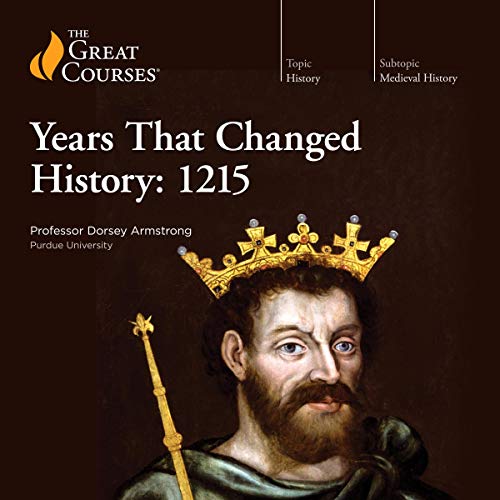
Years That Changed History: 1215
Summary
What is so important about the year 1215? There are some history buffs who may be able to tell you that 1215 is the year the Magna Carta was signed, but there are even fewer who know that King John of England’s acceptance of this charter was only one of four major, world-changing events of this significant year. In fact, the social, cultural, political, geographical, and religious shifts that occurred in this year alone had such a huge impact on the entire world, it warrants an entire course of study for anyone truly interested in the pivotal points of history that brought us to where we are now. As it turns out, the year 1215 was a major turning point in world history. Although the drafting of the Magna Carta is perhaps the most well-known event of 1215, anyone in Europe at the time would have told you the meeting of the Church’s Fourth Lateran Council was much more significant. Meanwhile, in Asia, a Mongol ruffian named Genghis Khan was embarking on a mission for world domination, beginning with his success at the Battle of Beijing, while Islam was experiencing a Golden Age centered around Baghdad’s House of Wisdom. Other cultures and societies around the globe were also experiencing pivotal moments in their development - from the Americas to Africa and Asia and beyond. These seismic events were only possible thanks to a confluence of global conditions, starting with the climate. Although we might not be familiar with the specifics, the ripple effect from these events can still be felt all over the world today. Years That Changed History: 1215 is a unique course, offering you the chance to delve into one of the most interesting periods in world history. Over 24 fast-paced lectures, Professor Dorsey Armstrong of Purdue University gives you the Big History of this surprisingly impactful year, introducing you to the people, events, and wide-ranging influences of the year 1215. Among other fascinating discoveries, you will investigate how climate changes affected the population of Europe; explore the circumstances for the Magna Carta (which originally had nothing to do with human rights and liberty for everyday people); find out why the Fourth Lateran Council mattered so much; and tour the world beyond Europe to gain a true sense of global history. This last point about “global history” is an important one. Most history courses have to select a theme, which by its nature limits the scope of the curriculum. In choosing a year as her theme, Professor Armstrong is able to take you around the world, from the ancient Maya to the House of Baghdad to Shogun Japan. Professor Armstrong takes the world as her theme - and what a truly captivating world it is! PLEASE NOTE: When you purchase this title, the accompanying PDF will be available in your Audible Library along with the audio.
©2019 The Great Courses (P)2019 The Teaching Company, LLC

Five Presidents
Summary
A rare and fascinating portrait of the American presidency from the number-one New York Times best-selling author of Mrs. Kennedy and Me and Five Days in November. Secret Service agent Clint Hill brings history intimately and vividly to life as he reflects on his 17 years protecting the most powerful office in the nation. Hill walked alongside Presidents Dwight D. Eisenhower, John F. Kennedy, Lyndon B. Johnson, Richard M. Nixon, and Gerald R. Ford, seeing them through a long, tumultuous era - the Cold War; the Cuban Missile Crisis; the assassinations of John F. Kennedy, Martin Luther King, Jr., and Robert F. Kennedy; the Vietnam War; Watergate; and the resignations of Spiro Agnew and Richard M. Nixon. Some of his stunning, never-before-revealed anecdotes include: Eisenhower's reaction to Russian prime minister Khrushchev's refusal to talk following the U-2 incident The torture of watching himself in the Zapruder film in a Secret Service training Johnson's virtual imprisonment in the White House during violent anti-Vietnam protests His decision to place White House files under protection after a midnight phone call about Watergate The challenges of protecting Ford after he pardoned Nixon With a unique insider's perspective, Hill sheds new light on the characters and personalities of these five presidents, revealing their humanity in the face of grave decisions.
©2016 Hill McCubbin, LLC. (P)2016 Simon & Schuster, Inc.

Pacific
Summary
Following his acclaimed Atlantic and The Men Who United the States, New York Times best-selling author Simon Winchester offers an enthralling biography of the Pacific Ocean and its role in the modern world, exploring our relationship with this imposing force of nature. As the Mediterranean shaped the classical world and the Atlantic connected Europe to the New World, the Pacific Ocean defines our tomorrow. With China on the rise, so, too, are the American cities of the West Coast, including Seattle, San Francisco, and the long cluster of towns down the Silicon Valley. Today the Pacific is ascendant. Its geological history has long transformed us - tremendous earthquakes, volcanoes, and tsunamis - but its human history, from a Western perspective, is quite young, beginning with Magellan's 16th-century circumnavigation. It is a natural wonder whose most fascinating history is currently being made. In telling the story of the Pacific, Simon Winchester takes us from the Bering Strait to Cape Horn, from the Yangtze River to the Panama Canal, and to the many small islands and archipelagos that lie in between. He observes the fall of a dictator in Manila, visits aboriginals in Northern Queensland, and is jailed in Tierra del Fuego, the land at the end of the world. His journey encompasses a trip down the Alaska Highway, a stop at the isolated Pitcairn Islands, a trek across South Korea, and a glimpse of its mysterious northern neighbor. Winchester's personal experience is vast and his storytelling second to none. And his historical understanding of the region is formidable, making Pacific a paean to this magnificent sea of beauty, myth, and imagination that is transforming our lives.
©2015 Simon Winchester (P)2015 HarperCollins Publishers

The Normans
Summary
There is much more to the Norman story than the Battle of Hastings. These descendants of the Vikings who settled in France, England, and Italy - but were not strictly French, English, or Italian - played a large role in creating the modern world. They were the success story of the Middle Ages: a footloose band of individual adventurers who transformed the face of medieval Europe. During the course of two centuries, they launched a series of extraordinary conquests, carving out kingdoms from the North Sea to the North African coast. In The Normans, Lars Brownworth follows their story, from the first shock of a Viking raid on an Irish monastery to the exile of the last Norman Prince of Antioch. In the process, he brings to vivid life the Norman tapestry's rich cast of characters: figures like Rollo the Walker, William Iron-Arm, Tancred the Monkey King, and Robert Guiscard. The Normans presents a fascinating glimpse of a time when a group of restless adventurers had the world at their fingertips.
©2014 Lars Brownworth (P)2014 Tantor

Disappointment River
Summary
In 1789, Alexander Mackenzie traveled the 1,125 miles of the immense river in Canada that now bears his name, in search of the fabled Northwest Passage, only to confront impassable pack ice. In 2016 the acclaimed memoirist Brian Castner retraced Mackenzie's route by canoe in a grueling journey - and discovered the passage he could not find. Disappointment River is a dual historical narrative and travel memoir that at once transports listeners back to the heroic age of North American exploration and places them in a still rugged but increasingly fragile Arctic wilderness in the process of profound alteration by the dual forces of energy extraction and climate change. Eleven years before Lewis and Clark, the Scottish explorer Alexander Mackenzie actually crossed the North American continent with a team of voyageurs and Indian guides. Before that he was the first to discover a route to the Arctic Ocean from the Great Lakes, along the river he named Disappointment because he believed he'd failed in his mission to find a trade route to the riches of the East. In fact he had - he was just two-plus centuries early. In this book, Brian Castner not only retells the story of Mackenzie's epic voyages in vivid prose, he personally retraces his travels in an 1,125 mile canoe voyage down the river that bears his name, battling exhaustion, exposure, mosquitoes, white-water rapids, and the threat of bears. He transports listeners to a world rarely glimpsed in the media, of tar sands, thawing permafrost, remote Native American villages, and, at the end, a wide open Arctic Ocean that is quickly becoming a far-northern Mississippi of barges and pipelines and oil money.
©2018 Brian Castner (P)2018 Random House Audio

How the West Won
Summary
Modernity developed only in the West - in Europe and North America. Nowhere else did science and democracy arise; nowhere else was slavery outlawed. Only Westerners invented chimneys, musical scores, telescopes, eyeglasses, pianos, electric lights, aspirin, and soap. The question is, why? Unfortunately, that question has become so politically incorrect that most scholars avoid it. But acclaimed author Rodney Stark provides the answers in this sweeping new look at Western civilization. How the West Won demonstrates the primacy of uniquely Western ideas - among them the belief in free will, the commitment to the pursuit of knowledge, the notion that the universe functions according to rational rules that can be discovered, and the emphasis on human freedom and secure property rights. How the West Won displays Stark's gifts for lively narrative history and making the latest scholarship accessible to all. This bold, insightful book will force you to rethink your understanding of the West and the birth of modernity - and to recognize that Western civilization really has set itself apart from other cultures.
©2014 Rodney Stark (P)2014 Tantor

Dead Reckoning
Summary
With this book - his most ambitious yet - Ken McGoogan delivers a vivid, comprehensive recasting of Arctic-exploration history. Dead Reckoning challenges the conventional narrative, which emerged out of Victorian England and focused almost exclusively on Royal Navy officers. By integrating non-British and fur-trade explorers and, above all, Canada's indigenous peoples, this work brings the story of Arctic discovery into the 21st century. Orthodox history celebrates such naval figures as John Franklin, Edward Parry and James Clark Ross. Dead Reckoning tells their stories, but the book also encompasses such forgotten heroes as Thanadelthur, Akaitcho, Tattanoeuck, Ouligbuck, Tookoolito and Ebierbing, to name just a few. Without the assistance of the Inuit, Franklin's recently discovered ships, Erebus and Terror, would still be lying undiscovered at the bottom of the polar sea. The book ranges from the 16th century to the present day, looks at climate change and the politics of the Northwest Passage, and recognizes the cultural diversity of a centuries-old quest. Informed by the author's own voyages and researches in the Arctic, Dead Reckoning is a colourful, multidimensional saga that demolishes myths, exposes pretenders and celebrates unsung heroes. For international listeners, it sets out a new story of Arctic discovery. For Canadians, it brings that story home.
©2017 Ken McGoogan (P)2017 Audible, Inc.

Archaeology: An Introduction to the World's Greatest Sites
Summary
The work of archaeologists has commanded worldwide attention and captivated the human imagination since the earliest days of exploration, with groundbreaking discoveries such as the treasures of ancient Egypt, the lost kingdoms of the Maya, and the fabled city of Troy. Archaeology brings us face-to-face with our distant ancestors, with treasures of the past, and with life as it was lived in long-ago civilizations. Despite the fascinating and often romantic appeal of archaeology, many of us have little idea of what the field actually involves. What, exactly, do archaeologists do? What takes place on an archaeological dig? And how does the reality of the work differ from what we see in Indiana Jones movies? Archaeology: An Introduction to the World's Greatest Sites, taught by renowned archaeologist and National Geographic Explorer Eric H. Cline, answers these questions and more in rich and provocative detail. These 24 thrilling lectures, produced in partnership with National Geographic, introduces you to over 20 of the most significant and enthralling archaeological sites on the planet, providing both in-depth looks at the sites themselves and an insider's view of the history, science, and technology of archaeology. Prepare yourself for a vivid and detailed exploration of archaeology's most magnificent discoveries in the company of an expert archaeologist with decades of experience in the field.
©2016 The Great Courses (P)2016 The Teaching Company, LLC

Warriors, Queens, and Intellectuals: 36 Great Women Before 1400
Summary
Throughout history, women have played integral roles in family, society, religion, government, war - in short, in all aspects of human civilization. Powerful women have shaped laws, led rebellions, and played key roles in dynastic struggles. Some were caught up in forces beyond their control, while others manipulated and murdered their way to the top. However, unearthing their stories from the historical record has been a challenge, with the ordinary difficulties of preserving information across the generations increased by centuries of historical bias and gendered expectations. Women, when they were mentioned at all, often filled the role of virtuous maiden, self-effacing mother, or seductive villain. Imagine what you are missing when only half the story is being told. In Warriors, Queens, and Intellectuals: 36 Great Women Before 1400, taught by Professor Emerita of Humanistic Studies Joyce E. Salisbury, you will experience another side of history, one that has often been overlooked. In these 36 lectures, women step out from the footnotes and sidebars of traditional history and into the spotlight, illuminating the dark corners of the pre-modern world along the way. From thwarted daughters and ambitious wives to fearless revolutionaries and brilliant philosophers, you will see how women have played diverse roles throughout history and why their influence is so vital to a fuller understanding of the world we live in today. Beginning at the start of the Roman Empire and carrying you through to the end of the Middle Ages, Professor Salisbury will introduce you to dozens of influential women from all across the globe. PLEASE NOTE: When you purchase this title, the accompanying PDF will be available in your Audible Library along with the audio.
©2019 The Great Courses (P)2019 The Teaching Company, LLC

A Renegade History of the United States
Summary
Historian Howard Zinn demonstrated that there are compelling, alternative histories that are both scholarly and valuable. Now, Thaddeus Russell provides a challenging new way of reading history that will turn convention on its head and is sure to elicit as much controversy as it does support. Russell shows that drunkards, laggards, prostitutes, and pirates were the real heroes of the American Revolution. Slaves worked less and had more fun than free men. Prostitutes, not feminists, won women's liberation. White people lost their rhythm when they became good Americans. Without organized crime, we might not have Hollywood, Las Vegas, labor unions, legal alcohol, birth control, or gay rights. Zoot-suiters and rock-and-rollers, not Ronald Reagan or the peace movement, brought down the Soviet Union. And Britney Spears will win the war on terror. It was not the elitists who created real revolution in America nor the political radicals whom Zinn credits, but the people on the fringes of society who laid the foundation for change and were responsible for many of the freedoms we cherish today. American history was driven by clashes between those interested in preserving social order and those more interested in pursuing their own desires---the "respectable" versus the "degenerate", the moral versus the immoral, "good citizens" versus the "bad". The more that "bad" people existed, resisted, and won, the greater was our common good. In A Renegade History of the United States, Russell introduces us to the origins of our nation's identity as we have never known them before.
©2010 Thaddeus Russel (P)2010 Tantor

American Moonshot
Summary
A 2020 Audie Awards winner - history/biography As the 50th anniversary of the first lunar landing approaches, the award-winning historian and perennial New York Times best-selling author takes a fresh look at the space program, President John F. Kennedy’s inspiring challenge, and America’s race to the moon. “We choose to go to the Moon in this decade and do the other things, not because they are easy, but because they are hard; because that goal will serve to organize and measure the best of our energies and skills, because that challenge is one that we are willing to accept, one we are unwilling to postpone, and one we intend to win.” (President John F. Kennedy) On May 25, 1961, JFK made an astonishing announcement: his goal of putting a man on the moon by the end of the decade. In this engrossing, fast-paced epic, Douglas Brinkley returns to the 1960s to recreate one of the most exciting and ambitious achievements in the history of humankind. American Moonshot brings together the extraordinary political, cultural, and scientific factors that fueled the birth and development of NASA and the Mercury, Gemini, and Apollo projects, which shot the US to victory in the space race against the Soviet Union at the height of the Cold War. Drawing on new primary source material and major interviews with many of the surviving figures who were key to America’s success, Brinkley brings this fascinating history to life as never before. American Moonshot is a portrait of the brilliant men and women who made this giant leap possible, the technology that enabled us to propel men beyond earth’s orbit to the moon and return them safely, and the geopolitical tensions that spurred Kennedy to commit himself fully to this audacious dream. Brinkley’s ensemble cast of New Frontier characters include rocketeer Wernher von Braun, astronaut John Glenn, and space booster Lyndon Johnson. A vivid and enthralling chronicle of one of the most thrilling, hopeful, and turbulent eras in the nation’s history, American Moonshot is an homage to scientific ingenuity, human curiosity, and the boundless American spirit.
©2019 Douglas Brinkley (P)2019 HarperCollins Publishers

Endurance
Summary
The year was 1915. Equipment and food supplies were totally inadequate. After battling its way for six weeks through thousands of miles of pack ice and located only a day's sail from its destination, the Endurance became locked inside an island of ice. Yet Ernest Shackleton enabled all 27 of his men to survive for over a year on the ice-bound Antarctic seas - leadership without equal. This gripping account is based on contemporaneous diaries and interviews conducted by the author with these exceptional men.
©1959 Alfred Lansing (P)2000 by The Audio Partners Publishing Corp.

The Big History of Civilizations
Summary
The history of human civilization is an astonishing story of migration, innovation, and social development. Now, the exciting new field of "big history" allows us to explore human civilizations in ways unavailable to historians of previous generations. Big history scholars take a multidisciplinary approach to study great spans of time, unlocking important themes, trends, and developments across time and space. Unlike a traditional survey of history - with its focus on dates and events, kings and battles - The Big History of Civilizations is your chance to apply this cutting-edge historical approach to the epic story of humanity around the world. Taught by acclaimed Professor Craig G. Benjamin of Grand Valley State University, these 36 sweeping lectures trace the story of human civilizations from our emergence as a species, through the agricultural and industrial revolutions, and into the future. It only takes a few minutes of one lecture for you to discover that Big History is an amazing approach to history. Its grand vision will give you powerful new insights into human civilization, and it offers a profound analysis of some of our biggest questions: What makes us human? Where did we come from? And where are we going? There may be no easy answers, but Professor Benjamin takes you on a powerful journey to the limits of our understanding. What differentiates big history from any other field is the way it combines divergent fields, from archaeology and anthropology to ecology and philosophy, and ties them together, allowing you to see patterns of our past, present - and even future. From the just-right "Goldilocks factors" that allow civilizations to emerge to different ways civilizations have emerged across time and around the word, this riveting approach to history offers a multidisciplinary toolkit to tell the story about what makes us human. PLEASE NOTE: When you purchase this title, the accompanying reference material will be available in your Library section along with the audio.
©2016 The Great Courses (P)2016 The Teaching Company, LLC
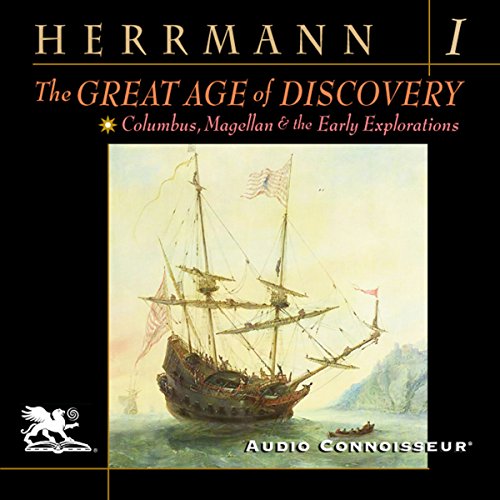
The Great Age of Discovery, Volume 1
Summary
In the space of 400 years, Western man methodically set out to explore and map the entire earth. During some of the most dangerous expeditions ever mounted, an extraordinary group of determined men forced passages through vast oceans, dark jungles, and withering deserts. Never has their like been seen since. What drove these soldiers, sailors, and civilians to leave the comforts of civilized life and face the horrors of shipwreck, starvation, cannibals, and disease? The primary motivations were fame, fortune, and adventure...sometimes all three. But with some of these explorers there was also a sense of duty, the idea that it was their destiny to discover new lands, new trading routes, to further the prominence of their king and country, and to illuminate the dark corners of the planet to solve the geological riddles that had puzzled humanity for eons. In Paul Herrmann's great synthesis of anthropology, archaeology, medicine, and wonderful narrative history, we discover the story behind the great expeditions. We learn how they were organized and carried out, what happened when Europeans confronted strange and often savage societies, and what happened to these explorers upon their return to Europe. We also learn what impact their discoveries had on primitive cultures and European society. But this history is also much more. The result is an unbelievable picture of mankind swept up in the dramatic passage from enforced isolation to a dynamic worldwide trading network. Volume 1 follows the voyages of Columbus, da Gama, Magellan, Cortes, Pizarro, and others as the Western hemisphere is discovered and mapped. After Magellan's voyage, the world of trade takes a revolutionary turn and the fortunes of Europe and the Mediterranean are changed forever.
©2004 Audio Connoisseur

The History of White People
Summary
A mind-expanding and myth-destroying exploration of notions of white race—not merely a skin color but also a signal of power, prestige, and beauty to be withheld and granted selectively. Ever since the Enlightenment, race theory and its inevitable partner, racism, have followed a crooked road, constructed by dominant peoples to justify their domination of others. Filling a huge gap in historical literature that long focused on the non-white, eminent historian Nell Irvin Painter guides us through more than two thousand years of Western civilization, tracing not only the invention of the idea of race but also the frequent worship of “whiteness” for economic, social, scientific, and political ends.
Our story begins in Greek and Roman antiquity, where the concept of race did not exist, only geography and the opportunity to conquer and enslave others. Not until the eighteenth century did an obsession with whiteness flourish, with the German invention of the notion of Caucasian beauty. This theory made northern Europeans into “Saxons,” “Anglo-Saxons,” and “Teutons,” envisioned as uniquely handsome natural rulers. Here was a worldview congenial to northern Europeans bent on empire. There followed an explosion of theories of race, now focusing on racial temperament as well as skin color. Spread by such intellectuals as Madame de Stael and Thomas Carlyle, white race theory soon reached North America with a vengeance.
Its chief spokesman, Ralph Waldo Emerson, did the most to label Anglo-Saxons—icons of beauty and virtue—as the only true Americans. It was an ideal that excluded not only blacks but also all ethnic groups not of Protestant, northern European background. The Irish and Native Americans were out and, later, so were the Chinese, Jews, Italians, Slavs, and Greeks—all deemed racially alien. Did immigrations threaten the very existence of America? Americans were assumed to be white, but who among poor immigrants could become truly American?
A tortured and convoluted series of scientific explorations developed—theories intended to keep Anglo-Saxons at the top: the ever-popular measurement of skulls, the powerful eugenics movement, and highly biased intelligence tests—all designed to keep working people out and down. As Painter reveals, power—supported by economics, science, and politics—continued to drive exclusionary notions of whiteness until, deep into the twentieth century, political realities enlarged the category of truly American.
A story filled with towering historical figures, The History of White People forcefully reminds us that the concept of one white race is a recent invention. The meaning, importance, and realty of this all-too-human thesis of race have buckled under the weight of a long and rich unfolding of events.
©2010 Nell Irvin Painter (P)2013 Audible, Inc.

Hiroshima
Summary
A journalistic masterpiece. John Hersey transports us back to the streets of Hiroshima, Japan on August 6, 1945 - the day the city was destroyed by the first atomic bomb. Told through the memories of six survivors, Hiroshima is a timeless, powerful classic that will awaken your heart and your compassion. In this new edition, Hersey returns to Hiroshima to find the survivors - and to tell their fates in an eloquent and moving final chapter.
©1985 John Hersey (P)2000 Recorded Books, LLC

The History of World Literature
Summary
Whether around the campfire, between the covers of a great book, or in the theater, the desire to tell stories has been a common human impulse for thousands of years. These 48 lectures take you on a journey through time and around the world- from the enormous auditoriums of ancient Greece to a quiet study in the home of a 19th-century New England spinster- to introduce the history of world literature. In this course, you'll sample some of the greatest literary expressions the world has known and experience storytelling in its many forms, including poetry, drama, and narrative. You'll explore: the ancient world, where tribal bards created national myths and founded religious texts out of legends, history, philosophy, and local lore; the countryside and aristocratic courts of India and the Middle East, collecting stories and folklore of magical men, terrifying beasts, alluring women, and conniving tricksters that live on in today's fairy tales and bedtime stories; the Middle Ages, the Renaissance, and the Enlightenment to trace the evolution of storytelling from the poetic masterpiece of Dante's Inferno to the great drama pioneered by Shakespeare to sophisticated narratives such as Wu Ch'eng-en's Monkey and Voltaire's Candide; and the rise of Realism in the works of Flaubert, Dostoevsky, and Chekhov and the development of experimental modes by Brecht, Beckett, and Borges. Offering concise summaries and thought-provoking interpretations of some of the world's greatest literary masterpieces, this course gives you the tools you need to appreciate these great literary works and understand how authors, playwrights, and poets throughout the centuries have practiced their craft. PLEASE NOTE: When you purchase this title, the accompanying reference material will be available in your Library section along with the audio.
©2007 The Teaching Company, LLC (P)2007 The Great Courses