David Rapkin has narrated 12 audiobooks on Listento.it by 15 authors, with an average listener rating of 4.2★ across 24 ratings. The most-rated is The Concept of Anxiety.

The Concept of Anxiety
Summary
This first new translation of Kierkegaard's masterwork in a generation brings an essential work of modern philosophy to vivid life. Although Soren Kierkegaard's death in the fall of 1855 foreshadowed a lasting split between conservative Christians and young contemporaries who saw him as a revolutionary thinker, it was not until the turn of the 20th century - and beyond the borders of his native Denmark - that his lasting significance came to be felt. By transcending distinctions of genre, Kierkegaard brought traditionally separated disciplines to bear on deep human concerns and was able, through his profound self-insight, to uncover the strategies with which we try to deal with them. As a result, he is hailed today as no less than the father of modern psychology and existentialism. While the majority of Kierkegaard's work leading up to The Concept of Anxiety dealt with the intersection of faith and knowledge, here the renowned Danish philosopher turns to the perennial question of sin and guilt. First published in 1844, this concise treatise identified - long before Freud - anxiety as a deep-seated human state, one that embodies the endless struggle with our own spiritual identities. Ably synthesizing human insights with Christian dogma, Kierkegaard's "psychological deliberation" suggests that our only hope in overcoming anxiety is not through "powder and pills" but by embracing it with open arms. Indeed, for Kierkegaard, it is only through our experiences with anxiety that we are able to become truly aware of ourselves and the freedoms and limitations of our own existence. While Kierkegaard's Danish prose is surprisingly rich, previous translations - the most recent in 1980 - have tended either to deaden its impact by being excessively literal or to furnish it with a florid tone foreign to its original directness. In this new edition, Alastair Hannay re-creates its natural rhythm in a way that will finally allow this overlooked classic not only to become as celebrated as Fear and Trembling, The Sickness unto Death, and Either/Or but also to earn a place as the seminal work of existentialism and moral psychology that it is.
©2014 Alastair Hannay (P)2014 Audible Inc.

The Money Game
Summary
Hailed by the New York Times Book Review as "the best book there is about the stock market," this timeless classic by the creator and host of the Emmy Award-winning TV show Adam Smith's Money World is still relevant more than 40 years later. This essential book takes listeners to the Street to learn about the intricacies of money and how the stock market impacts every area of our lives. According to the author, the key to making wise, lucrative investments is knowing ourselves. In witty, easily accessible language, he shares pithy insights about the role of intuition and the psychology of guilt, arguing that there is no substitute for information. Smith's Irregular Rules shatter common myths and misconceptions, revealing why nothing works all the time and illustrating how greed and fear fuel the market. Listeners will learn about the safest types of investing, the key to following market trends, and how to capitalize growth, gleaning tips on stock movers, winners and losers, and much more. Peppered with entertaining and prescient anecdotes, The Money Game analyzes who makes the really big money and explores the meaning of our desire to become rich. From selling short and buying long to Wall Street's crowd mentality, from what constitutes a random walk to why timing is everything, this is the definitive portrait of the Street, then and now.
©1967, 1968, 1976 Adam Smith; This edition published in 2015 by Open Road Integrated Media, Inc. (P)2015 Audible, Inc.

Who Really Killed Kennedy?
Summary
Almost nothing gives rise to more national intrigue than the murder of an American president. And on November 22, 2013, the nation will experience the fiftieth anniversary of one of the most traumatic events in modern American history, the assassination of President John F. Kennedy. From day one, the truth behind JFK's assassination has been mired in controversy and dispute. The Warren Commission, established just seven days after Kennedy's death, delved into the who, what, when, and where of the tragedy, and over the course of the following year compiled an 889-page report that arrived at the now widely contested conclusion: Lee Harvey Oswald was the sole assassin. In Who Really Killed Kennedy?, No. 1New York Times bestselling author Jerome R. Corsi, Ph.D., provides listeners with the ultimate JFK assassination theory book. One-by-one, each chapter will examine the strongest arguments regarding the killing of JFK, including theories surrounding the mob, the CIA, Cuban radicals, LBJ, right-wing extremists and more. By the audiobook's end, Who Really Killed Kennedy? will provide convincing analysis that existing evidence rules out the possibility that JFK was killed by a lone assassin. Fifty years after this epic American tragedy, there's still a gunman on the loose.
©2013 Jerome R. Corsi, Ph.D. (P)2014 Audible Inc.

Conflict
Summary
In June 1950 Communist forces poured across the 38th Parallel (the arbitrary, militarily indefensible line of latitude separating the Communist North from the independent Republic of Korea) to unite the country by force. Three bloody, bitter years of fighting ensued during which the seesawing fortunes of this frustrating war thwarted North Korea's ambitions while treating the ill-equipped, overconfident UN peacekeeping forces, mostly Americans, no less harshly. Conflict examines the war in all its military, political, and human dimensions: the battles at Pusan Perimeter, at Inchon, at Chosin Reservoir, at Heartbreak Ridge; significant figures like Syngman Rhee, Kim Il Sung, Ridgway, MacArthur, and Truman; controversies like MacArthur's dismissal, the difficulties of P.O.W. exchanges, and charges of brainwashing and germ warfare; as well as penetrating analyses of the performance of the American soldier, and the war's effect on the U.S. military and our national psyche. As such, Conflict stands as an unsurpassed, vivid contribution to history.
©1962, 1990 Robert Leckie (P)2013 Audible, Inc.

The Man Who Killed Kennedy
Summary
Lyndon Baines Johnson was a man of great ambition and enormous greed, both of which, in 1963, would threaten to destroy him. In the end, President Johnson would use power from his personal connections in Texas and from the underworld and from the government to escape an untimely end in politics and to seize even greater power. President Johnson, the thirty-sixth president of the United States, was the driving force behind a conspiracy to murder President John F. Kennedy on November 22, 1963. In The Man Who Killed Kennedy, you will find out how and why he did it. Political consultant, strategist, and Libertarian Roger Stone has gathered documents and used his firsthand knowledge to construct the ultimate tome to prove that LBJ was not only involved in JFK's assassination, but was in fact the mastermind. With 2013 being the fiftieth anniversary of JFK's assassination, this is the perfect time for The Man Who Killed Kennedy to be available to readers. The research and information in this book is unprecedented, and as Roger Stone lived through it, he's the perfect person to bring it to everyone's attention.
©2013 Roger Stone (P)2013 Audible, Inc.

The Great Divide
Summary
History tends to cast the early years of America in a glow of camaraderie when there were, in fact ,many conflicts between the Founding Fathers - none more important than the one between George Washington and Thomas Jefferson. Their disagreement centered on the highest, most original public office created by the Constitutional Convention: the presidency. It also involved the nation's foreign policy, the role of merchants and farmers in a republic, and the durability of the union. At its root were two sharply different visions of the nation's future. Acclaimed historian Thomas Fleming examines how the differing characters and leadership styles of Washington and Jefferson shaped two opposing views of the presidency - and the nation. This clash profoundly influenced the next two centuries of America's history and persists in the present day.
©2015 Thomas Fleming (P)2015 Audible Inc.

Broadsides: The Age of Fighting Sail, 1775-1815
Summary
In the late 18th century, it was widely thought that to be a sailor was little better than to be a slave. "No man will be a sailor," wrote Samuel Johnson, "who has contrivance enough to get himself into jail. A man in jail has more room, better food, and commonly better company."If that were true, historian Nathan Miller suggests, then the record of sailing in the age of tall ships would likely be distinguished by few heroes and fewer grand narratives. He counters that in the regular navies of England, the fledgling United States, and most other nations, brutal captains and thuggish crewmen were rare, and professionalism was the order of the day. It was their high standard of service that made those naval forces such powerful, even indispensable arms of the land-based military. Miller's great hero throughout this fine history is Horatio Nelson, whose valor was exemplary throughout countless battles around the world. But he writes with equal admiration of lesser-known figures, such as Lambert Wickes, Pierre de Villeneuve, Juan de Cordova, and "Foul Weather Jack" Byron, who served their nations and fellow sailors well, and often heroically.
©2000 Nathan Miller (P)2014 Audible, Inc.

The Adventures of Henry Thoreau
Summary
Henry David Thoreau has long been an intellectual icon and folk hero. In this strikingly original profile, Michael Sims reveals how the bookish, quirky young man, who kept quitting jobs, evolved into the patron saint of environmentalism and nonviolent activism. Working from 19th-century letters and diaries by Thoreau’s family, friends, and students, Sims charts Henry’s course from his time at Harvard through the years he spent living in a cabin beside Walden Pond. Sims uncovers a previously hidden Thoreau - the rowdy boy reminiscent of Tom Sawyer, the sarcastic college iconoclast, the devoted son who kept imitating his beloved older brother’s choices in life. Thoreau was deeply influenced by his parents - his father owned a pencil factory in Concord, his mother was an abolitionist and social activist - and by Ralph Waldo Emerson, his frequent mentor. Sims relates intimate, telling moments in Thoreau’s daily life: in Emerson’s library; teaching his neighbor and friend, Nathaniel Hawthorne, to row a boat; exploring the natural world and Native American culture; tutoring Emerson’s nephew on Staten Island and walking the streets of New York in the hope of launching a writing career. Returned from New York, Thoreau approached Emerson to ask if he could build a cabin on his mentor's land on the shores of Walden Pond, anticipating the isolation would galvanize his thoughts and actions. That it did. While at the cabin, he wrote his first book, A Week on the Concord and Merrimack Rivers, and refined the journal entries that formed the core of Walden. Resisting what he felt were unfair taxes, he spent the night in jail that led to his celebrated essay "Civil Disobedience", which would inspire the likes of Gandhi and Martin Luther King. Chronicling Thoreau’s youthful transformation, Sims reveals how this decade would resonate over the rest of his life, and thereafter throughout American literature and history.
©2014 Michael Sims (P)2014 Audible Inc.

The Doomsday Machine
Summary
Today, there are over 100 nuclear reactors operating in our backyards, from Indian Point in New York to Diablo Canyon in California. Proponents claim that nuclear power is the only viable alternative to fossil fuels, and due to rising energy consumption and the looming threat of global warming, they are pushing for an even greater investment. Here, energy economist Andrew McKillop and social scientist Martin Cohen argue that the nuclear power dream being sold to us is pure fantasy. Debunking the multilayered myth that nuclear energy is cheap, clean, and safe, they demonstrate how landscapes are ravaged in search of the elusive yellowcake to fuel the reactors, and how energy companies and politicians rarely discuss the true costs of nuclear power plants - from the subsidies that build the infrastructure to the unspoken guarantee that the public will pick up the cleanup cost in the event of a meltdown, which can easily top $100 billion dollars.
©2012 Martin Cohen (P)2013 Audible, Inc.

Alaskan Travels
Summary
Thirty years ago, celebrated American writer Edward Hoagland, in his early fifties and already with a dozen acclaimed books under his belt, had a choice: a midlife crisis or a midlife adventure. He chose the adventure. Pencil and notebook at the ready, Hoagland set out to explore and write about one of the last truly wild territories remaining on the face of the earth: Alaska. From the Arctic Ocean to the Kenai Peninsula, the backstreet bars of Anchorage to the Yukon River, Hoagland traveled the “real” Alaska from top to bottom. Here he documents not only the flora and fauna of America’s last frontier, but also the extraordinary people living on the fringe. On his journey he chronicles the lives of an astonishing and unforgettable array of prospectors, trappers, millionaire freebooters, drifters, oilmen, Eskimos, Indians, and a remarkably kind and capable frontier nurse named Linda. In his foreword, novelist Howard Frank Mosher describes Edward Hoagland’s memoir as “the best book ever written about America’s last best place.” In the tradition of Twain’s Life on the Mississippi and Jonathan Rabin’s Old Glory, with a beautiful love story at its heart, this is an American masterpiece from a writer hailed by the Washington Post as “the Thoreau of our times.”
©2012 Edward Hoagland (P)2013 Audible, Inc.
Great Catastrophe
Summary
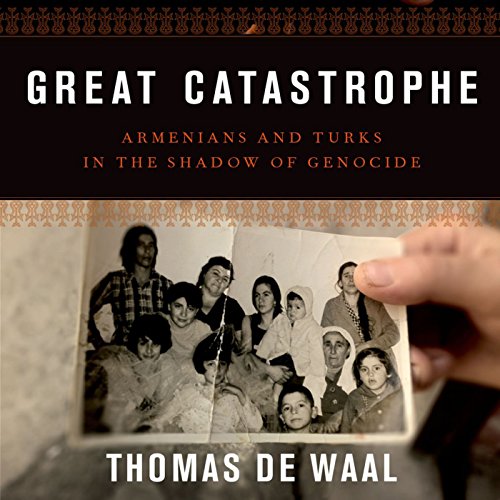
The destruction of the Armenians of the Ottoman Empire in 1915-16 was the greatest atrocity of World War I. Around one million Armenians were killed, and the survivors were scattered across the world. Although it is now a century old, the issue of what most of the world calls the Armenian Genocide of 1915 is still a live and divisive issue that mobilizes Armenians across the world, shapes the identity and politics of modern Turkey, and has consumed the attention of U.S. politicians for years. In Great Catastrophe, the eminent scholar and reporter Thomas de Waal looks at the aftermath and politics of the Armenian Genocide and tells the story of recent efforts by courageous Armenians, Kurds, and Turks to come to terms with the disaster as Turkey enters a new post-Kemalist era. The story of what happened to the Armenians in 1915-16 is well-known. Here we are told the "history of the history" and the lesser-known story of what happened to Armenians, Kurds, and Turks in the century that followed. De Waal relates how different generations tackled the issue of the "Great Catastrophe" from the 1920s until the failure of the Protocols signed by independent Armenia and Turkey in 2010. Quarrels between diaspora Armenians supporting and opposing the Soviet Union broke into violence and culminated with the murder of an archbishop in 1933. The devising of the word "genocide", the growth of modern identity politics, and the 50th anniversary of the massacres re-energized a new generation of Armenians. In Turkey the issue was initially forgotten, only to return to the political agenda in the context of the Cold War and an outbreak of Armenian terrorism. More recently, Turkey has started to confront its taboos. In an astonishing revival of oral history, the descendants of tens of thousands of "Islamized Armenians", who have been in the shadows since 1915, have begun to reemerge and reclaim their identities.
©2015 Thomas de Waal (P)2014 Audible Inc.

Target Tokyo
Summary
From deep within imperial Japan, a Soviet agent smuggled out intelligence that helped the Allies win the war Richard Sorge was dispatched to Tokyo in 1933 to serve the spymasters of Moscow. For eight years, he masqueraded as a Nazi journalist and burrowed deep into the German embassy, digging for the secrets of Hitler's invasion of Russia and the Japanese plans for the East. In a nation obsessed with rooting out moles, he kept a high profile - boozing, womanizing, and operating entirely under his own name. But he policed his spy ring scrupulously, keeping such a firm grip that by the time the Japanese uncovered his infiltration, he had done irreversible damage to the cause of the Axis. The first definitive account of one of the most remarkable espionage sagas of World War II, Target Tokyo is a tightly wound portrayal of a man who risked his life for his country, hiding in plain sight.
©1984 Anne Prange and Prange Enterprises, Inc. (P)2014 Audible Inc.