Thomas Fleming has 4 audiobooks on Listento.it, narrated by 4 narrators, with an average listener rating of 3★ across 2 ratings. The most-rated is The Great Divide.

The Great Divide
Summary
History tends to cast the early years of America in a glow of camaraderie when there were, in fact ,many conflicts between the Founding Fathers - none more important than the one between George Washington and Thomas Jefferson. Their disagreement centered on the highest, most original public office created by the Constitutional Convention: the presidency. It also involved the nation's foreign policy, the role of merchants and farmers in a republic, and the durability of the union. At its root were two sharply different visions of the nation's future. Acclaimed historian Thomas Fleming examines how the differing characters and leadership styles of Washington and Jefferson shaped two opposing views of the presidency - and the nation. This clash profoundly influenced the next two centuries of America's history and persists in the present day.
©2015 Thomas Fleming (P)2015 Audible Inc.

A Disease in the Public Mind
Summary
By the time his body hung from the gallows for his crimes at Harper’s Ferry, abolitionists had made John Brown a "holy martyr" in the fight against Southern slave owners. But Northern hatred for Southerners had been long in the making. Northern rage was born of the conviction that New England, whose spokesmen and militia had begun the American Revolution, should have been the leader of the new nation. Instead, they had been displaced by Southern "slavocrats" like Thomas Jefferson. And Northern envy only exacerbated the South’s greatest fear: race war. In the 60 years preceding the outbreak of civil war, Northern and Southern fanatics ramped up the struggle over slavery. By the time they had become intractable enemies, only the tragedy of a bloody civil war could save the Union. In this riveting and character-driven history, one of America’s most respected historians traces the "disease in the public mind" - distortions of reality that seized large numbers of Americans - in the decades-long run-up to the Civil War.
©2013 Thomas Fleming (P)2013 Blackstone Audio, Inc.
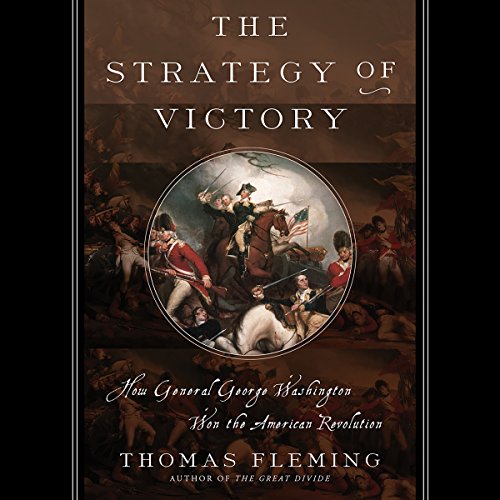
The Strategy of Victory
Summary
A sweeping and insightful grand strategic overview of the American Revolution, highlighting Washington's role in orchestrating victory and creating the US Army Led by the Continental Congress, the Americans almost lost the war for independence because their military thinking was badly muddled. Following the victory in 1775 at Bunker Hill, patriot leaders were convinced that the key to victory was the homegrown militia - local men defending their families and homes. But the flush of early victory soon turned into a bitter reality as the British routed Americans fleeing New York. General George Washington knew that having and maintaining an army of professional soldiers was the only way to win independence. As he fought bitterly with the leaders in Congress over the creation of a regular army, he patiently waited until his new army was ready for pitched battle. His first opportunity came late in 1776, following his surprise crossing of the Delaware River. In New Jersey the strategy of victory was about to unfold. In The Strategy of Victory, preeminent historian Thomas Fleming examines the battles that created American independence, revealing how the creation of a professional army worked on the battlefield to secure victory, independence, and a lasting peace for the young nation.
©2017 Thomas Fleming (P)2017 Hachette Audio

The Intimate Lives of the Founding Fathers
Summary
With his usual storytelling flair and unparalleled research, Tom Fleming offers a compelling, intimate look at the founders—George Washington, Ben Franklin, John Adams, Thomas Jefferson, Alexander Hamilton, and James Madison—and the women who played essential roles in their lives. From hot-tempered Mary Ball Washington to promiscuous Rachel Lavien Hamilton, the founding fathers’ mothers powerfully shaped their sons’ visions of domestic life. But lovers and wives played more critical roles as friends and often partners in fame. We learn of the youthful Washington’s tortured love for the coquettish Sarah Fairfax, wife of his close friend; of Franklin's two “wives,” one in London and one in Philadelphia; of Adams’s long absences, which required a lonely, deeply unhappy Abigail to keep home and family together for years on end; of Hamilton’s adulterous betrayal of his wife and their reconciliation; and how the brilliant Madison was jilted by a flirtatious fifteen-year-old and went on to marry the effervescent Dolley, who helped make this shy man into a popular president. Jefferson’s controversial relationship to Sally Hemings is also examined, with a different vision of where his heart lay. Fleming nimbly takes us through a great deal of early American history, as the founding fathers strove to reconcile their private and public lives, often beset by a media every bit as gossip-seeking and inflammatory as ours today. He offers a powerful look at the challenges women faced in the late eighteenth and early 19th centuries. While often brilliant and articulate, the wives of the founding fathers all struggled with the distractions and dangers of frequent childbearing and searing anxiety about infant mortality. All the more remarkable, then, that these women loomed so large in the lives of their husbands—and, in some cases, their country.
©2009 Thomas Fleming (P)2010 Blackstone Audio, Inc.