David Timson has narrated 58 audiobooks on Listento.it by 49 authors, with an average listener rating of 4.5★ across 1,378 ratings. The most-rated is Fulgrim.

The Templar Revelation
Summary
In the course of their investigation into Leonardo da Vinci, Lynn Pickett and Clive Prince found clues about his strangely passionate belief in the importance of John the Baptist. Here, along with a reassessment of the significance of Mary Magdalene and the sacred feminine, the authors reveal that Da Vinci’s apparently peculiar religion was shared by the Knights Templar. And their profoundly heretical belief that the Baptist was superior to Jesus himself still has the power to pose a threat to the very foundations of the Christian Church....
©1997 Lynn Picknett and Clive Prince (P)2015 W F Howes Ltd

The Trial and the Death of Socrates
Summary
The Trial and the Death of Socrates remains a powerful document not least because it gives a first-hand account of the end of one of the greatest figures in history. In Apology, Socrates defends himself before the Athenian court against charges of corrupting youth. Phaedo is the account by a young man of the actual last words and moments of Socrates. Tom Griffith presents these with scene-setting introductions to the historical situation in this new translation. Translated by Tom Griffith.
©2001 Naxos AudioBooks Ltd. (P)2001 Naxos AudioBooks Ltd.

The Socratic Dialogues: Late Period, Volume 1
Summary
These five very different Socratic Dialogues date from Plato's later period, when he was revisiting his early thoughts and conclusions and showing a willingness for revision. In Timaeus (mainly a monologue read by David Timson in the title role), Plato considers cosmology in terms of the nature and structure of the universe, the ever-changing physical world and the unchanging eternal world. And he proposes a demiurge as a benevolent creator God. Though unfinished, Critias (read by Peter Kenny) is a fascinating document in which Plato tells the story of the strong island empire of Atlantis and reports of a more ideal Athens in the past. In Sophist, Plato questions the nature of the sophist and how he differs from a statesman or a philosopher. In Statesman, Plato questions his earlier projection as the philosopher king as the ideal ruler (The Republic) and considers the importance of other issues such as political awareness. In Philebus, Plato's spotlight falls on hedonism, the life of pleasure - and the balance offered by wisdom and intelligence. Translation by Benjamin Jowett.
Public Domain (P)2018 Ukemi Productions Ltd

The Faerie Queene
Summary
This remarkable poem, dedicated to Queen Elizabeth I, was Spenser's finest achievement. The first epic poem in modern English, The Faerie Queene combines dramatic narratives of chivalrous adventure with exquisite and picturesque episodes of pageantry. At the same time, Spenser is expounding a deeply felt allegory of the eternal struggle between Truth and Error.... PLEASE NOTE: When you purchase this title, the accompanying reference material will be available in your Library section along with the audio.
Public Domain (P)2015 Naxos AudioBooks

The Floating Admiral
Summary
Inspector Rudge does not encounter many cases of murder in the sleepy seaside town of Whynmouth. But when an old sailor lands a rowing boat containing a fresh corpse with a stab wound to the chest, the Inspector's investigation immediately comes up against several obstacles. The vicar, whose boat the body was found in, is clearly withholding information, and the victim's niece has disappeared. There is clearly more to this case than meets the eye - even the identity of the victim is called into doubt. Inspector Rudge begins to wonder just how many people have contributed to this extraordinary crime and whether he will ever unravel it.... In 1931 Agatha Christie, Dorothy L. Sayers and 10 other crime writers from the newly formed Detection Club collaborated in publishing a unique crime novel. In a literary game of consequences, each author would write one chapter, leaving G. K. Chesterton to write a typically paradoxical prologue and Anthony Berkeley to tie up all the loose ends. In addition, all of the authors provided their own solutions in sealed envelopes, all of which appeared at the end of the book, with Agatha Christie's ingenious conclusion acknowledged at the time to be 'enough to make the book worth buying on its own'. The authors of this novel are G. K. Chesterton, Canon Victor Whitechurch, G. D. H. Cole and Margaret Cole, Henry Wade, Agatha Christie, John Rhode, Milward Kennedy, Dorothy L. Sayers, Ronald Knox, Freeman Wills Crofts, Edgar Jepson, Clemence Dane and Anthony Berkeley.
©1931, 2011 The Detection Club (P)2017 HarperCollins Publishers

Life & Works - Johannes Brahms
Summary
Brahms is one of the best loved yet most controversial of all the Romantics. Almost uniquely, his works have never suffered the slightest period of eclipse. Profoundly emotional yet governed by an iron discipline, the music, like the man, is a fascinating, entertaining, often deeply moving blend of opposites. He had a gift for friendship and a capacity for love far beyond the ordinary, yet no man could be ruder or more hurtful. Though humble, he was consumed by a sense of destiny, and his inner life, colored by his adoration and fear of women, found expression in some of the greatest music ever written. Listening to this audio-biography is leaping inside the life and times of a great German Romantic, understanding the man who was haunted by the ghost of Beethoven for years and was 43 before he wrote his first symphony. PLEASE NOTE: When you purchase this title, the accompanying reference material will be available in your Library section along with the audio.
©2002 Naxos AudioBooks (P)2002 Naxos AudioBooks

The Crimson Fist
Summary
Becalmed in the backwater Phall system, the Imperial Fists' relief fleet originally headed for Isstvan III has been waiting out the warp storms that waylaid them so many months ago. Under the assumed command of Captain Alexis Polux and seemingly forgotten by the rest of the Imperium, they hope yet to complete their mission and report back to their primarch Rogal Dorn, so that they might return to the greater conflict. But destiny calls as old rivalries are rekindled, and the treacherous Iron Warriors await their moment to strike - the feud between Dorn and his wayward brother Perturabo promises now to erupt into open war.
©2012 Games Workshop Limited (P)2015 Games Workshop Limited

Ghost Stories
Summary
Charles Dickens was a master of the macabre. His stories of madness, murder and revenge, often imbued with a sympathetic moral undertone, have continued to thrill and chill fans ever since they were written. Here then are 15 tales that display the full range of Dickens' Gothic talents. "The Signalman," perhaps the most well-known, is a chilling story about a mysterious figure and its deathly omen; "The Haunted Man and the Ghost's Bargain" shows the consequences for those who make deals with the dead; "The Portrait-Painter's Story" follows an artist who paints a non-living person by memory; and "Captain Murderer and the Devil's Bargain," a bedtime story from Dickens' own childhood, tells of a bloodthirsty man who kills his brides and bakes them into pies. Among others, the collection also includes "A Christmas Carol," "The Baron of Grogzwig" from "The Pickwick Papers," and "The Ghost in the Bride's Chamber," a novella co-written with Wilkie Collins.
Public Domain (P)2018 Naxos Audiobooks

The Decline and Fall of the Roman Empire, Volume II
Summary
The Decline and Fall of the Roman Empire has always maintained its initial appeal to both the general public and scholars alike. Its sheer scale is daunting, encompassing over a millennium of history, covering not merely the Western Empire from the days of the early emperors to its extinction in AD 476, but also the Eastern Empire, which lasted for another thousand years until the Turks vanquished it in 1453. But Gibbon’s style, part historical fact and part literature, is enticing, and the sheer honesty of the man, who endeavours to be scrupulously impartial in his presentation, endears him to the reader. In this recording, David Timson incorporates the most salient of Gibbon’s footnotes. In Volume II (Chapters XVI-XXVI), Gibbon continues his powerful history of the Empire, shining the spotlight on some of the best-known figures and their impact on the growing influence of Christianity, including Nero and, three centuries later, Constantine, whose establishment of Constantinople resulted in the division of the Empire into East and West. Gibbon also presents a sympathetic portrait of Julian, whose wisdom, courage and clarity bore the hallmarks of the great emperor that Rome needed.
Public Domain (P)2014 Naxos AudioBooks

The Decline and Fall of the Roman Empire, Volume VI
Summary
In Volume VI (Chapters LVII - LXXI), Gibbon ends his masterful history by charting the rise of the Turkish nation and the birth of the Ottoman Empire, which becomes an unstoppable force as it eventually captures the remains of the Eastern Empire. Weakened under the continuing schism of the Greek and Latin Christians, the strategically important site of Constantinople becomes an easy target for Sultan Mohammed II much to the consternation and apathy of the West.
Public Domain (P)2014 Naxos AudioBooks

The Decline and Fall of the Roman Empire, Volume I
Summary
The Decline and Fall of the Roman Empire has always maintained its initial appeal to both the general public and scholars alike. Its sheer scale is daunting, encompassing over a millennium of history, covering not merely the Western Empire from the days of the early emperors to its extinction in AD 476, but also the Eastern Empire, which lasted for another thousand years until the Turks vanquished it in 1453. But Gibbon’s style, part historical fact and part literature, is enticing, and the sheer honesty of the man, who endeavours to be scrupulously impartial in his presentation, endears him to the reader. In this recording, David Timson incorporates the most salient of Gibbon’s footnotes. In Volume I (chapters I-XV), Gibbon opens by setting the scene with the Empire as it stood in the time of Augustus (d. AD 14) before praising the time of the Antonines (AD 98-180). The death of Marcus Aurelius and the accession of Commodus and his successors ushers in turbulent and dangerous times which were only occasionally marked by a wise and temperate ruler. The volume ends in AD 324, with Constantine the Great becoming undisputed Roman emperor, uniting both the East and Western Empires. PLEASE NOTE: When you purchase this title, the accompanying reference material will be available in your Library section along with the audio.
Public Domain (P)2014 Naxos AudioBooks

A Study in Scarlet
Summary
A Study in Scarlet was the very first Sherlock Holmes novel. Here, in the most remarkably precise manner, Doyle produced two of the most well-known characters in English fiction. Their individual traits and their relationships, their ambitions and foibles are introduced against the backdrop of an exciting story of revenge and persistence, which starts in Victorian England but moves to the American West, and the environment of the early Mormon communities. PLEASE NOTE: When you purchase this title, the accompanying reference material will be available in your Library section along with the audio.
©2002 NAXOS AudioBooks Ltd. (P)2002 NAXOS AudioBooks Ltd.

Thebes
Summary
The riveting, de?nitive account of the ancient Greek city of Thebes, by the acclaimed author of The Spartans. Among the extensive writing available about the history of ancient Greece, there is precious little about the city-state of Thebes. At one point the most powerful city in ancient Greece, Thebes has been long overshadowed by its better-known rivals, Athens and Sparta. In Thebes: The Forgotten City of Ancient Greece, acclaimed classicist and historian Paul Cartledge brings the city vividly to life and argues that it is central to our understanding of the ancient Greeks' achievements - whether politically or culturally - and thus to the wider politico-cultural traditions of western Europe, the Americas, and indeed the world. From its role as an ancient political power, to its destruction at the hands of Alexander the Great as punishment for a failed revolt, to its eventual restoration by Alexander's successor, Cartledge deftly chronicles the rise and fall of the ancient city. He recounts the history with deep clarity and mastery for the subject and makes clear both the di?erences and the interconnections between the Thebes of myth and the Thebes of history. Written in clear prose and illustrated with images, Thebes is a gripping listen for students of ancient history and those looking to experience the real city behind the myths of Cadmus, Hercules, and Oedipus.
©2020 Paul Cartledge (P)2020 Blackstone Publishing

The Life of Samuel Johnson
Summary
Charming, vibrant, witty and edifying, The Life of Samuel Johnson is a work of great obsession and boundless reverence. The literary critic Samuel Johnson was 54 when he first encountered Boswell; the friendship that developed spawned one of the greatest biographies in the history of world literature. The book is full of humorous anecdote and rich characterization, and paints a vivid picture of 18th-century London, peopled by prominent personalities of the time such as Sir Joshua Reynolds, John Wilkes, Oliver Goldsmith and David Garrick, while also giving a compelling insight into Johnson's complex humanity - his depression, fear of death, intellectual brilliance and rough humor. PLEASE NOTE: When you purchase this title, the accompanying reference material will be available in your Library section along with the audio.
Public Domain (P)2017 Naxos AudioBooks

The Adventure of the Engineer's Thumb
Summary
This is a story from the The Adventures of Sherlock Holmes II collection. In this collection are four of the finest cases of Mr. Sherlock Holmes, narrated by his faithful friend and admirer Dr. Watson. What was the mystery of the engineer's thumb? What was behind the disappearance of the race horse? Why did masked royalty walk up to see Holmes in Baker Street? These and other puzzles are solved in this collection by this bloodhound of a genius.
Public Domain (P)1999 NAXOS AudioBooks Ltd.

The Forsyte Chronicles, Vol. 2
Summary
John Galsworthy's magnificent trilogy of power and passion chronicles the wealthy Forsyte family. As the disintegrating values of the Victorian era progress to World War I and the political uncertainty of the 1930s, the family's material and emotional struggles are set within the dwindling status of the affluent middle classes. Infused with warmth, compassion, and engaging characters, the complete Chronicles are divided into three volumes, containing nine books and four interludes in total. Volume 2, A Modern Comedy, focuses on Soames's vivacious daughter, Fleur. Soames tries constantly to protect her but is baffled by the carefree attitudes in post-war London. In their elegant, fashionable house, Fleur and her husband Michael Mont host society gatherings, but her previous affair with Jon Forsyte leaves embers of a passion that are ready to ignite - with dreadful consequences. A Modern Comedy contains Book 1: The White Monkey, Interlude: A Silent Wooing, Book 2: The Silver Spoon, Interlude: Passers By and Book 3: Swan Song. PLEASE NOTE: When you purchase this title, the accompanying PDF will be available in your Audible Library along with the audio.
©2021 Naxos Audiobooks (P)2021 Naxos AudioBooks
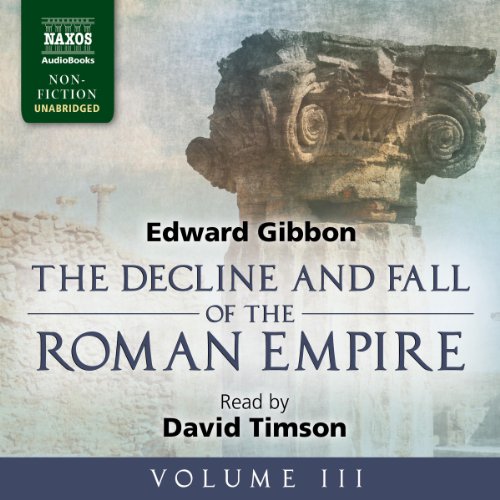
The Decline and Fall of the Roman Empire, Volume III
Summary
The Decline and Fall of the Roman Empire has always maintained its initial appeal to both the general public and scholars alike. Its sheer scale is daunting, encompassing over a millennium of history, covering not merely the Western Empire from the days of the early emperors to its extinction in AD 476, but also the Eastern Empire, which lasted for another thousand years until the Turks vanquished it in 1453. But Gibbon’s style, part historical fact and part literature, is enticing, and the sheer honesty of the man, who endeavours to be scrupulously impartial in his presentation, endears him to the reader. In this recording, David Timson incorporates the most salient of Gibbon’s footnotes. In Volume III (chapters XXVII-XXXVI), Gibbon charts the fall of the Western Empire. Starting with the reign of Emperor Gratian (d. AD 383), his survey moves to political and religious issues in the East and West before covering the increasing military power of the Barbarians. Occasionally a great Roman general emerges to stem the tide, but internecine power struggles see the Western Empire weakened, until Gaul, Britain, Spain and other territories find themselves, as the 5th century advances, unable to rely on Rome for defence.
Public Domain (P)2014 Naxos AudioBooks

The Eye of Apollo
Summary
This is a story from the The Innocence of Father Brown - Volume 2 collection. Here are the six final stories from The Innocence of Father Brown relating the crime-solving adventures of a rather unconventional detective. Having accumulated wisdom and empathy from years of listening to the dark confessions of his parishioners, in a flash Father Brown is able to solve mysteries that confound all others. Here is an eccentric and loveable character that will appeal to fans of the legendary sleuth Sherlock Holmes. The stories are engagingly read by David Timson: "The Wrong Shape", "The Sins of Prince Saradine", "The Hammer of God", "The Eye of Apollo", "The Sign of the Broken Sword", and "The Three Tools of Death".
Public Domain (P)2010 Naxos AudioBooks

Quite a Good Time to Be Born
Summary
In this memoir of his life, David Lodge looks back over his childhood and youth, including his undergraduate years at University College London. After National Service and two years’ postgraduate research, married at last and soon a father, he struggles to make a start as both novelist and academic. Candid, witty and insightful, Quite a Good Time to Be Born gives a fascinating picture of the evolution of a writer who has become a classic in his own lifetime.
©2015 David Lodge (P)2015 W F Howes Ltd

The Decline and Fall of the Roman Empire, Volume IV
Summary
The Decline and Fall of the Roman Empire has always maintained its initial appeal to both the general public and scholars alike. Its sheer scale is daunting, encompassing over a millennium of history, covering not merely the Western Empire from the days of the early emperors to its extinction in AD 476, but also the Eastern Empire, which lasted for another thousand years until the Turks vanquished it in 1453. But Gibbon’s style, part historical fact and part literature, is enticing, and the sheer honesty of the man, who endeavors to be scrupulously impartial in his presentation, endears him to the listener. In this recording, David Timson incorporates the most salient of Gibbon’s footnotes. In Volume IV (Chapters XXXVII–XLVI), Gibbon explores the state of the Roman provinces after the dissolution of the Western Empire, and examines the reasons for its fall - not excluding its ‘immoderate greatness’. He then moves to the Empire in the East and its rule under Justinian (527-565), whose formidable leadership saw the re-fortification of Constantinople and the frontiers of the Eastern Empire. However, dangerous times remain ahead as the Persians make attempts to siege Constantinople. Gibbon ends with the state of the Eastern Empire in the sixth century and its weaknesses after a long war.
Public Domain (P)2014 Naxos AudioBooks