David Zarbock has narrated 10 audiobooks on Listento.it by 4 authors, with an average listener rating of 5★ across 1 ratings. The most-rated is Fisherman's Summer.

Fisherman's Summer
Summary
An end to Roderick L. Haig-Brown’s seasons cycle, Fisherman’s Summer is a book that can be listened to again and again, for both knowledge and pleasure. In this installment, he focuses again on the rivers of his native British Columbia such as the Campbell, the Columbia, and the Nimpkish. Among his vast wealth of knowledge concerning fly fishing, listeners are also exposed to his wise reflections. His discussions of the past fishermen of these rivers, including Native Americans and pioneers, and his hope that the future of these rivers will remain abundant and full of life, will touch the hearts of fishers and non-fishers alike. Chapters included are:Summer DefinedThe Indian and MeThe Beginning of ChangeThe Dry Fly and Very Fast WaterStandard-BearerArctic Fish DerbiesThe Great DestroyersThe BeachesTableRiverBlackholeAnd many more Within these pages are the exciting angling stories of an expert flyfisherman, laced with thoughtful reflections and musings, all of which showcase Haig-Brown as the excellent writer and flyfisherman that he was.
©1959, 1975 Roderick L.Haig-Brown (P)2014 Audible Inc.
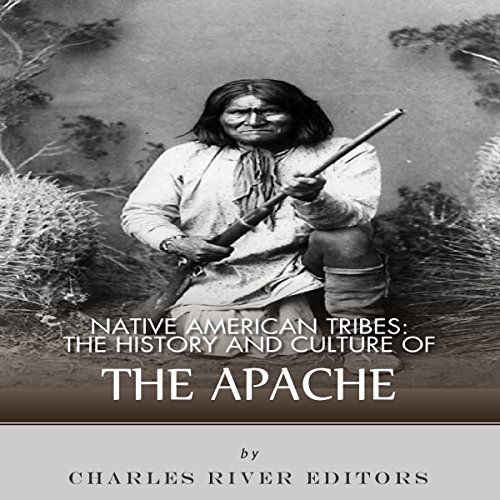
Native American Tribes: The History and Culture of the Apache
Summary
Among all the Native American tribes, the Spanish, Mexicans, and Americans learned the hard way that the warriors of the Apache were among the fiercest in North America. Based in the Southwest, the Apache fought all three in Mexico and the American Southwest, engaging in seasonal raids for so many centuries that the Apache struck fear into the hearts of all their neighbors. Given the group's reputation, it's fitting that they are inextricably associated with one of their most famous leaders, Geronimo. Descendants of people killed by "hostile" Apache certainly considered warriors like Geronimo to be murderers and thieves whose cultures and societies held no redeeming values, and even today, many Americans associate the name Geronimo with a war cry. The name Geronimo actually came about because of a battle he fought against the Mexicans. Over time, however, the historical perception of the relationship between America and Native tribes changed drastically. With that, Geronimo was viewed in a far different light, as one of a number of Native American leaders who resisted the US and Mexican governments when settlers began to push onto their traditional homelands. Like the majority of Native American groups, the Apache were eventually vanquished and displaced by America's westward push, and Geronimo became an icon for eluding capture for so long. Native American Tribes: The History and Culture of the Apache comprehensively covers the culture and history of the famous group, profiling their origins, their history, and their lasting legacy.
©2012 Charles River Editors (P)2015 Charles River Editors

Crippled America: How to Make America Great Again, by Donald J. Trump
Summary
Please note: This is a summary and analysis of the book, and not the original book. In this quick listen, get a crystal clear sense of Trump's best seller. Inside this Summary Reads summary and highlights of Crippled America: Highlights of each chapter Best quotes (Which quotes are just sizzle and which are the steak?) Bonus: Free report about Vladimir Putin (the Russian head-of-state that Trump says he can partner with)
©2015 Level Press (P)2015 Level Press

Native American Tribes: The History and Culture of the Chippewa
Summary
"Sometimes I go about in pity for myself, and all the while, a great wind carries me across the sky." (Chippewa proverb) From the Trail of Tears to Wounded Knee and Little Bighorn, the narrative of American history is incomplete without the inclusion of the Native Americans who lived on the continent before European settlers arrived in the 16th and 17th centuries. Since the first contact between natives and settlers, tribes like the Sioux, Cherokee, and Navajo have both fascinated and perplexed outsiders with their history, language, and culture. In Charles River Editors' Native American Tribes series, listeners can get caught up on the history and culture of North America's most famous native tribes in the time it takes to finish a commute. And they can do so while learning interesting facts long forgotten or never known. Outside of the Midwest, the Chippewa are not as well known as other Native American tribes like the Sioux or Cherokee, but they have long been one of the biggest groups in all of North America. Not surprisingly their presence around the Great Lakes region made them especially important to early European explorers who sailed the St. Lawrence and came into contact with the natives as they continued searching for the Northwest Passage. The French in particular conducted substantial fur trading with the Chippewa. And it is thanks to the European explorers that the various groups have all been identified as Chippewa today. Unlike other Plains peoples and tribes scattered throughout North America, the Chippewa fared relatively well after contact was established with European and American settlers. They had been enemies of the Iroquois before and during European colonization of North America. They then engaged in different political alliances with the French and British as their interests dictated.
©2012 Charles River Editors (P)2015 Charles River Editors

History for Kids: Apollo 11 and the First Moon Landing
Summary
"10, 9, ignition sequence start, 6, 5, 4, 3, 2, 1, zero. All engines running. Liftoff! We have a liftoff! Thirty-two minutes past the hour. Liftoff on Apollo 11!" (Jack King, NASA Chief of Public Information) At 9:32 a.m. on July 16, 1969, time stands still throughout the world, as thousands converge on the Kennedy Space Center and millions tune in on live television. At that instant, the first rumbles began to shake the ground as a small spacecraft attached to a giant Saturn V rocket several hundred feet tall starts to lift off. Quickly being propelled several thousand miles per hour, it takes just a few minutes to reach a speed of 15,000 miles per hour, and just a few more minutes to enter orbit at 18,000 miles per hour. Apollo 11 is on its way to a historic first landing on the Moon. Apollo 11's trip to the Moon may have started on that day in 1969, but the journey began over a decade earlier as part of the space race between the United States and the Soviet Union. While landing on the Moon was a noble goal, proposed as early as 1961 by President Kennedy, NASA and the nation as a whole moved with urgency simply to best the Soviet Union, which had spent the 1950s beating America to important space-related firsts, including launching the first satellite and the first cosmonaut in orbit. In fact, President Eisenhower's administration began the design for the Apollo program in 1960 in hopes of getting a head start to the Moon. The plans originated a year before the first Russian cosmonaut, Yuri Gagarin, orbited the Earth and two years before John Glenn did. Over the next decade, NASA would spend tens of billions on the Apollo missions, the most expensive peacetime program in American history to that point. Apollo 11 was only one of almost 20 Apollo missions.
©2012 Charles River Editors (P)2015 Charles River Editors

American Legends: The Life of Clint Eastwood
Summary
A lot of ink has been spilled covering the lives of history's most influential figures, but how much of the forest is lost for the trees? In Charles River Editors' American Legends series, readers can get caught up to speed on the lives of America's most important men and women in the time it takes to finish a commute, while learning interesting facts long forgotten or never known. Today, the name Clint Eastwood conjures up many different and unforgettable images. While many will always associate him as the quintessential Western hero in classics like The Good, the Bad, and the Ugly, new generations know him as a critically acclaimed director and even an outspoken conservative firebrand. Even if he is no longer the most prominent star in Hollywood, he is assuredly the most decorated octogenarian in the industry. In addition to his acting, two of his pictures, Unforgiven (1992) and Million Dollar Baby (2004), garnered Oscars for Best Director and Best Picture. Eastwood's acting and directing abilities have long appealed to both high classes and mass audiences, although it is true that his early works were skewed more toward the popular while the later ones reflect the opposite dynamic. Debuting in the 1950s, Eastwood's career has now spanned over 50 years, and he has been involved in over 75 films, not to mention his appearances in television and other media. The sheer volume of films is especially impressive considering that he has also directed a significant number of them.
©2013 Charles River Editors (P)2017 Charles River Editors

Jimmy Hoffa
Summary
A century ago, if one were to come across a manual laborer from the early 20th century or the Roaring Twenties and relayed to them the possibility of one day sticking it to the man, one would probably be laughed out of the century. However, this was exactly what one man with solid-gold aspirations and audacity set out to achieve. Jimmy Hoffa, once described by Bobby Kennedy as the second most powerful man in America, was a union boss who evoked both respect and fear, and he continues to be a legendary figure who often crops up in conversation and the media over 40 years after his disappearance. While it was an open secret that Hoffa had shady connections, the success of his leadership allowed supporters to overlook them. As Sloane put it, "More apparent to Teamster members than any moral lapses were the tangible gains that had been steadily realized under Hoffa since his advent to power." Charles Brandt once wrote, "From 1955 until 1965 Jimmy Hoffa was as famous as Elvis Presley. From 1965 until 1975 Jimmy Hoffa was as famous as the Beatles." But as famous as he was in life, it was Jimmy Hoffa's demise that continues to fascinate the country. On July 30, 1975, Hoffa drove to an important meeting at the Machus Red Fox Restaurant, but he was never seen or heard from again. To this day, authorities are still searching for him (or presumably his remains), having been overloaded with false and dead-end leads throughout the decades. By championing the hearts and loyalty of America's trucking industry and arousing fear in the public for his rumored mob connections, earning a couple of enemies along the way was inevitable for Hoffa, but the mystery remains. Naturally, people have put forward ridiculous theories to explain his disappearance, but either way, it's fair to say that the legendary life and times of the controversial and still-missing Teamster leader have produced one of the world's most baffling ongoing mysteries for good reason.
©2016 Charles River Editors (P)2017 Charles River Editors

Native American Tribes: The History and Culture of the Arapaho
Summary
One of the most influential Native American tribes on the Great Plains was the Arapaho, a group so renowned among neighboring Native Americans that it's believed their name came from a Pawnee word for "trader. Like other notable Plains tribes, the Arapaho split off from other groups around the 16th-17th centuries and shifted from a sedentary agricultural society to the kind of nomadic group many envision when thinking of groups on the Plains. That nomadic lifestyle brought them into contact with the Sioux and Cheyenne, both of whom became allies as white settlers pushed west and led to conflicts. The United States sought to defuse tensions with natives during the westward push by drafting treaties regarding major pieces of land, often without understanding the complex structure of the various tribes, and subgroups within those tribes. Most notably, the Arapaho were victims of the Sand Creek Massacre in 1864, an action considered so heinous that the leader of the attack, Colonel John Chivington, was actually relieved of command after it. Ultimately, the Arapaho were forced onto reservations alongside the Shoshone, one of the tribes Lewis and Clark encountered on their historic expedition in the early 19th century. Today, they are jointly recognized with the Cheyenne, a group they were closely associated with for centuries. Native American Tribes: The History and Culture of the Arapaho comprehensively covers the culture and history of the famous group, profiling their origins, their history, and their lasting legacy.
©2012 Charles River Editors (P)2015 Charles River Editors

History for Kids: An Illustrated Biography of Franklin and Eleanor Roosevelt for Children
Summary
Perfect for ages 7-10. In Charles River Editors’ History for Kids series, your children can learn about history’s most important people and events in an easy, entertaining, and educational way. This concise but comprehensive audiobook will keep your kid's attention all the way to the end. Franklin Delano Roosevelt might be America’s greatest 20th century president, but there’s no question that he was the most unique. A well-connected relative of Theodore Roosevelt, FDR was groomed for greatness until he was struck down by polio. Nevertheless, he persevered, rising through New York politics to reach the White House just as the country faced its greatest challenge since the Civil War, beginning his presidency with one of the most iconic lines ever spoken during an inaugural address. For over a decade, President Roosevelt threw everything he had at the Great Depression, and then threw everything the country had at the Axis powers during World War II. Ultimately, he succumbed to illness in the middle of his fourth term, just before the Allies won the war. If Dolley Madison was instrumental in molding the role of first lady in the 19th century, credit can be given to Eleanor Roosevelt for revolutionizing the political nature of the role in the 20th and 21st centuries and making it possible for presidents like Bill Clinton to enlist their wives to handle political duties. At the same time, history might remember Eleanor more for what she did outside of the White House, as she became a critically acclaimed and world famous international author and advocate of civil rights, women’s rights. By the time she had finished working for the United Nations, working on the Universal Declaration of Human Rights, President Truman rightly called her “The First Lady of the World." Eleanor is one of her country’s most famous and admired first ladies, an ironic fact considering she was worried being the wife of a successful politician would force her to take on what she considered to be irrelevant ceremonial roles. But Franklin’s offices and illnesses made it possible for her to run in the social and political circles that interested her, and she began wielding substantial influence both for herself and on behalf of her husband. Much like Hillary and Bill Clinton, the Roosevelts' marriage evolved into one of friendship and political convenience as Eleanor became a political power player herself. By the end of the 1940s, Eleanor’s name was being bandied about for positions like governorships, the US Senate, and even the vice presidency, which was still completely unprecedented for a woman in those times. History for Kids: An Illustrated Biography of Franklin and Eleanor Roosevelt covers all the well-known highlights of their lives, their relationship, and their work. Along the way, your kids will learn interesting facts about the Roosevelts and the important people and events in their lives.
©2012 Charles River Editors (P)2017 Charles River Editors

The Twenty-Year Death: Police at the Funeral
Summary
Returning east for the reading of his first wife’s will, a desperate man - drunk and down to his last penny - is pushed over the edge when he learns that another man is the sole beneficiary. How far will he go to get what he believes he’s due? And afterwards, will he be able to escape the long arm of the law? Set in 1951 and written in the style of noir master Jim Thompson, Police at the Funeral is the third volume of Ariel S. Winter’s extraordinary debut novel, The Twenty-Year Death.
©2012 Ariel S. Winter (P)2014 Audible Inc.